Landmarks in Andorra la Vella
Europe's highest capital pairs a 1580 council house with two early medieval churches.
Andorra la Vella's older landmarks sit apart from the shopping streets that now define the centre: a granite manor house, two early stone churches and a hump-backed bridge, scattered across the parish rather than gathered downtown. The Church of Santa Coloma, with a nave from the 8th or 9th century and a tower added in the 12th, stands in its own hamlet outside the centre; the Pont de la Margineda crosses the Gran Valira further out still. Only Casa de la Vall, the sixteenth-century manor built for the Busquets family, and the Romanesque parish church of Sant Esteve stand in the town proper. Granite predominates throughout, worked by local builders rather than imported masons, a plainness that reflects centuries without the wealth to build anything grander.
Casa de la Vall
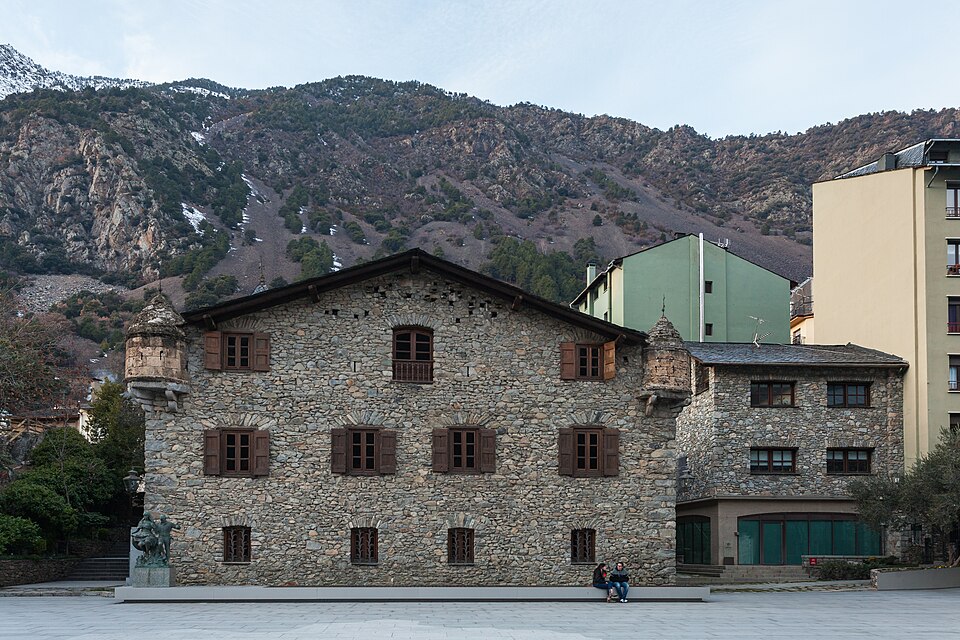
1580
A squat, two-storey rectangular stone house with a dovecote-shaped corner tower, a carved coat of arms above the doorway, and a stone cross on a pillar standing beside it.
Built in 1580 as a fortified manor for the Busquets family, the house was bought in 1702 by the Consell de la Terra and served as the seat of the General Council until 2011. Its ground floor held the courtroom; upstairs, the council chamber and a chapel dedicated to St Ermengol sit beside a cabinet with seven locks, one per parish, that holds historic documents. A postal museum occupied the top floor until the early 1990s, when the space was cleared for the commission drafting Andorra's 1993 constitution.
- A document cabinet inside has seven separate locks, one for each parish, securing historic legal texts.
- Its top floor held a postal museum until the early 1990s, when the room was cleared for the commission that drafted Andorra's 1993 constitution.
- A contemporary sculpture by Francesc Viladomat stands in the gardens.
Photo: Diego Delso (CC BY-SA 3.0)
Church of Sant Esteve
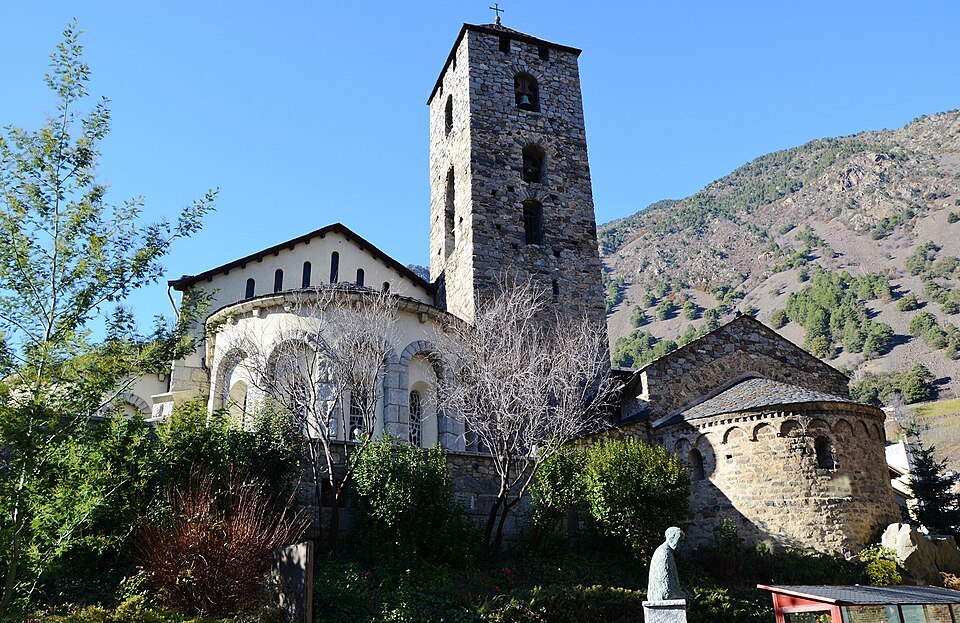
1100
A plain, stone-built Romanesque church with thick walls and rounded arches, identified by its unadorned parish-church form rather than any single ornamental feature.
The church stands on Plaça del Príncep Benlloch, in Andorra la Vella's old town. Built in Romanesque style, it dates from around 1100, making it one of the oldest structures in the parish. It is registered as a heritage property in Andorra's cultural inventory and continues to serve as a Roman Catholic parish church. Josep Puig i Cadafalch, the architect who died in 1956, is credited as its architect.
Photo: MARIA ROSA FERRE ✿ (CC BY-SA 2.0)
Church of Santa Coloma
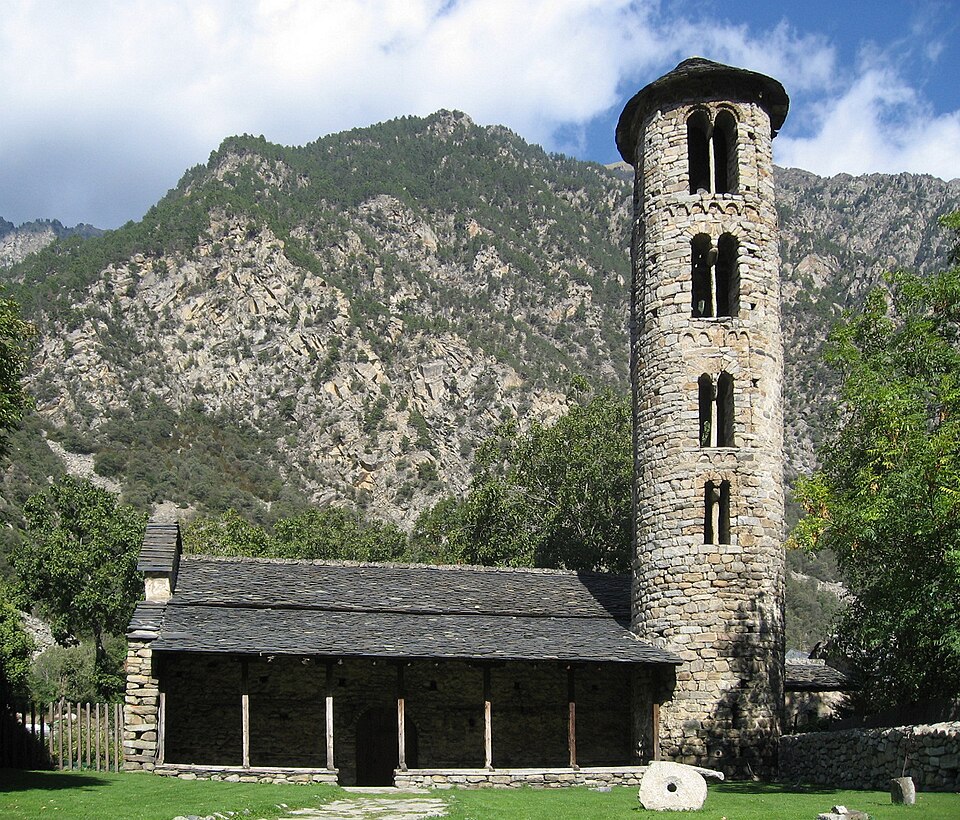
8th–12th century
A plain single-nave stone church topped by a squarer, later bell tower, the visible seam between eighth- or ninth-century masonry below and a twelfth-century addition above.
The nave, raised in the 8th or 9th century, makes this Andorra's oldest church; a tower was added in the 12th century. Twelfth-century wall paintings once covered its interior; most were removed in 1933 and kept in Berlin until 2007, when they returned to Andorra's Government Exhibition Hall. Dedicated to Columba of Sens, Andorra's patron saint, the church is registered as a heritage property in Andorra's cultural inventory and stands in the hamlet of Santa Coloma, outside Andorra la Vella's centre.
- The wall paintings are attributed to an anonymous artist known only as the Master of Sant Coloma.
- Removed in 1933, the paintings spent decades in Berlin before returning to Andorra in 2007.
Photo: Simonjoan (changes by Rabanus Flavus) (CC BY-SA 3.0)
Pont de la Margineda
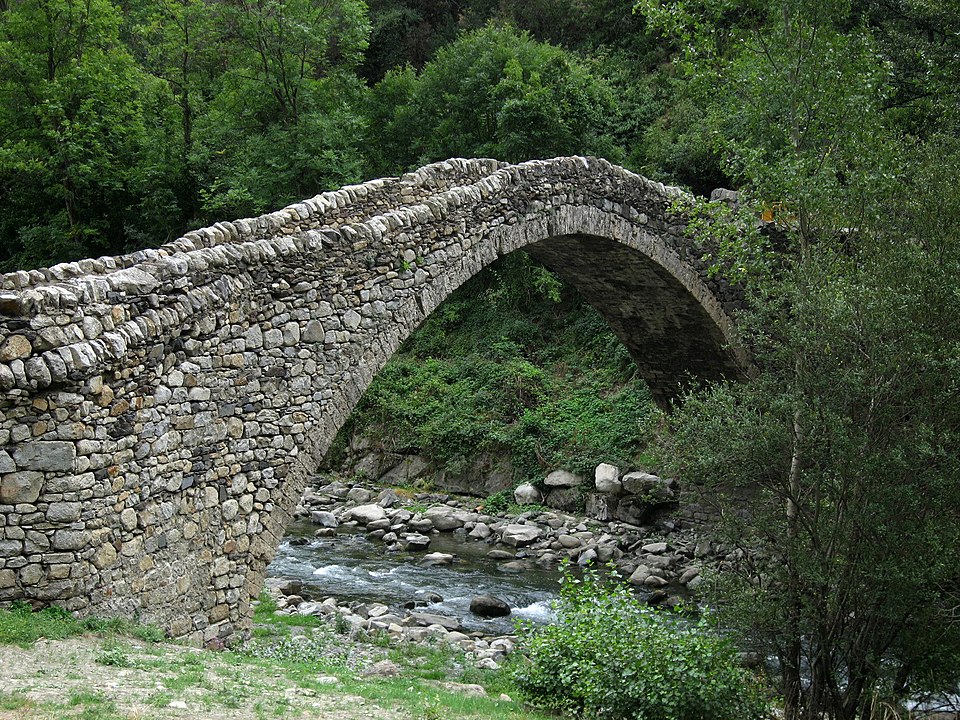
14th–15th century
A grey granite bridge with a pale, rough-textured arch built of lightweight pumice stone, spanning the Gran Valira river.
The bridge spans the Gran Valira between Andorra la Vella and the hamlet of Santa Coloma, built in the 14th or 15th century to carry a route across the river. Its walls are built of granite, while the arch itself uses pumice stone, chosen for its light weight so as not to overload the crossing. It is registered as a heritage property in Andorra's cultural inventory.
Photo: Joan Simon (CC BY 3.0)
Església de Sant Romà de les Bons
A Romanesque and Lombard-style church in Les Bons, consecrated in 1164. Its walls were repainted in Gothic style during the 16th century; the original murals now hang in the Museu Nacional d'Art de Catalunya, replaced here by replicas.
Madriu-Perafita-Claror Valley
A glacial valley covering 42.47 square kilometres in southeastern Andorra, about 9% of the country's total area. It became Andorra's first and only UNESCO World Heritage Site in 2004, recognized as a haven for rare and endangered wildlife.
Casa Rull Museum
A historic house in La Massana dating to 1732, built on the site of earlier structures owned by the landowning Rull family. It burned down in the late 19th century, was rebuilt, and opened as a museum in 2000.
Església de Sant Martí de la Cortinada
A Romanesque church in La Cortinada, later given Baroque additions in renovations between the 17th and 20th centuries. It was registered as an asset of cultural interest by the Cultural Heritage of Andorra on 16 July 2003.
Església de Sant Julià i Sant Germà
A Romanesque church in Sant Julià de Lòria, later given Baroque additions in renovations between the 17th and 20th centuries. It was registered as an asset of cultural interest by the Cultural Heritage of Andorra on 16 July 2003.
Andorra National Library
Founded in 1930 and reopened in 1974, the national library has been housed since 2020 in the former Hotel Rosaleda in Encamp. It serves as Andorra's legal deposit and copyright library.
History
Little here predates the tenth century: the nave of Santa Coloma, raised in the 8th or 9th century with a tower added in the 12th, is the valley's oldest standing building, one of a scatter of early stone churches serving a farming population. Stone bridges such as the Pont de la Margineda, built in the 14th or 15th century, carried people and goods across the Gran Valira between these parishes. Self-government produced Casa de la Vall in 1580, a fortified manor that the Consell de la Terra bought in 1702 and used as the seat of government until 2011. Tourism and the country's tax status later filled the valley floor with modern retail and apartment blocks, leaving these older buildings as exceptions in a townscape that is otherwise recent.