Landmarks in Dhaka
Mughal forts and a Nawab's riverside palace anchor Old Dhaka's dense, waterside quarter.
Dhaka's landmarks cluster in the old city along the Buriganga River, within walking distance of one another despite belonging to different centuries. Lalbagh Fort, begun in 1678, dates from Dhaka's decades as a Mughal provincial capital, when the city's muslin trade made it wealthy enough for a prince and a provincial governor to start a fortified palace they never finished; its walls carry the pink-red tones typical of that architecture. Ahsan Manzil, raised on the riverbank two centuries later, reflects the Indo-Saracenic taste of the Nawab family who then administered the city. Star Mosque, tucked in nearby Armanitola, is smaller and more private: an early-nineteenth-century mosque whose builder covered it in star-patterned tilework rather than scale.
Lalbagh Fort
1678
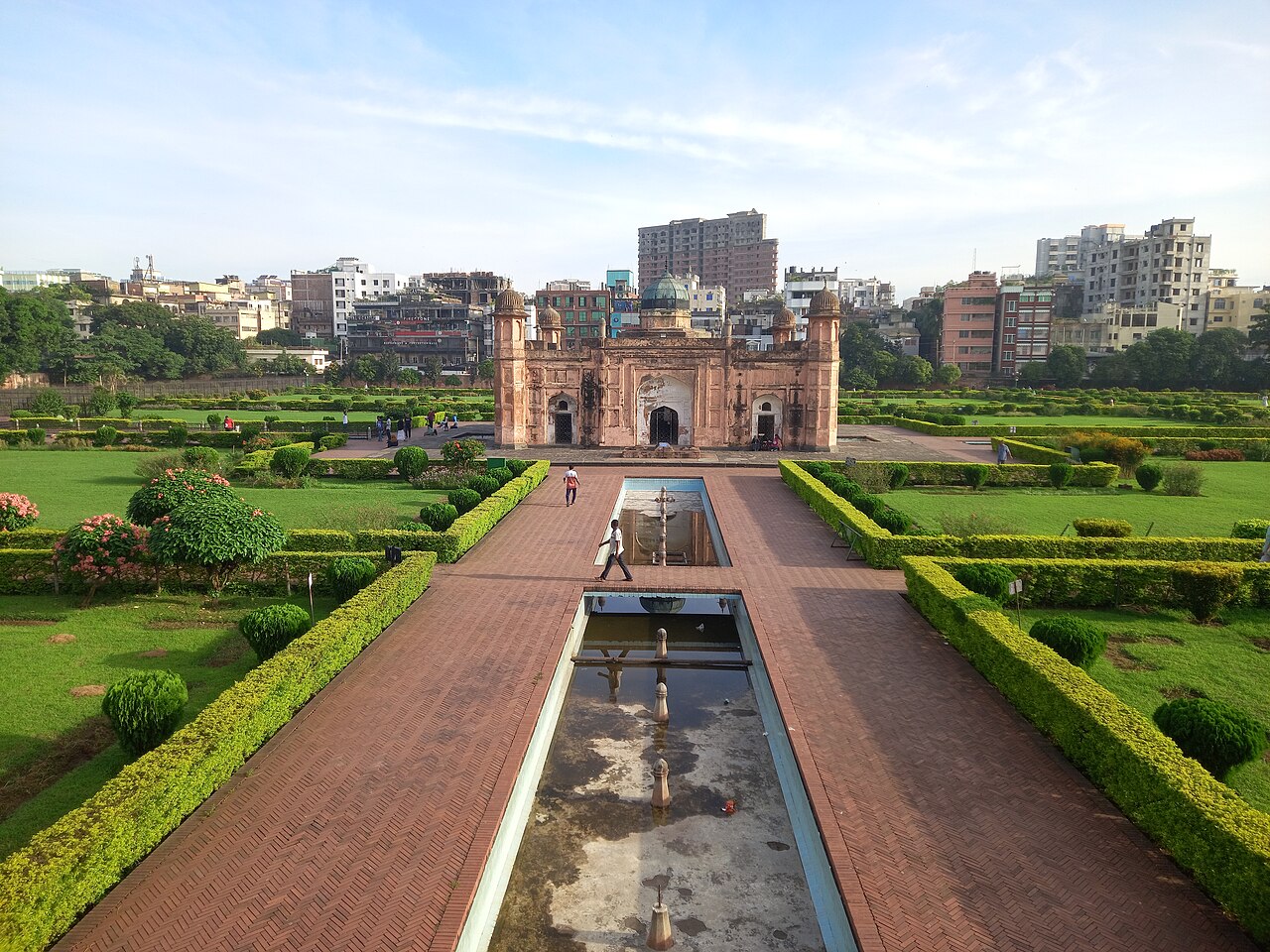
A walled, unfinished Mughal fort compound holding a governor's house, a tomb and a mosque, laced with lawns, fountains and water channels. Its south side keeps two gateways built as grand arches in the style of major Mughal forts, and its name, meaning Red Garden, echoes the pink-red tones typical of that architecture.
Begun in 1678 as the residence of the governor of Mughal Bengal, the fort was originally called Fort Aurangabad. Construction started under Prince Muhammad Azam Shah, a son of Emperor Aurangzeb, and continued under the provincial governor Shaista Khan after the prince was recalled. Work stopped when Shaista Khan's daughter, Pari Bibi, died and was buried within the walls, an event he took as a bad omen. The unfinished complex includes the governor's house, her tomb, and a mosque, set among lawns and water channels.
- It began construction under the name Fort Aurangabad, only later taking the name of its neighbourhood, Lalbagh.
- Its layout was modelled as a smaller version of grand Mughal forts such as the Red Fort and Fatehpur Sikri.
Photo: No machine-readable author provided. Shmunmun assumed (based on copyright claims). (Public domain)
Ahsan Manzil
1872
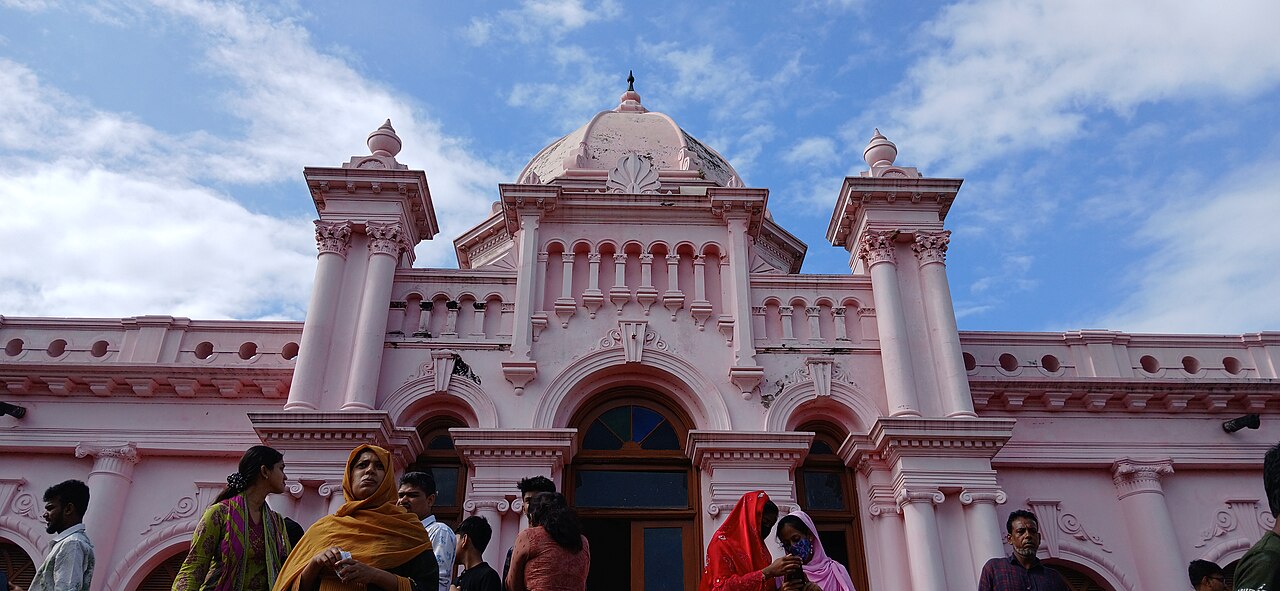
A riverside palace built in the Indo-Saracenic style directly above the Buriganga's bank. It survives today as a museum, its rooms arranged to display the furnishings and belongings of the family that once governed from within it.
Built in 1872 on the bank of the Buriganga River in the Kumartoli area, Ahsan Manzil served as the official residence and administrative seat of the Nawab of Dhaka through the late nineteenth and early twentieth centuries. It was raised in the Indo-Saracenic style favoured for grand residences of the period. Designated an Old Dhaka Heritage Site, the palace is now preserved as a museum under the Bangladesh National Museum, its rooms holding artefacts tied to the Nawab family and to the city's wider social and political history.
Photo: Md. Ahsanul Haque Nayem (CC BY-SA 4.0)
Star Mosque
early 19th century
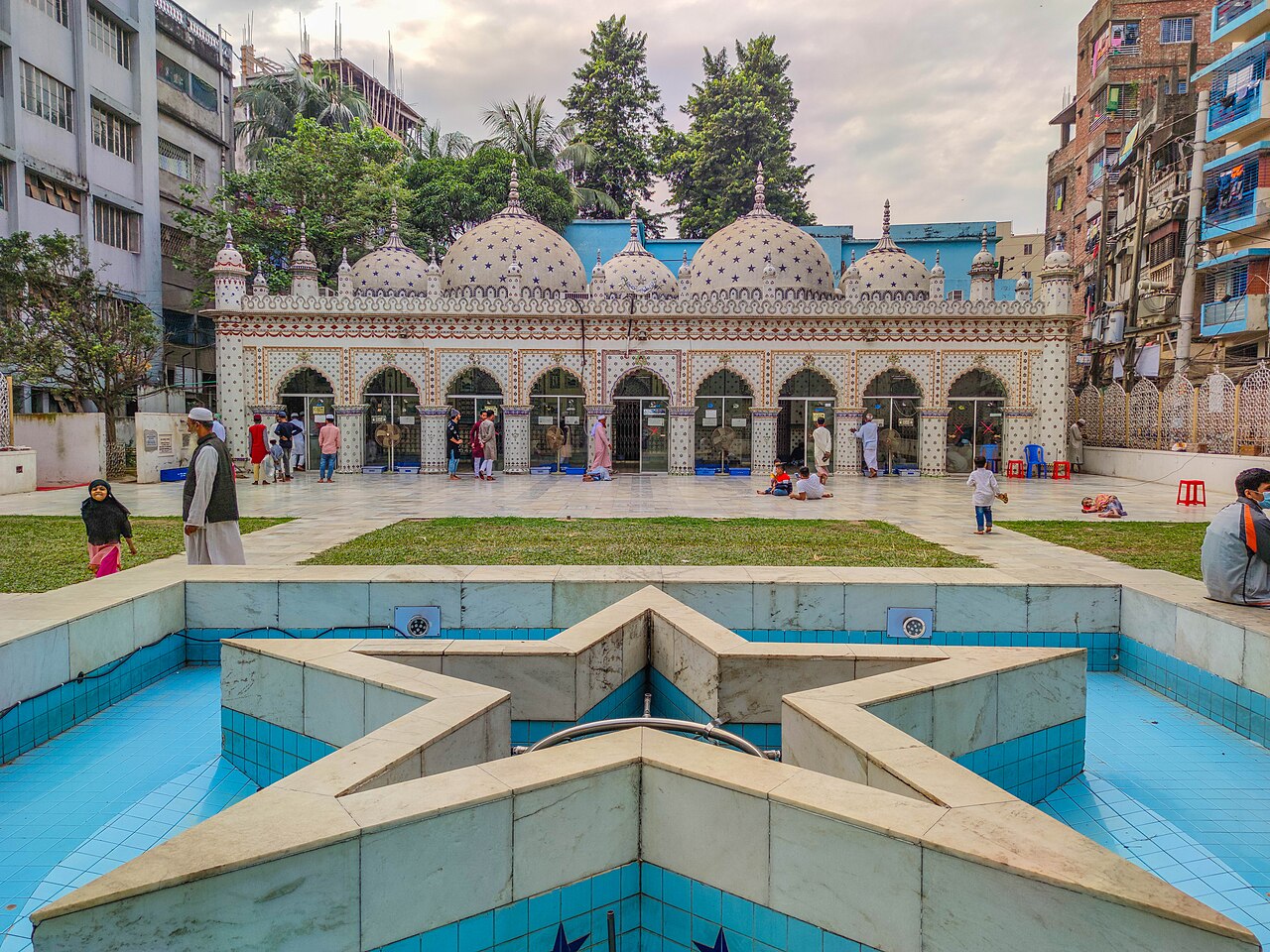
A small mosque whose facades and interior are covered in ornate mosaic work built up from repeated blue five-pointed stars rather than the domes or minarets that usually draw the eye on a mosque. The star pattern alone is what identifies the building.
Standing in the Armanitola area of the old city, Star Mosque, also called Tara Masjid, was built in the first half of the nineteenth century by Mirza Golam Pir, also known as Mirza Ahmed Jan. Its facades and interior surfaces are covered in ornate decoration built up from repeated motifs of blue five-pointed stars, applied across walls that might otherwise carry plain plasterwork. The star pattern, rather than any dome or minaret, is what identifies the building at a glance.
- The mosque's star motif is distinctive enough to appear on Bangladesh's five-taka banknote.
- It is also known by its Bengali name, Tara Masjid.
Photo: Ishtiaque Ayub Zico. (CC BY-SA 2.5)
Jatiya Sangsad Bhaban
The Parliament house of Bangladesh at Sher-e-Bangla Nagar, initially designed for the Parliament of Pakistan by architect Louis Kahn. The complex covers 840,000 square metres, making it one of the largest legislative complexes in the world.
Shaheed Minar
A national monument commemorating those killed on 21 and 22 February 1952, when Pakistani police opened fire on students and activists demanding official status for the Bengali language. Bengali gained that status in Pakistan in 1956, alongside Urdu.
Baitul Mukarram
The National Mosque of Bangladesh, standing at the centre of the capital and completed in 1968. It has a capacity of more than 42,000 worshippers.
Dhakeshwari Temple
A state-owned Hindu temple in Old Dhaka, whose name means 'Goddess of Dhaka' and gave the city its name. Considered one of the holiest shakta pithas, its original idol was moved to Kumortuli in West Bengal during Partition, and a replica is worshipped here instead.
Ruplal House
A 19th-century mansion on the northern bank of the Buriganga River in Farashganj, built in 1825 by Armenian businessman Stephen Aratoon. Bought in 1840 by merchants Ruplal Das and his brother Raghunath Das, it was later reconstructed by the Calcutta firm Martin Company.
Burdwan House
A historic building built in 1906 during the British colonial period, combining Mughal and European architectural styles. Now home to the Bangla Academy museum, it once hosted guests including Rabindranath Tagore, Kazi Nazrul Islam and Sarat Chandra Chattopadhyay.
Mausoleum of Three Leaders
A shrine at Shahbag holding the graves of three leaders of the Pakistan Movement from Bengal: A. K. Fazlul Huq, Huseyn Shaheed Suhrawardy and Khwaja Nazimuddin. All three served as Prime Minister of Bengal under British rule, and two later became Prime Minister of Pakistan.
Bara Katra
A palatial caravanserai, its name meaning 'Great Caravanserai', dating to the reign of the Mughal dynasty in Bengal. Situated south of Chowk Bazaar near the Buriganga's north bank, it is one of the city's oldest surviving monuments, though partially demolished in 2022.
Khan Mohammad Mridha Mosque
A historical mosque standing near Lalbagh Fort, in the old quarter of the city.
Hussaini Dalan
A Twelver Shi'ite imambara originally built in the 17th century during the later Mughal period, as a gathering place for the Shia Muslim community. It remains the city's main venue for majlis held during Muharram, commemorating the martyrdom of Hussain, grandson of the Prophet Muhammad.
Armenian Church
A historically significant church in the Armanitola area of Old Dhaka, also known as the Armenian Apostolic Church of the Holy Resurrection. It bears witness to a once-significant Armenian community that lived in the region during the 17th and 18th centuries.
Bangabhaban
The official residence of the President of Bangladesh, originally built as a government house under the British Empire. It served the governors of East Bengal and East Pakistan before President Abu Sayeed Chowdhury became its first Bangladeshi resident, in 1972.
Bangladesh National Museum
The national repository of Bangladesh's cultural and historical artifacts in Shahbag, established as the Dhaka Museum in 1913. Reorganized after independence and formally inaugurated in its current form in 1983, it now holds more than 50,000 artifacts spanning prehistory to contemporary history.
Suhrawardy Udyan
A 95-acre national memorial park, originally known as the Ramna Race Course, renamed in honour of Huseyn Shaheed Suhrawardy. It is where Sheikh Mujibur Rahman delivered his call to struggle on 7 March 1971, and where Pakistani forces surrendered on 16 December 1971.
Mausoleum of Ziaur Rahman
An architectural monument at Sher-e-Bangla Nagar, holding the grave of Ziaur Rahman, president of Bangladesh from 1977 to 1981. The grave of his wife, former prime minister Khaleda Zia, who died in 2025, lies beside his.
Buckland Bund
A historic riverside embankment on the Buriganga in Old Dhaka, constructed in 1864 by Charles Thomas Buckland. He was the commissioner of Dhaka at the time.
St Thomas Church
The cathedral of the Diocese of Dhaka, seat of the Church of Bangladesh, a United Protestant body formed by the merger of Anglican and Presbyterian churches. Standing near Bahadur Shah Park, it was a major focal point of the city centre in the nineteenth century.
Ramna Park
A 68.50-acre urban park at the centre of the city, built during the British colonial era around a central lake. Known as the 'lungs of Dhaka City', it hosts cultural festivals, notably the annual Bengali New Year celebrations.
Anti Terrorism Raju Memorial Sculpture
A sculpture on the University of Dhaka campus, created by Shaymol Chowdhury in 1997. It commemorates student activist Moin Hossain Raju, killed during a clash between rival student groups at the university on 13 March 1992.
Gurdwara Nanak Shahi
The principal Sikh gurdwara on the University of Dhaka campus in Nilkhet, said to have been built in 1830 to commemorate a visit by Guru Nanak in 1506-1507. Considered the largest of the country's nine or ten gurdwaras, its current building was renovated in 1988-1989.
Ramna Kali Temple
A Hindu temple originally built during the Mughal Empire, also known as Ramna Kalibari. It is dedicated to the goddess Kali.
History
Dhaka has been settled since the first millennium, but its built character was set from 1608, when the Mughal Empire made it a provincial capital of Bengal, renaming it Jahangirnagar. For most of the seventeenth and eighteenth centuries it was a hub of the muslin trade and one of the wealthiest cities in the empire, drawing merchants from across Eurasia and a Mughal elite that included princes and the sons of emperors, wealth visible in projects like Lalbagh Fort, begun in 1678 as a governor's residence and never completed. After Mughal authority receded, a new elite shaped the nineteenth-century city: the Nawab family built their riverside residence, Ahsan Manzil, in 1872, while smaller, privately funded buildings such as Star Mosque added their own ornament to the old quarters around them.