Landmarks in Marrakesh
Red sandstone walls raised in 1122 still ring a medina built up by four ruling dynasties.
Marrakesh's landmarks cluster inside and around the old medina, the fortified core the Almoravids laid out after founding the city around 1070. Its red sandstone walls, raised in 1122–1123, gave the whole settlement the ochre tone that still defines it and that later builders kept matching in mudbrick and stone. The Koutoubia Mosque's minaret, from the mid-twelfth century, anchors the medina's southwest corner near its main marketplace. Two rulers left grander interiors: the Saadian dynasty's El Badi Palace, begun in 1578 as a showcase of imported marble and gilding, now stands roofless and stripped; the nineteenth-century Bahia Palace, built and enlarged by successive viziers, keeps its painted ceilings and zellij tilework intact for visitors today.
Koutoubia Mosque
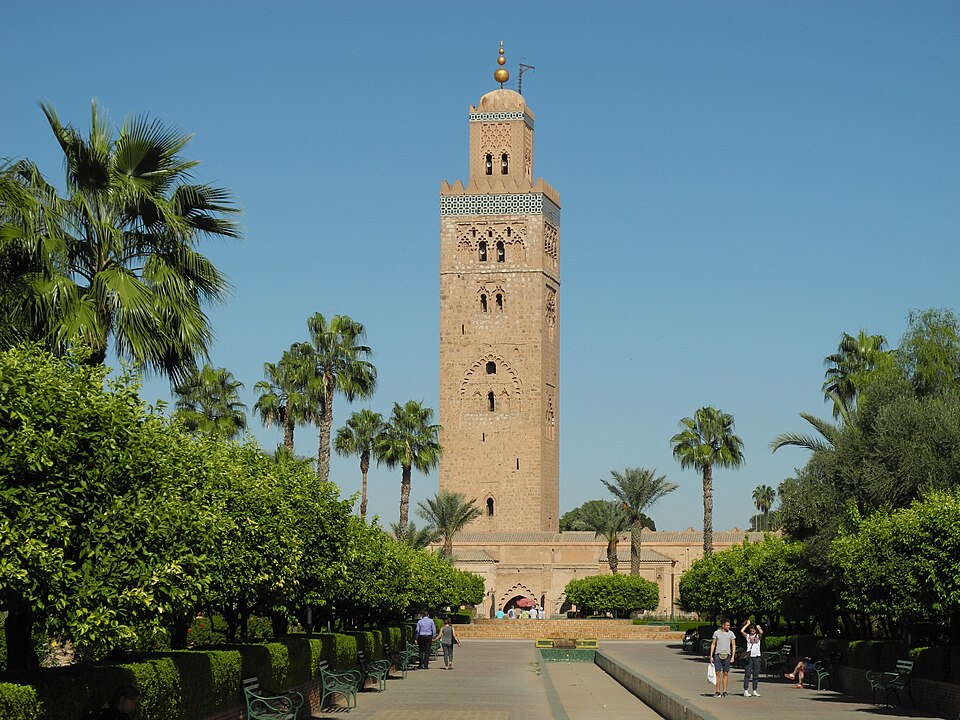
1158
A single square minaret in ochre-toned stone stands 77 metres tall, its four faces divided into bands of varying geometric and multifoil arch motifs and finished with a spire carrying stacked metal orbs, rising over gardens beside the medina's main square.
The Koutoubia Mosque was founded in 1147 by the Almohad caliph Abd al-Mu'min just after he took Marrakesh from the Almoravids, then rebuilt in its present form around 1158; its minaret may not have been finished until roughly 1195, under Ya'qub al-Mansur. Standing in the medina's southwest quarter near the Jemaa el-Fnaa marketplace and flanked by gardens, it is the city's largest mosque and a key example of Almohad and Moroccan mosque architecture. Its minaret is thought to have influenced towers built soon after in Seville and Rabat.
- Its minaret is thought to have influenced the Giralda in Seville and the Hassan Tower in Rabat, both raised soon after in the same architectural era.
- The mosque standing today is actually a second version: the first, built in 1147, was demolished and rebuilt around 1158.
Photo: Baca12 (CC BY-SA 4.0)
Bahia Palace
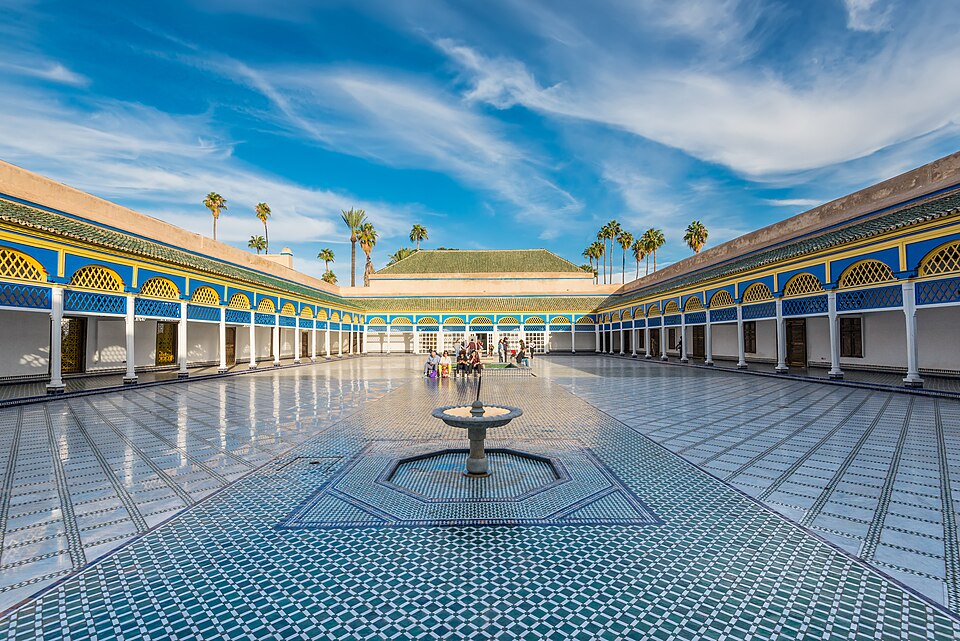
1866–1900
Painted wood ceilings, sculpted stucco and zellij tilework cover a sprawling, irregular complex of roughly 150 rooms opening onto internal courtyards and riad gardens, laid out without any single symmetrical plan.
The Bahia Palace was begun in the 1860s by Si Musa, grand vizier under Sultan Muhammad ibn Abd al-Rahman, and enlarged between 1894 and 1900 by his son Si Ba Ahmed ibn Musa, vizier to Sultan Moulay Abdelaziz. Its irregular plan holds around 150 rooms set around courtyards and riad gardens, distinguished by painted wood ceilings, sculpted stucco and zellij tilework. The original grounds also included gardens, stables, a mosque and other annexes. It now functions as a historic monument and museum open to visitors.
- Its original grounds reached well beyond the surviving rooms, taking in stables, a mosque and further gardens now separated from the palace.
Photo: Val Traveler (CC BY-SA 4.0)
El Badi Palace
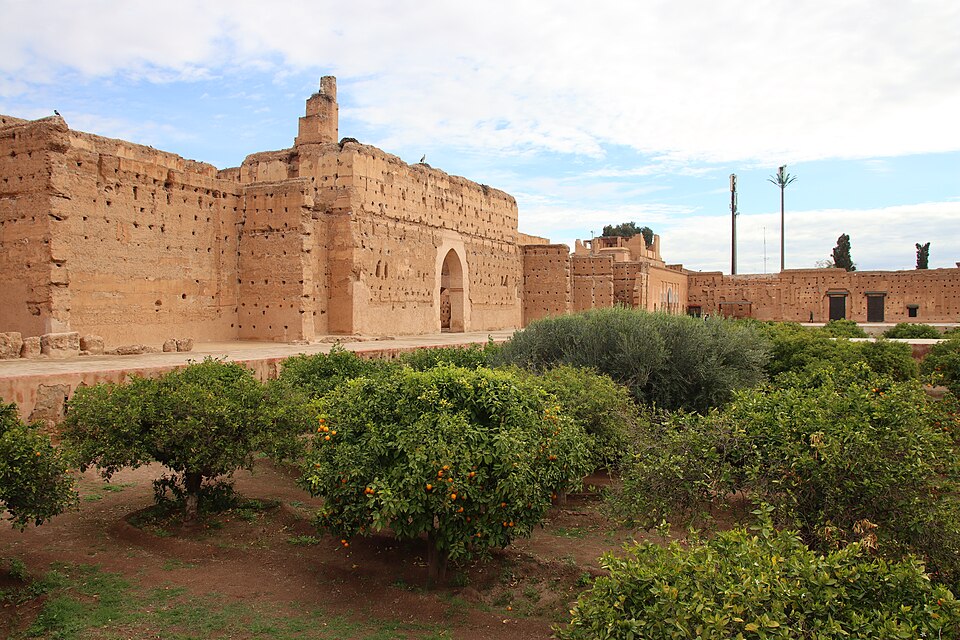
1578–1593
Roofless courtyards and stripped walls, once faced with marble imported from Italy and materials brought from as far as Mali, form a large ruined palace complex that now serves as an exhibition space, displaying a historic carved wooden minbar.
El Badi Palace was commissioned by the Saadian sultan Ahmad al-Mansur a few months after he took power in 1578, with construction and decoration continuing through most of his reign; a completion date of 1593 is generally given. Faced with imported materials, including Italian marble and goods brought from as far as Mali, it was designed for receptions that displayed the sultan's wealth. After al-Mansur's death in 1603 it was neglected, and its marble was stripped for reuse elsewhere in Morocco. It is now a ruin used as an exhibition space, housing the Koutoubia Mosque's historic minbar.
- Its valuable marble facing was pried off and reused in buildings across Morocco after the palace fell out of use.
- The wooden minbar originally made for the Koutoubia Mosque is now displayed inside the ruin.
Photo: Draceane (CC BY-SA 4.0)
City Walls
Defensive ramparts enclosing the historic medina, first laid out in the early 12th century by the Almoravid dynasty that founded the city in 1070. They were extended south to include the Kasbah and north to the neighborhood around the Zawiya of Sidi Bel Abbes.
Saadian Tombs
A royal necropolis beside the Kasbah Mosque, dating mainly to the reign of Ahmad al-Mansur between 1578 and 1603. Many art historians regard its luxurious decoration and interior design as the high point of Saadian-era Moroccan architecture.
Jemaa el-Fnaa
A square and marketplace in the medina, functioning as the main square of Marrakesh. It remains a gathering place for both residents and tourists.
Ben Youssef Madrasa
An Islamic college commissioned in 1564-65 by the Saadian sultan Abdallah al-Ghalib and named after the adjacent Ben Youssef Mosque. At its height it was the largest Islamic college in the Maghreb, and it is a historical site seen as a pinnacle of Saadian architecture.
Menara Gardens
A public garden and orchard established around 1157 by the Almohad ruler Abd al-Mu'min, later listed as a UNESCO World Heritage Site in 1985. Its central reservoir and pleasure pavilion, rebuilt in the 19th century, are often photographed against the High Atlas Mountains.
Majorelle Garden
A one-hectare garden created from 1923 by French painter Jacques Majorelle, with a Cubist villa added by architect Paul Sinoir in the 1930s. Purchased and restored in the 1980s by fashion designer Yves Saint-Laurent and Pierre Bergé, the villa now houses the Berber Museum.
Kasbah Mosque
A mosque built by the Almohad ruler Yaqub al-Mansur between 1185 and 1190, also known as the Moulay al-Yazid Mosque. Standing in the Kasbah district near the former royal palaces, it ranks with the Kutubiyya Mosque as one of the city's most important historic mosques.
Agdal Gardens
Historic gardens and orchards south of the Kasbah and royal palace, listed as part of the Marrakesh UNESCO World Heritage Site in 1985. They hold several historic reservoirs and pavilions, including the Dar el-Hana and the Dar al-Bayda.
Ben Youssef Mosque
A mosque named after the Almoravid ruler Ali ibn Yusuf, founded as the city's main mosque in the late 11th or early 12th century. Almost nothing of the original survives except the nearby Almoravid Qubba; the current building dates from a reconstruction completed in 1819-20.
Almoravid Qubba
A small monument erected by the Almoravid dynasty in the early 12th century. It is noted for its extraordinary decoration and for being one of the only surviving examples of Almoravid architecture in Marrakesh.
Yves Saint Laurent Museum
A museum in Marrakesh dedicated to the fashion designer Yves Saint Laurent.
Dar el Bacha
A palace in the old medina of Marrakesh. It currently houses the Museum of Confluences.
Bab er Robb
A southern city gate in the historic medina of Marrakesh.
Mouassine Mosque
A major mosque built in the 16th century for the Saadian sultan Abdallah al-Ghalib, anchoring a complex that also included a madrasa, hammam, library and the Mouassine Fountain. Its design is typical of the period except for an unusually short, simple minaret.
Zawiya of Sidi Bel Abbes
A Sufi complex centered on the mausoleum of Abu al-Abbas al-Sabti, who died in 1204 and is considered Marrakesh's patron saint. Its buildings, arranged around two courtyards and dating partly to the early 17th century, include a mosque, a madrasa and a hospice.
Bab Doukkala Mosque
A 16th-century Saadian mosque named after the nearby Bab Doukkala gate, also called the al-Hurra Mosque after its founder, Massa'uda al-Wizkitiya. Like the Mouassine Mosque, it anchored a charitable complex that included a madrasa, a hammam, a library and a fountain.
Villa Taylor
A residence in the Guéliz district built between 1926 and 1927 by Moses Taylor, requisitioned during World War II to house the American vice-consul. In January 1943, following the Casablanca Conference, it hosted Franklin Roosevelt and Winston Churchill, who painted his only wartime picture there.
Mouassine Fountain
A public fountain that is part of the 16th-century religious complex built around the Mouassine Mosque. Marrakesh had long built public fountains, but they took on a monumental character in the Saadian era.
Mouassine Museum
A museum in the Mouassine neighborhood, housed in a restored 16th- to 17th-century house that includes an upper-floor apartment known as a douiria. It was recently converted into a Museum of Music, with permanent and temporary exhibits.
Slat al-Azama Synagogue
A synagogue in the historic Mellah, the old Jewish quarter of Marrakesh. It functions as a Jewish congregation and place of worship.
Marrakech Museum
A historic palace turned museum in the old center of Marrakesh, notable for its architecture. Its collection spans historic art objects and contemporary art from Morocco.
Dar Si Said
A late-19th-century palace in Marrakesh, now a museum. It houses the National Museum of Weaving and Carpets.
Shrob ou Shouf Fountain
A wall fountain in the medina dating from the late 16th or early 17th century, near the Ben Youssef Madrasa. Its name, Shrob ou Shouf, means drink and look.
History
Marrakesh was founded around 1070 by Abu Bakr ibn Umar as capital of the Almoravid dynasty, which laid out the city and raised its first major buildings. Ali ibn Yusuf enclosed it with red sandstone walls in 1122–1123, and later builders kept using the same stone, fixing the ochre colour for which the city is still known. Marrakesh became a trading and religious centre for the wider Maghreb before entering a period of decline. It recovered in the early sixteenth century as capital of the Saadian dynasty, whose sultans Abdallah al-Ghalib and Ahmad al-Mansur added the era's grandest monuments. From the seventeenth century the city drew Sufi pilgrims visiting the tombs of its seven patron saints. France established a protectorate in 1912, and T'hami El Glaoui governed as Pasha until Moroccan independence in 1956.