Landmarks in Melbourne
Gold-boom wealth raised a grand hall, then a rebuilt station and a granite war memorial.
Melbourne's built landmarks span barely sixty years but three distinct booms. The Royal Exhibition Building, raised in the Carlton Gardens on the north-eastern edge of the central business district in 1879–1880, reflects a colony grown rich on gold, built in stone to a neoclassical design meant to rival Europe's own exhibition halls. Flinders Street station, where the city centre meets the Yarra River, replaced an 1854 terminus with an Edwardian-era building of curling Art Nouveau detail as rail traffic multiplied. Further south on St Kilda Road, the granite Shrine of Remembrance, finished in 1934, answers the losses of the First World War with a deliberately ancient vocabulary: a stepped roof and a classical portico rather than anything colonial.
Royal Exhibition Building
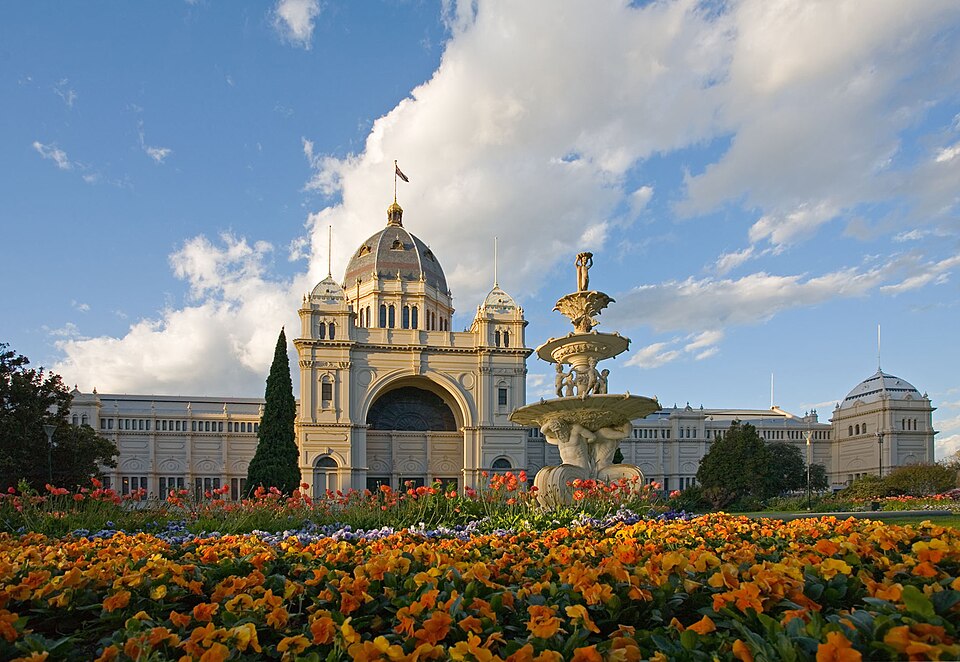
1879–1880 · Joseph Reed
A long neoclassical exhibition hall, some 150 metres end to end, set within formal gardens and flanked by streets on every side, its Great Hall wing the only original section still standing after later fires and demolitions.
Designed by Joseph Reed and built in 1879–1880 in the Carlton Gardens, it was raised to host the Melbourne International Exhibition of 1880–81 and went on to hold the larger Centennial International Exhibition in 1888. In 1901 its Great Hall was chosen as the site for the ceremony founding the Commonwealth of Australia. Wings were lost to fire and demolition through the twentieth century, but the Great Hall survived, was restored in the 1990s, and in 2004 became the first building in Australia awarded UNESCO World Heritage status.
- Its Great Hall was the site chosen for the ceremony that founded the Commonwealth of Australia in 1901.
- Queen Elizabeth II granted it the title "Royal" in 1980.
- In 2004 it became the first building in Australia to receive UNESCO World Heritage status.
Photo: Photograph taken by Diliff and straightened by Ian Fieggen (CC BY 2.5)
Flinders Street railway station
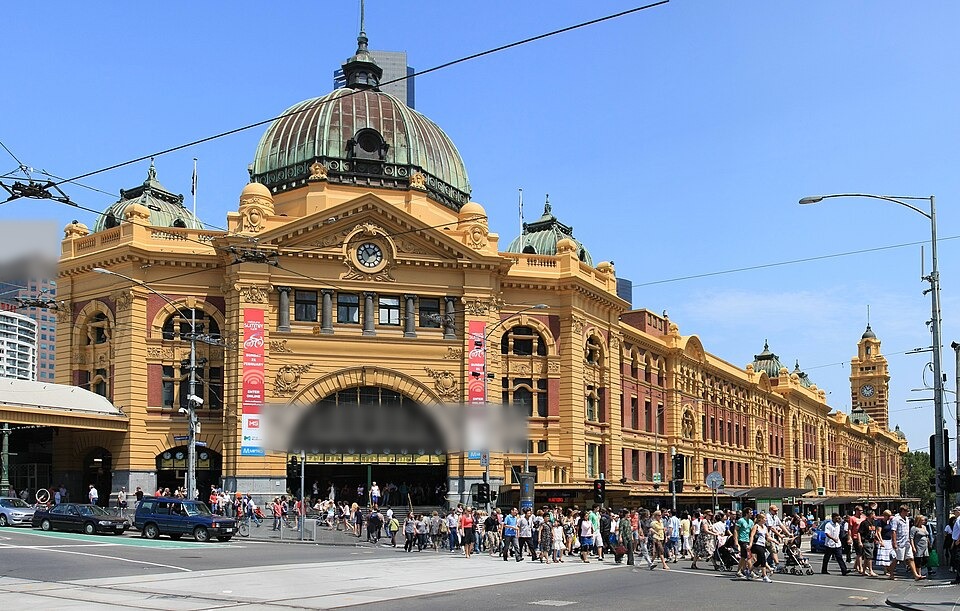
1909
An Art Nouveau passenger building with an ornamented, curved street frontage on a corner site above a river, fronting a much larger complex of thirteen platforms that stretches over more than two city blocks.
A railway terminus first opened in 1854 by the Melbourne and Hobson's Bay Railway Company, though the building standing today is not that original structure. It was the terminus of the first railway line built in Australia and, reputedly, the world's busiest passenger station in the 1920s. Patronage fell after the Second World War and further declined once additional city stations on the City Loop opened in the 1980s to relieve it. It now has thirteen platforms and remains the busiest station on the metropolitan network.
- It was reputedly the world's busiest passenger station in the 1920s.
- It was the terminus of the first railway line built in Australia.
- The building standing today is not the one that opened on the site in 1854.
Photo: Adam.J.W.C. (CC BY-SA 2.5)
Shrine of Remembrance
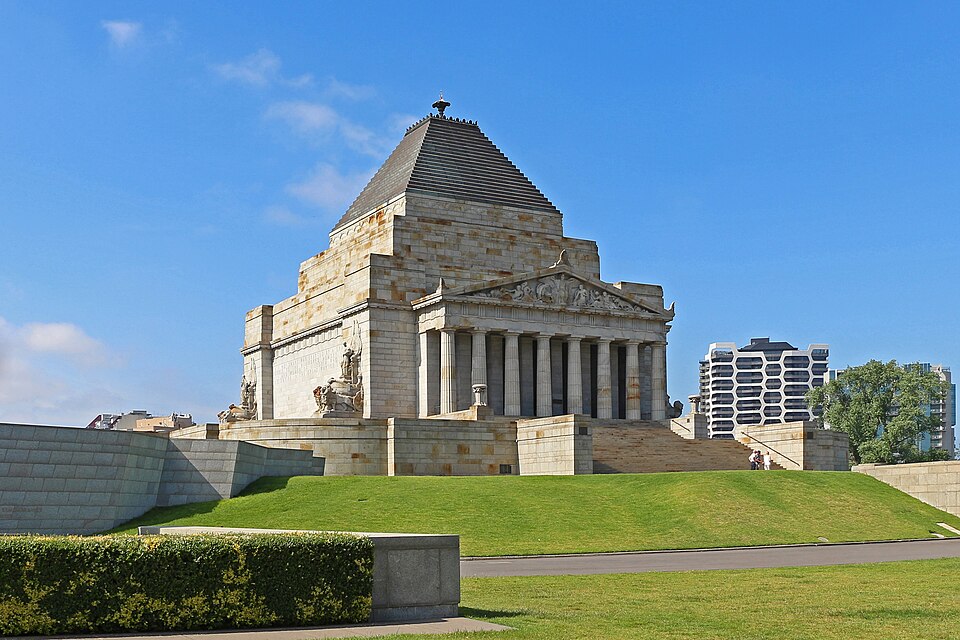
1934 · Hudson and Wardrop
A stone block built of grey Tynong granite in a severe classical style, its stepped, ziggurat-like roof capped by a small tiered element referencing the Choragic Monument of Lysicrates, fronted by a colonnade recalling the Parthenon.
Designed by Phillip Hudson and James Wardrop, both First World War veterans, and completed in 1934, it was built to honour Victorians who served in that war and now commemorates all Australians who have served in any conflict. Built of Tynong granite in a classical style drawing on the Tomb of Mausolus at Halicarnassus and the Parthenon, its sanctuary holds the Stone of Remembrance, and a crypt beneath it contains a bronze statue of a soldier and his son with panels listing every unit of the Australian Imperial Force.
- Once a year, at 11 a.m. on Remembrance Day, sunlight through a roof aperture lights up the word "Love" in the crypt's inscription.
- Both of its architects were First World War veterans themselves.
- Its roof's crowning element references the Choragic Monument of Lysicrates in Athens.
Photo: Bernard Gagnon (CC BY-SA 4.0)
Melbourne Cricket Ground
A multi-purpose stadium in Yarra Park established by the Melbourne Cricket Club in 1853, still owned by the Victorian Government. Known locally as 'the G', it hosts the annual AFL Grand Final and the Boxing Day Test match.
Federation Square
A 3.2-hectare venue for arts, culture, and events at Flinders and Swanston Streets, built above railway lines. It houses cultural institutions including the Ian Potter Centre, ACMI, and the Koorie Heritage Trust around a large paved square.
Parliament House
The meeting place of the Parliament of Victoria on Spring Street, with construction beginning in 1855. It has never been completed, its planned dome still one of Melbourne's best-known unbuilt features, and it served as the federal Parliament of Australia from 1901 to 1927.
National Gallery of Victoria
Founded in 1861, it is Australia's oldest and most visited art museum, with the country's largest gallery collection. Its collection is split between NGV International on St Kilda Road, opened in 1968, and the Ian Potter Centre at Federation Square, opened in 2002.
St Paul's Cathedral
An Anglican cathedral designed by English Gothic Revival architect William Butterfield and completed in 1891. Its spires were added to a different design between 1926 and 1932, and it remains one of Melbourne's major architectural landmarks.
St Patrick's Cathedral
A Roman Catholic cathedral raised to the status of minor basilica by Pope Paul VI in 1974. Built on a Latin cross plan, it was visited by Pope John Paul II in 1986 and listed on the Victorian Heritage Register in 1999.
State Library Victoria
Established in 1854 as the Melbourne Public Library, it is Australia's oldest public library and one of the first free libraries in the world. As of 2023 it was the third-busiest library globally, holding a collection of over five million items.
Arts Centre Melbourne
A performing arts complex in Southbank designed by Sir Roy Grounds, with its masterplan approved in 1960 and construction beginning in 1973. It opened in stages, with Hamer Hall in 1982 and the Theatres Building in 1984.
Old Melbourne Gaol
A bluestone former jail on Russell Street, built from 1839 and operated as a prison from 1845 to 1924. It held and executed notorious criminals including bushranger Ned Kelly, with 133 people hanged in total before parts became RMIT University and the rest a museum.
Eureka Tower
A 297.3-metre skyscraper in Southbank, designed by Fender Katsalidis Architects and themed around the Eureka Stockade. Built from 2002 and officially opened in October 2006, it contains 556 apartments along with an observation deck on level 88 and a restaurant on level 89.
Royal Botanic Gardens Victoria
Botanic gardens across two sites, with the 38-hectare Melbourne Gardens founded in 1846 on the south side of the Yarra River. It displays almost 50,000 plants from 8,500 species, while the 363-hectare Cranbourne Gardens on the city's southeastern fringe was established in 1970.
Rialto Towers
A skyscraper at 525 Collins Street that was the tallest office building in the Southern Hemisphere when it was built. It featured Melbourne's first skyscraper public observation deck, open from 1994 to 2009, and hosted the city's first tower running event.
Old Treasury Building
A former government building on Spring Street, built between 1858 and 1862 in the Renaissance Revival style. Its basement vaults were designed to hold gold from the Victorian gold rush, and it is now a museum of Melbourne's history.
Rod Laver Arena
A multipurpose arena in Melbourne Park. It is the main venue for the Australian Open, the first Grand Slam tennis tournament of the calendar year.
Princess Theatre
A 1,452-seat theatre established in 1854 and rebuilt in 1886 to a design by William Pitt. Built in an ornate Second Empire style, it featured early electric stage lighting and the world's first sliding ceiling, rolled back on warm nights.
Manchester Unity Building
An Art Deco, Gothic-inspired office and retail building constructed in 1931–32 for the Manchester Unity Independent Order of Oddfellows. Its soaring stepped corner tower opposite Melbourne Town Hall makes it one of the city's most prominent and best-known buildings.
Block Arcade
A historic shopping arcade built between 1891 and 1893, considered one of the finest of the late Victorian era. Its ornate, L-shaped interior of mosaic tiling and glass canopies connects Collins Street to Elizabeth Street, near Melbourne's older Royal Arcade.
Melbourne Central Shopping Centre
A large shopping centre, office complex, and public transport hub in the central business district. It stands at the corner of La Trobe Street and Swanston Street.
Regent Theatre
A former picture palace built in 1929, closed in 1970, and reopened as a live theatre in 1996. Designed by Cedric Heise Ballantyne, it combines a Gothic lobby, a Louis XVI-style auditorium, and the Spanish Baroque Plaza Ballroom in its basement.
Sidney Myer Music Bowl
An outdoor bandshell performance venue in the Kings Domain, near the Arts Centre and Southbank. It was opened by Prime Minister Robert Menzies on 12 February 1959.
Polly Woodside
A three-masted, iron-hulled barque built in Belfast and launched in 1885, preserved as the central feature of the South Wharf precinct. It is typical of the thousands of smaller iron barques built in the last days of sail, designed for economical deep-water trade.
Sandridge Bridge
A steel girder bridge across the Yarra River, completed in 1888 as the third bridge on the site. Once a railway crossing, it was redeveloped in 2006 into a pedestrian and cycle path featuring public art, connecting the city centre to Southbank.
History
The land now built over has been used by Aboriginal Victorians, the Boonwurrung, Woiwurrung and Wurundjeri peoples of the Kulin nation, for over 40,000 years. A British penal settlement attempted at Port Phillip in 1803 was abandoned within a year; permanent colonial settlement followed only in 1835, when free settlers arrived from Van Diemen's Land and founded the town that became Melbourne. Within decades the young settlement was wealthy enough from the Victorian goldfields to fund the 1879–1880 Royal Exhibition Building, a hall grand enough to host two international exhibitions. It was later prosperous enough to rebuild its main railway terminus in 1909, replacing an 1854 station and coping with a rail network that briefly made it, by some counts, the world's busiest. By 1934 the same civic ambition produced the granite Shrine of Remembrance, commemorating a war that had reshaped the city's sense of itself.