Landmarks in Mexico City
This high-altitude capital rose in Baroque stone over a razed Aztec city.
Nearly every landmark here sits within a few blocks of the Zócalo, the vast square laid out over the former Aztec sacred precinct after the conquest of Tenochtitlan. The cathedral and the National Palace both rise on that reused ground, built in stone across the colonial centuries and, in the palace's case, partly from masonry salvaged from an earlier Aztec ruler's residence. Their Baroque bulk sets the tone for the historic center. A few streets further west, near the Alameda Central park, the Palacio de Bellas Artes breaks from that pattern entirely: a 20th-century performance hall whose Art Nouveau shell and Art Deco interior belong to an independence-centennial building campaign interrupted by revolution.
Mexico City Metropolitan Cathedral
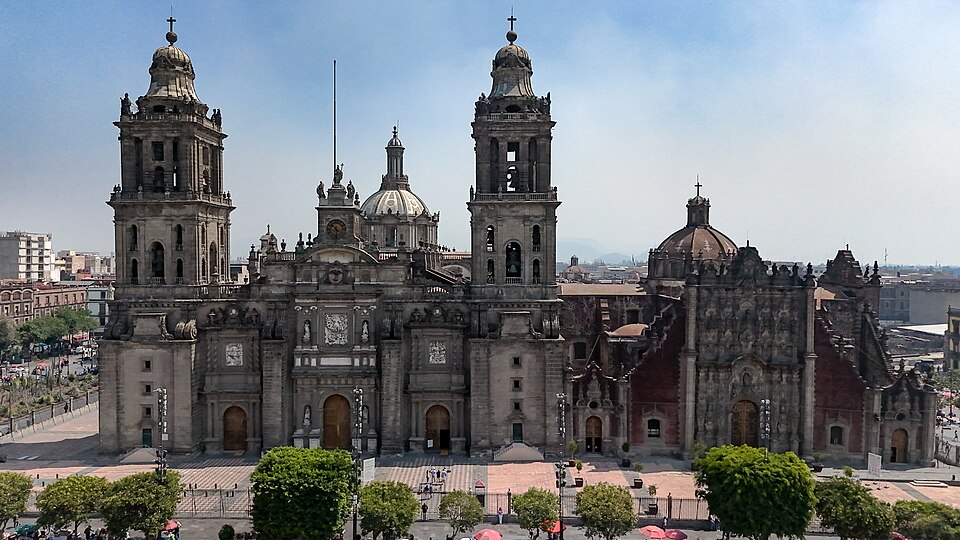
1573–1813 · Claudio de Arciniega
Twin bell towers rise above a wide Baroque facade that faces a vast paved square from its northern side, with the excavated stone platforms of a former Aztec temple precinct exposed just beside the building.
The cathedral church of the Catholic Archdiocese stands on the site of the Aztec sacred precinct, built around an earlier church raised soon after the conquest until that first structure was entirely replaced. Claudio de Arciniega planned the design, drawing on Gothic cathedrals in Spain, and construction continued under Juan Gómez de Trasmonte, José Eduardo de Herrera, José Damián Ortiz de Castro and Manuel Tolsá as it stretched across nearly 250 years.
- It stands directly on top of the former Aztec sacred precinct, beside the excavated Templo Mayor.
- Building it took under 250 years, long enough that virtually every architect, painter and sculptor working in the viceroyalty had a hand in it at some point.
- It was built around an earlier church and eventually replaced that structure entirely rather than starting from a cleared site.
Photo: ProtoplasmaKid (CC BY-SA 4.0)
National Palace
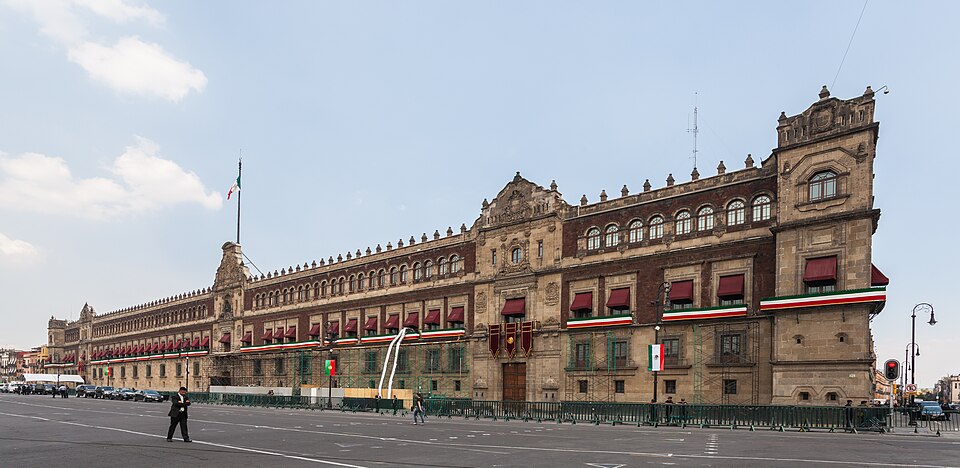
1693
A long, low Baroque facade in dark stone runs the length of one side of a vast central square; inside, much of the fabric was raised from masonry taken from the razed palace that stood on the same spot.
The National Palace is the seat of Mexico's federal executive and, since 2018, the official residence of the president. The site has held a palace for the country's rulers since the Aztec Empire, and much of the present building's material comes from the original residence of the 16th-century leader Moctezuma II. The standing Baroque palace dates to a 1693 rebuilding, distinct from that earlier Aztec-era structure it replaced and reused.
- Much of its building material was salvaged from the palace of the Aztec ruler Moctezuma II, which stood on the same site.
- It has served as an official presidential residence only since 2018, despite centuries as a seat of government.
Photo: Diego Delso (CC BY-SA 3.0)
Palacio de Bellas Artes
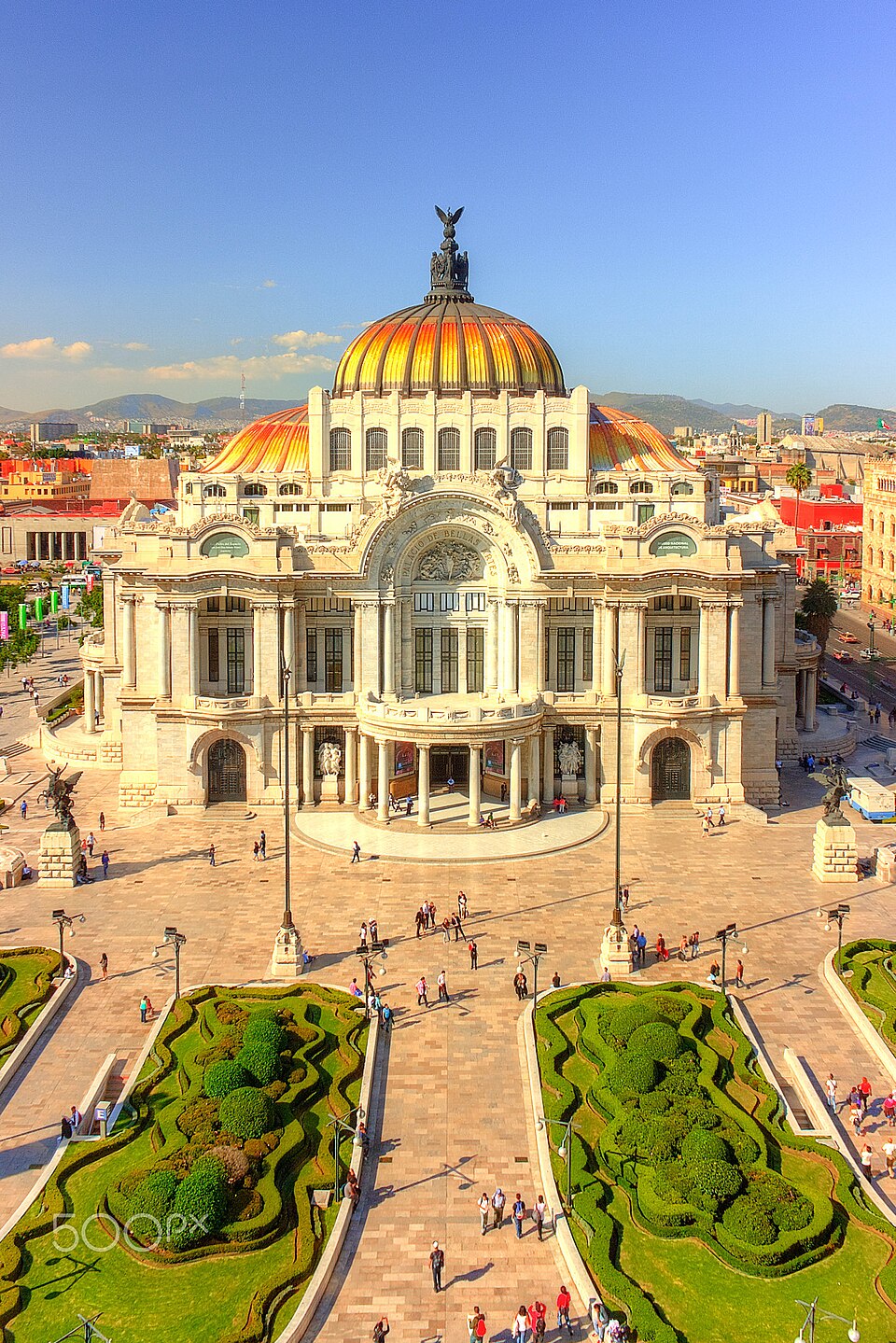
1934 · Federico Ernesto Mariscal Piña
An Art Nouveau and Neoclassical exterior encloses an Art Deco interior, a combination that comes from a single building finished in two widely separated phases; it stands near a central park and holds murals by major muralists inside.
Built to replace the old National Theater as an opulent venue for the centennial of Mexican independence, the building was designed and begun by the Italian architect Adamo Boari in 1904. Soft subsoil and the political upheaval before and during the Mexican Revolution stopped work by 1913. Federico Mariscal resumed construction in 1932 and completed it in 1934, giving the Art Nouveau and Neoclassical exterior an Art Deco interior, filled with murals by Diego Rivera, Siqueiros and others.
- Construction stopped for nearly two decades, from 1913 to 1932, because of the Mexican Revolution and problems with the soft subsoil.
- The exterior and interior were designed in different styles because two different architects, working decades apart, completed each part.
Photo: Octavio Alonso Maya Castro (CC BY-SA 3.0)
Alameda Central
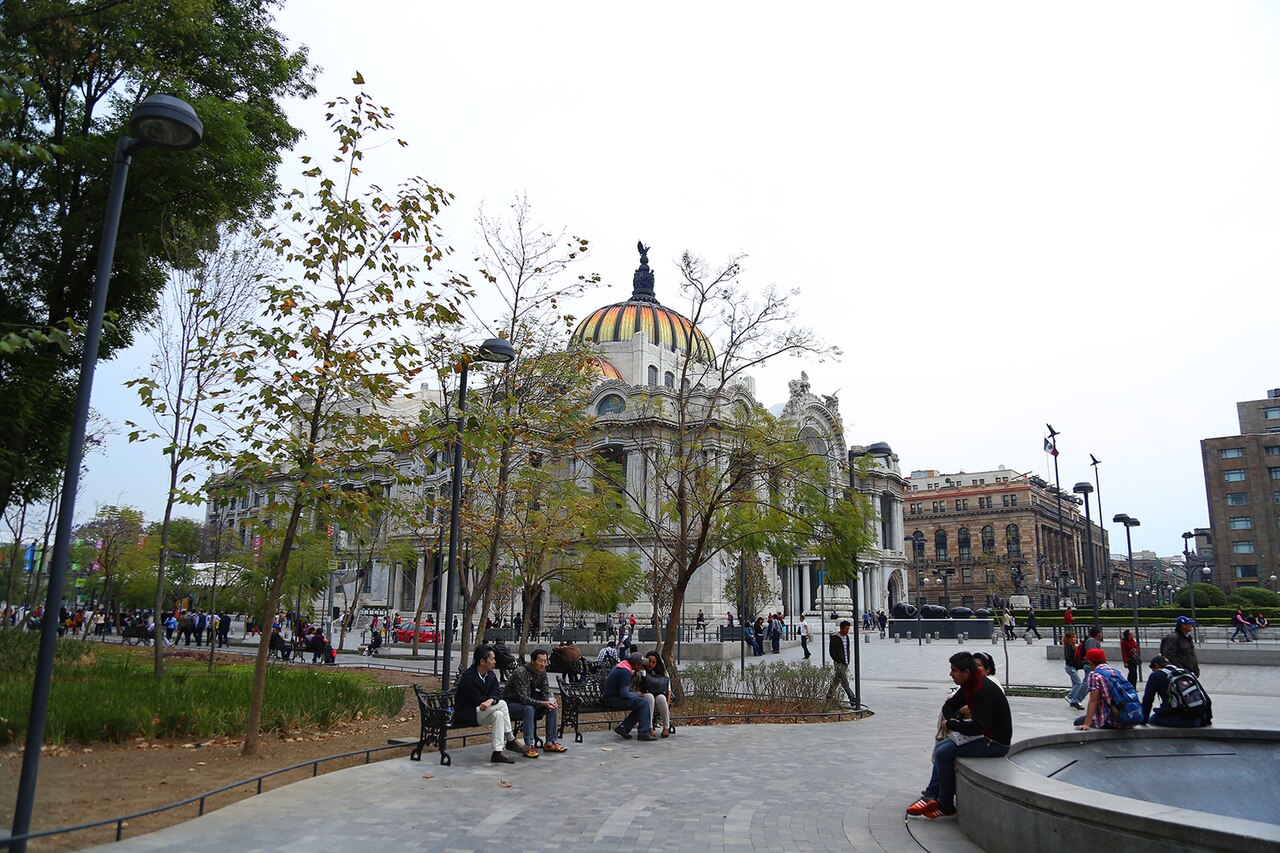
1592
Straight paved paths radiate outward from a central bandstand and a set of classical fountains inspired by Greco-Roman mythology, framed by mature shade trees and nineteenth-century statues, including a large monument to Beethoven donated by the city's German community.
Alameda Central is a public park in downtown Mexico City, created in 1592 by order of the viceroy on the site of a former Aztec marketplace. Its name comes from the álamo, or poplar, trees planted there, and the grounds later absorbed an adjoining plaza once used by the Inquisition for public burnings. Gas lamps installed in 1868 were replaced by electric lighting in 1892, and the park underwent a full rehabilitation in 2012, with new paving, planting and lighting. Fountains and statues from the nineteenth century remain throughout the grounds.
- In 1846, President Santa Anna ordered the park's fountains filled with alcohol to celebrate his triumphant return to the city.
- Part of the grounds began as El Quemadero, a plaza where the Inquisition publicly burned condemned people at the stake, before it was absorbed into the park in 1770.
- In 1791, a nobleman fenced the park with wood to reserve it for the nobility; by 1821 it was instead the site of the city's popular independence celebrations.
Photo: Gobierno CDMX (CC0)
Cuicuilco
An archaeological site on the former shore of Lake Texcoco, in today's Tlalpan borough, its pyramid begun a few centuries BCE. Occupied until destroyed by the eruption of Xitle between 245 and 315 CE, it may be the Valley of Mexico's oldest city.
Old Portal de Mercaderes
The west side of the Zócalo, occupied by commercial buildings since the Spanish Conquest of the Aztec Empire in 1521. Madero Street divides its two building groups, with jewelry stores on the south side marking the start of the Centro Joyero Zocalo.
La Enseñanza Church
A church built between 1772 and 1778 on Donceles Street, popularly named for the adjoining Convent of the Teaching. Its Churrigueresque altarpieces are considered the pinnacle of Mexican Baroque, and after the convent was disbanded following the Reform War, the church returned to religious use.
Palace of Iturbide
A palatial residence built 1779–1785, a wedding gift from the Count of San Mateo Valparaíso to his daughter. It is named for Agustín de Iturbide, who lived there and accepted the First Mexican Empire's crown, and now houses the Palacio de Cultura Banamex.
World Trade Center
Commonly known by its former name, Hotel de México, a complex in Colonia Nápoles centred on the 50-story, 172-metre Torre WTC. At its roof it stands 218 metres, the city's third tallest building including antennas, with a convention centre and revolving restaurant.
San Juan Market
A traditional market in the historic centre, the city's only one specializing in gourmet and exotic foods. Known for exotic meats such as venison, crocodile, wild boar and lion, plus products from Europe and the Americas, it caters mainly to chefs, restaurateurs and foodies.
Convent of La Merced
A former colonial complex, mostly demolished for later buildings, with only its cloister surviving from a Mercedarian monastery built around 1600. Located on Uruguay and Talavera Streets, it lent its name to the surrounding La Merced neighborhood and its well-known market.
Palacio de Minería
A Neoclassical building built 1797–1813 by architect Manuel Tolsá, a fine example of the style in the Americas. Built to house the Royal School of Mines for mineralogist Fausto Elhuyar, it later hosted the National University and is now a UNAM museum.
Bench of Fidel Castro and Che Guevara
Two bronze statues of Fidel Castro and Che Guevara seated on a bench, designed by Óscar Ponzanelli and installed in Tabacalera in 2017. The monument marks the pair's 1955 meeting and has drawn polarized reactions, being removed for lacking authorization in both 2018 and 2025.
Museo Nacional de las Intervenciones
Housed in the former Monastery of San Diego Churubusco, itself built atop an Aztec shrine. Its lower floor covers the site's monastic history while upstairs galleries cover military conflicts on Mexican soil, and it is one of five museums run directly by INAH.
Santa Teresa la Antigua
A former convent northeast of the main plaza, which ceased operating as a convent in the late 19th century. Since 1989 it has housed the Santa Teresa la Antigua Alternative Art Center.
Biblioteca de México José Vasconcelos
A public library in Centro, across from the Balderas metro station, open daily from 8:30 am to 7:30 pm.
Museo Nacional de San Carlos
A national art museum devoted to European art, housed in the Palace of the Count of Buenavista, a neoclassical building in Colonia Tabacalera. Its collection includes works by Lucas Cranach the Elder, Parmigianino, Frans Hals, Anthony van Dyck, Jean-Auguste-Dominique Ingres and Auguste Rodin.
Palacio de la Autonomía
A museum where the university gained autonomy from government control in 1929, in a late 19th-century building on land once granted by Hernán Cortés. Built under President Porfirio Díaz and ceded to the university in 1910, it now houses the Museo de la Autonomía Universitaria.
Parque de la Bombilla
A public park in San Ángel, memorializing revolutionary general and former president Álvaro Obregón, assassinated at the restaurant La Bombilla in 1928. The monument complex opened on 17 July 1935, the seventh anniversary of Obregón's assassination by José de León Toral, opposed to anti-Catholic policies.
Edificio La Nacional
An Art Deco office building on Avenida Juárez, built between 1929 and 1932, considered the first building over ten stories in Mexico. Named for its original tenant, the National Insurance Company, it stood 56 metres over 13 floors and was the city's tallest until 1937.
Corpus Christi Church
A former church on Avenida Juárez, the only remaining part of the Convent of Corpus Christi, founded in 1724 for indigenous women. Designed by architect Pedro de Arrieta in Baroque style, it was damaged in the 1985 earthquake and later restored.
Valvanera Cathedral
A church southeast of the Zócalo, founded 1573 as the Convent of Santo Niño Perdido, rebuilt as a convent in 1667. The 1861 Reform Laws forced out the nuns and razed the convent; the oil of the Black Virgin of Valvanera survived the altar's near-destruction.
History
After the Spanish conquest of Tenochtitlan, colonial builders raised the new city's principal structures directly on and from the remains of the Aztec capital: the cathedral rose over the old sacred precinct, and the palace of the viceroys reused stone from the razed residence of Moctezuma II. The cathedral alone took shape over roughly 250 years, from 1573 to 1813, drawing in turn on Gothic, Baroque, Churrigueresque and Neoclassical fashion as generations of architects succeeded one another. Centuries later, the same historic center gained a very different landmark: construction on the Palacio de Bellas Artes began in 1904 to mark the centennial of independence, stalled during the Mexican Revolution, and resumed only in 1932, finishing in 1934.