Landmarks in Moscow
A walled medieval fortress, a domed church and grand 19th-century halls ring one square.
Moscow's best-known landmarks cluster close together on the north bank of the Moskva River, most within walking distance of a single central square. A walled medieval fortress of palaces and cathedrals anchors one side; facing it stands a sixteenth-century church crowned with nine painted domes, and along another edge runs a nineteenth-century trading arcade built in a revival of older Russian ornament. A little further along the riverbank, a monumental cathedral completed in 2000 replaces a nineteenth-century original torn down under Soviet rule, while a colonnaded imperial theatre nearby reflects the same nineteenth-century building boom that filled the area around the fortress with civic and cultural institutions.
Saint Basil's Cathedral
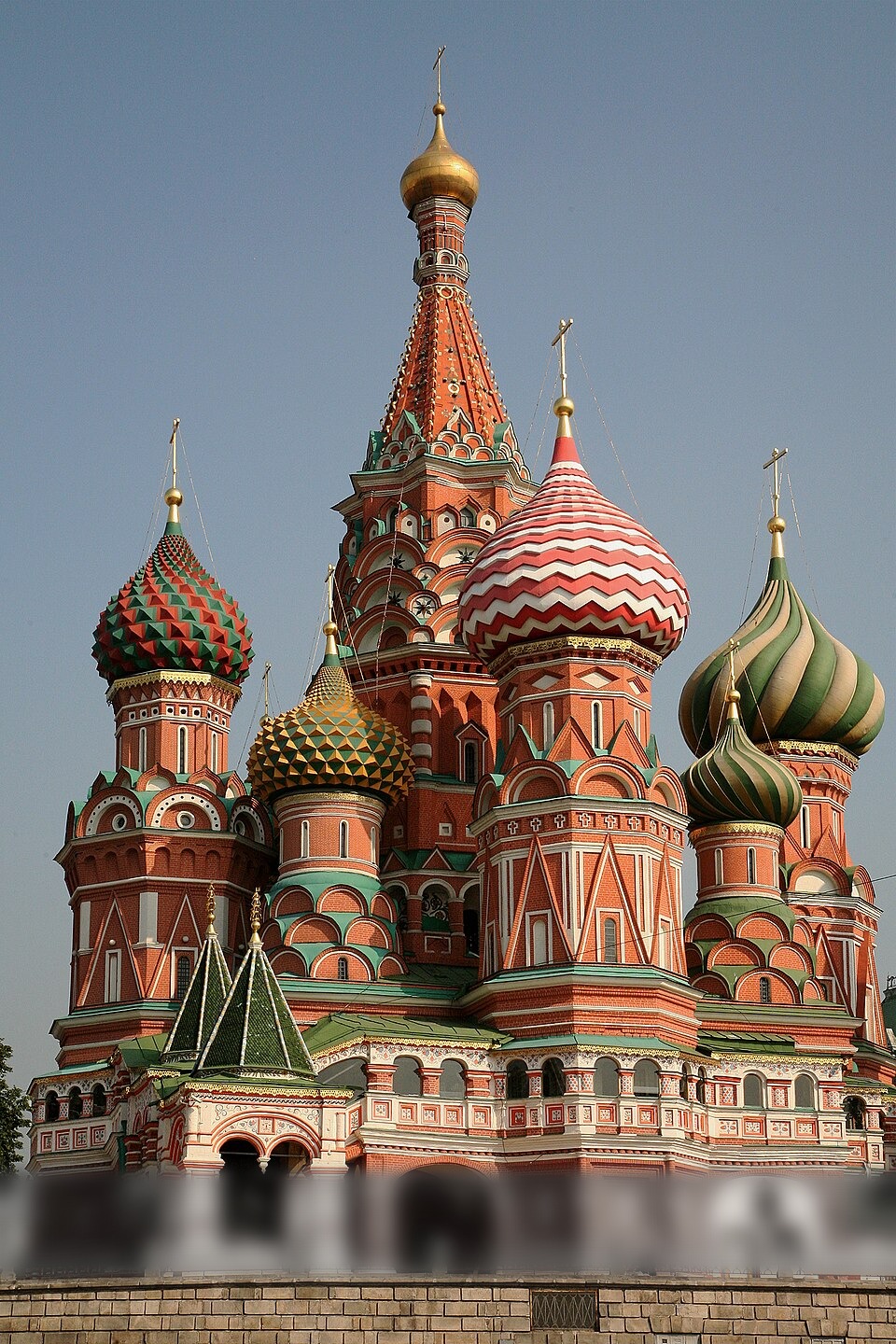
1561 · Postnik Yakovlev
Nine distinct domes in clashing colours and patterns cluster around a tall central tented tower, the whole silhouette likened to a flame rising from the ground.
Built between 1555 and 1561 on the orders of Ivan the Terrible, the cathedral originally centred on a Trinity Church with eight chapels arranged around a ninth, dedicated to the Intercession; a tenth chapel followed in 1588 over the grave of the venerated local saint Vasily. It commemorated the capture of Kazan and Astrakhan. Its multicoloured exterior was completed only in 1683, over a century after work began. Long used for worship, the building now functions as a museum on Red Square.
- The cathedral's popular name comes from a local saint, Vasily (Basil), whose grave received its own chapel in 1588, decades after the rest was built.
- Its distinctive colours were not part of the original design and were finished only in 1683, more than a century after construction began.
Photo: W. Bulach (CC BY-SA 4.0)
Moscow Kremlin
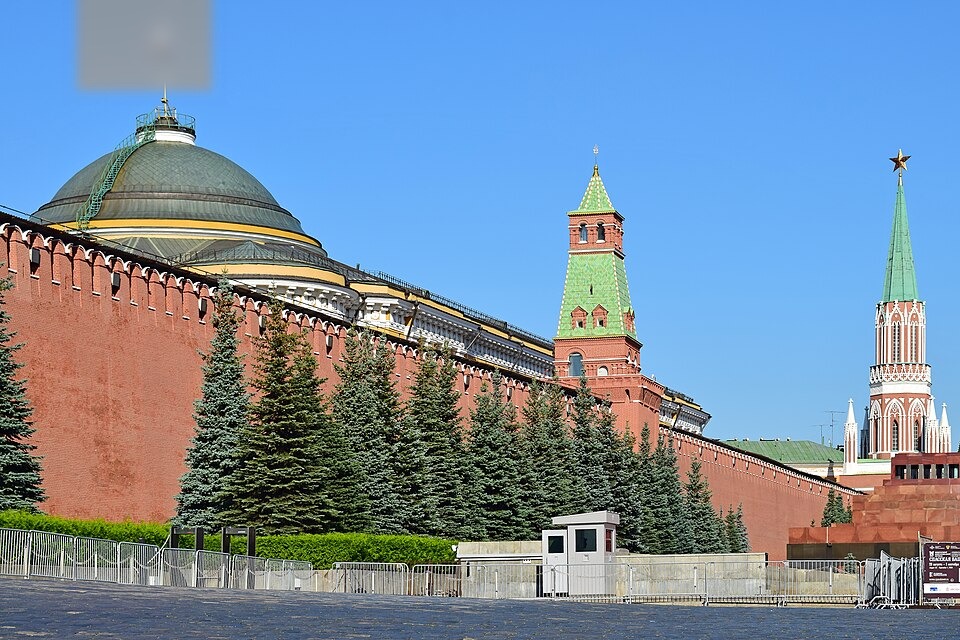
A crenellated wall studded with towers encloses a dense cluster of palace roofs and cathedral domes, with a river along one side, a formal garden along another and a vast open square along a third.
The complex brings together five palaces, four cathedrals and a perimeter wall studded with towers, at the heart of which the Grand Kremlin Palace once served as a residence of the Tsar and now houses the president of the Russian Federation. Sources disagree by decades on when the fortress reached this form; the brief credits the Italian architects Aristotile Fioravanti, Aloisio da Milano and Pietro Antonio Solari, without settling which building campaign each is tied to. The complex sits between the river to the south, a garden to the west and an open square to the east.
- The generic word behind the name describes any fortified Russian citadel, and several other Russian cities have one of their own.
Photo: Юрий Д.К. (CC BY 4.0)
Bolshoi Theatre
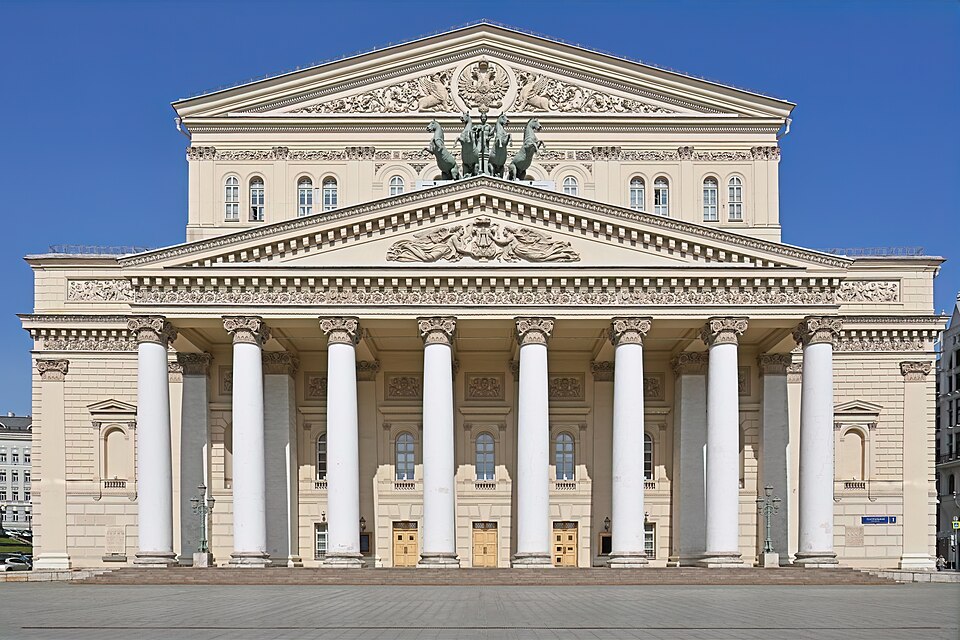
1825 · Joseph Bové
A neoclassical facade of tall columns beneath a triangular pediment fronts the main building, an image reproduced widely enough to appear on a Russian banknote.
The theatre company is dated by Wikidata to 1776, though the present main building was designed by Joseph Bové, matching the later date of 1825. Before the 1917 revolution it belonged to the Imperial Theatres of the Russian Empire, alongside houses in Saint Petersburg and the nearby Maly Theatre. Its ballet and opera companies are among the oldest in the world, and the ballet is by far the largest company of its kind, with more than 200 dancers. The building has been rebuilt and renovated repeatedly, most recently reopening in 2011 after a six-year restoration.
- Its neoclassical facade is reproduced on the Russian 100-ruble banknote.
- Its ballet company, with more than 200 dancers, is the largest in the world.
- It also runs a ballet school as far away as Joinville, Brazil.
Photo: Юрий Д.К. (CC BY 4.0)
Cathedral of Christ the Saviour
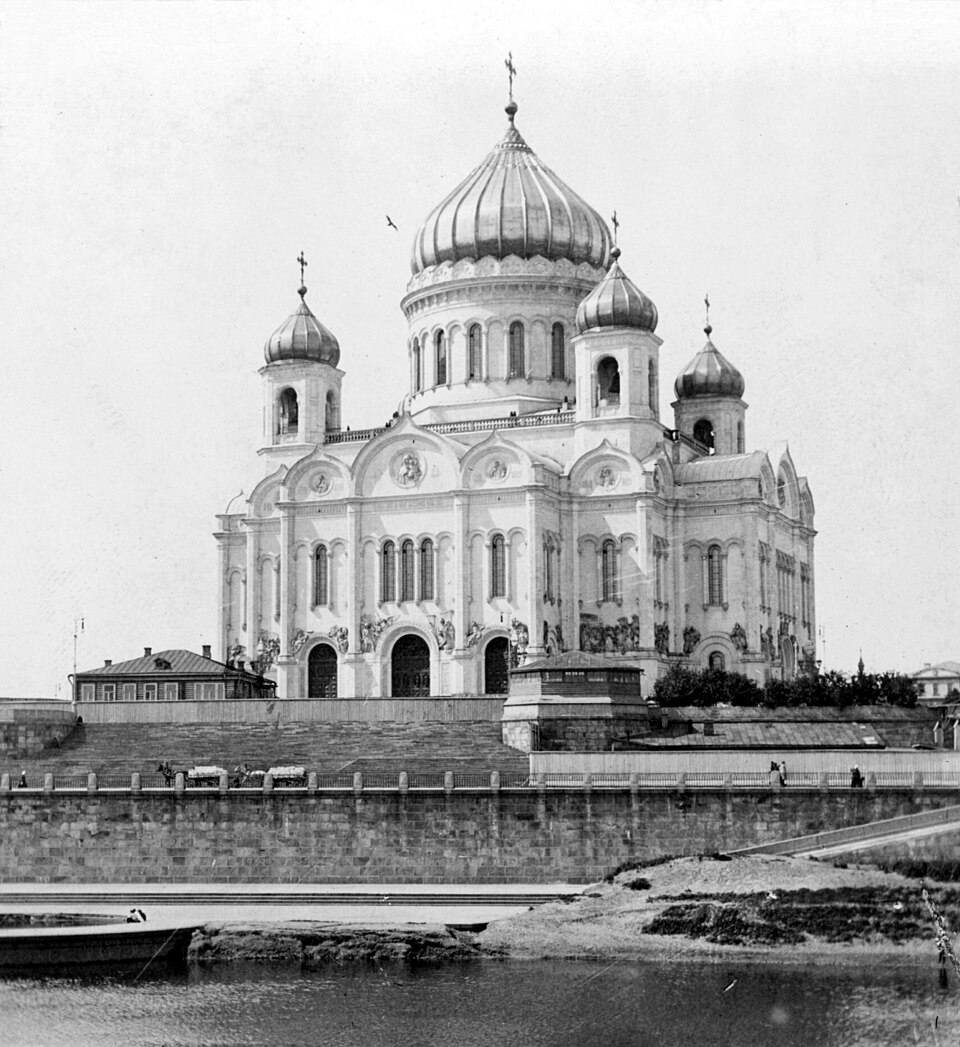
2000
Standing 103 metres tall, enough to rank as the third-tallest Orthodox church building anywhere, the cathedral is a rebuild of its nineteenth-century predecessor on the same riverside plot, a few hundred metres from the old fortress at the city's centre.
The present cathedral, completed in 2000, is the second church to stand on this site. Its nineteenth-century predecessor, designed by Konstantin Thon, took more than 40 years to build and hosted the 1882 world premiere of Tchaikovsky's 1812 Overture before its demolition in 1931 on the order of the Soviet Politburo, intended to clear ground for a Palace of the Soviets that construction later abandoned. Rising 103 metres, the rebuilt cathedral went up between 1995 and 2000 after the Soviet Union's dissolution and ranks as the third-tallest Orthodox church building anywhere.
- The site's first church hosted the 1882 world premiere of Tchaikovsky's 1812 Overture.
- The 1931 demolition was meant to clear ground for a Palace of the Soviets, whose construction was abandoned during the Second World War and never finished.
Photo: William H. Rau (Public domain)
GUM
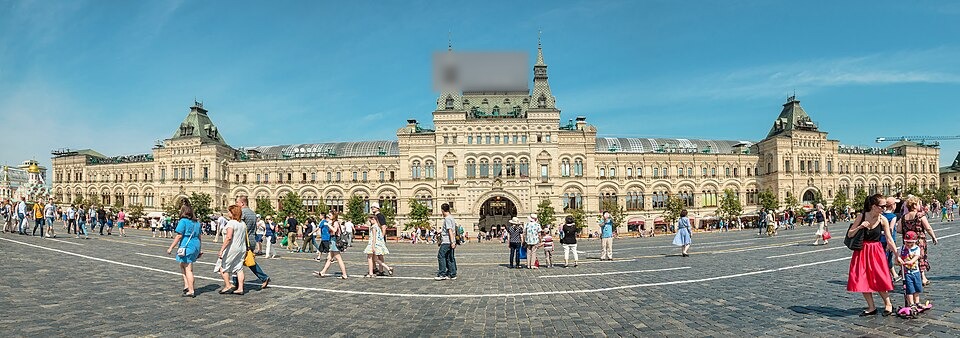
1893 · Alexander Pomerantsev
A decorative Russian Revival facade fronts directly onto Red Square, setting the building apart from the plainer structures nearby; behind it lies a shopping arcade that has kept the same trading function, on and off, since the 1890s.
Opened in 1893 to the design of Alexander Pomerantsev in the Russian Revival style, the building replaced an older market known as the Upper Trading Rows on the same site facing Red Square. It has functioned mainly as a shopping mall through its history, though for much of the Soviet period it operated as a department store with a single supplier, the Soviet state. Restored fully to retail use afterward, it now carries more than 100 brands alongside cafes and restaurants, and holds federal cultural heritage status.
- For most of the Soviet era the mall operated as a department store with exactly one supplier: the state itself.
- Before the 1920s the site was known by an older name, the Upper Trading Rows.
Photo: Skif-Kerch (CC BY-SA 4.0)
Red Square
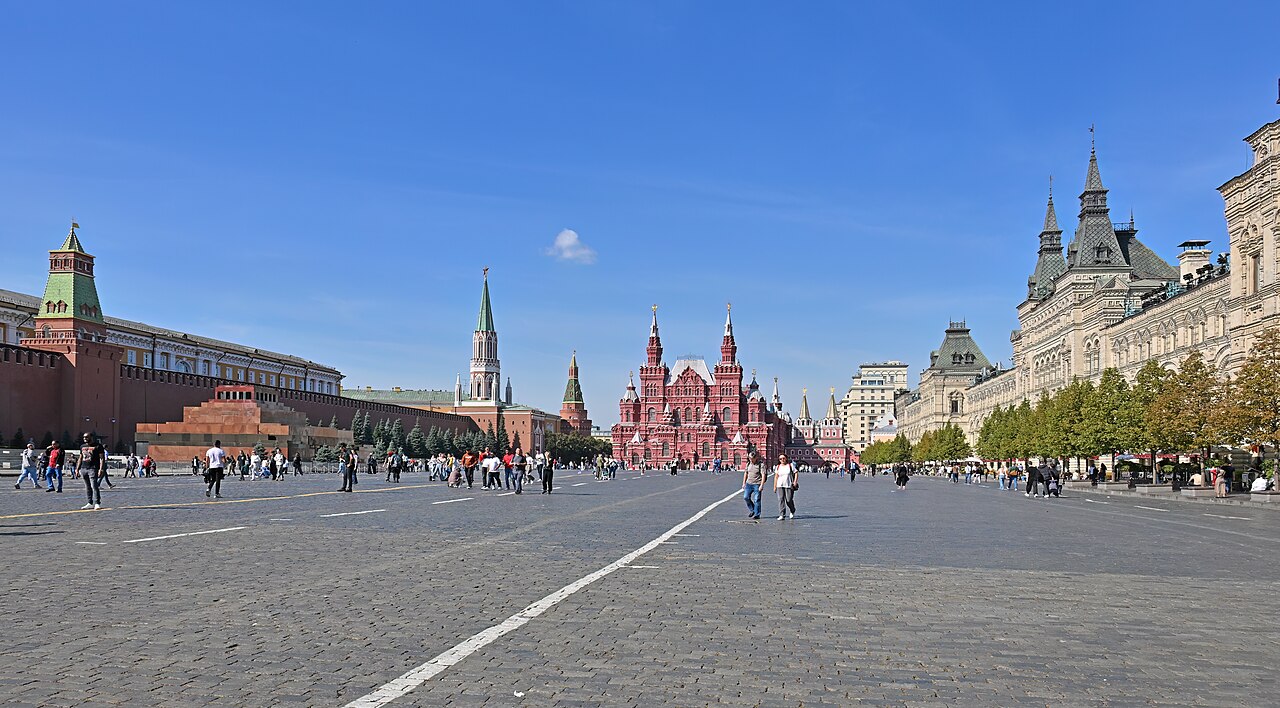
1500
A long rectangular cobbled square measuring roughly 330 by 70 metres, closed at one end by the multicoloured domes of a nine-chapel cathedral and lined by a crenellated fortress wall, a glass-roofed trading arcade and a red-brick museum building topped with tent-roofed towers.
Laid out along the eastern wall of a fortress, the square began as a marketplace and was known in turn as Torg, meaning market, and Pozhar, meaning burnt-out place, after repeated fires destroyed the wooden buildings that stood there. Its present name, first recorded in 1661–62, comes from an old Russian word for beautiful that later came to mean red. A defensive moat running along its fortress-facing edge was paved over in 1812. Covering nearly 73,000 square metres, it has hosted markets, executions, military parades and political demonstrations, and has held UNESCO World Heritage status since 1990.
- The word in its name once meant 'beautiful' in Russian; only later did the same word come to mean 'red'.
- Before taking its current name, the square was called 'Pozhar', meaning 'burnt-out place', after repeated fires destroyed the market buildings that stood there.
Photo: Юрий Д.К. (CC BY 4.0)
Grand Kremlin Palace
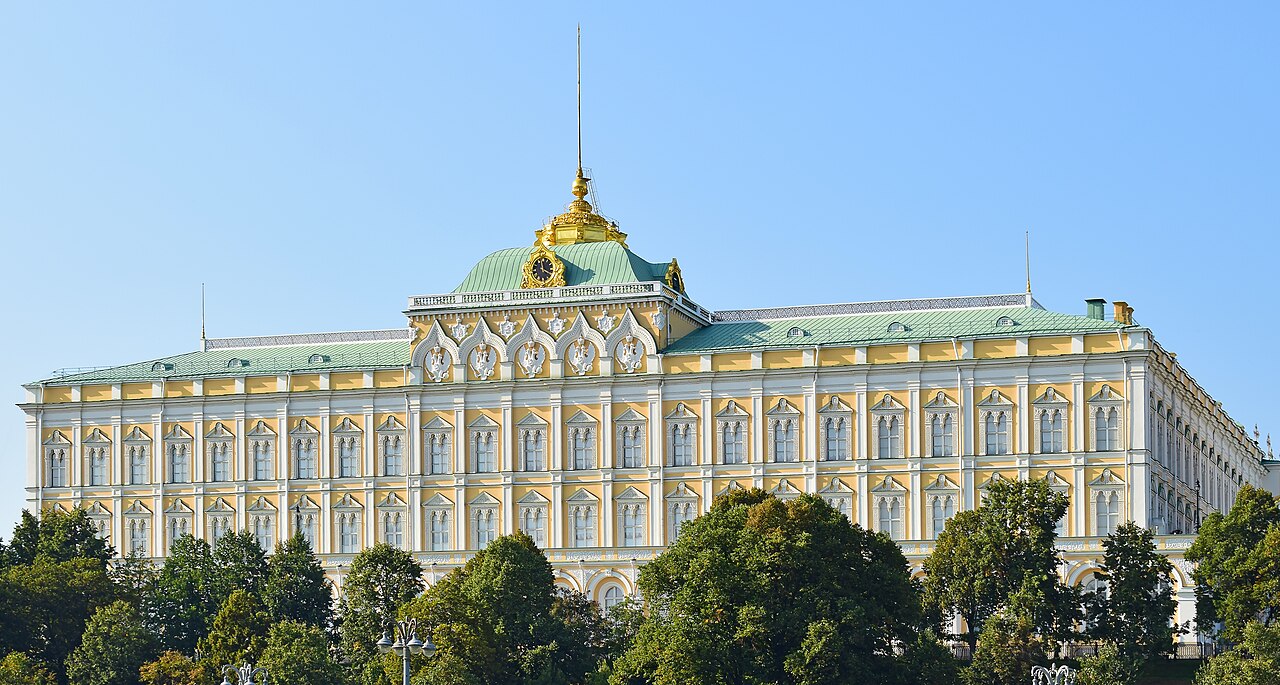
1837–1849 · Konstantin Thon
Behind a long, two-tier facade of tall arched windows and carved white-stone surrounds, the building appears to rise three storeys but in fact has only two, its upper level holding double-height ceilings and paired rows of windows; the main front overlooks a river embankment within a walled fortress complex.
Built between 1837 and 1849 under the direction of Konstantin Thon, the palace replaced an earlier Baroque residence and a sixteenth-century church, both demolished to clear the site on Borovitsky Hill. Serving through much of the nineteenth century as the tsar's official residence in Moscow, it incorporates the older Terem Palace, nine churches and more than 700 rooms behind a single rectangular facade. Its state reception halls, each named for an imperial order, are still used for ceremonies; the building now serves as the working residence of the Russian president and also houses a museum.
- The building looks three storeys tall from outside but is actually only two, its upper floor given high ceilings and two rows of windows to complete the illusion.
- Before 1917 its facade carried five bas-reliefs of double-headed eagles topped with regional coats of arms; after the revolution these were replaced with the letters CCCP and the Soviet emblem.
- The presidential inauguration of Russia takes place inside the Hall of the Order of St Andrew, one of five reception halls named after imperial military and civil honours.
Photo: Юрий Д.К. (CC BY 4.0)
Dormition Cathedral
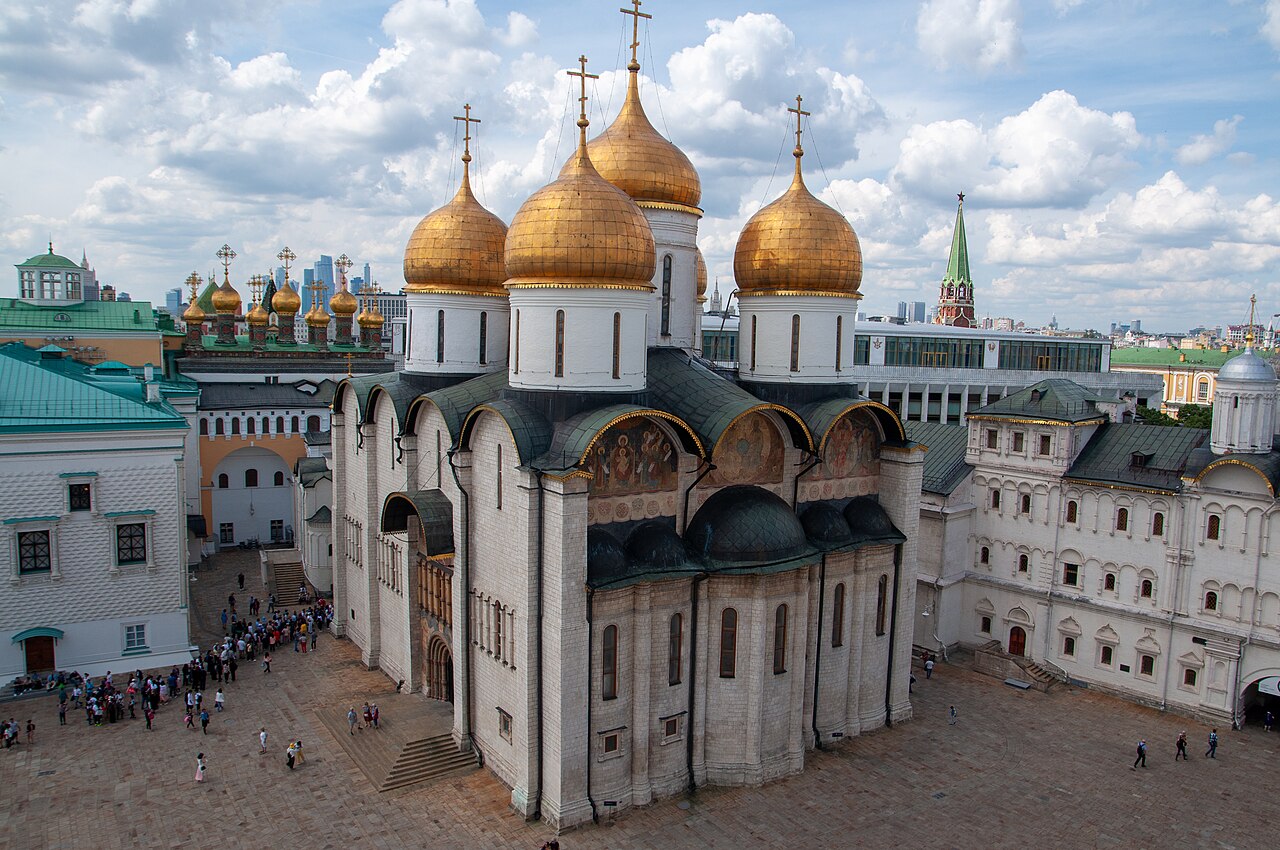
1475–1479 · Aristotele Fioravanti
A squat white-stone church of trimmed limestone blocks rises within the fortress walls, five gilded domes crowning a three-nave interior whose unusually slender columns and open, airy proportions set it apart from heavier Russian church design of the period.
Consecrated in 1479 to a design by the Italian architect Aristotele Fioravanti, this church replaced an earlier stone structure that had stood since 1326 and collapsed in 1474, shortly before its own completion by two Moscow architects. Built of trimmed white limestone and crowned with five domes representing Christ and the four Evangelists, it drew on a cathedral in Vladimir as its model while introducing groin vaults and slender columns unusual for Russian masonry of the period. From 1547 until the last tsarist coronation in 1896, it served as the coronation church of Russian monarchs.
- Its immediate predecessor collapsed in 1474 during an earthquake, just as two Moscow architects were nearing completion of the rebuild.
- In 1918, by special permission from Vladimir Lenin, it held one final Easter service before the Bolshevik government converted it into a museum.
Photo: Don-vip (CC BY-SA 4.0)
Spasskaya Tower
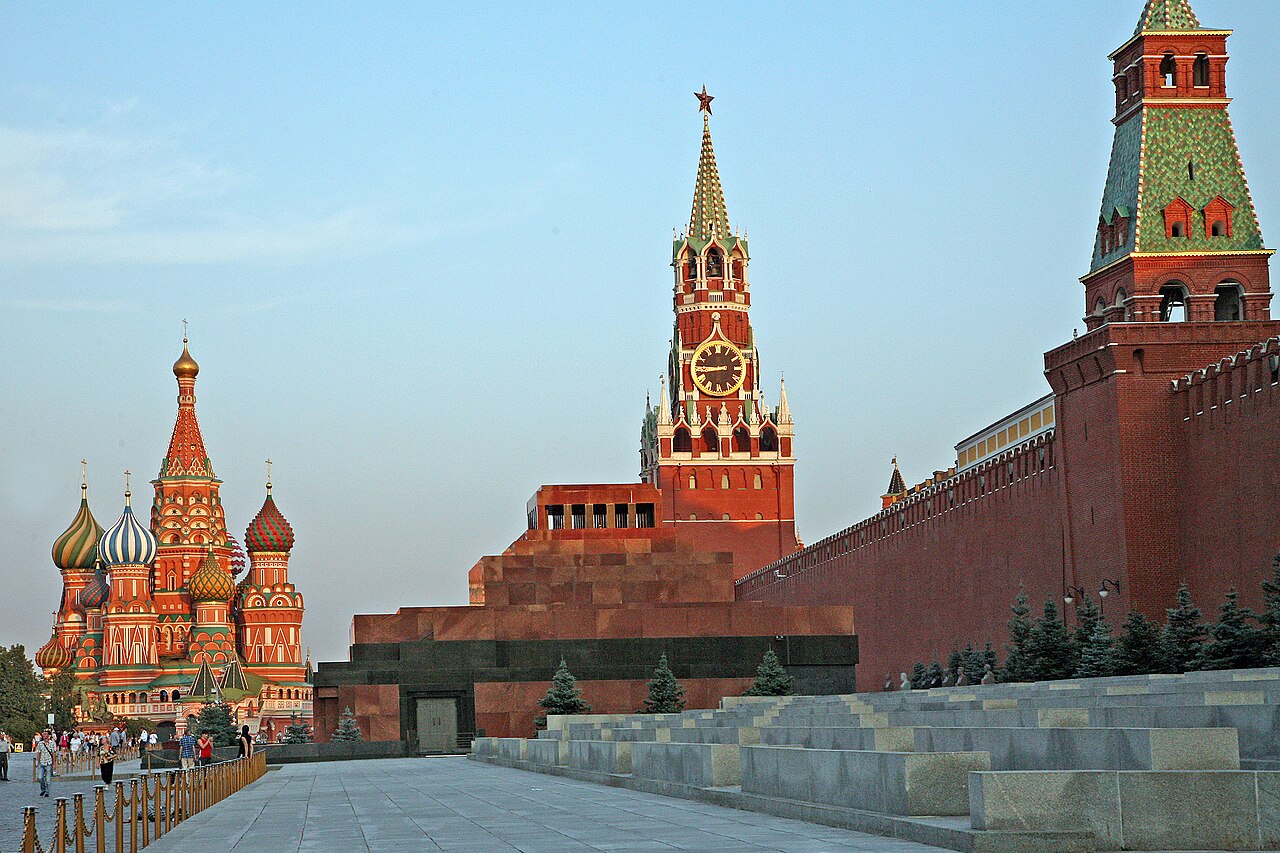
1491–1625 · Pietro Antonio Solari
A tall red-brick gate tower rises in tiers to a green tented roof topped by a red star, its lower stage pierced by an archway and its upper faces each carrying a six-metre clock dial.
Commissioned by Grand Prince Ivan III and completed in 1491 by the Italian architect Pietro Antonio Solari, the tower first bore the name of a nearby church before taking its current name from an icon placed above its gate in 1658. Architects Bazhen Ogurtsov and Christopher Galloway crowned it with a tented roof in 1624–1625, the first such roof on any of the fortress's towers, and a clock recorded as early as 1491 has occupied it since. In 1936 the double-headed eagle atop the tower was replaced with a red star, bringing the structure, star included, to 71 metres.
- A Latin inscription over its gate names both the Grand Prince who ordered it built and the Milanese architect who built it, dated to 1491.
- The gate's clock chimes serve as the country's official time signal, and its dial measures six metres across.
- An icon on its outward-facing wall was plastered over in 1937 and not uncovered and restored until 2010.
Photo: W. Bulach (CC BY-SA 4.0)
Lenin's Mausoleum
A mausoleum on Red Square holding the preserved body of Vladimir Lenin, on public display since shortly after his death in 1924. Designed by architect Alexey Shchusev, it draws on ancient mausoleums such as the Step Pyramid and the Tomb of Cyrus the Great.
Tsar Bell
A bell 6.14 metres tall and 6.6 metres in diameter, displayed on the grounds of the Kremlin. Commissioned by Empress Anna Ivanovna, niece of Peter the Great, it is the third of its line and has never been suspended, rung or put into working order.
Tsar Cannon
An early modern artillery piece cast in bronze in 1586 by the Russian founder Andrey Chokhov. Never used in war, it bears traces of at least one firing and is listed by Guinness as the largest bombard by caliber in the world.
Gorky Park
A central park named after Maxim Gorky. It celebrated its 90th anniversary in August 2018, placing its founding around 1928.
Cathedral of the Archangel
A Russian Orthodox church dedicated to the Archangel Michael, built 1505–1508 by the Italian architect Aloisio the New on the site of an older cathedral from 1333. It was the main burial place of Russia's tsars until the capital moved to St. Petersburg.
Tretyakov Gallery
An art gallery considered the foremost repository of Russian fine art, its collection begun in 1856 by the merchant Pavel Tretyakov. In 1892 he donated roughly 2,000 works to the Russian nation, and the museum ranked 13th among the world's most-visited art museums in 2020.
White House
A government building on the Krasnopresnenskaya Embankment, built between 1965 and 1981 to designs by architect Dmitry Chechulin. Now the office of Russia's prime minister, it became a center of resistance during the failed 1991 coup and was damaged in the 1993 constitutional crisis.
GES-2
A decommissioned power station on the Bolotnaya Embankment, launched in 1907 as the city's second major power plant and operating until 2014. The V-A-C Foundation bought the site afterward and commissioned the Renzo Piano Building Workshop to convert it into a cultural venue.
Pashkov House
A neoclassical mansion on a hill overlooking the western wall of the Kremlin, its design attributed to architect Vasily Bazhenov. In the 19th century it housed the Rumyantsev Museum, Moscow's first public museum, and today belongs to the Russian State Library.
Zaryadye Park
A landscape park adjacent to Red Square, built on the site of the former Zaryadye district and inaugurated on 9 September 2017 by President Vladimir Putin and Moscow's mayor. Time magazine included it on its 2018 list of the world's greatest places.
Melnikov House
A one-apartment house built in 1927–1929 in Krivoarbatsky Lane by architect Konstantin Melnikov for his own family, regarded as the pinnacle of Soviet avant-garde design. It was his last building, and since 2014 it has operated as the Melnikov Museum.
New Tretyakov Gallery
The second building of the Tretyakov Gallery, built in 1983 in Soviet modernist style and opened to visitors in 1986. It shows Russian art of the 20th and 21st centuries, but is closed for reconstruction from 2023 to 2027–2028.
House on the Embankment
A block-wide apartment building on the banks of the Moskva River, an example of constructivist architecture and the tallest residential building in the city until 1952. It is best remembered as home to Soviet elites, many arrested and executed during Stalin's Great Purge.
Church of the Twelve Apostles
A minor cathedral commissioned by Patriarch Nikon in 1653 as part of his residence and dedicated to Philip the Apostle three years later. Its exterior walls carry belts of columned arches that echo both the neighboring Kremlin cathedrals and the 12th-century Vladimir-Suzdal school.
Narkomfin building
A block of flats conceived as a 'transitional type of experimental house,' now a renowned example of Constructivist avant-garde housing design. After years of deterioration, a three-year reconstruction ended with the renovated building's official reopening on 9 July 2020.
Choral Synagogue
An Orthodox Jewish synagogue in the Basmanny District, near Kitai-Gorod Metro station, recognized as the main synagogue in Russia. Its spiritual head is Chief Rabbi Adolf Shayevich.
Marfo-Mariinsky Convent
A women's convent founded in 1908 by Grand Duchess Elizabeth Feodorovna, sister of Russia's last empress, to help sick and wounded soldiers recover and to provide for the poor and orphans. Both sisters are counted among the Russian New Martyrs.
Sretensky Monastery
An Orthodox monastery founded by Grand Prince Vasili I in 1397, originally near what is now Red Square. It moved to Bolshaya Lubyanka Street in the early 16th century, giving its name to several nearby streets, and the Sretensky Theological Academy is subordinate to it.
Eliseyevsky
A grocery store housed in a historic building at the corner of Tverskaya Street and Kozitsky Lane.
Morozova Mansion
A neo-Gothic mansion designed by architect Fyodor Schechtel, built between 1893 and 1898 for Zinaida Morozova, wife of industrialist Savva Morozov, with interiors decorated by Mikhail Vrubel. It has served as the Reception House of Russia's Ministry of Foreign Affairs since 1938.
History
Moscow first appears in the historical record in 1147 and grew over the following three centuries into the seat of the Grand Principality that unified the Russian lands, a status that produced the walled fortress at its centre. The proclamation of the Tsardom of Russia in 1547 was followed within a decade by a domed church raised to mark a pair of military conquests. Even after Peter the Great moved the capital to Saint Petersburg in 1712, starting a long decline in the city's political weight, Moscow kept building: a theatre and a vast trading arcade both went up during the nineteenth century. The Russian Revolution restored Moscow's capital status in 1918; a Soviet-era demolition and a later reconstruction of one riverside cathedral, finished in 2000, closed out that fuller cycle of building.