Landmarks in Porto
An iron double-deck bridge and tiled halls rise above the Douro's UNESCO waterfront.
Porto's landmarks cluster within the historic centre that flanks the Douro estuary, a district that has held UNESCO World Heritage status since 1996 together with the Dom Luis I Bridge and the Monastery of Serra do Pilar across the river. The oldest structure, the Romanesque core of the cathedral, rose above the water around 1110; later Baroque, Neoclassical and early twentieth-century buildings filled in around it as the city grew from a river port into a trading and rail hub. An iron double-deck bridge spans the gorge itself, while tiled murals and carved stonework mark the interiors of the churches, the former stock exchange and the railway terminal that followed.
Dom Luís I Bridge
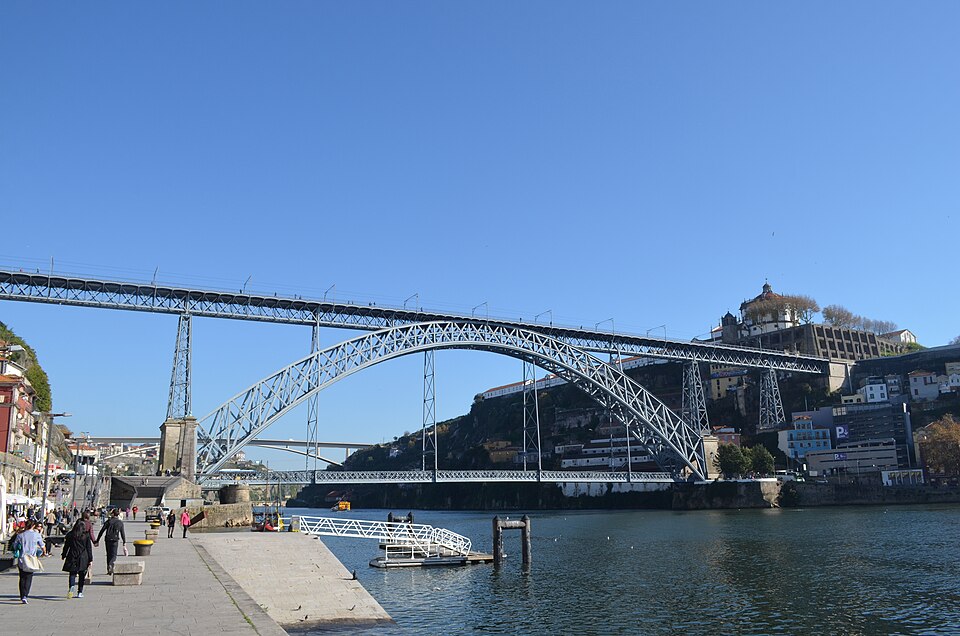
1886 · Theophile Seyrig
Its riveted iron arch carries two stacked decks, one above the other, an unusual double-tier profile that sets it apart from a similar-looking railway bridge nearby.
This iron arch bridge across the Douro replaced an earlier crossing point and briefly held the record for the longest metal arch span in the world. Theophile Seyrig and Leopold Valentin designed the double-deck structure: an upper level later given over to a light-rail line and pedestrians, and a lower level for road traffic and pedestrians. It links the historic waterfront on one bank to the wine-lodge quays on the other, with a funicular and a cable car serving its two ends.
- At completion its 172-metre arch was the longest of its kind anywhere.
- A nearby railway bridge, built nine years earlier, looks similar enough to cause confusion between the two.
Photo: Mark Koester (CC BY 2.0)
Clérigos Church
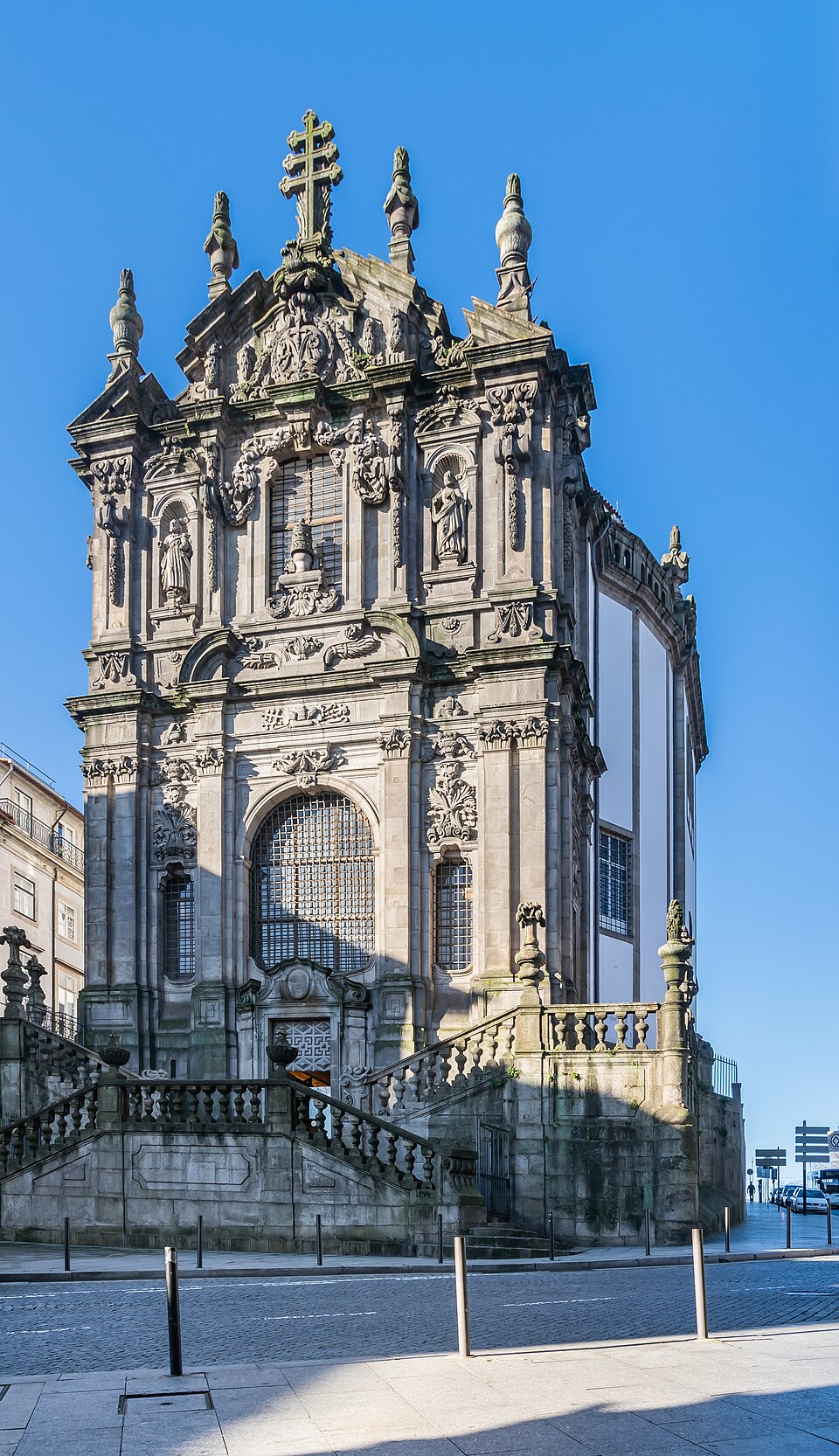
1732–1763 · Nicolau Nasoni
Its slender 75-metre bell tower, tiered in Baroque stonework and capped by a lantern, rises well above the surrounding rooftops and is the building's most recognisable feature.
Known as the Church of the Clergymen, this Baroque building was designed by Nicolau Nasoni, with work running from 1732 to the completion of its bell tower in 1763. That tower, the Torre dos Clerigos, stands 75 metres tall and can be seen from many points across the surrounding streets, making it one of the most recognisable structures in the old quarter.
- Its Portuguese name translates as the Church of the Clergymen.
Photo: Krzysztof Golik (CC BY-SA 4.0)
Porto Cathedral
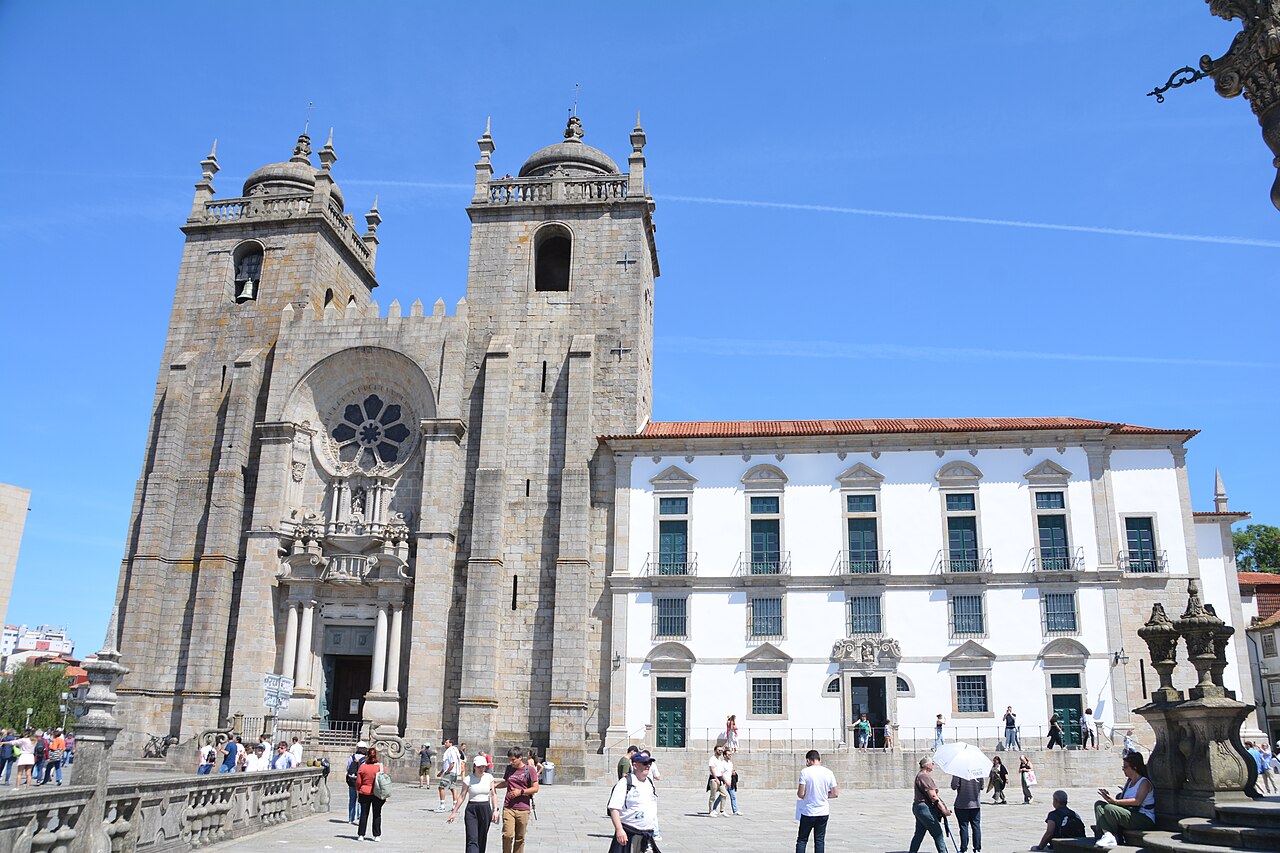
1110–1737
Rather than one uniform style, its fabric layers several building periods together: Romanesque masonry underlying Gothic, Mannerist and Baroque insertions added during later campaigns.
One of the area's oldest monuments, this cathedral began as a Romanesque church around 1110 and gained Gothic, Mannerist and Baroque additions over the following centuries, with work continuing into the 1730s. No architect is recorded for the building as it stands, reflecting its long and layered construction history. It ranks among the most important Romanesque monuments in the area and forms part of the historic centre's UNESCO World Heritage listing.
Photo: Georges Jansoone (CC BY 2.5)
Palácio da Bolsa
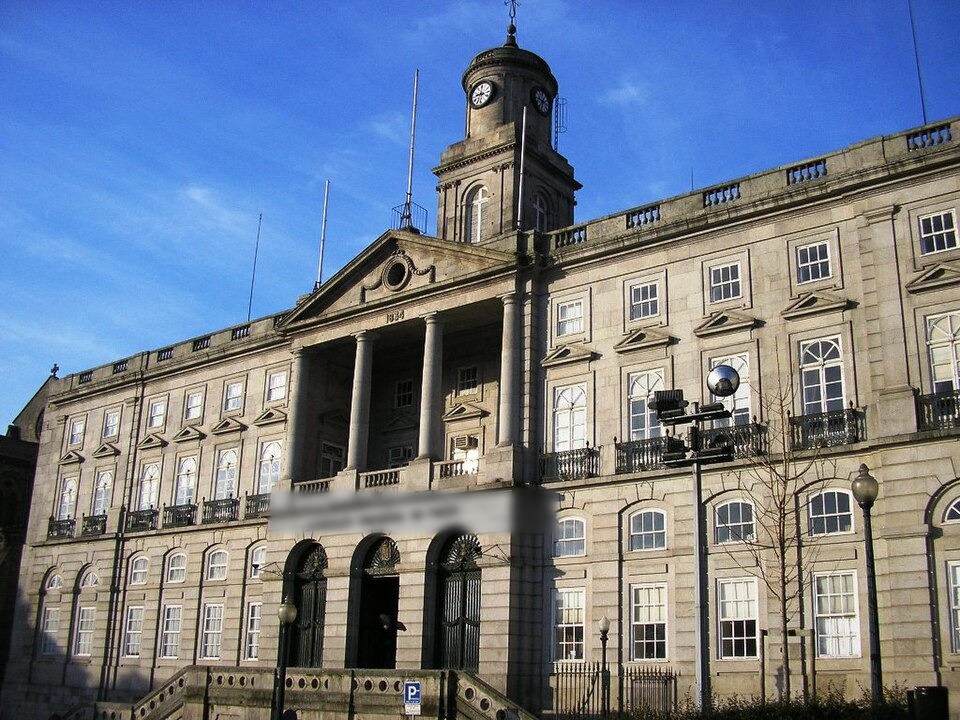
1850 · Joaquim da Costa Lima Junior
A symmetrical neoclassical facade set on a square in the heart of the historic centre, built for a merchants' association rather than a religious or royal patron.
The city's Commercial Association built this Neoclassical palace in the nineteenth century as its stock exchange, on the Infante D. Henrique Square in the historic centre. Joaquim da Costa Lima Junior designed the building, which has also served as a former town hall. It stands within the area later listed by UNESCO as a World Heritage Site and remains a National Monument of Portugal.
- Despite being built as a stock exchange, the palace has also served as a town hall.
Photo: Manuel de Sousa (Public domain)
São Bento Railway Station
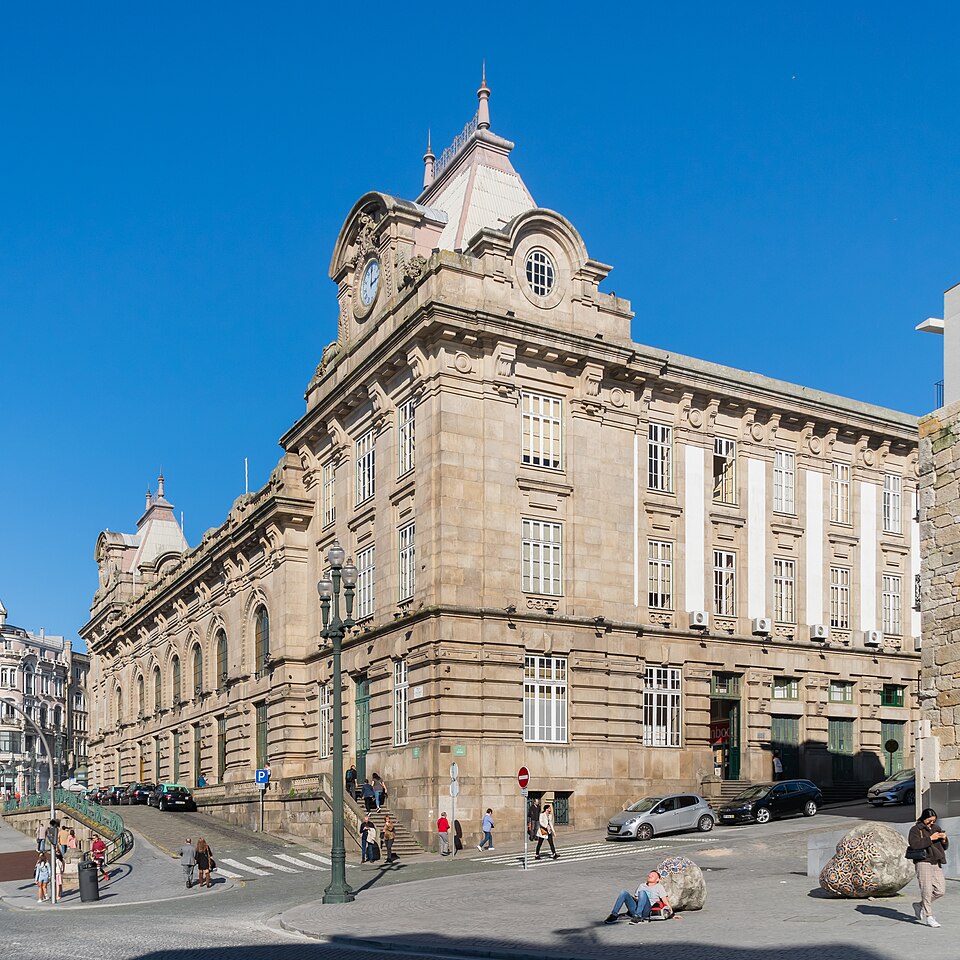
1904–1916 · Jose Marques da Silva
Its entrance hall is lined with around twenty thousand ceramic tiles arranged into large murals, multicoloured panels of rural scenes and historical episodes covering roughly 551 square metres of wall.
Built from 1904 to designs by Jose Marques da Silva, this railway terminal stands in the historic centre, part of the area's UNESCO World Heritage listing. Its entrance hall is lined with around twenty thousand hand-painted ceramic tiles by Jorge Colaco, covering roughly 551 square metres in murals depicting rural scenes and moments from national history. An underground passage links the terminal to a metro station of the same name on line D.
- The name translates as Saint Benedict.
- Its tile murals, covering about 551 square metres, were painted by an artist separate from the building's architect.
Photo: Krzysztof Golik (CC BY-SA 4.0)
Livraria Lello
A bookshop formerly known as Livraria Chardron until 1919, one of the oldest bookstores in Portugal alongside Bertrand in Lisbon. It is frequently rated among the world's best bookstores, placing third in lists by Lonely Planet and The Guardian.
Casa da Música
A concert hall designed by Rem Koolhaas, whose project won an international architecture tender in 1999. Inaugurated on 15 April 2005 to mark Porto's year as European Capital of Culture, it was the first building in Portugal designed exclusively for music.
Monastery of Serra do Pilar
A former monastery in Vila Nova de Gaia, overlooking the Dom Luís I Bridge and Porto's historic centre across the Douro River. Notable for its circular church and cloister, it was designated a UNESCO World Heritage Site in 1996 together with those landmarks.
Church of São Francisco
The most prominent Gothic monument in Porto, noted also for its outstanding Baroque inner decoration. It stands in the historic centre of the city, which UNESCO has declared a World Heritage Site.
Maria Pia Bridge
A wrought-iron railway bridge built in 1877 and attributed to Gustave Eiffel, spanning 353 metres, 60 metres above the Douro River. It held the record for the world's longest single-arch span, before being replaced for rail traffic by the Ponte de São João in 1991.
Serralves
A cultural institution combining a contemporary art museum, a park, and a villa, in contemporary, Modernist, and Art Deco styles respectively. The museum, designed by Álvaro Siza Vieira, is the second most visited in Portugal, drawing almost a million visitors a year.
Palácio do Freixo
A former residence in the Campanhã parish of Porto.
São João National Theatre
A theatre and concert venue in the municipality of Porto, commonly referred to as the São João National Theatre.
Casa do Infante
A historical house, also known as the Old Customshouse, originally built in the 14th century as a customs post and mint. Its present form dates mostly from a 17th-century remodelling, and oral tradition holds it as the 1394 birthplace of Prince Henry the Navigator.
Fort of São Francisco Xavier
A coastal fortification in the Nevogilde parish. It is commonly known as the Castelo do Queijo, or Cheese Castle.
Estádio do Dragão
An all-seater football stadium that has been home to FC Porto since 2003, seating 50,033 to rank as Portugal's third-largest venue. Designed by Manuel Salgado to replace the Estádio das Antas, it opened in 2003 and later hosted the 2019 UEFA Nations League Final.
Coliseu do Porto
A theatre and concert venue with a standing capacity of 4,000, among Porto's leading venues for music and cultural events. Along with Batalha Cinema, it is an example of the Portuguese Streamline Moderne and Art Deco styles in the city.
Soares dos Reis National Museum
Housed in the Carrancas Palace, it was founded in 1833 as the first Portuguese national museum dedicated to exhibiting Portuguese art. It takes its name from sculptor António Soares dos Reis, whose work forms part of its collection.
Liberdade Square
A square in the Baixa, the lower town area of Santo Ildefonso parish. Its north side runs continuously into the Avenida dos Aliados, one of the city's important avenues.
Café Majestic
A historic café on Rua de Santa Catarina, housed in an Art Nouveau building. Its style is reminiscent of the Parisian cafés of the period.
Factory House
An 18th-century Neo-Palladian building associated with British influence in the port wine industry. It belongs to a group of British landmarks in the city that also includes the Oporto Cricket and Lawn Tennis Club, founded in 1855, and the Oporto British School, founded in 1894.
Cinema Batalha
Originally the Salão High-Life cinema, it was rebuilt in Art Deco style by architect Artur Andrade and reopened in 1947. Closed in 2003 amid competition from video rental and multiplex cinemas, it reopened in 2006 as a cultural and concert venue in the same style.
Fountain of the Lions
A 19th-century fountain built by the French company Compagnie Générale des Eaux pour l'Étranger and cast at the Val d'Osne foundry. It is largely a copy of the fountain in the Town Hall Square of Leicester, England.
Casa-Museu Guerra Junqueiro
A former residence in Porto now serving as a museum. It is officially classified as an Imóvel de Interesse Público, a Property of Public Interest.
Monument to Pedro IV
A monument to King Pedro IV, located in Porto's Liberdade Square.
Episcopal Palace
The residence of the bishops of Porto, set on high ground near Porto Cathedral where it dominates the city skyline. An important example of late Baroque and Rococo civil architecture, it lies within the UNESCO-listed historic centre.
History
Settlement here goes back to the second century BC, when a Celtic-Latin outpost called Portus Cale stood on the Douro; the name is often traced forward into the word Portugal. A Romanesque cathedral rose above the river around 1110 and was reworked over the following centuries in Gothic, Mannerist and Baroque styles. The eighteenth century added Nicolau Nasoni's Baroque Clerigos Church and its tall bell tower. Nineteenth-century trade wealth financed the Neoclassical Palacio da Bolsa for the city's Commercial Association, while the Dom Luis I Bridge, completed in 1886, carried an iron arch across the Douro gorge to link the two riverbanks. In the early twentieth century, Jose Marques da Silva's Sao Bento railway station added a tiled entrance hall to the historic centre, which UNESCO recognised as a World Heritage Site in 1996.