Landmarks in Santiago
Santiago pairs its cathedral, mint and Beaux-Arts palace with a colonial grid from 1541.
Santiago's oldest landmarks cluster within the colonial grid Pedro de Valdivia laid around the Plaza de Armas, on a basin floor between the Andes and the Chilean Coastal Range. A cathedral rebuilt across a century and a half faces the square directly; a few blocks away, a former mint turned presidential palace and a Beaux-Arts fine-arts museum extend the same neoclassical vocabulary into the nineteenth and early twentieth centuries. None of the three went up in a single campaign: earthquakes, fires and long construction schedules repeatedly interrupted work, so each building layers later design over earlier foundations. Stone and stucco facades, colonnades and low domes dominate, a legacy of colonial and republican-era Chilean architects working within a grid that has held since 1541.
Santiago Metropolitan Cathedral
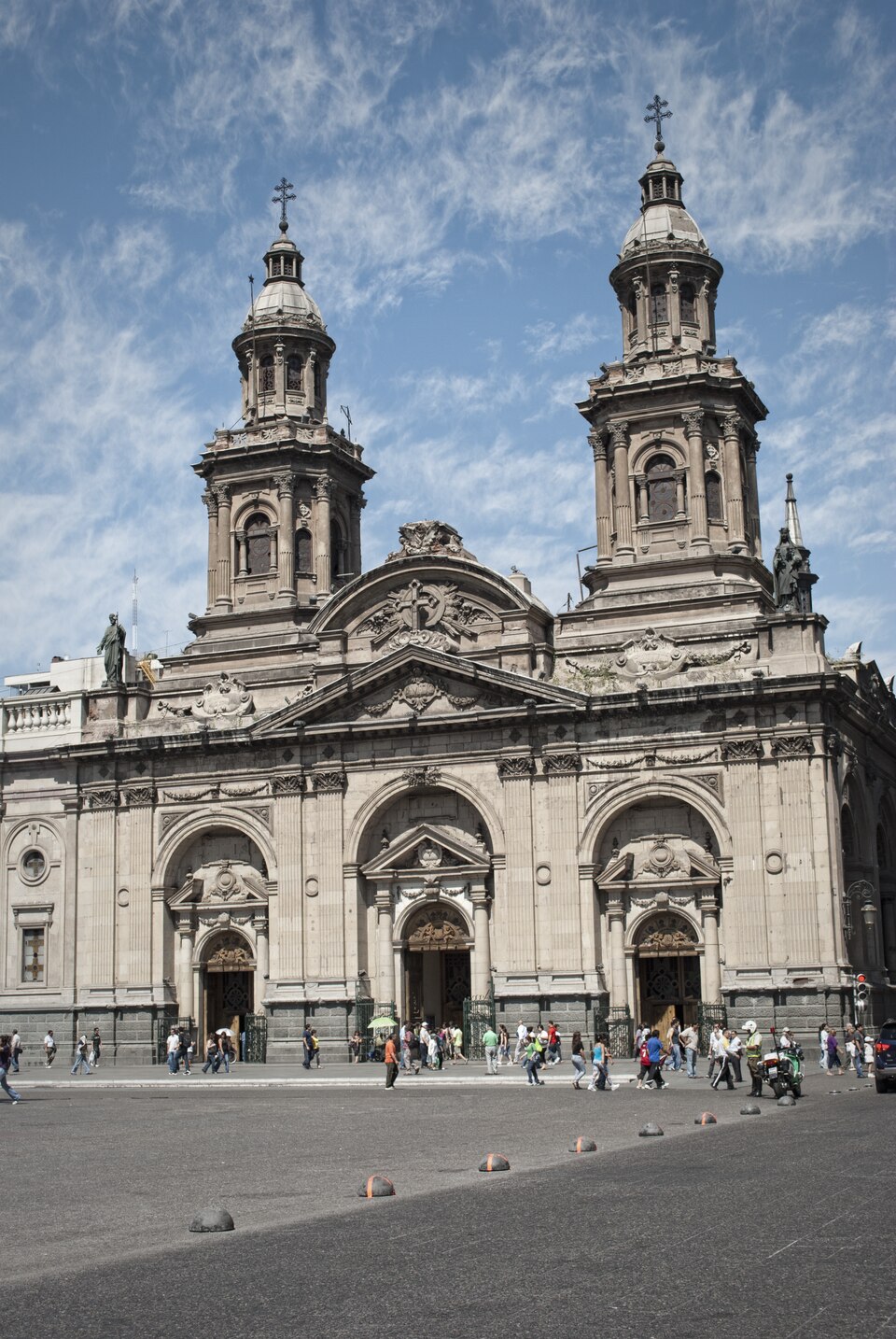
1748–1906 · Joaquín Toesca
A pale stone neoclassical facade with paired columns and twin bell towers fills one side of a large colonial square, fronted by an archbishop's palace and a smaller parish chapel.
The cathedral is the seat of the Archdiocese of Santiago and the main Catholic temple in the country, dedicated to the Assumption of the Virgin Mary. It stands opposite the Plaza de Armas as part of an ensemble with the Archbishop's Palace and the Parish del Sagrario. The building seen today is the fifth raised on the site, constructed between 1748 and 1906 to designs begun by Joaquín Toesca and carried through by Ignacio Cremonesi.
Photo: Cadres.g (CC BY-SA 3.0)
La Moneda Palace
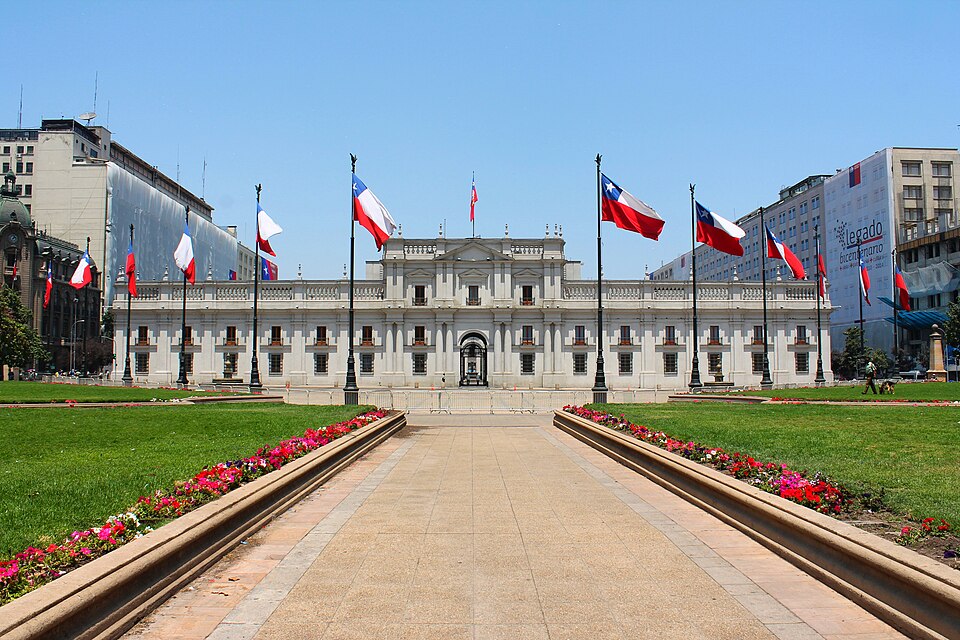
1805 · Gioacchino Toesca
A long, low neoclassical block with a colonnaded facade and an interior courtyard occupies an entire block of the civic district, its stone front broken by regular arched windows rather than any single dominant entrance.
Originally built as the royal mint, the palace now serves as the seat of the president of Chile and houses the offices of three cabinet ministries: Interior, the General Secretariat of the Presidency, and the General Secretariat of Government. It occupies a full block in Santiago's Civic District, bordered by Moneda, Morandé, Alameda and Teatinos streets. The architect, Gioacchino Toesca, died in 1799, before the building was completed.
Photo: Miguel hernandez (CC BY-SA 2.0)
Chilean National Museum of Fine Arts
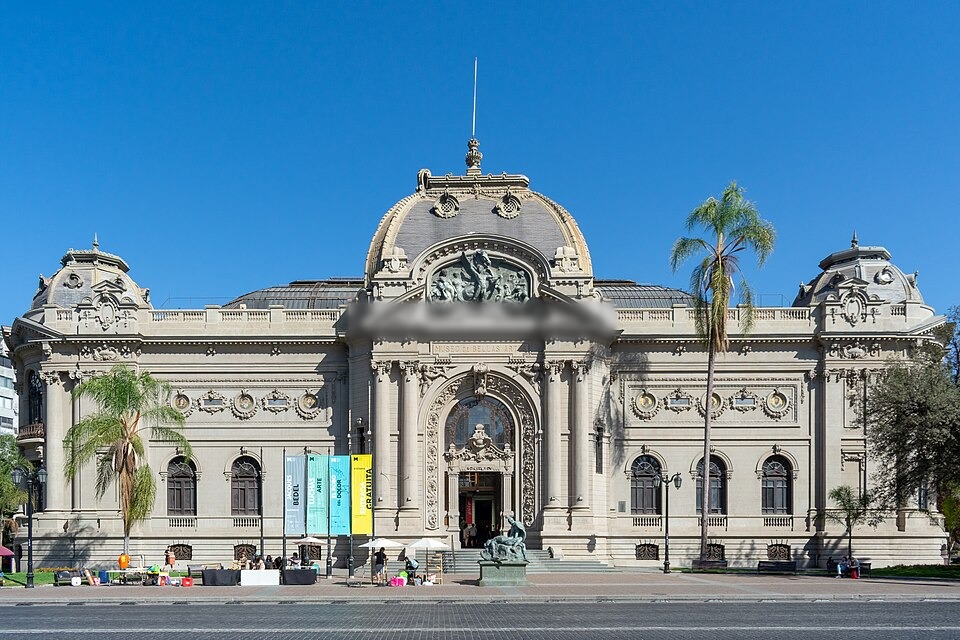
1910 · Emile Jéquier
A Beaux-Arts palace with a glazed central dome and a symmetrical stone facade stands within a riverside park, its light-filled interior built around a large sculpture-lined gallery beneath the dome.
The museum is one of the principal centres for Chilean and South American art, run by the Artistic Union. The institution itself was established in 1880, making it the oldest of its kind in South America, but the Palace of Fine Arts that now houses it dates to 1910, built to a design by the Chilean architect Emile Jéquier for the centennial of Chilean independence. It stands in the Parque Forestal, behind the University of Chile's Museum of Contemporary Art.
- The museum's collection predates its own building by three decades: the institution was founded in 1880, thirty years before the palace it now occupies.
Photo: Carlos Figueroa Rojas (CC BY-SA 4.0)
Plaza de Armas
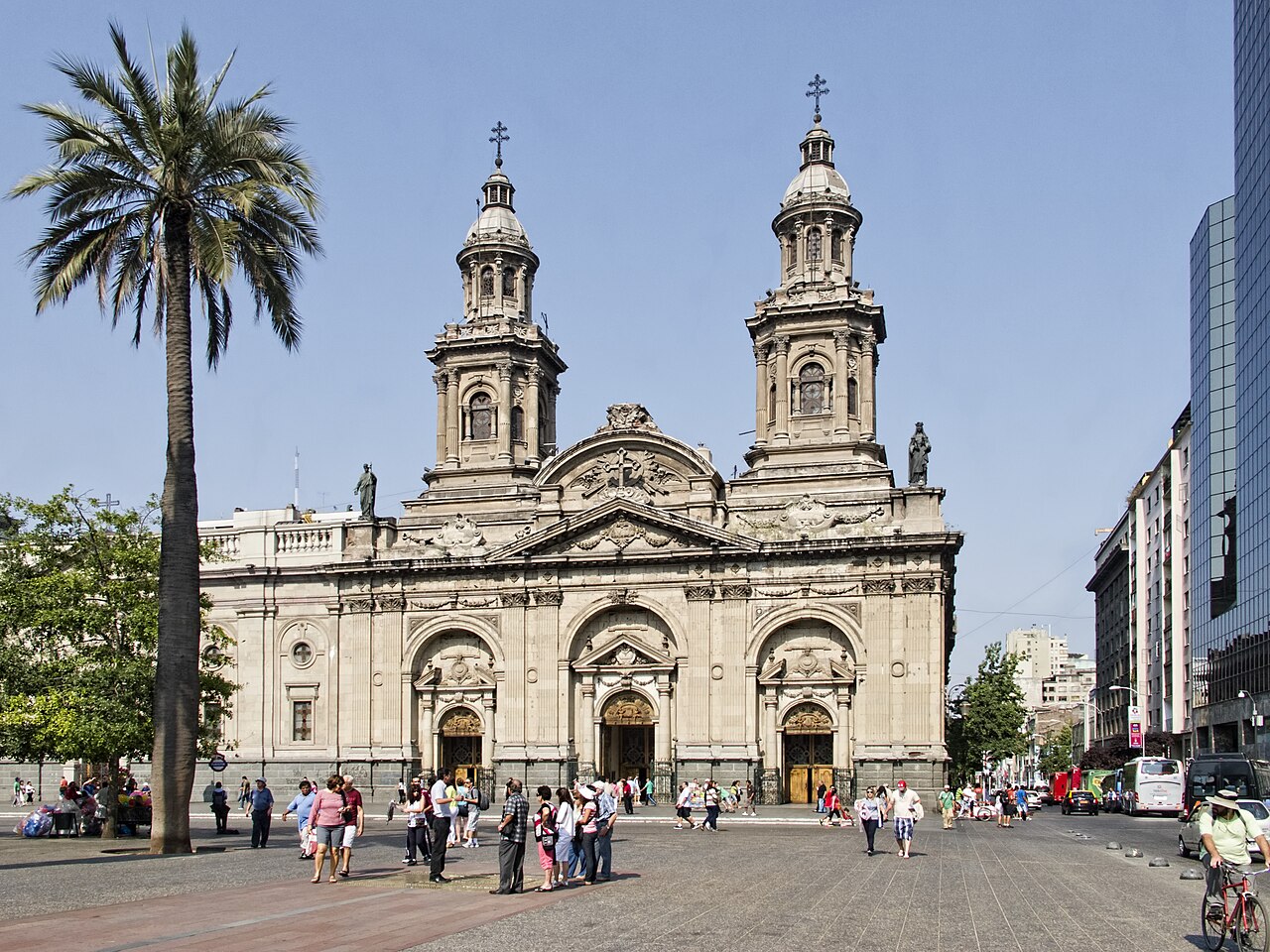
1541 · Pedro de Gamboa
A large paved plaza bordered by a stone cathedral with twin bell towers, a domed neoclassical post office building and an arcaded shopping gallery, its center marked by a white marble statue of a woman breaking chains beside a bronze equestrian statue.
The Plaza de Armas is Santiago's main square, laid out on a grid designed by the architect Pedro de Gamboa around the city's 1541 founding, with a metro station running beneath it. A Carrara marble monument depicting an allegory of freedom, carved by Francesco Orselino, stands at its center; it replaced an earlier 1671 bronze fountain now kept at La Moneda Palace. The square once hosted markets in surrounding arcades and a gallows for public executions. Declared a national monument in 1986, it is framed today by the cathedral, the Central Post Office and the Portal Fernández Concha arcade.
- Researchers have argued that an Inca settlement once occupied the ground beneath the square, its infrastructure later reused to found the city.
- The bronze fountain the marble freedom monument replaced was not destroyed; it was moved to La Moneda Palace, where it remains.
- The streets around the cathedral are informally nicknamed "Little Lima" for the Peruvian immigrants and businesses long settled there.
Photo: Dan Lundberg (CC BY-SA 2.0)
Municipal Theatre of Santiago
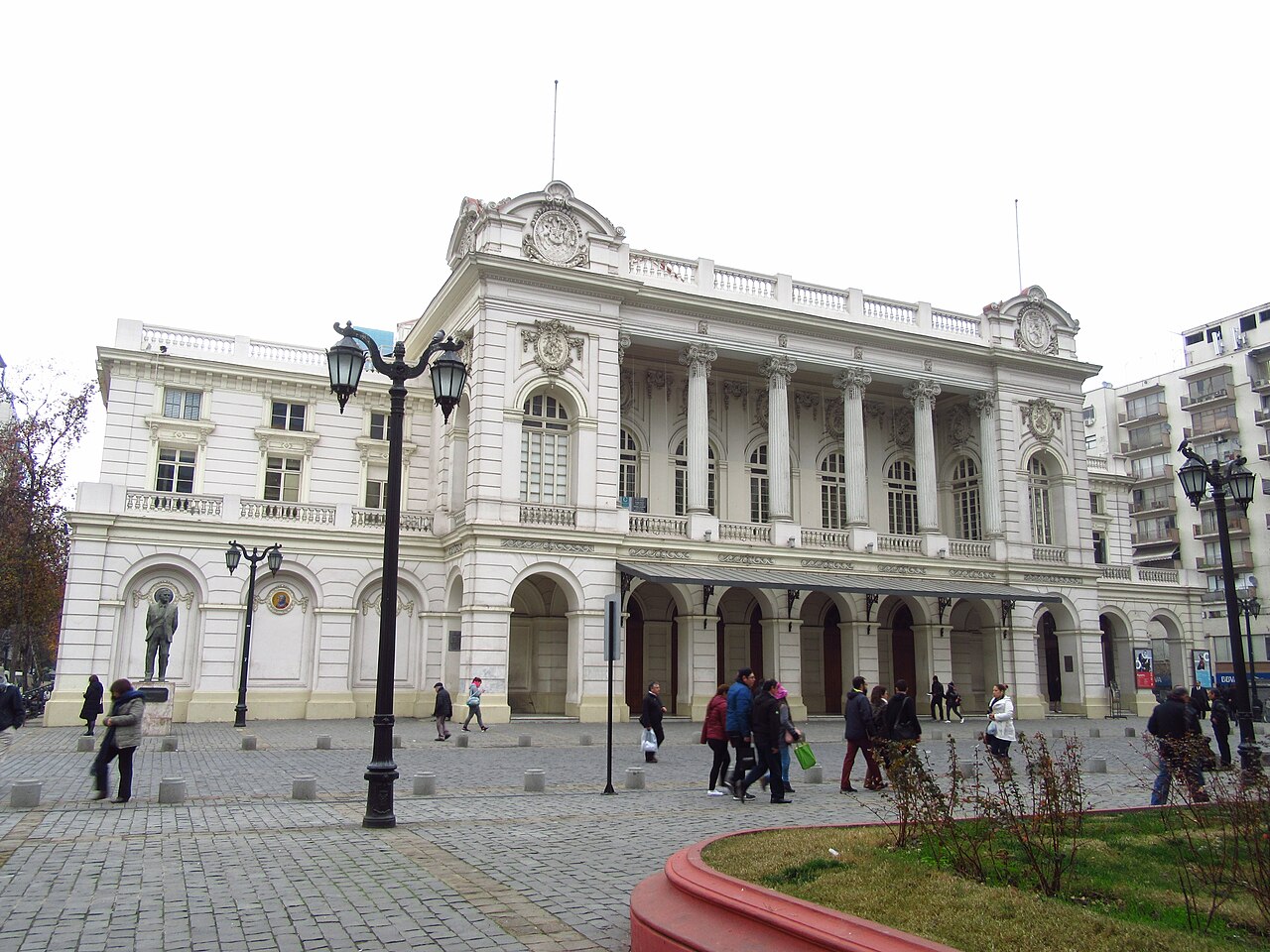
1857–1873 · François Brunet de Baines
A neoclassical building with a colonnaded stone facade opens onto an ornate main hall lit by a crystal chandelier, its interior and stage curtain repeatedly renewed after fires and an earthquake yet still staging opera, ballet and orchestral performances under one roof.
The Municipal Theatre is Santiago's principal opera house and the National Opera of Chile, commissioned by presidential decree in 1853 and designed by François Brunet de Baines in a French Neoclassical style. It opened in 1857 with Verdi's Ernani, but a fire following an 1870 performance destroyed most of the building; it reopened, rebuilt by Lucien Hénault, in 1873. A 1906 earthquake and a 1927 fire each damaged the theatre again, though it recovered both times. Declared a national historical monument in 1974, it now houses a philharmonic orchestra, ballet company and chorus.
- Its 1995 replacement stage curtain was funded partly by selling pieces of the old one to donors as keepsakes.
- Pianist Claudio Arrau, who had left Chile in 1941, returned in 1984 for the opening of a 250-seat hall named after him inside the theatre.
- The original design benefited from input by Charles Garnier, architect of the Paris Opera.
Photo: Felipe Restrepo Acosta (CC BY-SA 4.0)
Gran Torre Costanera
A 62-story skyscraper that is the tallest building in South America and the second-tallest in Latin America, behind Mexico's Torre 1. It was designed by the Chilean firm Alemparte Barreda & Asociados together with Argentine architect César Pelli and Canada's Watt International.
Santiago Metropolitan Park
An urban park spanning about 722 hectares across the San Cristóbal, Chacarillas, and Los Gemelos hills, making it the largest urban park in the Americas. It stretches across four communes of Santiago and also maintains 16 smaller urban parks spread over 13 communes citywide.
Sanctuary on San Cristóbal Hill
A Catholic sanctuary on the summit of San Cristóbal Hill, about 863 meters above sea level, dedicated to the Immaculate Conception. It is one of Chile's principal Catholic places of worship, marked by a large statue of the Immaculate Conception.
Santa Lucía Hill
A hill in central Santiago, also known by its Mapuche name Huelén, rising 69 meters above the surrounding area to an altitude of 629 meters. Its 65,300-square-meter park is decorated with ornate facades, stairways, and fountains, with a viewpoint at the summit.
Torre Entel
A 127-meter telecommunications tower with a public observation deck, built between 1970 and 1974 during Eduardo Frei Montalva's presidency. It was Chile's tallest structure until the Telefónica Tower opened in 1996, and remains a symbol of Santiago.
Torre Telefónica Chile
An office skyscraper in the Providencia district, formerly known as Edificio CTC, built between 1993 and 1996. Standing 143 meters tall with 34 floors, it is currently the third-tallest building in Chile.
Museo Chileno de Arte Precolombino
An art museum of pre-Columbian artworks from Central and South America, opened in December 1981 in the city centre. It was founded by architect and collector Sergio Larraín García-Moreno to house a private collection he had built up over nearly fifty years.
National Library of Chile
The national library of Chile, in a building on Avenida Libertador General Bernardo O'Higgins completed in 1925. Its history reaches back to the early nineteenth century, before it was relocated to its current home.
Bernardo O'Higgins Monument
A bronze equestrian monument depicting Bernardo O'Higgins at the Battle of Rancagua in 1814, in front of the Palacio de La Moneda. Made by French sculptor Albert-Ernest Carrier-Belleuse and inaugurated in 1872, its pedestal carries four bas-reliefs, two of them by Chilean sculptor Nicanor Plaza.
O'Higgins Park
Santiago's second-largest public park after Metropolitan Park, covering about 75 hectares and previously known as Parque Cousiño. It hosted the annual Lollapalooza Chile music festival from 2011 to 2019 and remains a popular gathering spot during the September 18 national holiday.
Former National Congress of Chile building
The former home of the Chilean Congress, in central Santiago. Congress met here until Salvador Allende's government was overthrown by Augusto Pinochet's military coup on 11 September 1973.
Chilean National Museum of Natural History
One of Chile's three national museums, located in Quinta Normal Park. It was founded in 1830 by French naturalist Claudio Gay.
Estadio Nacional Julio Martínez Prádanos
A football stadium in the Ñuñoa commune, built between 1937 and 1938 on the model of Berlin's Olympiastadion. It hosted the final of the 1962 FIFA World Cup, where Brazil defeated Czechoslovakia 3–1.
Manuel Foster Observatory
An astronomical observatory built in 1903 on Cerro San Cristóbal, originally called the D. O. Mills Observatory after philanthropist Darius Ogden Mills. Built as an offshoot of the Lick Observatory, it helped determine the apex of the Sun's motion through space.
Santiago Chile Temple
The first Latter-day Saint temple built in a Spanish-speaking country, announced in 1980 and dedicated in 1983 by Gordon B. Hinckley. Designed by Emil B. Fetzer, it has a central spire topped by a statue of the angel Moroni and uses copihue motifs.
Plaza Yungay
A square in the historic Barrio Yungay neighborhood, at the western edge of the Santiago commune. It holds a monument marking the end of Chile's War of the Confederation (1836–1839) and a church dedicated to the saint said to protect the city from earthquakes.
Teatro Caupolicán
A theatre and music venue on San Diego street, opened in 1936, that has hosted sporting, political, and cultural events. Today it is an important concert venue with a seating capacity of 4,500 and a total capacity of 5,400 including standing room.
Pereira Palace
A neoclassical mansion in downtown Santiago, built in the second half of the 19th century and declared a National Historic Monument in 1981. In 2011 the government bought it to house heritage agencies, and a restoration led by architect Cecilia Puga was completed in 2014.
Portal Fernández Concha
A mixed-use building built in 1871 as a commercial building with a hotel, forming the south side of the Plaza de Armas. It was registered as a national monument in 1986, part of a protected zone including the square and the former National Congress building.
Santiago Museum of Contemporary Art
One of Santiago's major museums, created in 1947 and run by the University of Chile's Faculty of Arts. Since 2005 it has had two sites: one in Parque Forestal, sharing the Palacio de Bellas Artes, and another in Quinta Normal Park.
Basílica de Nuestra Señora del Perpetuo Socorro
A Catholic basilica in the Gothic Revival style, designed by Redemptorist priests Gustave Knockaert and Huberto Boulangeot, with its foundation stone laid in 1904. Construction began in 1906, led by a 15-architect team that Knockaert, a Belgian priest, was appointed to assemble.
Estadio Monumental David Arellano
A football stadium in Macul, southeast of central Santiago, with a spectator capacity of 47,347. It is the home ground of Colo-Colo, and its pitch is named for David Arellano, the club's founder.
Santiago General Cemetery
One of the largest cemeteries in Latin America, with an estimated two million burials, established in 1821. Its grounds hold roughly 237 sculptures among ornate mausoleums and are the final resting place of all but three of Chile's deceased presidents.
History
Conquistador Pedro de Valdivia founded Santiago del Nuevo Extremo on 12 February 1541, laying a grid plan around the Plaza Mayor, now the Plaza de Armas. Despite Indigenous attacks, floods and earthquakes, notably in 1647, the settlement consolidated as the capital of the Captaincy General of Chile. The cathedral fronting the square was rebuilt through a succession of predecessor structures between 1748 and 1906, the fifth church to occupy that ground. The colonial mint on Alameda, later the seat of government, went up under the same neoclassical influence that shaped the cathedral. By the early twentieth century Santiago was adding to its civic core again, raising a Beaux-Arts palace for the fine arts in 1910 to mark the centenary of independence, on ground now within the Parque Forestal.