Landmarks in Shanghai
Three supertall towers, raised in twenty years, turned Pudong into a record of ambition.
The three tallest structures on record here cluster in Lujiazui, the financial district of Pudong, standing together across the Huangpu River from the historic Bund. All are skyscrapers raised within a twenty-year span: the futurist Oriental Pearl Tower went up first, between 1991 and 1994, followed within a few years by the neo-futurist Jin Mao Tower, and finally by the postmodern Shanghai Tower, completed in 2014 as the tallest of the three. Their closeness is no accident — each marked a stage in Pudong's transformation into a financial hub, and each was, briefly, the tallest building in China. Seen together, they read as a record of how high the district's ambitions climbed, decade by decade.
Oriental Pearl Tower
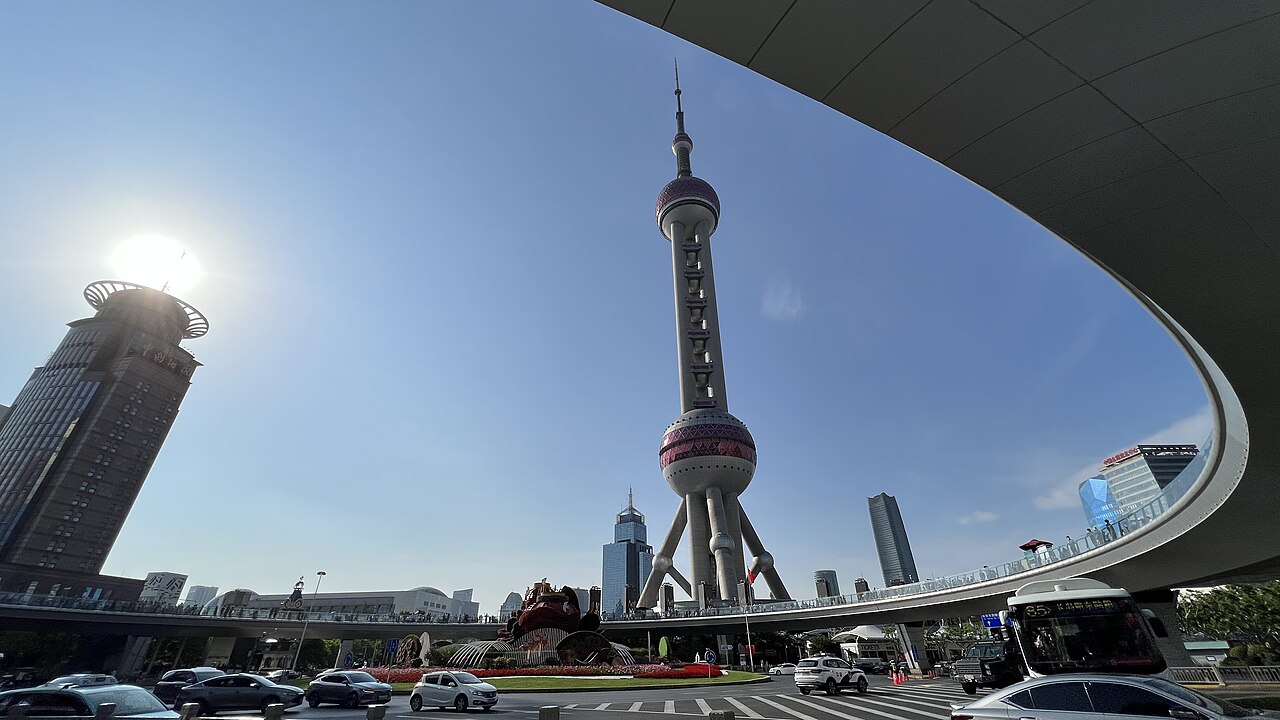
1991–1994 · East China Architectural Design & Research Institute
Its futurist silhouette — unusual enough to have made it Shanghai's first AAAAA-rated tourist attraction — carries fifteen observation decks up a single slender tower. It was the tallest structure in China until the Shanghai World Financial Center overtook it in 2007, and remains one of the most recognisable structures in the skyline it rises from.
The Oriental Pearl Tower is a television tower in Lujiazui, built between 1991 and 1994 to a futurist design by the East China Architectural Design & Research Institute. It held the record as the tallest structure in China until the Shanghai World Financial Center was completed in 2007. Beyond broadcasting, it functions as a tourist attraction, the first in Shanghai rated AAAAA, and offers fifteen observation decks across its height. Its unusual form has made it one of the defining structures of the modern city.
- It was the tallest structure in China until 2007, when the nearby Shanghai World Financial Center overtook it.
- It became Shanghai's first tourist attraction to receive the top AAAAA rating.
Photo: Bechology (CC BY 4.0)
Shanghai Tower
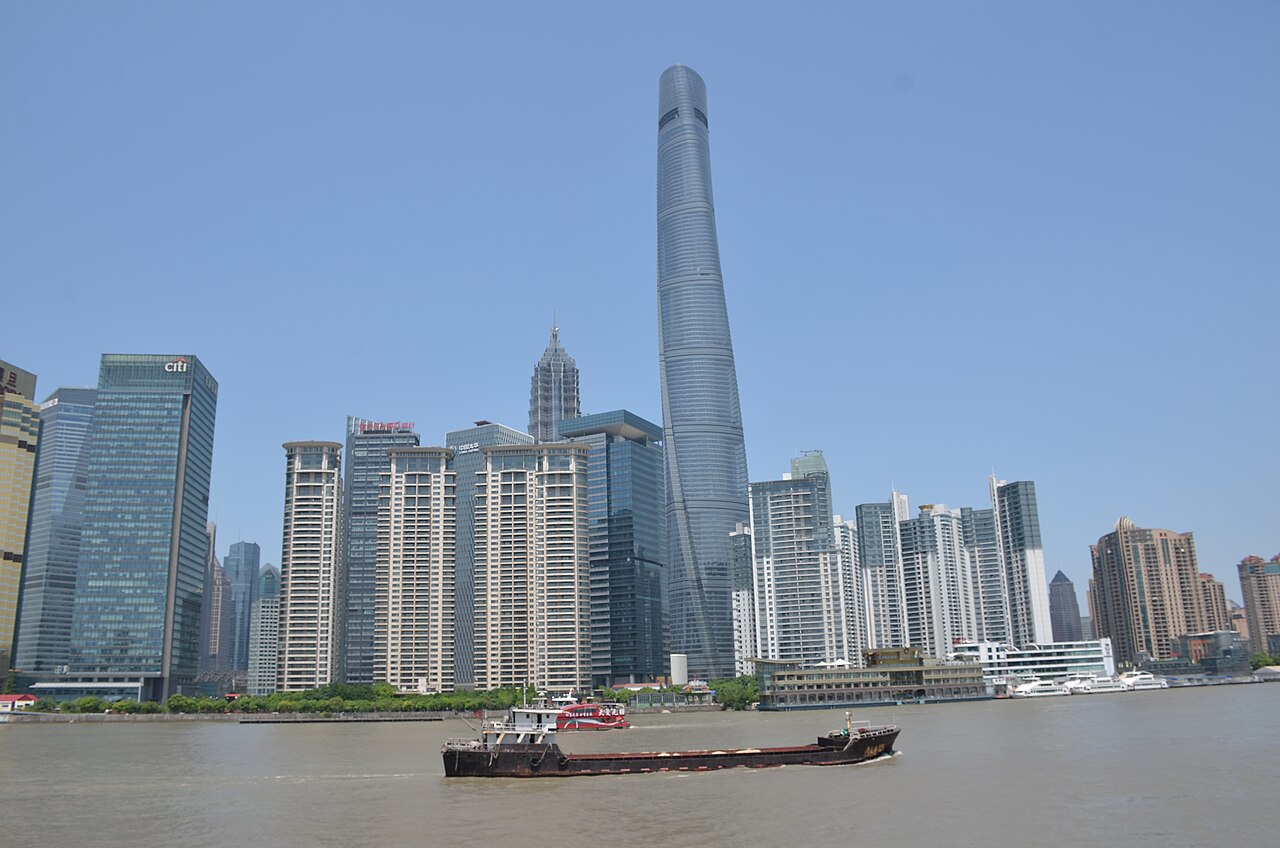
2014 · Gensler
It is the tallest of three adjacent supertall towers in Pudong — alongside the Jin Mao Tower and the Shanghai World Financial Center — its bulk built up in nine tiered zones from a broad base to a slender crown. At 632 metres, it stands well above both older neighbours.
The Shanghai Tower is a 128-storey, 632-metre skyscraper in Lujiazui, Pudong, designed by Gensler and owned by the Shanghai Municipal Government. Groundbreaking took place in November 2008 and the structure topped out in August 2013. Its tiered form is divided into nine zones mixing office, retail and leisure use, an arrangement praised for energy efficiency. It is the tallest of three adjacent supertall towers in the district, the other two being the Jin Mao Tower and the Shanghai World Financial Center, and was for years the second-tallest building in the world.
- Its elevators reached 20.5 metres per second, the fastest in the world until 2017, when the Guangzhou CTF Finance Center overtook it.
- It was the second-tallest building in the world from 2015 to 2021, until Merdeka 118 in Malaysia surpassed it.
- It was the largest LEED-CS Platinum certified building in the world from 2016 to 2025.
Photo: shankar s. from Dubai, united arab emirates (CC BY 2.0)
Jin Mao Tower
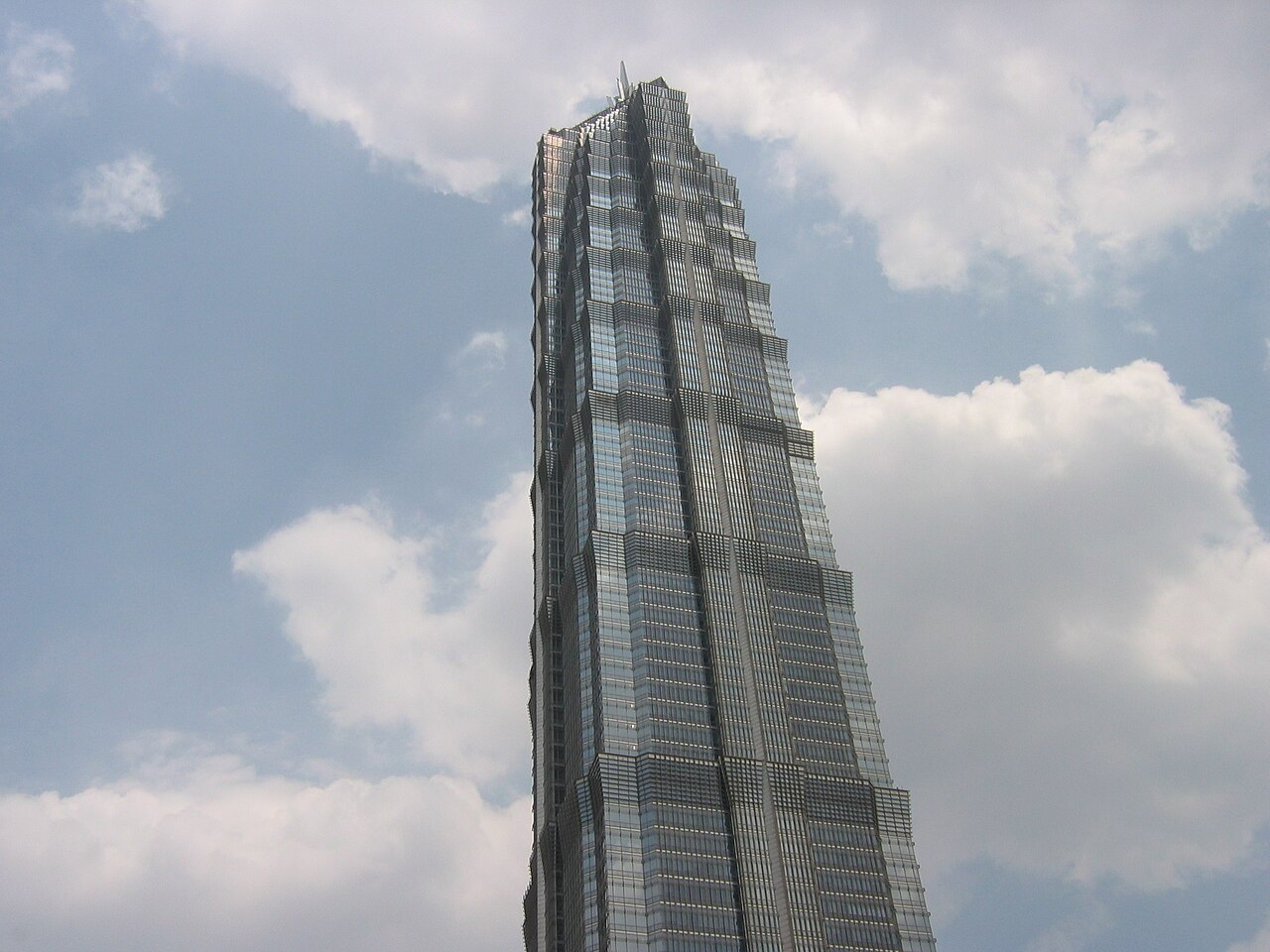
1998
It is an 88-storey (93 counting the spire) neo-futurist skyscraper standing 420.5 metres tall, one of four towers — with the Oriental Pearl Tower, the Shanghai World Financial Center and the Shanghai Tower — that make up the Lujiazui skyline seen from across the river on the Bund.
The Jin Mao Tower is an 88-storey skyscraper in Lujiazui, Pudong, rising 420.5 metres, or 93 storeys counting its spire. Built in neo-futurist style, it combines a shopping mall and offices with the Grand Hyatt Shanghai, which occupies its floors from the 53rd upward and was, at opening, the highest hotel in the world. Together with the Oriental Pearl Tower, the Shanghai World Financial Center and the Shanghai Tower, it forms part of the Lujiazui skyline visible from across the river on the Bund.
- Its hotel, occupying the floors from the 53rd storey up, was the highest hotel in the world when it opened.
- Its spire adds five extra storeys to the building's 88, for 93 in total.
Photo: Gerd Eichmann (CC BY-SA 4.0)
HSBC Building, the Bund
1921–1923 · Palmer & Turner
A domed neoclassical building faced in granite, fronted by six tall Ionic columns and flanked by a pair of bronze lion statues at its entrance staircase — one shown roaring, the other calm.
The HSBC Building stands at No. 12 the Bund, built between 1921 and 1923 to a neoclassical design by the British firm Palmer & Turner. It served as the Shanghai headquarters of the Hongkong and Shanghai Banking Corporation until 1955, when the Shanghai Municipal Government took over the building and used it as its offices for four decades. Since 1995 it has housed the Shanghai Pudong Development Bank. At the time of construction it was the largest bank building in the Far East and the second-largest bank building in the world.
- Feng shui masters were hired to choose the timing and direction of the first excavation, and coins from around the world were buried in the foundations to ward off spirits.
- The entrance lions, nicknamed Stephen and Stitt after two former bank managers, were removed during the Cultural Revolution and now stand in the Shanghai Museum; the pair outside today are 1997 replicas.
- Mosaic murals in the entrance dome, depicting the zodiac and eight cities with HSBC branches, were plastered over in 1956 and only rediscovered during renovations in 1997.
Photo: Hermann Luyken (CC0)
Peace Hotel
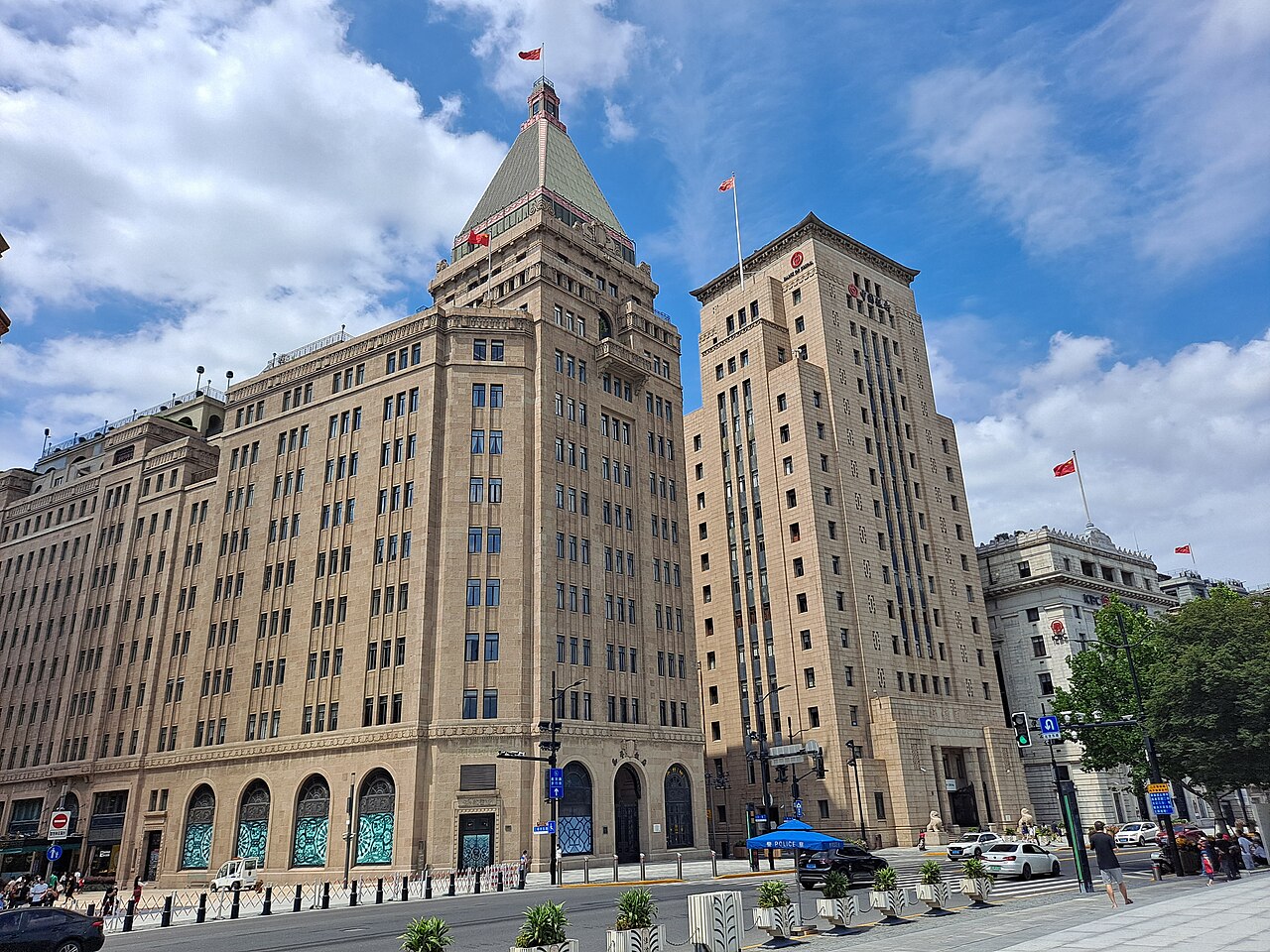
1908–1929 · Palmer & Turner
The taller of its two buildings rises in a stepped Art Deco profile faced in granite, crowned by a steep pyramidal roof clad in copper that has weathered to pale green; a plainer, older building in Renaissance style stands across the street on the same corner.
The Peace Hotel occupies two buildings on the Bund. The taller north building, known as Sassoon House, was designed by Palmer & Turner for Victor Sassoon and completed in 1929 as the Cathay Hotel, its Art Deco design faced in granite beneath a copper-clad pyramidal roof. Across Nanjing Road, the smaller south building opened in 1908 as the Palace Hotel. Renamed the Peace Hotel in 1956, the north building reopened as the Fairmont Peace Hotel in 2010 after renovation, while the south building now houses the Swatch Art Peace Hotel, home to visiting artists.
- Sun Yat-sen stayed at the hotel on the south building's site in 1911, after the success of the Xinhai Revolution, and spoke there in support of the revolutionary cause.
- During the Cultural Revolution, the Gang of Four's Zhang Chunqiao ran the Shanghai Commune from headquarters inside the hotel.
- In 2025 the owners announced that once renovations finish in 2027, the north building will be renamed the Raffles Peace Hotel Shanghai.
Photo: 钉钉 (CC BY-SA 4.0)
Waibaidu Bridge
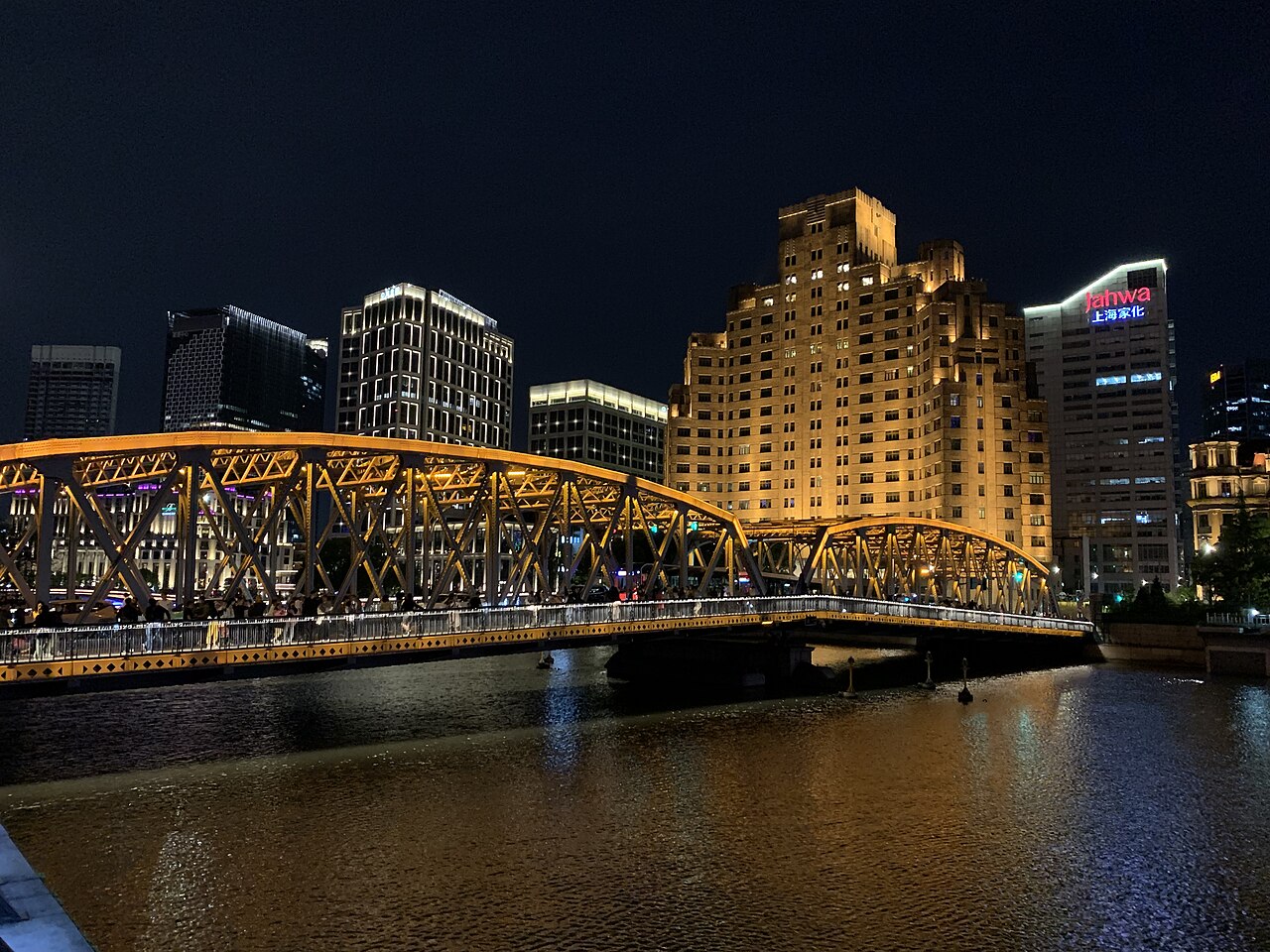
1908
Two triangulated steel spans rise into a humped camelback profile — the only bridge of this type still standing in the country — crossing a creek just before it meets a much wider river, with a row of colonial-era stone buildings visible along the bank beyond it.
The Waibaidu Bridge, known in English as the Garden Bridge, crosses the mouth of Suzhou Creek near its junction with the Huangpu River, connecting the Huangpu and Hongkou districts. Opened on 20 January 1908, it is the fourth Western-designed bridge built at this site since 1856, replacing a series of wooden toll bridges. It is the country's only surviving camelback truss bridge and its first all-steel bridge. The Shanghai Municipal Government declared it a heritage structure in 1994, and it remains a fixture of the waterfront skyline.
- Its 1856 predecessor, built by a British-American consortium, charged a toll that fell more heavily on Chinese users than on foreigners, who often crossed on credit; a free replacement bridge was built nearby in 1873 after the original wore out.
- One proposed reading of its Chinese name translates as "outer free crossing," recalling the toll once charged there and later abolished.
Photo: Chainwit. (CC BY 4.0)
Custom House
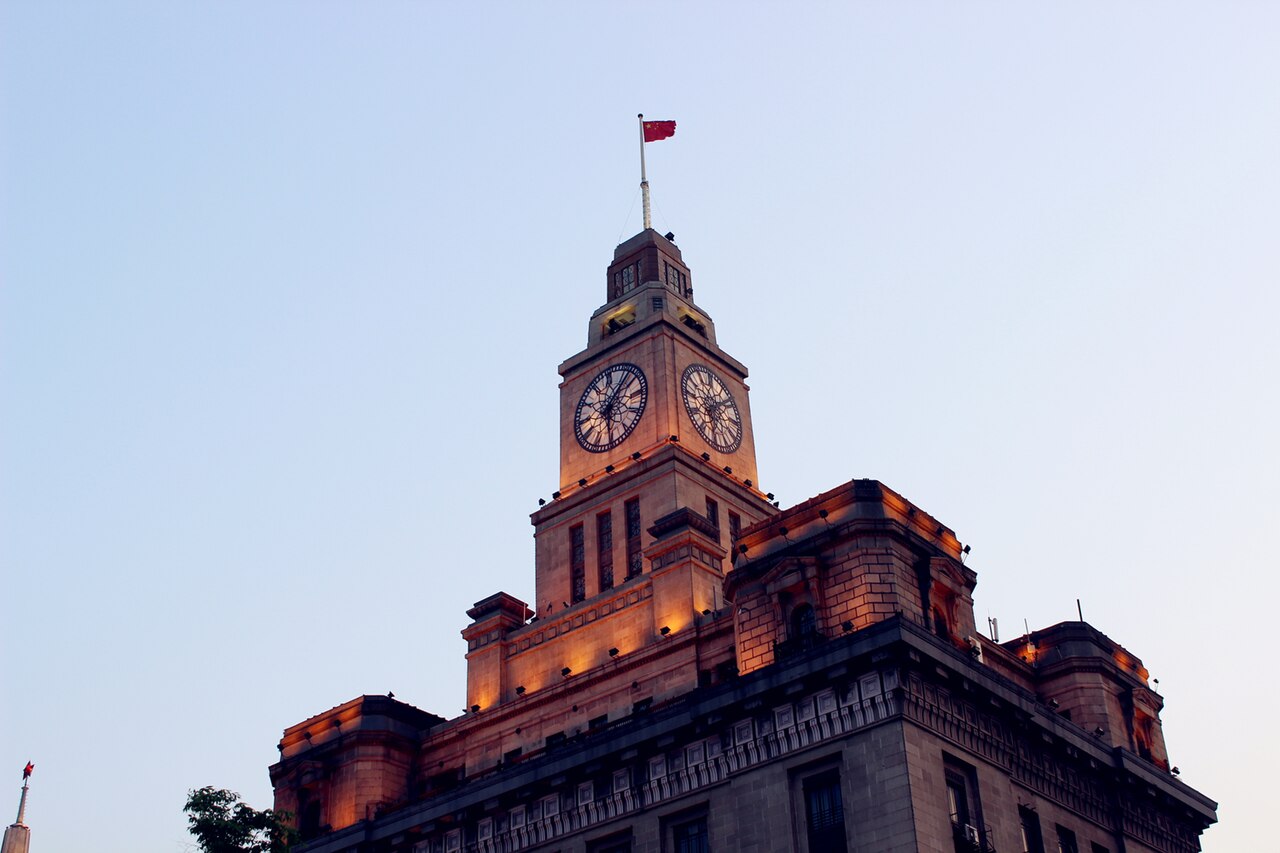
1925–1927 · Palmer & Turner
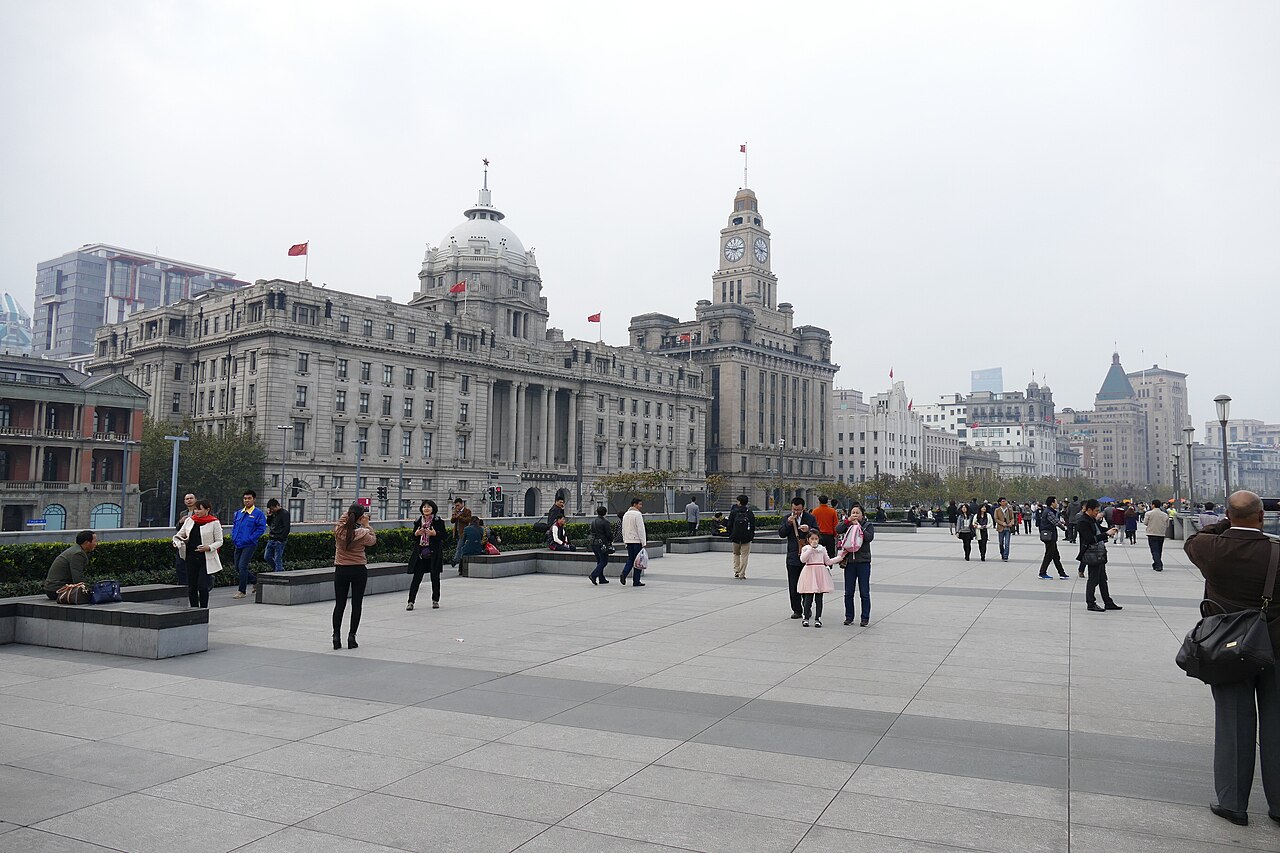
Its granite-faced eastern block is topped by an eleven-storey clock tower with four illuminated faces, each over five metres across and built from more than a hundred pieces of glass, with four Doric columns framing the main entrance below.
The Custom House stands on the Bund, its present eight-storey eastern block completed in 1927 to a Greek Revival neoclassical design by Palmer & Turner, replacing a Gothic-style customs house from 1891. It remains a functioning customs building today. Its eleven-storey clock tower holds bells and a movement built in England to the design of Big Ben and shipped to Shanghai in 1927. Together with the neighbouring HSBC Building, it is regarded as one of the defining structures of the Bund.
- During the Cultural Revolution the clock's chimes were switched from the Westminster Quarters to the tune "The East Is Red"; the original chimes were restored in 1986 for a visit by Queen Elizabeth II.
- A statue of Robert Hart, the customs service's long-serving inspector general, stood in front of the building from 1927 until Japanese occupying forces removed it in 1943.
- Since October 2018 the clock's bells no longer play any tune, sounding only the hour.
Photo: Legolas1024 (CC BY-SA 4.0)
China Art Museum
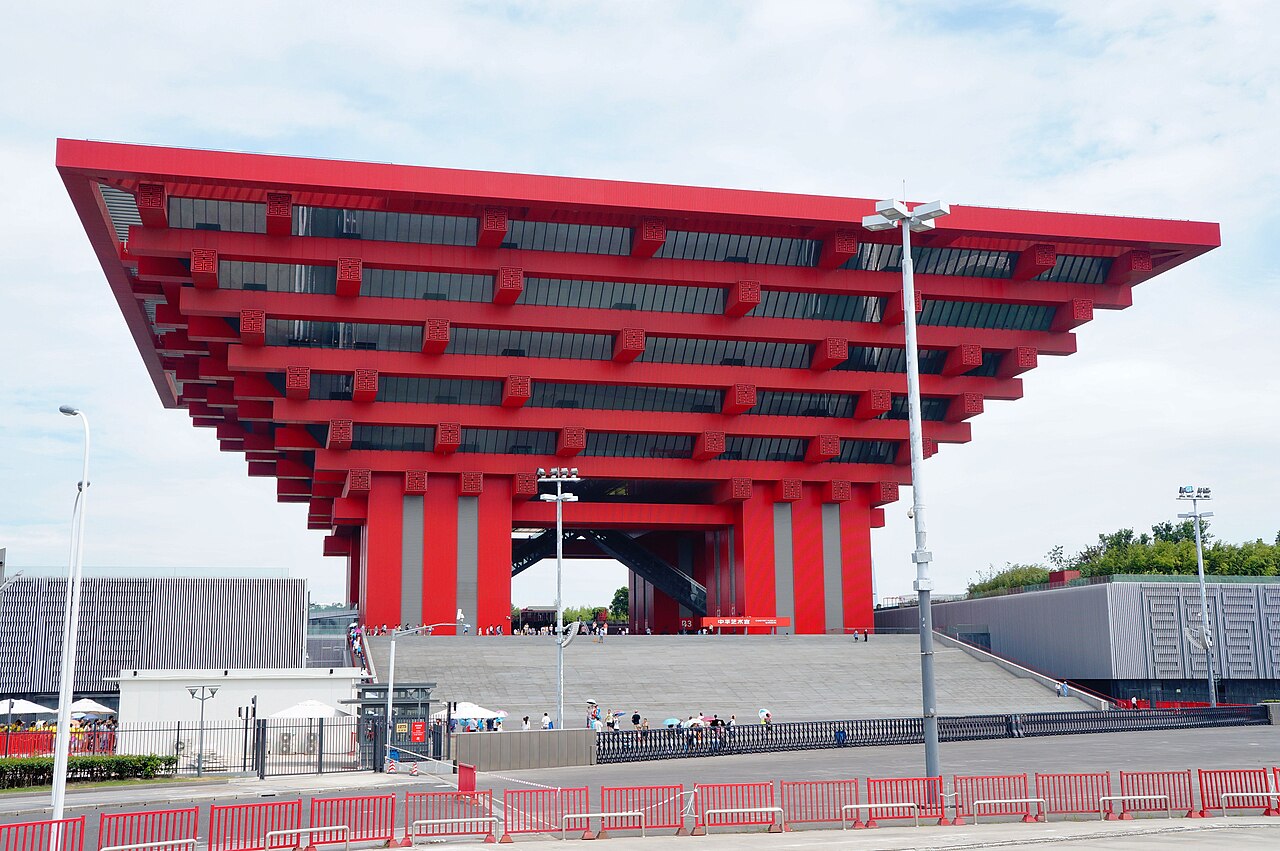
2007–2010 · He Jingtang
A tiered, inverted form of interlocking wooden-bracket-like eaves widens as it rises rather than tapering, echoing a traditional roof bracket and an ancient ceremonial cauldron; at 63 metres it stood taller than every other structure built for the fair around it.
China Art Museum occupies the China Pavilion, built for the 2010 Shanghai World Expo, where it drew close to 17 million visitors and, at an estimated cost of US$220 million, was the most expensive pavilion at the fair. Its 63-metre design, led by architect He Jingtang, drew on the traditional corbel bracket called dougong and the ancient bronze cauldron known as a ding. The museum itself was founded in 1956 in a former restaurant, later moving through several buildings before relocating here in 2012, into a space more than ten times larger than its previous home.
- The China Pavilion stayed open six extra months after the Expo's official close, owing to its popularity.
- The Shanghai Race Club building the museum previously occupied had itself once housed the Shanghai Library.
- More than 12,000 visitors came through the museum's previous home in its last two days of opening, in December 2012.
Photo: Jiaqian AirplaneFan (CC BY 3.0)
Longhua Pagoda
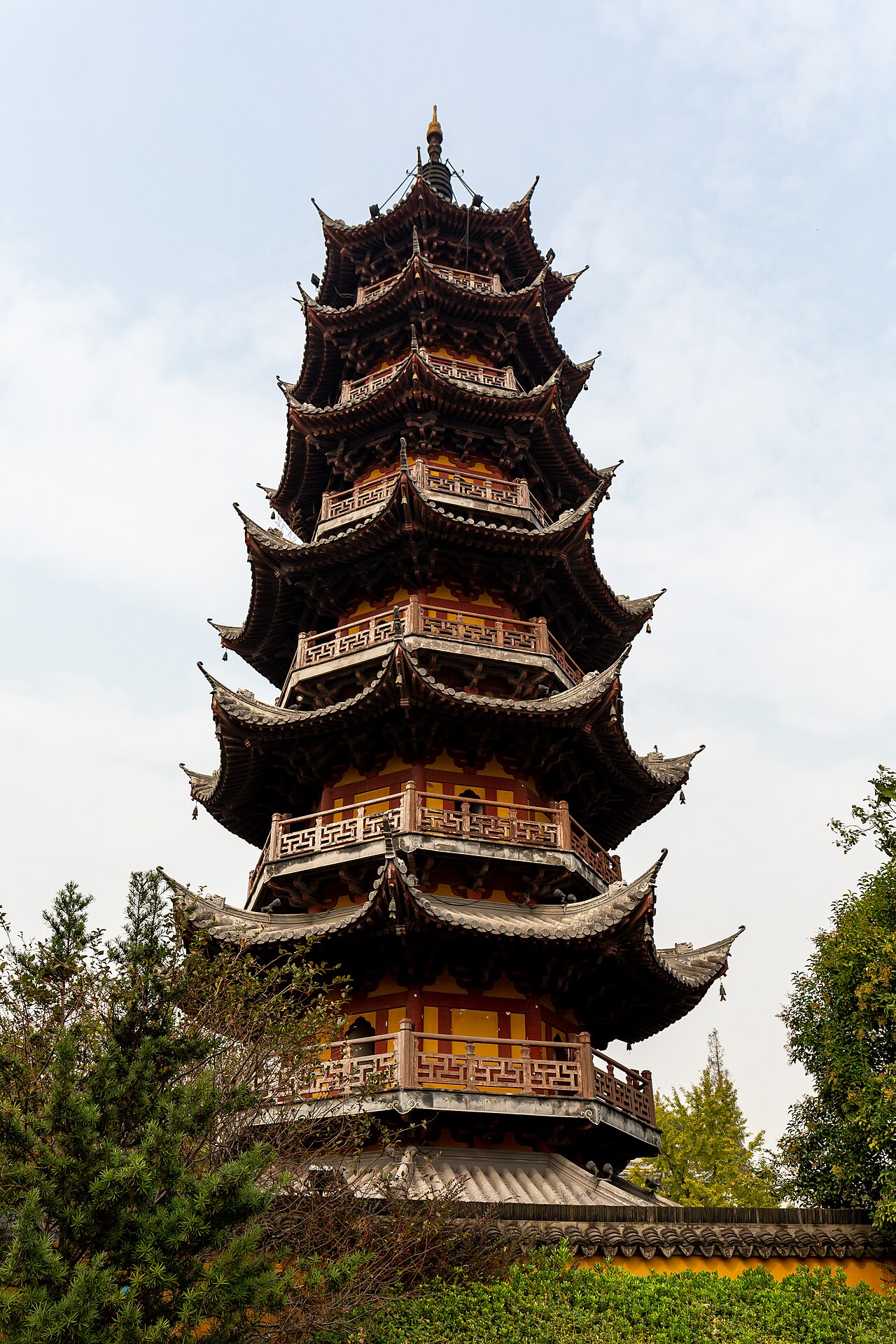
977–1955
Seven octagonal wooden-galleried storeys, each narrower than the one below, taper toward a slender finial connected internally to an eighteen-metre pillar; brick construction is masked as timber-frame styling typical of Song-dynasty design, with doorways and shrine niches rotating position on each ascending floor.
Longhua Pagoda is thought to have first been built between 242 and 247 during the Three Kingdoms period, to house sacred relics, though it was destroyed by fire in 880. Its present structure dates from 977, raised under King Qian Chu of Wuyue in the Northern Song dynasty, and survives as seven octagonal storeys of wood and brick reaching 40.64 metres. Damaged repeatedly by fire and lightning over the centuries and altered with non-Song features, it was stripped of those later additions and restored to its Song-dynasty form between 1954 and 1955, gaining national heritage protection in 2006.
- According to folk legend, the pagoda was built by the ruler Sun Quan out of gratitude to his mother, and a plaque reading "Pagoda of Gratitude" once hung above its entrance.
- During the Cultural Revolution, a Red Guard unit tied the pagoda to a tractor in an attempt to pull it down, then tried to burn it, and only stopped after being blocked by local residents.
- One monk funded a nineteenth-century restoration of the pagoda by selling his own paintings after a fire destroyed its ground-floor gallery in 1892.
Photo: Balon Greyjoy (CC0)
Yu Garden
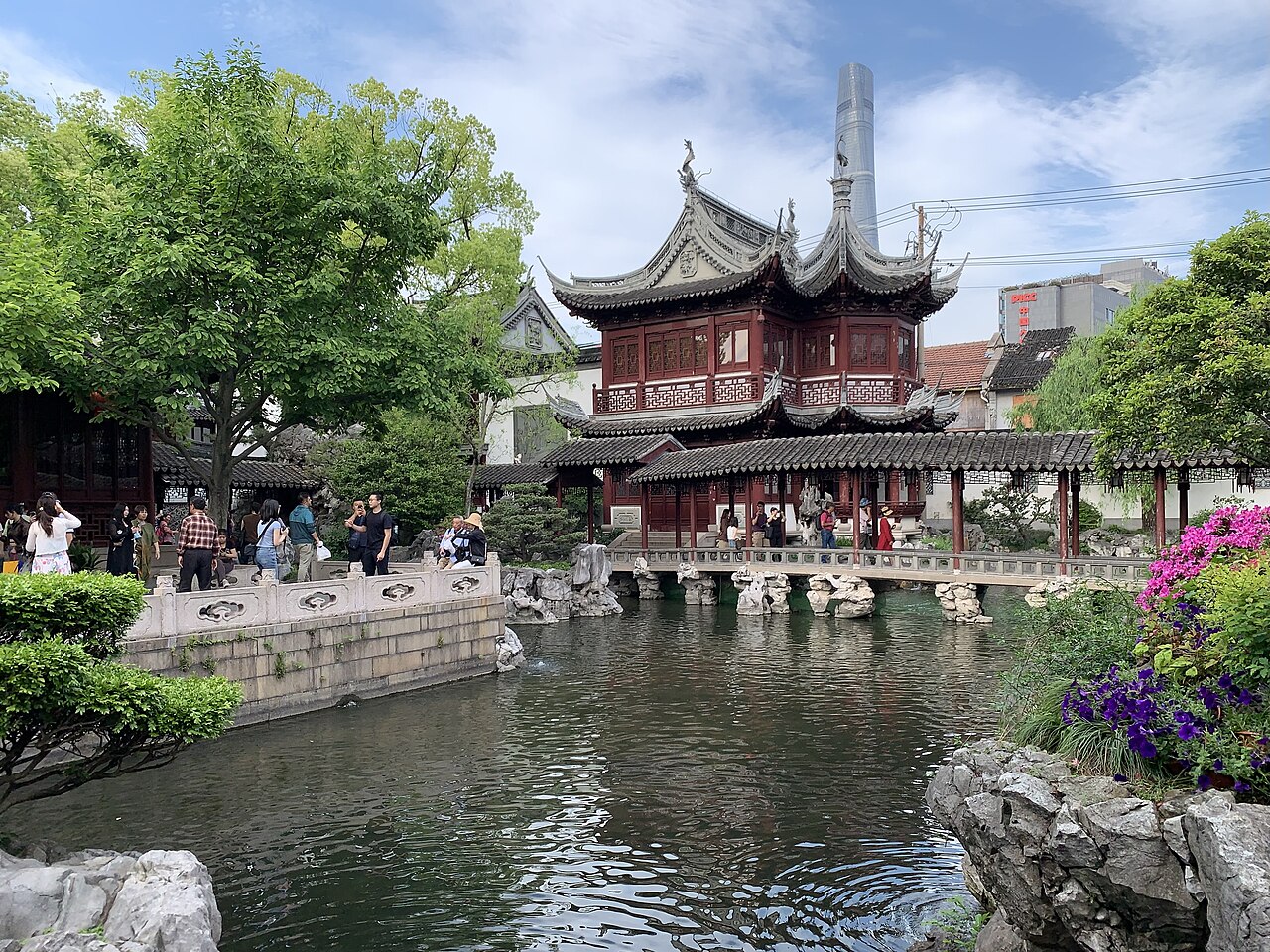
1577–1961
Zigzagging corridors and dragon-topped walls with undulating grey-tiled ridges divide the grounds into distinct courtyards linked by a nine-turn bridge over a teahouse pond; at its centre stands a tall, deeply pitted grey-white boulder pierced through with holes.
Yu Garden was built from 1559 by the official Pan Yunduan as a gift to please his aging father, its name meaning "pleasing and satisfying to one's parents"; a governorship in Sichuan delayed its completion until 1577. Its expense contributed to the ruin of the Pan family, and the garden passed through a succession of later owners, who expanded and subdivided it into six themed areas linked by zigzag corridors and dragon walls. Damaged during the Opium War, the Taiping Rebellion and the Japanese occupation, it was extensively repaired between 1956 and 1961 and declared a national monument in 1982.
- Its centrepiece boulder, the Exquisite Jade Rock, is rumoured to have been salvaged from the Huangpu River after the boat carrying it to an emperor's garden sank.
- Nearly three quarters of Pan Yunduan's journal entries from 1586 to 1601 record public performances held in the garden's Leshou Tang hall.
- During the Taiping Rebellion, a rebel group calling itself the Small Swords Society ran its headquarters from inside one of the garden's halls.
Photo: Chainwit. (CC BY 4.0)
Shanghai World Financial Center
A supertall skyscraper in Pudong, designed by Kohn Pedersen Fox and topped out at 492 metres in 2007. On completion it was the second-tallest building in the world and the tallest in mainland China, combining offices, hotels and a ground-floor mall.
Jing'an Temple
An esoteric Tangmi Buddhist temple on West Nanjing Road, historically known as the Bubbling Well Temple.
Shanghai Club Building
A six-story Baroque Revival building on the Bund, constructed in 1864 and opened in 1911 as one of Shanghai's premier men's clubs. Now under national heritage protection, it is operated today as the Waldorf Astoria Shanghai on the Bund.
Bank of China Building
A tower at No. 23 the Bund, built on the site of the old German Club and formerly the headquarters of the Bank of China. Its comparatively short height is attributed to Victor Sassoon's insistence that no other building on the Bund rise higher than his own.
Broadway Mansions
A 19-floor Art Deco hotel near the confluence of Suzhou Creek and the Huangpu River, at the northern end of the Bund. Completed in 1934 by the firm Palmer and Turner, it became the tallest apartment building in Shanghai and remained a symbol of the city for decades.
Astor House Hotel
A hotel established in 1846 as Richards' Hotel and Restaurant near the confluence of the Huangpu River and Suzhou Creek, later known as the Pujiang Hotel from 1959 to 2018. Once called one of the famous hotels of the world, it closed in 2018 and reopened as the China Securities Museum that December.
Old City
The traditional walled urban core of Shanghai, formerly the seat of the old county and, later, of Chinese municipal authority even after foreign concessions were established around it. Its walls were demolished in 1912 and replaced by a circular avenue, with the City God Temple remaining at its center.
Longhua Temple
A Buddhist temple dedicated to the Maitreya Buddha, the largest ancient temple complex in Shanghai. Though most of today's buildings are later reconstructions, they preserve the architectural design of a Song-dynasty Chan Buddhist monastery.
Jade Buddha Temple
A Buddhist temple founded in 1882 around two jade Buddha statues shipped from Myanmar, including a seated figure nearly two metres tall. It now also holds a larger marble reclining Buddha donated from Singapore, which visitors sometimes mistake for the original.
St. Ignatius Cathedral
The Catholic cathedral of the diocese of Shanghai, in Xujiahui, dedicated to Saint Ignatius of Loyola through its French Jesuit founders. Its altar was imported from Paris and arrived on Easter Sunday 1919, and the church has served as the seat of the Bishop of Shanghai since 1960.
Shanghai Grand Theatre
A performing arts complex on People's Square, designed by the French architect Jean-Marie Charpentier and opened in 1998. It houses the Shanghai Opera House and stages opera, ballet, symphony and Chinese opera performances.
Wukang Mansion
A protected historic apartment building in the former French Concession, designed by the Hungarian-Slovak architect László Hudec and completed in 1924. Originally known as the Normandie Apartments, it has been home to many celebrities.
Shanghai Exhibition Centre
An exhibition and convention centre built in 1955 as the Sino-Soviet Friendship Building, commemorating the alliance between China and the Soviet Union, in a Russian neoclassical style. At 110.4 metres to the top of its spire, it was the tallest building in Shanghai from 1955 until 1988.
City God Temple of Shanghai
A Taoist city god temple in the Old City, commemorating Shanghai's elevation to municipal status and honoring three figures venerated as its city gods. The surrounding commercial district takes its Chinese name from the temple and is known in English as Yu Garden.
Great World
An amusement arcade and entertainment complex built in 1917, once billed as the leading entertainment venue in the Far East and the first of its kind in Shanghai. It remains a popular tourist attraction and has given its name, Dashijie, to the surrounding locality.
Ohel Rachel Synagogue
The largest synagogue in the Far East, built by Sir Jacob Elias Sassoon in memory of his wife and completed in 1920. One of only two synagogues still standing in Shanghai, it has been a protected architectural landmark since 1994.
Shanghai Jewish Refugees Museum
A museum in the former Ohel Moshe Synagogue commemorating the more than 20,000 Jewish refugees who fled Nazi persecution for Shanghai. It documents their lives in the wartime "Shanghai Ghetto," the Restricted Sector for Stateless Refugees under Japanese occupation.
Site of the First National Congress of the Chinese Communist Party
A museum in Xintiandi occupying the historic shikumen buildings where the Chinese Communist Party's first National Congress took place in July 1921. It combines exhibits on the city's history with the founding of the party, and is a major site for red tourism.
History
Shanghai began as a fishing village and market town on the Yangtze's southern estuary before growing to global prominence in the nineteenth century through trade. After the First Opium War it was forced open as one of five treaty ports, and foreign powers established the Shanghai International Settlement and the French Concession within it. By the 1930s the city had become Asia's principal commercial and financial hub. The Second World War brought the Battle of Shanghai and Japanese occupation, followed by the Chinese Civil War, after which the Communist Party took control of the city and most of the mainland. Decades later, Pudong, across the Huangpu River, was redeveloped as a financial district: the Oriental Pearl Tower rose there in the early 1990s, with the Jin Mao Tower and the Shanghai Tower following as its skyline grew taller.