Landmarks in Tel Aviv
Jaffa's Ottoman stone monuments stand beside a city founded as a 1909 housing estate.
Tel Aviv's landmarks split between two distinct pasts. Jaffa, the older Mediterranean port the city later absorbed, holds an Ottoman-era clock tower of limestone raised in 1900 and the Mahmoudiya Mosque, a complex whose courtyards and gates were added in stages across the eighteenth and nineteenth centuries under Ottoman rule. The city itself began only in 1909, when the Yishuv founded a Jewish housing estate on the coast north of Jaffa and named it Ahuzat Bayit. Within two decades that estate had grown into a working city, and its early commercial core on Allenby Street produced the Great Synagogue, an Art Deco building of 1926 later fitted with a Modernist arched façade. Ottoman-era stone in Jaffa sits beside 1920s Art Deco in the newer city, joined only recently.
Jaffa Clock Tower
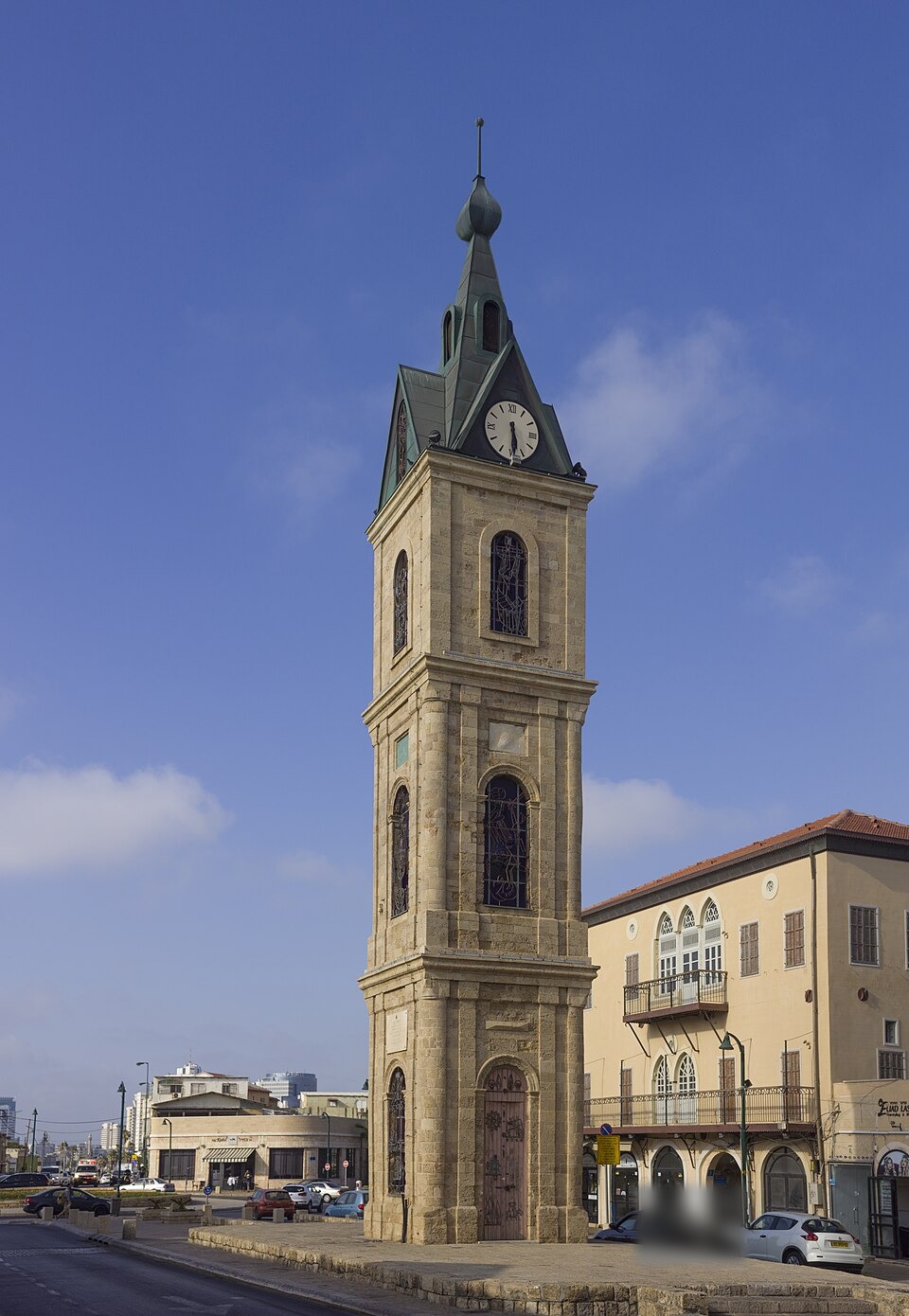
1900
A square limestone clock tower with two separate clock faces, standing at the north end of a street in Jaffa's older quarter; a memorial plaque was added later for those killed defending the town in 1948.
The Jaffa Clock Tower is a limestone tower built in 1900 at the north end of Yefet Street in Jaffa. It was initiated by the Jewish businessman Joseph Bey Moyal and funded by contributions from Jaffa's Jewish, Armenian, Maronite and Arab communities, to mark the twenty-fifth anniversary of the reign of Ottoman Sultan Abdul Hamid II. It is one of seven such towers raised across Ottoman Palestine, alongside those in Safed, Acre, Nazareth, Haifa and Nablus. A plaque added later commemorates Israelis killed in the 1948 fighting for the town.
- One of seven near-identical clock towers built across Ottoman Palestine, including in Safed, Acre, Nazareth, Haifa and Nablus.
- Funded jointly by Jaffa's Jewish, Armenian, Maronite and Arab communities rather than by any one group.
- A plaque was added later to commemorate Israelis killed in the 1948 battle for the town.
Photo: Godot13 (CC BY-SA 4.0)
Great Synagogue of Tel Aviv
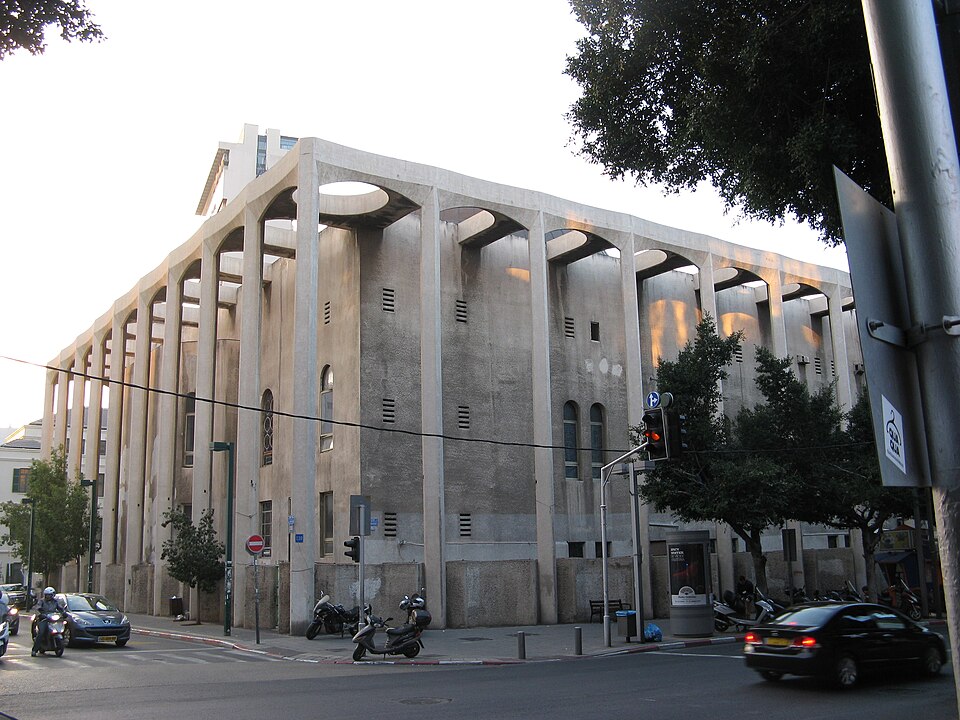
1926 · Yehuda Magidovitch
A monumental Art Deco synagogue on a busy commercial street, its façade fitted in 1969 with a row of rounded modernist arches; the vast sanctuary now used mainly for weddings sits above a smaller everyday synagogue on the lower level.
The Great Synagogue of Tel Aviv is an Orthodox Jewish congregation and synagogue on Allenby Street, designed by Yehuda Magidovitch and completed in 1926 in Art Deco style, sited just east of the Shalom Meir Tower. Once at the heart of Little Tel Aviv, it now stands in the city's business and financial district. A 1969 renovation added a Modernist façade with arches. Demographic change through the 1960s has thinned the regular congregation, so the main sanctuary is used mainly for weddings and special occasions, with daily services held in a smaller synagogue on the lower level.
- Sits in what is now Tel Aviv's business district but was once the heart of 'Little Tel Aviv.'
- Daily services now take place in a smaller synagogue on the lower level rather than the grand main hall.
Photo: Yair Haklai (CC BY-SA 3.0)
Mahmoudiya Mosque
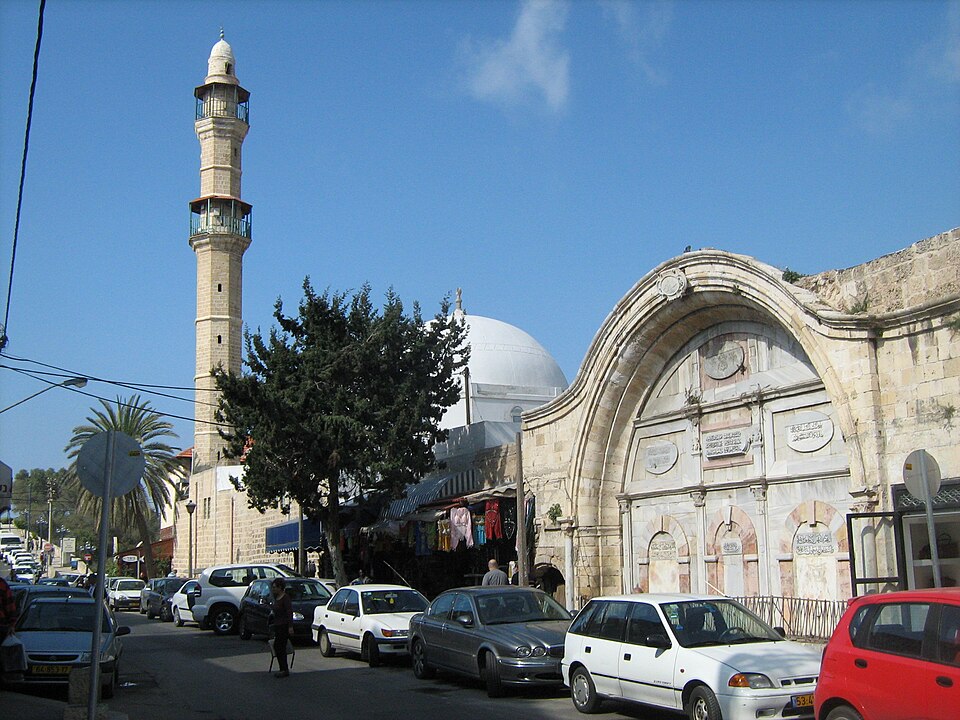
1730–1812
Identifiable by its layout of interlocking buildings, gates and courtyards — two large ones and a third, smaller court — assembled piecemeal over more than a century rather than to one single plan.
The Mahmoudiya Mosque is the largest and most significant mosque in Jaffa, within the Tel Aviv District of Israel. It comprises a complex of buildings, gates and courtyards, centred on two large courtyards and a third, smaller one. Rather than rising from a single building campaign, the complex took shape in stages across the eighteenth and nineteenth centuries, while the area lay under Ottoman rule. That piecemeal history is why sources disagree on when it was built: earlier phases date to the early eighteenth century, later ones to the early nineteenth.
Photo: Ori~ (CC BY-SA 3.0)
White City
A collection of more than 4,000 buildings from the 1930s, built in the International Style known as Bauhaus by German Jewish architects who fled the Nazis. It was declared a UNESCO World Heritage Site in 2003, the largest such collection anywhere.
Independence Hall
Originally Meir Dizengoff's home, redesigned in the International Style by architect Carl Rubin and later gifted to the city. It housed the Tel Aviv Museum of Art from 1932 to 1971 and is now a museum marking the signing of Israel's Declaration of Independence.
Habima Theatre
The national theatre of Israel, and one of the first Hebrew-language theatres, standing in Habima Square at the city's center.
Azrieli Center
A complex of three skyscrapers with a large shopping mall at its base, designed by architect Eli Attia. After Attia fell out with developer David Azrieli, whom the complex is named for, its completion was handed to the firm Moore Yaski Sivan Architects.
St. Peter's Church
A Franciscan Catholic church in Old Jaffa.
Old Jaffa
The oldest neighborhood in Tel Aviv-Jaffa, sitting on a hill along the Mediterranean that forms the northern end of a kurkar ridge, historically reinforced with fortifications. One of Israel's main tourist attractions, it is filled with art galleries, restaurants, theaters, museums and nightclubs.
Jaffa Port
An ancient port on the Mediterranean, with archaeological finds and mentions dating back 4,000 years, possibly making it one of the oldest ports in the region. Once called the Port of Jerusalem, it now serves as a fishing and yacht harbor with seafood restaurants.
Tel Aviv Museum of Art
An art museum dedicated to the preservation and display of modern and contemporary art from Israel and around the world.
Hassan Bek Mosque
An Ottoman-style mosque built between 1916 and 1923 at the northern boundary of Arab Jaffa, its history closely tied to the Arab–Jewish conflict. Standing between the Neve Tzedek neighbourhood and the Mediterranean Sea, its architecture contrasts sharply with the surrounding modern high-rises.
Immanuel Church
A Protestant church built in 1904 for the German Evangelical community, which used it until its dissolution in 1940. In 1955 control passed to the Norwegian Church Ministry to Israel, and it is now used by various Protestant denominations, including the Messianic movement.
Suzanne Dellal Centre
A centre for dance and theatre in the Neve Tzedek neighbourhood.
Shalom Meir Tower
An office tower, commonly known by the Hebrew name Migdal Shalom.
Ben-Gurion House
A historic house museum that served as David Ben-Gurion's family home from 1931 to 1953, and as an additional residence until his death in 1973. It stands at 17 Ben-Gurion Boulevard in northern Tel Aviv.
Anu – Museum of the Jewish People
A museum on the Tel Aviv University campus telling the story of the Jewish people from antiquity to the present. Reopened in March 2021 as a $100 million expansion of the former Beit Hatfutsot, it was built over ten years with state and private funding.
Eretz Israel Museum
A historical and archaeological museum in Ramat Aviv, established in 1953 as the Haaretz Museum. Its grounds hold separate pavilions for glassware, ceramics, coins and more, a planetarium, and the Tel Qasile excavation, where 12 distinct layers of culture have been uncovered.
Moshe Aviv Tower
A 235-metre, 68-storey skyscraper in the Diamond Exchange District of Ramat Gan, in the Tel Aviv District, originally named City Gate. It is the fourth-tallest building in Israel, after Tel Aviv's 238-metre Azrieli Sarona Tower.
Max Liebling House
A Bauhaus-style building at 29 Idelson Street, designed by architect Dov Karmi and engineer Zvi Barak and built in 1936. Donated to the city in the 1970s, it has housed the Liebling Haus – The White City Center, a research and education institution, since 2019.
Yachin House
A landmark office building at the corner of Kaplan and Ibn Gabirol streets, designed by architects Arieh Sharon and Benjamin Idelson. A significant example of brutalist architecture in Israel, it marks a notable transition in Sharon's practice from early modernism to brutalism.
Bloomfield Stadium
A football stadium with a capacity of 29,400, home to both Hapoel Tel Aviv and Maccabi Tel Aviv. It also hosts select home matches for the Israel national football team.
Sabil Abu Nabbut
A public fountain in Jaffa, also known as Tabitha's Well, built in 1815 or 1816 during the Ottoman period. Its main purpose was to serve travelers making the journey between Jaffa and Jerusalem.
Alhambra Cinema
A 1937 Art Deco building on Jerusalem Boulevard in Jaffa, designed by Lebanese architect Elias Al-Mor and named for the Alhambra palace in Spain. Originally a cinema and later a theatre after 1963, it was purchased and renovated by the Church of Scientology in 2010.
Hechal Yehuda Synagogue
An Orthodox synagogue on Menahem ben Saruq street in central Tel Aviv, commonly called the Recanati synagogue. It is nicknamed the Seashell Synagogue for its unusual shape resembling a seashell.
History
The land under today's Tel Aviv had been built on for centuries before the city existed. In Jaffa, the Mahmoudiya Mosque's courtyards, gates and buildings were assembled in stages through the eighteenth and nineteenth centuries, and a limestone clock tower went up there in 1900, paid for jointly by the port's Jewish, Armenian, Maronite and Arab communities to mark a sultan's twenty-fifth year on the throne. Tel Aviv itself dates only to 1909, when the Yishuv founded a housing estate just north of Jaffa and named it Ahuzat Bayit, House Estate. The new town grew fast: within two decades it had a commercial spine along Allenby Street, where the Great Synagogue was completed in 1926 in Art Deco style and later given a Modernist arched façade in a 1969 renovation. Ottoman Jaffa and twentieth-century Tel Aviv still read as two separate building phases rather than one continuous city.