Landmarks in Amsterdam
Golden Age wealth built canal-ring houses on timber piles driven into reclaimed peat.
Amsterdam's landmarks sit along two overlapping rings: a medieval core near Dam Square and the seventeenth-century canal belt built during the Golden Age. The oldest survivors are a Gothic brick parish church and a defensive tower from the old city walls, put up when Amsterdam was still a fortified trading town on the Amstel. Golden Age wealth then paid for a new city hall grand enough to later serve as a royal palace, and for parish churches built inside the freshly dug canals. Nineteenth-century prosperity added larger public institutions further out, including a national museum that finally opened a purpose-built home after decades of its collection moving between temporary quarters. Brick and reclaimed land tie the periods together; each ring shows a different budget and a different ambition.
Rijksmuseum
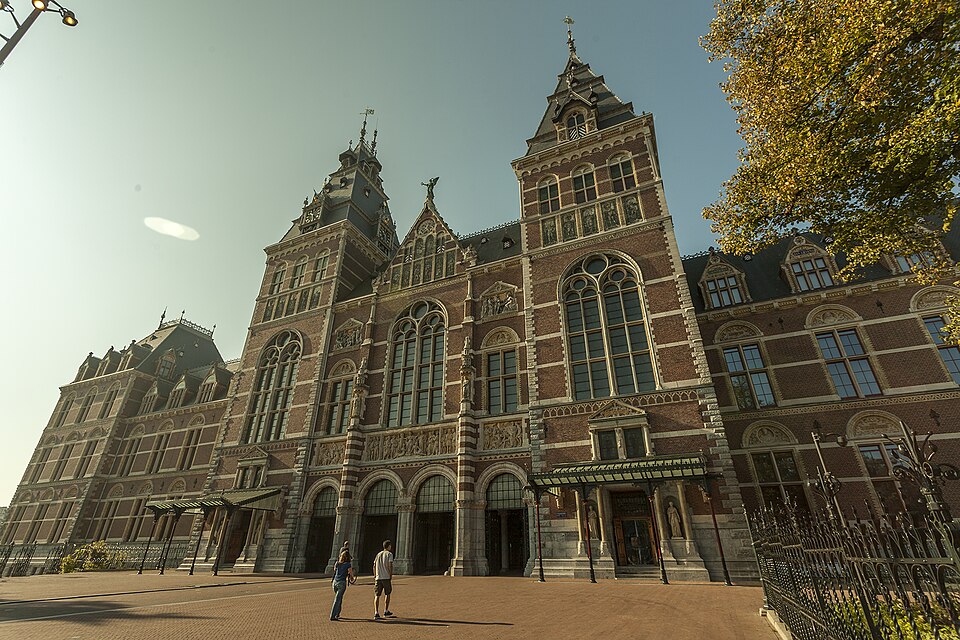
1885 · Pierre Cuypers
It sits on a shared museum square alongside the country's other major galleries and is, by its own collection size, the largest art museum in the country, with a million objects behind its walls.
The Rijksmuseum is the national museum for Dutch art and history, founded in The Hague in 1798 and moved to Amsterdam a decade later, first housed in the former city hall and then in the Trippenhuis. Its purpose-built home, designed by Pierre Cuypers, opened in 1885. A ten-year renovation costing 375 million euros closed the main building until 2013. It now displays 8,000 objects from a collection of one million, including Golden Age paintings by Rembrandt, Hals and Vermeer, plus a small Asian collection.
- It began in The Hague in 1798 and only reached Amsterdam a decade later.
- A ten-year, 375-million-euro renovation closed the main building until Queen Beatrix reopened it in 2013.
- It was the country's most-visited museum in both 2013 and 2014, with 2.47 million visitors the second year.
Photo: Rodrigo Silva (CC BY 2.0)
Royal Palace of Amsterdam
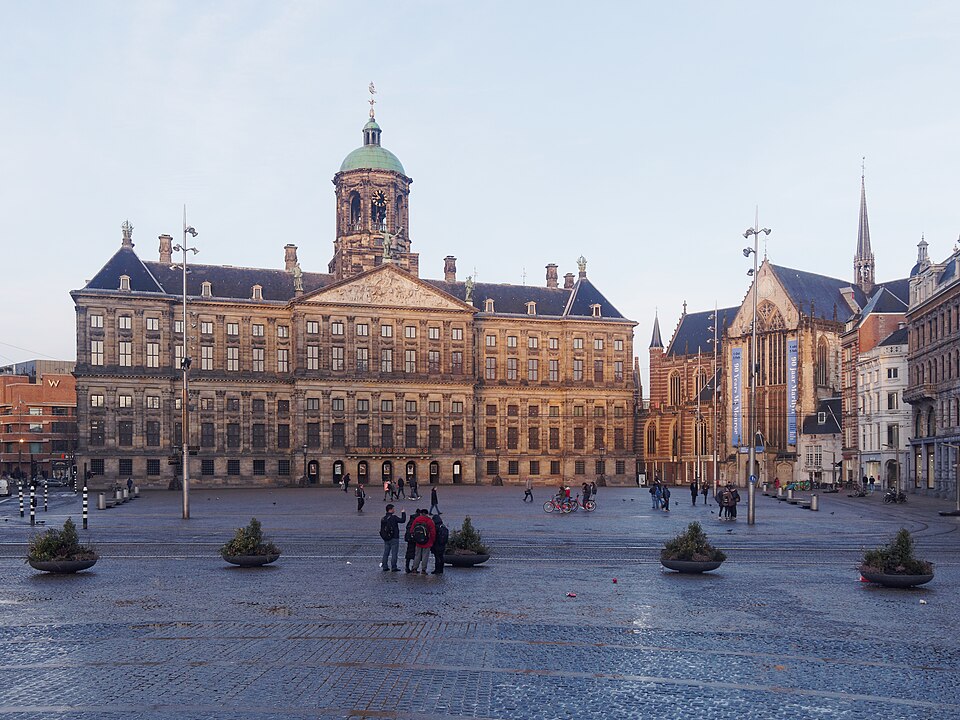
1665 · Jacob van Campen
A symmetrical Dutch Baroque facade closes off one side of the main square, standing beside a large church and facing a war memorial across the open plaza.
Commissioned by burgemeester Nicolaes Tulp as a new city hall even before the old one burned down in 1652, the building was completed in 1656 and became an internationally admired showpiece, its rooms recorded and copied by visiting artists. Design is credited to Jacob van Campen, with Daniël Stalpaert also named among its architects. Under the Batavian Republic its public floors became Amsterdam's first museum, run by Louis Bonaparte; once Napoleon made him king, the building became a royal palace, and it has remained at the monarch's disposal since.
- It was commissioned as a city hall before the building it was meant to replace had even burned down.
- Its public floors briefly served as Amsterdam's first museum before the building became a royal palace.
Photo: C messier (CC BY-SA 4.0)
Westerkerk
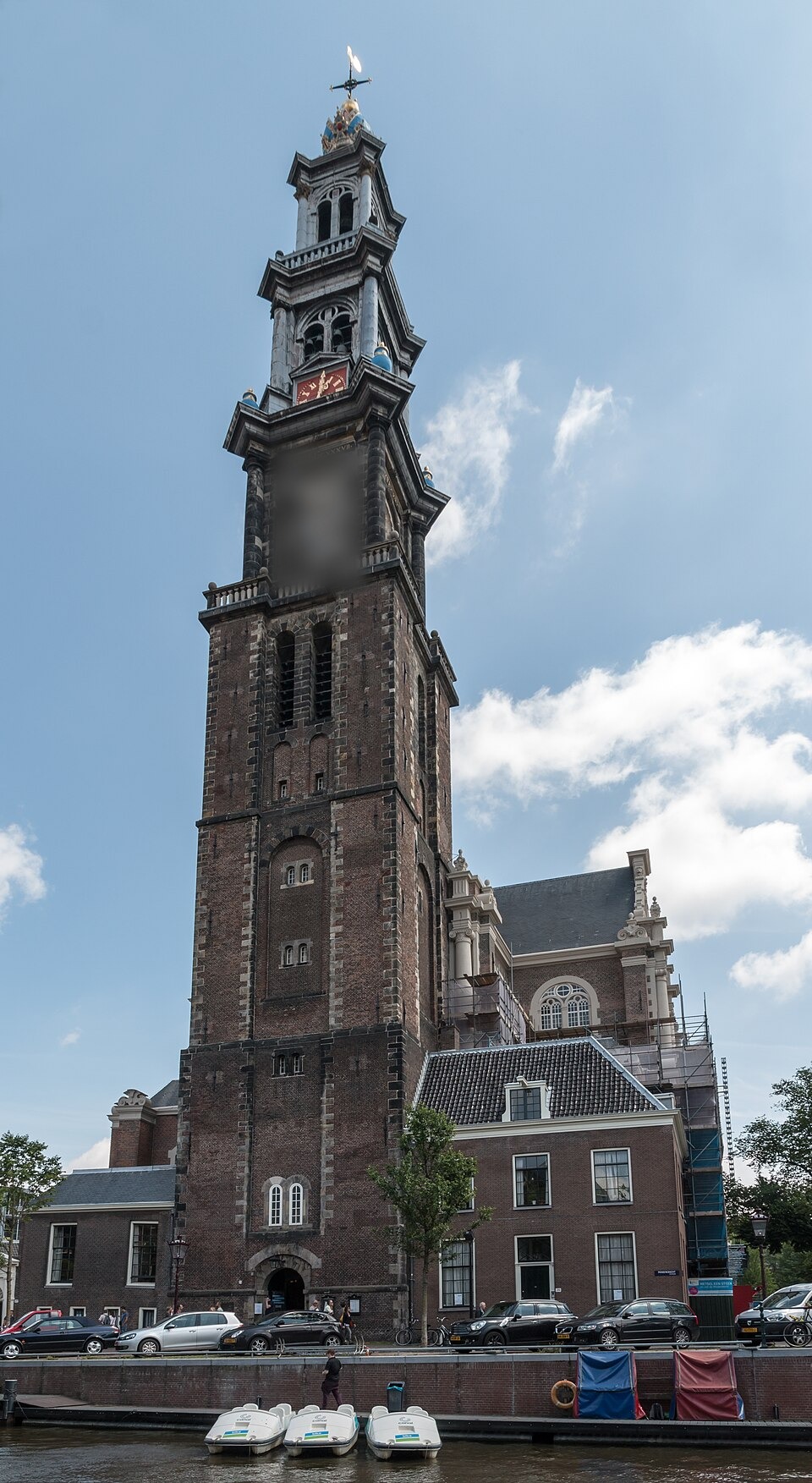
1631 · Hendrick de Keyser
Its Baroque profile marks the western edge of the canal ring, wedged between the Prinsengracht and Keizersgracht and set right against the Jordaan district.
The Westerkerk is a Reformed church serving Dutch Protestant Calvinism, built in 1631 to a design by Hendrick de Keyser, who died a decade before its completion. It stands at the western edge of the Grachtengordel canal district, next to the Jordaan neighbourhood and between the Prinsengracht and Keizersgracht. Raised during Amsterdam's Golden Age expansion, it belongs to the Baroque architectural period and is protected as a Rijksmonument. It continues to hold Reformed services today, one of the working parish churches built inside the seventeenth-century canal ring.
- Its architect died in 1621, a decade before the church he designed was finished.
Photo: Dietmar Rabich (CC BY-SA 4.0)
Oude Kerk
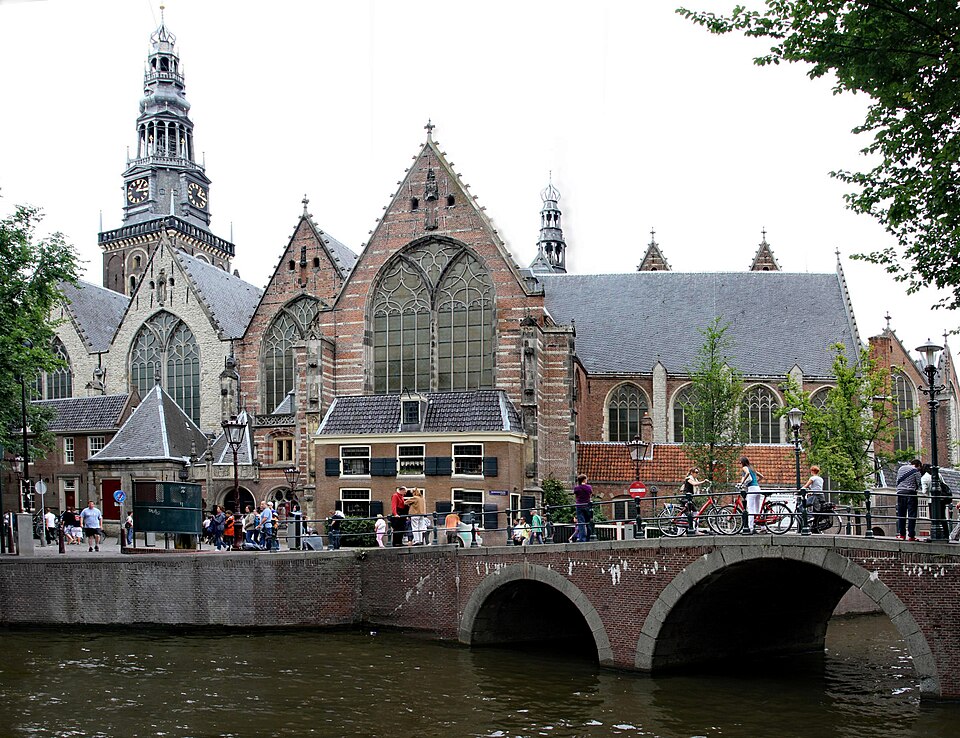
1306
Its Holland Gothic exterior encloses a square in the De Wallen district; since 2012 the church has hosted contemporary art exhibitions alongside its ongoing Reformed services.
The Oude Kerk is Amsterdam's oldest surviving building and its oldest parish church. Founded around 1213 as a modest chapel, it was consecrated in 1306 as a Roman Catholic church dedicated to Saint Nicolas by the bishop of Utrecht. After the Reformation of 1578 it became, and remains, a Reformed Calvinist church. Built in the Holland Gothic style, it stands in the De Wallen district, where the surrounding square takes its name. Since 2012 it has also hosted contemporary art exhibitions alongside worship, and it is protected as a Rijksmonument.
- It began as a wooden chapel around 1213, nearly a century before the stone church was consecrated.
- It has hosted contemporary art exhibitions alongside Reformed worship since 2012.
Photo: Gerd Eichmann (CC BY-SA 4.0)
Montelbaanstoren
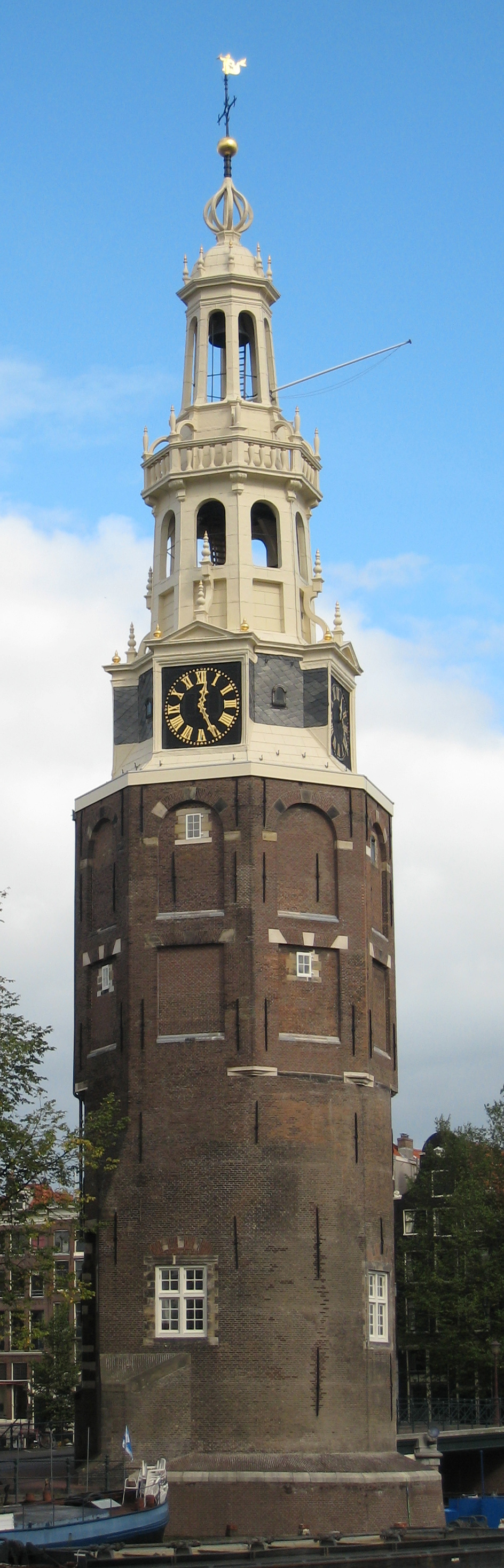
1516
A tower on the bank of the Oudeschans canal, its plain lower section from the early 1500s topped by an ornate section added a century later that brings it to 48 metres tall.
The Montelbaanstoren is a tower on the bank of the Oudeschans canal, built in 1516 as part of Amsterdam's fortified walls to help defend the city and its harbour. Its plain lower section survives from that original construction; the decorative upper half, designed by Hendrick de Keyser, was added in 1606, bringing the tower to its current height of 48 metres. A sixteenth-century plan to fold the tower into a castle called Monte Albano was never carried out, though the scheme left its garbled trace in the tower's Dutch name.
- Its name is a garbled memory of Monte Albano, a castle planned around the tower but never built.
- The tower has stood at exactly 48 metres since its decorative top was added in 1606.
Photo: S Sepp (CC BY-SA 3.0)
Canal Ring
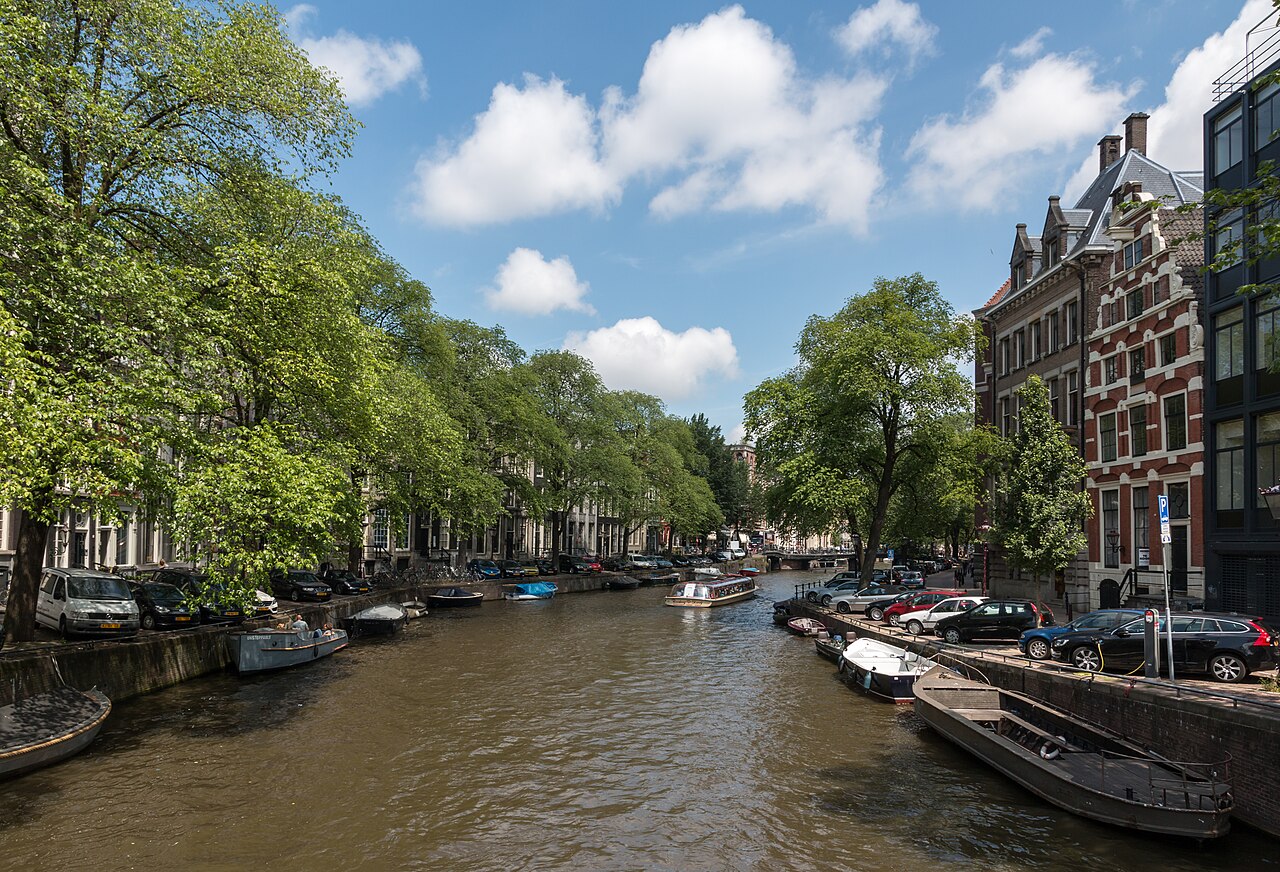
1613–1664
Three parallel, concentric canals lined with narrow, gabled brick townhouses; the grandest stretch, known for double-width mansions and coach houses, runs along the innermost of the three main canals.
The Canal Ring, known locally as the Grachtengordel, comprises three concentric waterways, Herengracht, Keizersgracht and Prinsengracht, dug from 1613 under a seventeenth-century city plan that also added a defensive outer canal and radial cross-canals. Construction proceeded sector by sector, reaching the southern stretch only after 1664; the planned eastern arc was largely abandoned for parks and public institutions instead. Some 1,550 monumental brick townhouses line the three main canals, long polluted until the sewer system finally reached them in 1987. The ring joined the UNESCO World Heritage list in 2010.
- Between 12,000 and 15,000 bicycles are pulled out of the canals every year, a practice known locally as 'bike fishing'.
- Peter the Great stayed in houses on both the Herengracht and the Keizersgracht during his two visits; John Adams and the physicist Daniel Fahrenheit also lived on the Keizersgracht.
- Houseboats were still allowed to release sewage straight into the canals as late as 2018, when new rules finally required them to connect to the sewer system.
Photo: Dietmar Rabich (CC BY-SA 4.0)
Anne Frank House
A 17th-century canal house on the Prinsengracht where Anne Frank hid with her family from Nazi persecution during World War II. Her diary was published in 1947, and the museum occupying the building opened on 3 May 1960.
Concertgebouw
A concert hall whose acoustics rank among the finest in the world, alongside Carnegie Hall, Boston's Symphony Hall and Vienna's Musikverein. Queen Beatrix granted it the royal title "Koninklijk" in 2013, on its 125th anniversary.
Stedelijk Museum
A museum of modern and contemporary art and design, its 19th-century building designed by Adriaan Willem Weissman on the Museumplein. A 21st-century wing by Benthem Crouwel Architects added the current entrance, and the collection runs from van Gogh and Kandinsky to Warhol and de Kooning.
Van Gogh Museum
A museum dedicated to Vincent van Gogh and his contemporaries, opened on 2 June 1973 in buildings by Gerrit Rietveld and Kisho Kurokawa. It holds the world's largest collection of van Gogh's paintings and drawings, and in 2017 was the Netherlands' most-visited museum.
Beurs van Berlage
A former stock exchange on the Damrak, designed by Hendrik Petrus Berlage and built between 1896 and 1903 in red brick with an iron-and-glass roof. It influenced modernist architects and the Amsterdam School, and now hosts concerts, exhibitions and conferences.
Portuguese Synagogue
An Orthodox Jewish synagogue, also called the Esnoga, completed in 1675 for a Sephardic community that was one of the largest and richest in Europe during the Dutch Golden Age. It remains an active place of worship and has drawn tourists since the 17th century.
Homomonument
A memorial of three large pink triangles set into the ground by the Keizersgracht canal, near the Westerkerk church. Opened on 5 September 1987, it was the world's first monument to commemorate gay men and lesbians killed by the Nazi regime.
Waag
A 15th-century former city gate on Nieuwmarkt square, later used as a guildhall, museum, fire station and anatomical theatre. It is Amsterdam's oldest surviving non-religious building and appears in Rembrandt's 1632 painting The Anatomy Lesson of Dr. Nicolaes Tulp.
EYE Film Institute Netherlands
A film archive, museum and cinema that preserves and presents both Dutch and foreign films screened in the Netherlands.
Vondelpark
A 47-hectare public park west of the Leidseplein and Museumplein, opened in 1865 as Nieuwe Park before being renamed for the 17th-century poet Joost van den Vondel. It now draws about 10 million visitors a year and includes an open-air theatre and playground.
Rembrandt House Museum
The house where Rembrandt van Rijn lived and worked as a painter and art dealer from 1639 to 1658. Built around 1606, it was renovated in 1627 with a new facade, and now includes the studio and gallery spaces of the museum.
Magna Plaza
A former main post office turned shopping centre, built in 1895–1899 in neo-Gothic and neo-Renaissance style. It has been a national monument since 1974 and is included among the Netherlands' Top 100 heritage sites.
Museumplein
A public square in the Museumkwartier flanked by the Rijksmuseum, Van Gogh Museum, Stedelijk Museum and the Concertgebouw. Laid out after the Rijksmuseum's completion in 1885 on former marshy meadows, it was redesigned in 1999 by the Swedish-Danish landscape architect Sven-Ingvar Andersson.
National Monument
A 1956 cenotaph on Dam Square, built to commemorate the dead of the Second World War. Each year on 4 May it hosts the national Remembrance of the Dead ceremony, now honoring casualties of later conflicts as well.
Royal Theater Carré
A Neo-Renaissance theatre by the river Amstel, founded in 1887 as a permanent circus building. It now seats about 1,700 for musicals, cabaret and pop concerts, near Waterlooplein.
Het Scheepvaartmuseum
A maritime museum that drew 419,060 visitors in 2012, ranking 12th among the busiest museums in the Netherlands the following year. Attendance later settled at around 300,000 to 350,000 visitors a year between 2015 and 2017.
Het Schip
A housing complex in the Spaarndammerbuurt, designed by Michel de Klerk in 1919 in the Amsterdam School style. It originally held 102 working-class homes plus a post office and school; since 2001 those two buildings house a museum about the style.
Scheepvaarthuis
Regarded as the first true example of the Amsterdam School, built in two phases, 1913–1916 and 1926–1928. It served as headquarters for six leading Amsterdam shipping companies, on the spot where Cornelis Houtman's 1595 voyage to the East Indies began.
Olympic Stadium
The main stadium for the 1928 Summer Olympics, originally holding 31,600 before a second ring raised capacity to 64,000 in 1937. Listed as a national monument in 1987, it was renovated from 1996 back toward its 1928 form, reducing capacity to 22,288.
Mozes en Aäronkerk
Officially the Roman Catholic Church of St. Anthony of Padua, it began as a clandestine Franciscan church on the Jodenbreestraat, named for wall tablets of Moses and Aaron that hung there. The present building was designated a national heritage monument in 1970.
He Hua Temple
A Buddhist temple on the Zeedijk in Chinatown, built in traditional Chinese palace style and affiliated with the Fo Guang Shan order. It is the largest such temple in Europe and the continent's first purpose-built Chinese Buddhist temple.
Walloon Church
A Protestant church on the Oudezijds Achterburgwal dating to the late 15th century, used by the Walloon congregation since 1586. Painter Bartholomeus van der Helst and scientist Jan Swammerdam are buried inside, and Vincent van Gogh attended sermons there in the 1870s.
Artis
A zoo and botanical garden that is the oldest in the Netherlands and the fifth-oldest still operating anywhere in the world. Its grounds hold an aquarium, planetarium and arboretum along with 27 listed historic buildings, bridges and ponds, most still used as animal enclosures.
Allard Pierson Museum
The archaeological museum of the University of Amsterdam, located at Oude Turfmarkt 127. Its collection covers ancient Egypt, the Near East, the Greek world, Etruria and the Roman Empire.
History
Amsterdam began as a small fishing settlement where the Amstel river was dammed to control flooding, and its oldest surviving building, a stone church consecrated in 1306, replaced an even earlier wooden chapel on the same spot. Defensive walls followed, including a tower raised in 1516 to guard the harbour and later given a decorative upper section. Wealth from seventeenth-century trade financed the canal ring and the buildings inside it: a Reformed church finished in 1631, and a new city hall commissioned even before its predecessor had burned down. Napoleonic rule later turned that city hall into a royal palace. Amsterdam's nineteenth-century prosperity built grand civic institutions further from the old centre, among them a national museum that opened a purpose-built home in 1885 after decades of its collection moving between temporary buildings.