Landmarks in Antwerp
A Scheldt port framed by a Gothic spire and Renaissance halls around one market square.
Antwerp's landmarks cluster tightly around the Grote Markt and the banks of the Scheldt, the two poles of a city built on river trade. A squat medieval fortress guards the waterfront where the old town began; a few streets inland, a Gothic cathedral and a Renaissance city hall face the same market square, raised a few decades apart during the city's sixteenth-century boom. A merchant printer's house nearby recalls the same era's trade in books rather than goods. Later prosperity left its own mark: the stone station built at the turn of the twentieth century announces the rail and port links that still drive the city today, in a style well apart from the older core it adjoins.
Cathedral of Our Lady
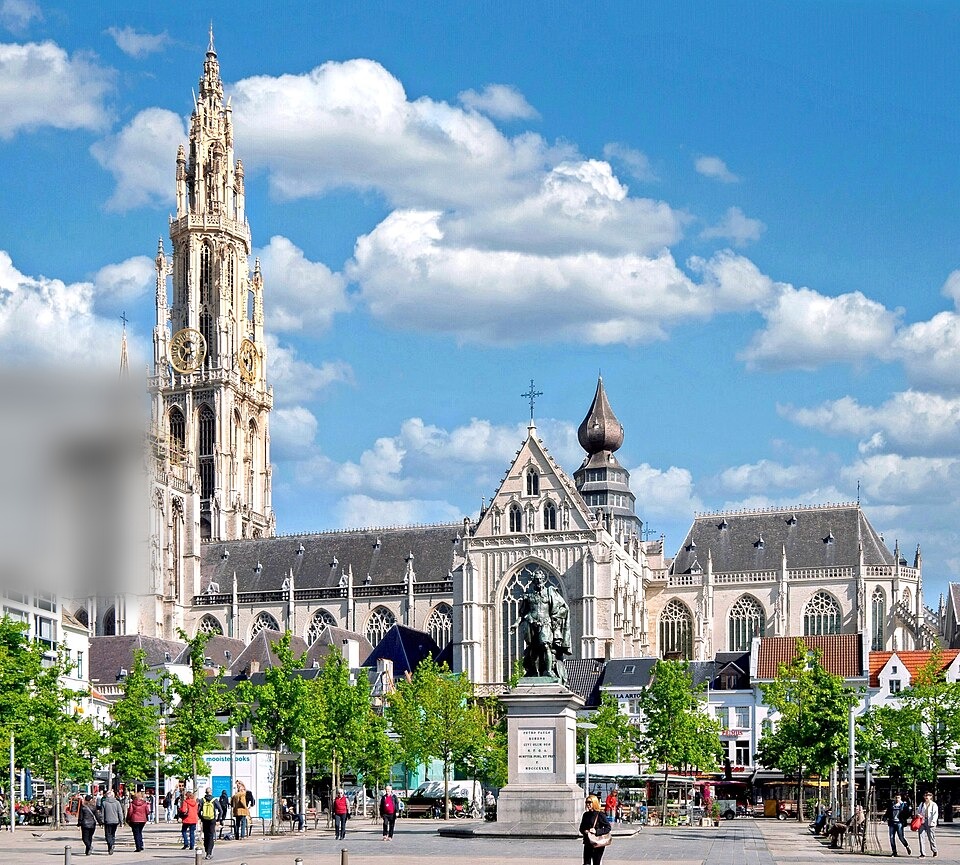
1352–1521 · Jan and Pieter Appelmans
A single tall, openwork stone spire rises over the west front, a legacy of a second tower never being finished; at 123 metres it dominates a large market square lined with stepped guild-house gables.
Construction began in 1352 and the first building phase closed in 1521, though the church was never fully finished; it is the largest Gothic church in Belgium, with a 123-metre tower. Later architects, including Rombout II Keldermans and, centuries afterward, Jules Bilmeyer, Jozef-Louis Stynen and Guido Derks, worked on later stages and restorations. The interior holds paintings by Peter Paul Rubens and other Antwerp masters.
- The church has never been fully completed, well over six centuries after construction began in 1352.
- Its belfry is listed separately from the cathedral itself, grouped with municipal bell towers under the Belfries of Belgium and France.
Photo: Rolf Kranz (CC BY-SA 4.0)
Antwerp Central Station
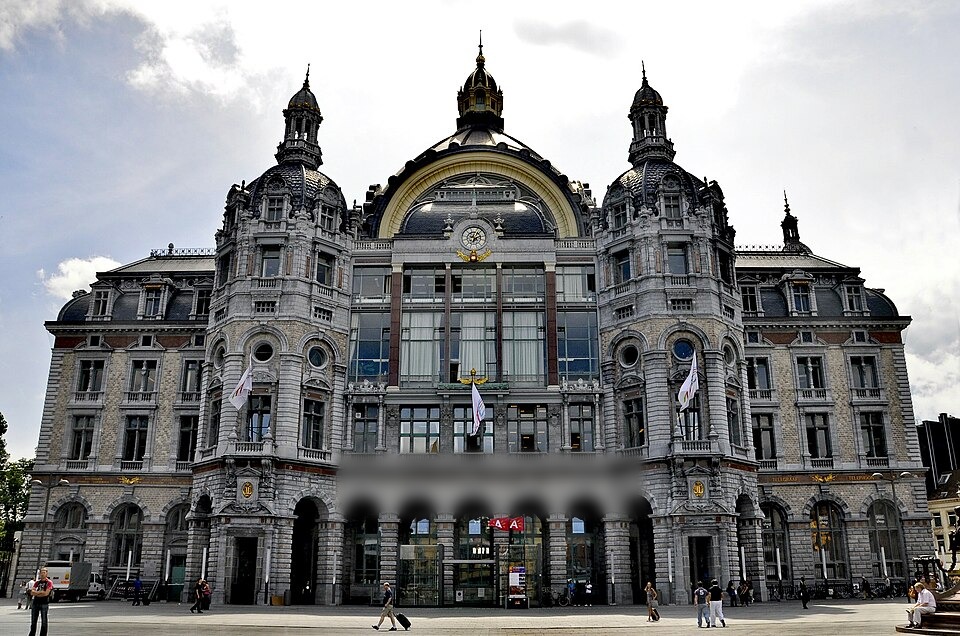
1895–1905 · Louis Delacenserie
A monumental stone entrance hall opens directly onto platforms sheltered by a single sweeping arched roof of glass and iron, the whole approach built to impress arriving passengers rather than simply move them through.
The current station building was designed by Louis Delacenserie, with Jacques Voncke, and constructed between 1895 and 1905. It served as a dead-end terminus from 1873 until 2007, when a tunnel opened beneath the city and the station itself, allowing through trains for the first time. It remains the country's main railway hub and one of four stops on the national high-speed network.
- It operated as a dead-end terminus for well over a century before a tunnel finally let trains pass straight through beneath it in 2007.
Photo: Paul Hermans (CC BY-SA 3.0)
Antwerp City Hall
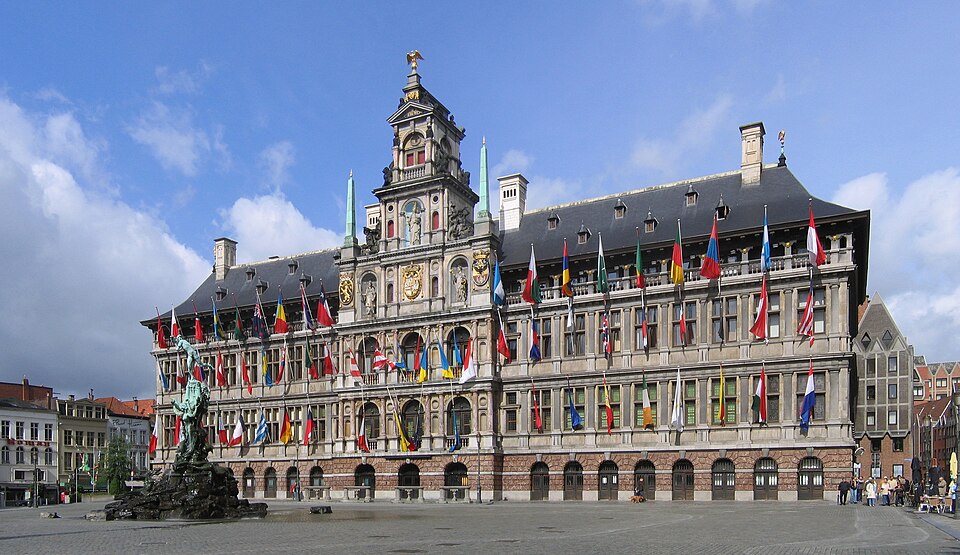
1561–1565 · Cornelis Floris II
A long, symmetrical stone façade with tiered classical windows and a central pedimented gable closes one side of a large market square, its restrained Italian-influenced detailing set against the taller, more ornate guild houses beside it.
Built between 1561 and 1565 to a design by Cornelis Floris II and several uncredited collaborators, the building mixes local tradition with Italian Renaissance detailing. It stands on the market square's western side and still serves as the seat of municipal government. Despite its civic function, it is classified among the Belfries of Belgium and France, a UNESCO listing shared with the nearby cathedral's tower.
- Its belfry is grouped for UNESCO purposes with dozens of other bell towers in Belgium and France, rather than listed on its own.
Photo: No machine-readable author provided. Klaus with K assumed (based on copyright claims). (CC BY-SA 3.0)
Het Steen
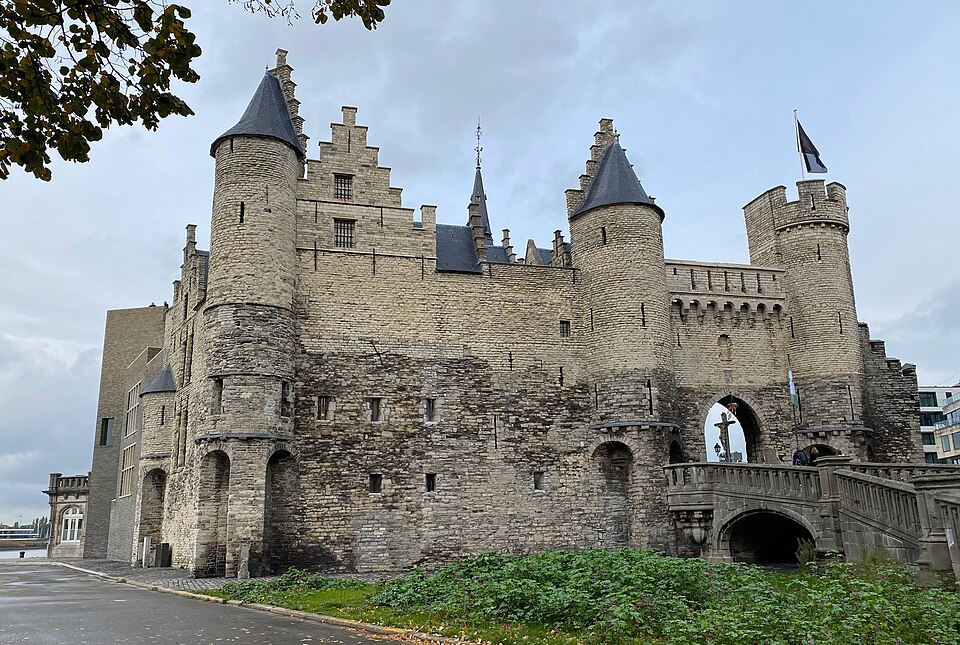
1200–1225
What remains is a single low, thick-walled stone block — originally just the gatehouse of a far larger castle pulled down in the nineteenth century — smaller and plainer than its fortress appearance first suggests, and older than any other building around it.
Built between 1200 and 1225, this fortress was originally the gateway to a larger castle belonging to the Dukes of Brabant; the rest of that castle was demolished in the nineteenth century. As the first stone fortification of the city wall, it is the oldest building still standing there. It has since served as a museum and, at other times, a prison.
- Its Dutch name is often translated as "the rock" in English, though that is not its true historical origin.
Photo: -wuppertaler (CC BY 4.0)
Plantin-Moretus Museum
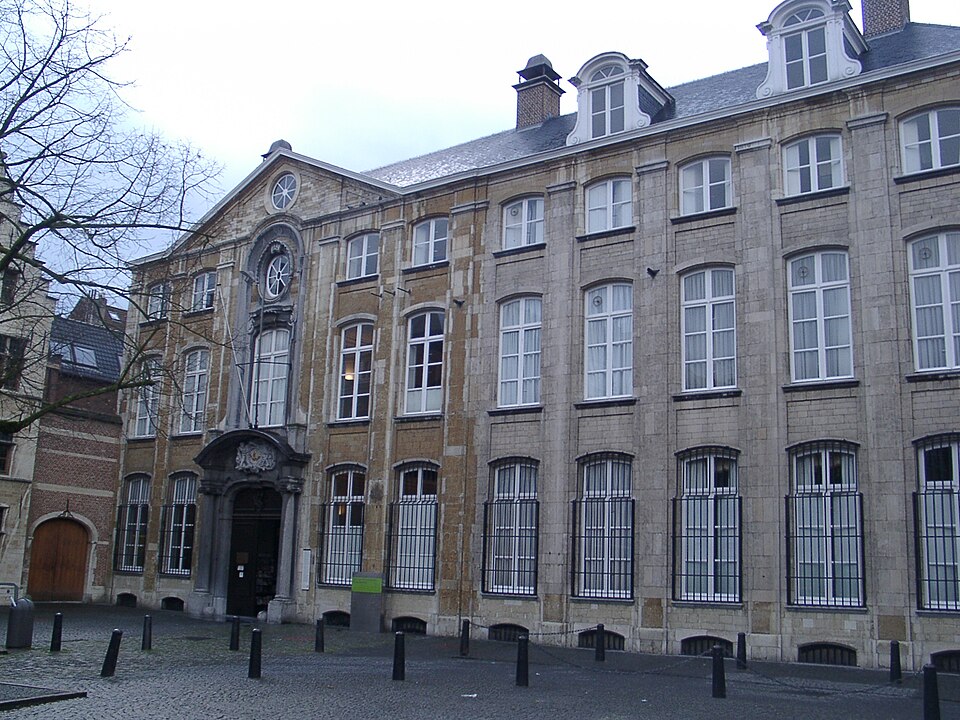
1576
The former printer's residence keeps its original rooms much as they were when they held the presses of the family printing business, set on a market square distinct from the city's main one.
The building on the Vrijdagmarkt served for four centuries as both the residence of the Plantin-Moretus family and the site of their printing company, founded by Christophe Plantin and Jan Moretus in the second half of the sixteenth century. It now houses a museum devoted to the history of printing in the city, and has been a UNESCO World Heritage Site since 2005.
- The same building served as both family home and print workshop for close to four hundred years before it became a museum.
Photo: Klaus Graf (CC BY 2.5)
Boerentoren
A high-rise built between 1929 and 1932 in Art Deco style, one of Europe's first tall buildings. It remained the tallest building in the city, second only to the cathedral spire, until the Antwerp Tower overtook it in 2019.
Brabo Fountain
An eclectic-style fountain in front of the City Hall on the Grote Markt, dating from 1887. Its bronze statue by Jef Lambeaux depicts the city's legendary founder Silvius Brabo throwing the severed hand of the giant Antigoon into the Scheldt.
Grote Markt
The city's central square, lined with the Renaissance Town Hall and guildhalls whose ornate façades are mostly 19th- and 20th-century reconstructions after old paintings. A few originals survive intact, including Sint-Joris's façade, and the square hosts a Christmas market each winter.
Rubenshuis
The former home and workshop of Peter Paul Rubens, purchased in 1610 and rebuilt to his own designs into an Italian-palazzo-style townhouse with a courtyard garden. Now a museum devoted mainly to Rubens and his contemporaries, its main residence wing is currently closed for renovation.
Royal Museum of Fine Arts Antwerp
A neoclassical museum building in the Zuid district, designed by Jean-Jacques Winders and Frans Van Dijk, built from 1884 and completed in 1894. It houses paintings, sculptures and drawings from the 14th to 20th centuries, founded as a collection in 1810.
St. Paul's Church
A Roman Catholic church with a mainly Gothic exterior, a Baroque tower, and a richly Baroque-decorated interior. It holds paintings by Rubens, van Dyck and Jordaens, plus an outdoor Calvary of 63 life-size statues and nine reliefs.
St. James' Church
A former collegiate church in Brabantine Gothic style, built by the Waghemakere family and Rombout Keldermans on the site of a pilgrims' hostel for Santiago de Compostela. Its Baroque interior holds paintings by Rubens and Jordaens alongside marble sculpture by Antwerp craftsmen.
Stock Exchange
The Handelsbeurs opened in 1531 as the world's first purpose-built commodity exchange, later inspiring London's Royal Exchange. It fell into disuse after Antwerp's 1584–1585 fall, burned in 1858, was rebuilt, and served as a stock exchange again from 1872 until 1997.
Vleeshuis
A former guildhall known as the Butchers' Hall, now a museum between the Drie Hespenstraat, Repenstraat and Vleeshouwersstraat. The nearby slope where Drie Hespenstraat meets the Burchtgracht was historically known as the Bloedberg, or Blood Mountain.
St. Charles Borromeo Church
A Baroque church on Hendrik Conscienceplein, built in 1615–1621 as Antwerp's Jesuit church and rededicated to Saint Charles Borromeo in 1779. It was once famed for 39 ceiling paintings by Rubens, lost when lightning struck the building in 1718.
Middelheim Open Air Sculpture Museum
A 24-hectare open-air sculpture park within Nachtegalen Park, displaying around 400 works including roughly 215 sculptures by artists such as Auguste Rodin, Carl Andre and Franz West. New pieces are added yearly, and contemporary artists including Ai Weiwei have created works specifically for the site.
Zoo
A zoo in the city centre next to the Antwerpen-Centraal railway station, established on 21 July 1843. It is the oldest animal park in Belgium and one of the oldest zoos in the world.
Hendrik Conscience Heritage Library
The city's repository library, named after the Flemish writer Hendrik Conscience, with a history dating back to 1481 and known as the City Library until 2008. It holds over a million books, focused on Dutch literature, Netherlandish history and early printed works from before 1830.
Olympisch Stadion
The main stadium built for the 1920 Summer Olympics, hosting athletics, football, gymnastics, rugby and other events, plus a demonstration korfball match. Later converted into a football venue, it is now home to K Beerschot VA, though the Olympic athletics track no longer survives.
Palace of Justice
A courthouse designed by the Richard Rogers Partnership, VK Studio and Arup, built on the site of the former Antwerp-South railway station over the Bolivar Tunnel. Nicknamed De Frietzakken and the Butterfly Palace, it was inaugurated on 28 March 2006 by King Albert II.
Museum aan de Stroom
A museum along the river Scheldt in the Eilandje district, opened in May 2011. It is the largest museum in the city.
Port Authority Building
A government building in the Eilandje district of the port, built between 2009 and 2016 and designed by Zaha Hadid, who died the year it opened. The diamond-shaped structure sits atop a former fire station and now houses about 500 Antwerp Port Authority employees.
Waterpoort
A monumental gate in the Zuiderdokken area, sculpted by Huibrecht van den Eynde and Johannes van Mildert and erected in 1624. It originally served as a water gate on the Scheldt river and as an honorary gate for King Philip IV of Spain.
Maagdenhuis Museum
An art and history museum in a 17th-century building on Lange Gasthuisstraat, used as an orphanage for maidens from the mid-16th to late 19th century. One of the smallest museums in the city, it holds paintings and sculpture by Rubens, Jordaens and others.
Sterckshof
A castle in the Deurne district, built in the 1920s as a reconstruction on the site of a much older castle or manor house. From 1994 to 2014 it housed the province of Antwerp's silver museum.
Schoonselhof cemetery
A cemetery in Hoboken with Islamic and Jewish sections, alongside a Commonwealth war graves plot laid out by Philip Hepworth, the Commonwealth War Graves Commission's principal architect. It holds 1,557 British Commonwealth service personnel from the two World Wars, plus Polish, French and American burials.
ModeMuseum Antwerpen
A fashion museum founded on 21 September 2002, collecting and exhibiting textiles and fashion creations under the administration of Antwerp province. It focuses on Belgian designers such as Martin Margiela, Dries Van Noten and Ann Demeulemeester, who rose to fame in the 1980s and 1990s.
Museum Mayer van den Bergh
A museum built around the collection of art dealer Fritz Mayer van den Bergh (1858–1901). Most works are Gothic and Renaissance pieces from Belgium, including paintings by Pieter Brueghel the Elder.
Eisenmann Synagogue
An Orthodox Ashkenazi synagogue at 30 Oostenstraat, established as a congregation by Jacob Eisenmann in 1905 and completed in 1907. It is the only synagogue in the city to have survived the Holocaust and the Nazi occupation of Belgium.
History
Antwerp grew up around a river crossing, defended from about 1200 by the stone fortress now known as Het Steen. Wealth from trade financed a long building spree: construction on the Gothic cathedral ran from 1352 to 1521, the Renaissance city hall went up between 1561 and 1565, and the printer Christophe Plantin set up his workshop nearby in the same decades. The Spanish Fury of 1576 and the Dutch Revolt that followed cut off much of that trade and slowed new building for generations. A nineteenth-century revival, tied to the port's renewed growth, produced a rebuilt stock exchange and, between 1895 and 1905, the grand station that still serves as the city's rail terminus. The 1920 Summer Olympics, hosted soon after, marked the city's return to the international stage.