Landmarks in Ghent
A medieval river city preserved less by design than by three centuries of decline.
Ghent grew at the confluence of the Scheldt and the Leie, and its wealth in the Late Middle Ages — one of the richest cities in northern Europe by 1300 — paid for a dense cluster of stone towers around the old trade centre. Three of them, the Belfry, Saint Bavo's Cathedral and Saint Nicholas' Church, still define the skyline in a tight line above the rooftops, raised over the thirteenth to sixteenth centuries in Gothic, Brabantine Gothic and Romanesque work. The moated Gravensteen, older and plainer, stands apart as the seat of the counts who once ruled the region. Because the city's fortunes fell after the late sixteenth century, little of this medieval fabric was ever replaced, leaving the centre unusually intact.
Gravensteen
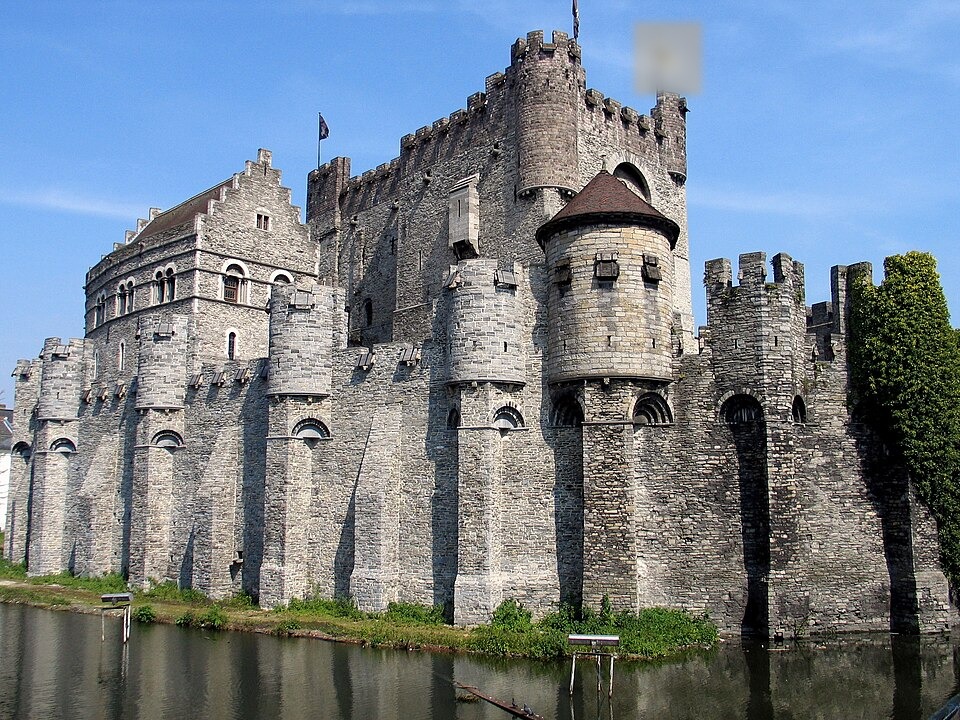
1180
A compact keep encircled by its own moat; the crisp, complete outline it now has comes from a restoration finished in 1903, not from an unbroken medieval survival.
The current structure dates from 1180 and served as the residence of the Counts of Flanders until 1353. It was later repurposed in turn as a courthouse, a prison, a mint, and even a cotton mill. By the late nineteenth century it had fallen into disrepair; a restoration completed in 1903 gave the castle much of the fortress-like appearance it presents today. Encircled by its own moat — a genuine water castle — it is a protected monument and now operates as a museum.
- For a time it served as a cotton mill.
- It also functioned as the city's mint, striking coins within its walls.
- Its familiar fortress-like silhouette today owes largely to a restoration finished in 1903.
Photo: Paul Hermans (CC BY-SA 3.0)
Belfry of Ghent
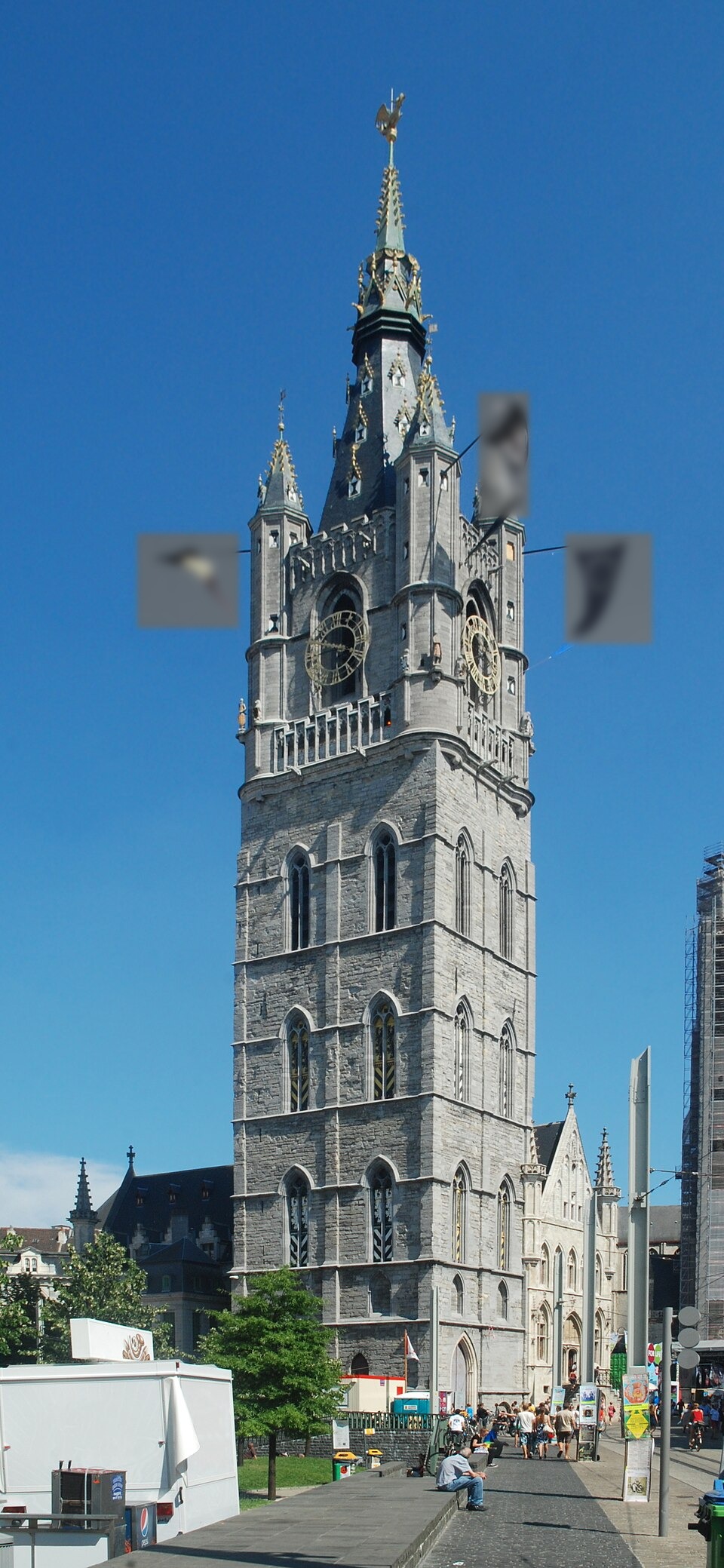
1313–1380 · Jan van Haelst
A slender Gothic tower standing 91 metres tall, taller than either of the two church towers it shares the historic skyline with.
Designed by Jan van Haelst, this Gothic tower rose over the course of the fourteenth century, from a commission in 1313 to completion around 1380. At 91 metres it is the tallest belfry in Belgium, one of three medieval towers — alongside a cathedral and a parish church — that define the skyline of the old city centre. Together with its attached buildings, it belongs to a cross-border set of belfries in Belgium and France inscribed as a single UNESCO World Heritage Site.
- At 91 metres it is the tallest belfry in Belgium.
- It is part of a single UNESCO World Heritage listing that spans both Belgium and France.
- It shares the old city skyline with two church towers — a cathedral and a parish church — that stand beside it.
Photo: EmDee (CC BY-SA 4.0)
Saint Bavo's Cathedral
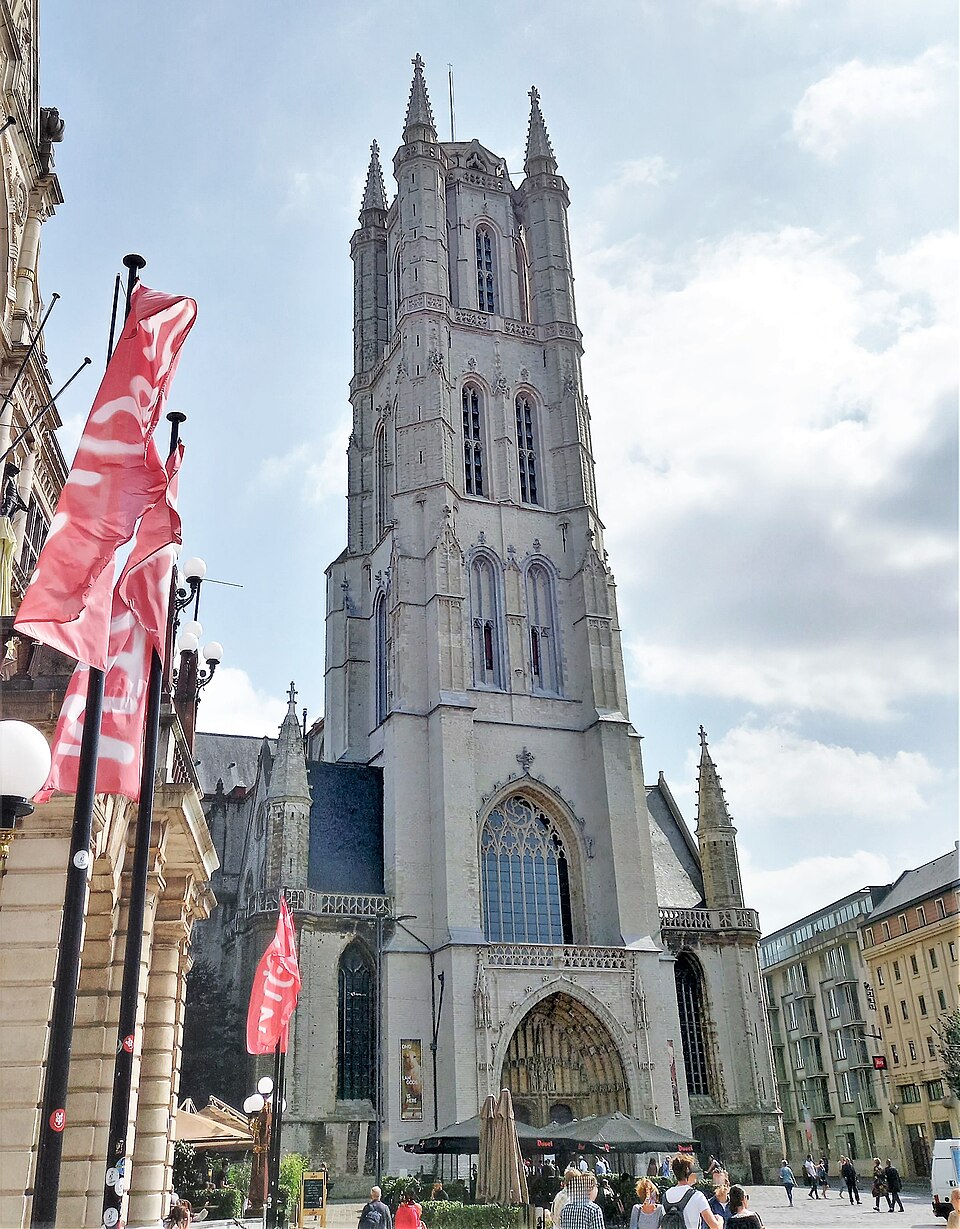
1569
An 89-metre Gothic church whose fabric mixes Romanesque, Gothic and Brabantine Gothic phases, best known for housing an altarpiece called the Adoration of the Mystic Lamb.
Built up over several architectural phases, from Romanesque beginnings to later Gothic and Brabantine Gothic work, the cathedral reached substantially its present form in 1569. Standing 89 metres tall, it serves as the seat of the Diocese of Ghent and is named for Saint Bavo of Ghent. It houses the Ghent Altarpiece, also known as the Adoration of the Mystic Lamb, and is a protected monument.
- Sources place its completion as much as six decades apart, reflecting a construction that unfolded across a long stretch of time.
Photo: Cmcmcm1 (CC BY-SA 4.0)
Saint Nicholas' Church
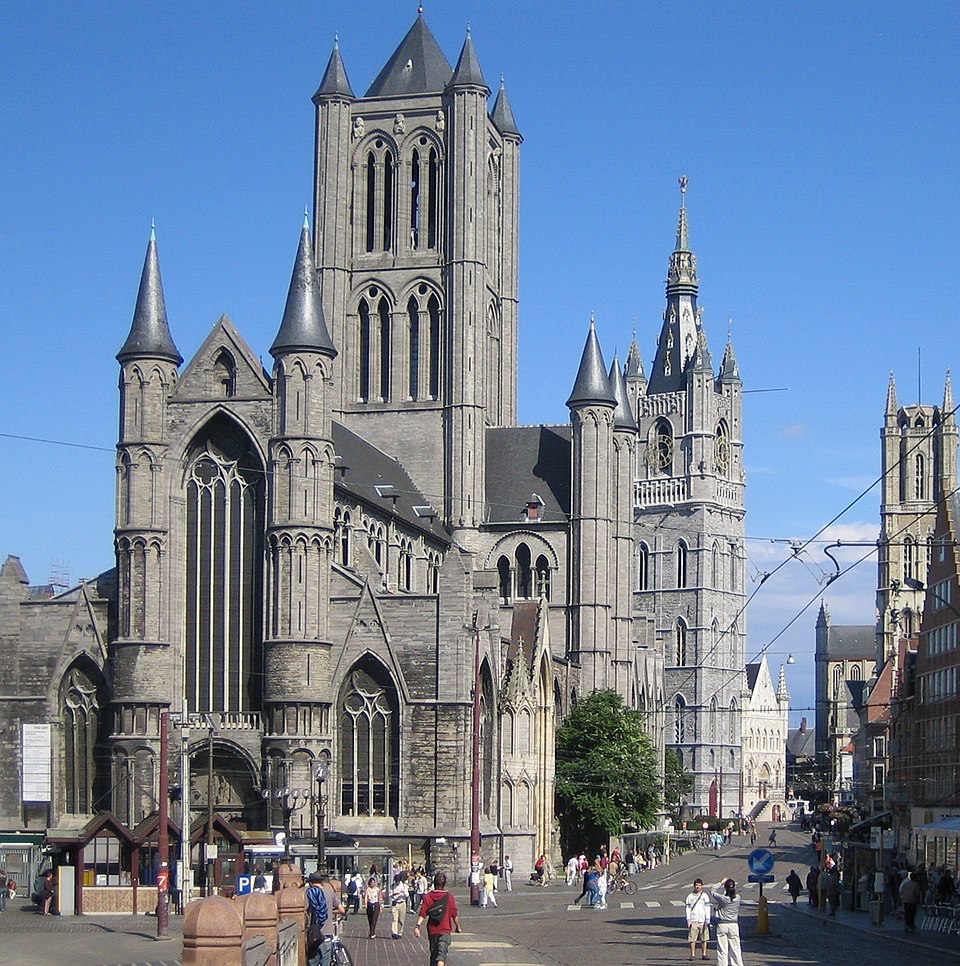
13th century
A blue-grey stone church in the Scheldt Gothic style, with a single tower over the crossing and slender turrets at each corner, standing beside the old Wheat Market in the historic centre.
Begun in the early thirteenth century as a replacement for an earlier Romanesque church, it was built over the rest of the century in the local Scheldt Gothic style, using blue-grey stone from the Tournai area, a single tower over the crossing, and slender corner turrets. Standing by the old Wheat Market, it was favoured by the trade guilds, who added their own chapels along its sides in the fourteenth and fifteenth centuries. Its tower, partly funded by the city, served as an observation post and carried the town bells until the Belfry of Ghent was built.
- Its organ was built by the French organ maker Aristide Cavaillé-Coll.
Photo: Jiel Beaumadier (http://jiel.b.free.fr) (CC BY-SA 2.5)
Great St. Elizabeth Beguinage
A beguinage also known as the Old St. Elizabeth Beguinage or the Holy Corner, one of three such communities in the city. It was named, like its counterpart in Sint-Amandsberg, after Elizabeth of Hungary, also known as Saint Elizabeth of Thuringia.
Saint Peter's Abbey
A former Benedictine abbey, now used as a museum and exhibition centre.
Great Beguinage, Sint-Amandsberg
An eight-hectare beguinage in the Sint-Amandsberg suburb, just outside the city centre, built between 1873 and 1874. It replaced the Old St. Elizabeth Beguinage in the centre, one of three such communities in the city, alongside Our Lady Ter Hooyen.
Boekentoren
A book tower designed by Belgian architect Henry van de Velde, forming part of Ghent University Library. It houses 3 million books and stands directly beside the Blandijn, home to the Faculty of Arts and Philosophy.
Museum of Fine Arts
An art museum on the east side of Citadelpark, designed by city architect Charles van Rysselberghe around 1900 and reopened in 2007 after a four-year restoration. Its collection of about 9,000 artworks, from the Middle Ages to the 20th century, focuses largely on Flemish art.
Saint Michael's Church
A Roman Catholic church built in the late Gothic style. It is known for its rich interior decoration.
Laarne Castle
A moated water castle near Laarne, about 15 kilometres southeast of Ghent, the historic capital of the County of Flanders. Its lordship can be traced to Beatrix van Massemen, recorded as lady of Laarne between 1213 and 1222.
Dulle Griet
A medieval large-calibre gun, cast in the city and nicknamed 'Mad Meg' after a figure from Flemish folklore.
Huis van Alijn
A museum on the Kraanlei, housed in the former Alijn Hospital that gives it its name. Its collection focuses on local culture and everyday life in the 20th century.
Saint Bavo's Abbey
A former abbey founded in the 7th century by Saint Amand, at the confluence of the Leie and Scheldt rivers. Raided twice by Vikings in the 9th century, its monks fled to Laon for nearly 50 years before returning to re-establish it.
Hotel d'Hane-Steenhuyse
An 18th-century hôtel particulier, or grand townhouse, on the Veldstraat. It was formerly owned by the D'Hane de Steenhuyse family.
Prinsenhof
A historic residence of the Counts of Flanders from the 15th century, after the Gravensteen fell into disuse. Holy Roman Emperor Charles V was born there in 1500, and later held the States General of the Netherlands there; only the postern gate survives today.
Vrijdagmarkt
A city square in the historic centre, named for the weekly market held there every Friday morning. One of the oldest squares in the city, it has played an important role in its history.
Sint-Pietersplein
A city square south of the historic centre, named after Saint Peter's Abbey on its east side. It is Ghent's largest public square, hosting events such as the annual Mid-Lent Fair, and is a protected cityscape.
Design Museum Gent
A museum of international design, its complex combining an 18th-century mansion with a modern wing in the tourist centre. The collection centres on Belgian design, supported by international objects.
Museum of Industry
The Museum of Industry, Work and Textiles, known as MIAT, in a city that was the centre of the Flanders textile region. It is an Anchor Point on the European Route of Industrial Heritage.
Campo Santo
A well-known Roman Catholic public burial ground in Sint-Amandsberg, in the district of Dampoort. It has been declared a historical monument by the Belgian government.
Drongen Abbey
A monastic complex on the River Leie in Drongen, formerly a Premonstratensian abbey. It has belonged to the Jesuits since 1837, and the whole property, including its garden, was declared a protected monument in 1998.
Zebrastraat
A small street holding the country's first worker-housing building, designed by architect Charles van Rysselberghe in 1906. The building, also called Zebrastraat, is now a private project combining housing, business and cultural initiatives.
Planet Group Arena
A multi-use stadium, known as Ghelamco Arena until 2024, that hosts the home matches of football club K.A.A. Gent. Opened on 17 July 2013 as the first newly built Belgian football stadium since 1974, it seats 20,185 and replaced the Jules Ottenstadion.
Ghent University Museum
A museum using academic heritage to show how science actually works, opened in 2020 alongside the university's botanical garden. It describes itself as a 'Forum for Science, Doubt and Art', highlighting doubt and failure as part of the research process.
History
The city began as a settlement where the Scheldt and the Leie rivers meet, and by the Late Middle Ages it had grown into one of the richest cities in northern Europe, home to some 50,000 people by 1300. The Gravensteen, raised in 1180 as the residence of the Counts of Flanders, is the oldest survivor from that era. Saint Nicholas' Church followed from the early thirteenth century, its tower doubling as bell-carrier and lookout post next to the old trade centre. The Belfry, begun in 1313 and finished by 1380, eventually took over the bell-ringing role and, at 91 metres, became the tallest such tower in the country. Saint Bavo's Cathedral reached substantially its present form later still, in 1569. After the late sixteenth century Ghent's fortunes declined, and the medieval centre these buildings define was rarely rebuilt, leaving it unusually well preserved today.