Landmarks in Athens
Ancient temples, a Roman theatre and a marble stadium sit within reach of one rocky hill.
Almost every landmark covered here sits on or immediately below one limestone hill, the Acropolis, where fifth-century-BC temples to Athena stood beside others now reduced to ruin. A short walk south-east, a Roman-era temple to Zeus, begun by Athenian tyrants and finished centuries later under Hadrian, once carried over a hundred columns; sixteen still stand. On the Acropolis's own slope, a stone theatre finished in AD 161 remains in use. Further south, a stadium first laid out as a racecourse was rebuilt in marble and refurbished in the nineteenth century for the revived Olympic Games. Building here spans Classical Greek, Roman and revivalist work, most of it concentrated within sight of that single hill.
Parthenon
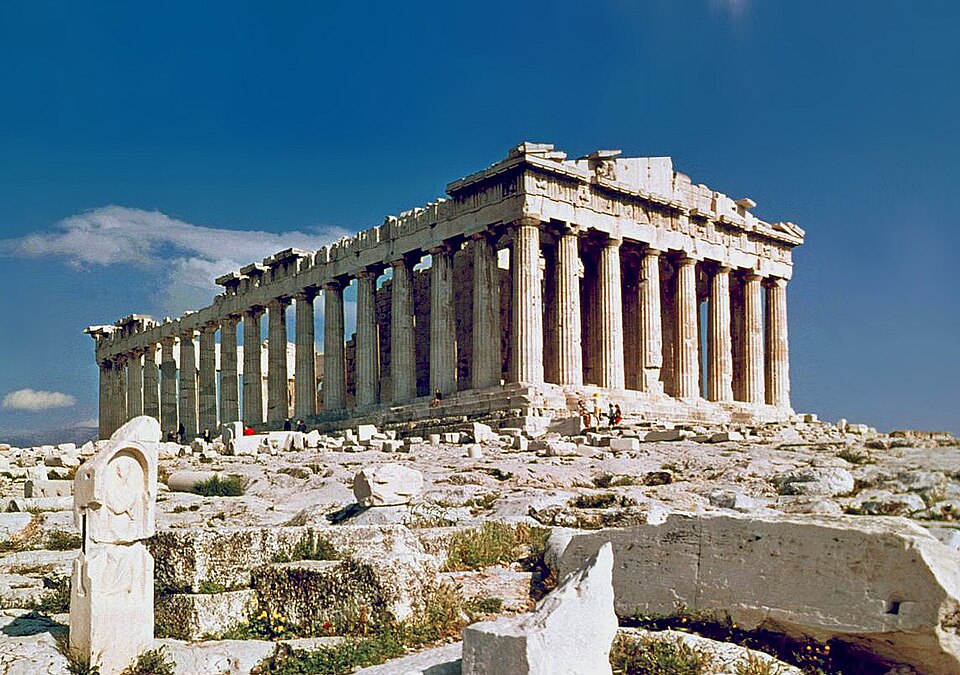
438 BC · Ictinus
A rectangular temple encircled on every side by a continuous row of columns, standing roofless and part-ruined with sections of its colonnade missing, crowning the flat summit of a rocky hill above the surrounding city.
A former temple to Athena on the Athenian Acropolis, built between 447 and 438 BC under Ictinus, with Callicrates and Phidias also credited; work on its sculpture continued until 432 BC. It doubled as a treasury and later became a Christian church, then, after the Ottoman conquest, a mosque. In 1687 a Venetian bombardment ignited an Ottoman gunpowder store kept inside it, causing serious damage. Between 1800 and 1803 many of its surviving sculptures were removed by the 7th Earl of Elgin, a move that remains disputed.
- It served for a time as the treasury of the Delian League.
- After the Ottoman conquest it was converted into a mosque.
- A Venetian bombardment in 1687 detonated an Ottoman gunpowder store housed inside it.
Photo: Steve Swayne (CC BY 2.0)
Acropolis of Athens
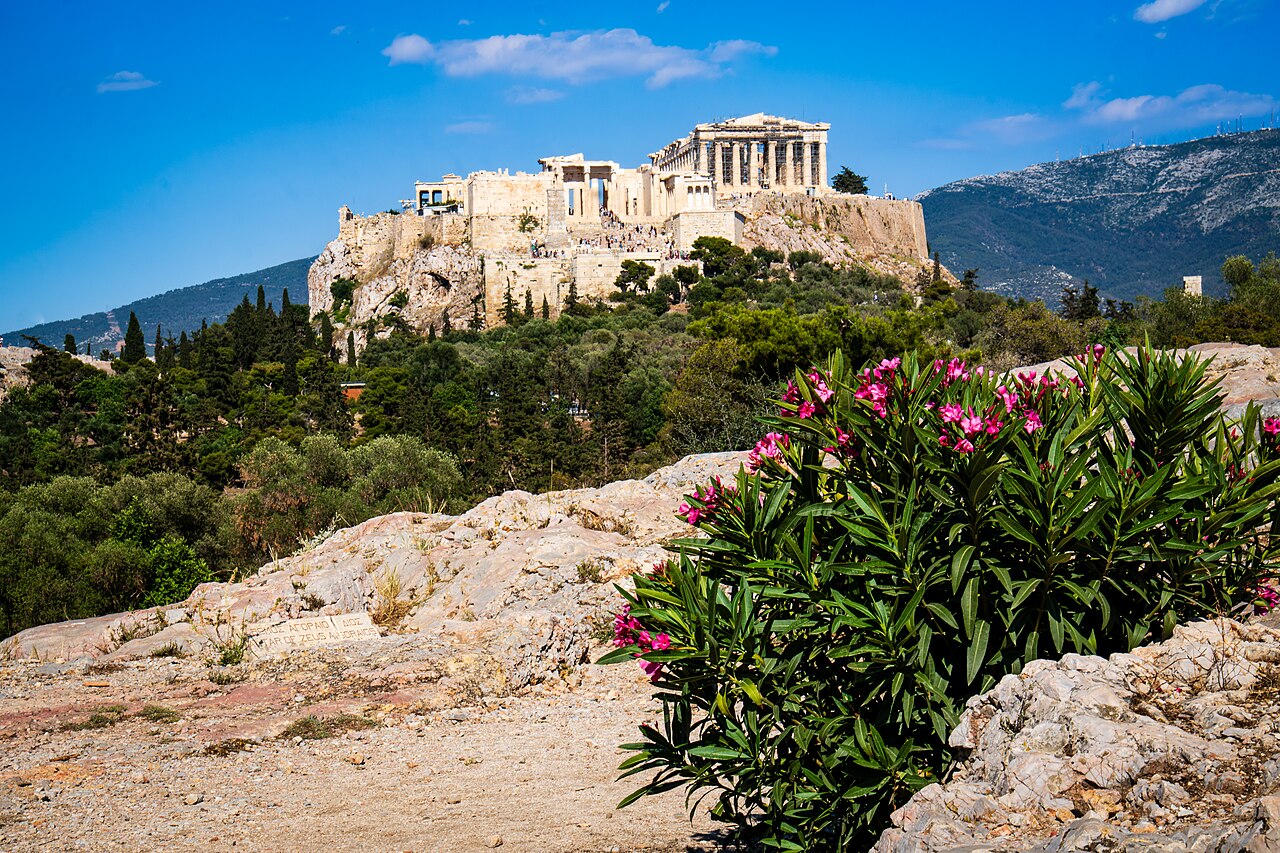
5th century BC
A cluster of roofless stone ruins spread across the flat top of a steep rocky outcrop that rises well above the surrounding rooftops, visible from much of the lower city.
An ancient citadel on a rocky outcrop above the city, inhabited as early as the 4th millennium BC and known in antiquity as Cecropia. In the fifth century BC, Pericles coordinated construction of its most significant surviving buildings, among them the Parthenon, the Propylaea, the Erechtheion and the Temple of Athena Nike. The site was seriously damaged in 1687, when a Venetian bombardment during the Morean War hit an Ottoman gunpowder store kept inside the Parthenon and set it off.
- The hill shows signs of habitation as far back as the 4th millennium BC.
- In antiquity it was known as Cecropia, after a legendary serpent-bodied king.
Photo: A.Savin (CC BY-SA 3.0)
Temple of Olympian Zeus
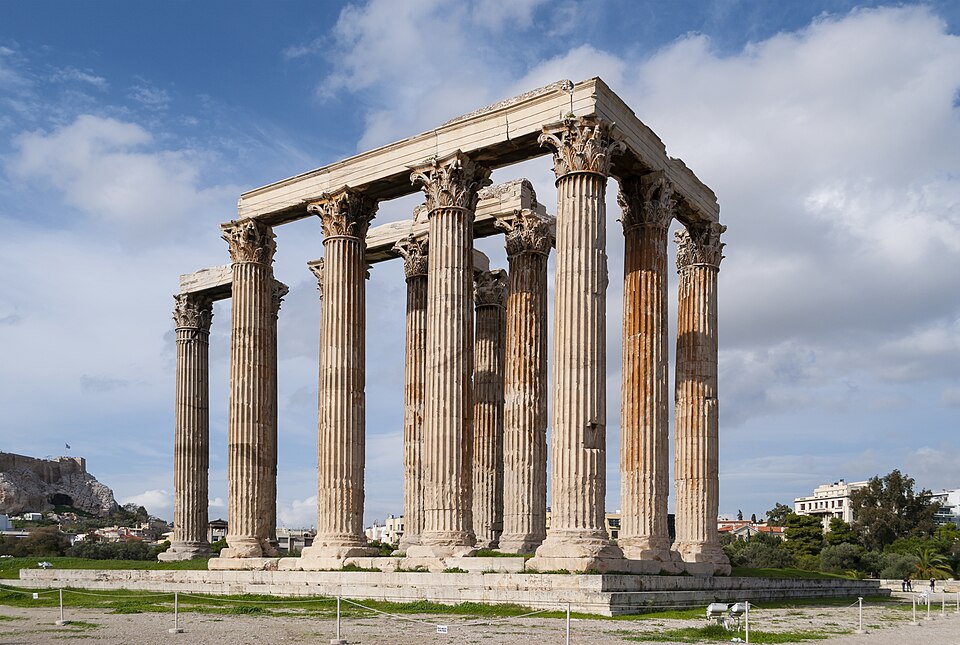
AD 131
A row of sixteen colossal Corinthian columns standing alone in an open precinct, all that remains upright of what was once a temple of over a hundred such columns.
A colossal temple to Zeus begun in the 6th century BC by Athenian tyrants who envisioned the largest temple in the ancient world, but left unfinished for over six centuries. The Roman emperor Hadrian completed it in the 2nd century AD, by which point it carried 104 colossal columns and housed one of the largest cult statues known in antiquity. It fell into disuse after being pillaged during a Germanic invasion in 267 AD and was later quarried for building stone used elsewhere in the city. Sixteen of the original columns still stand.
- Its construction spanned roughly 638 years, from the Athenian tyrants to Hadrian's completion.
- It once held one of the largest cult statues built in antiquity.
Photo: Ava Βabili (CC BY-SA 4.0)
Odeon of Herodes Atticus
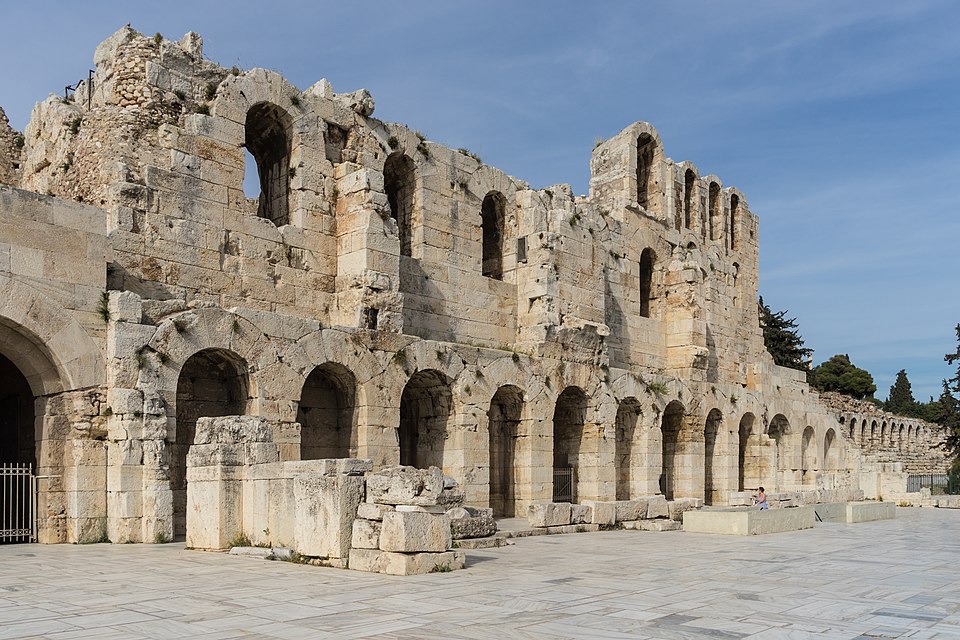
AD 161
A curved stone theatre structure set into the lower slope of a rocky hill, its tiered seating banked into the hillside itself.
A stone theatre on the Acropolis's south-west slope, built in the ancient Roman architectural style and today classified as an archaeological site in Greece. It was completed in AD 161 and later renovated in 1950. The brief record gives no further detail on who commissioned or designed it, its seating capacity, or the scope of that renovation.
Photo: Jebulon (CC0)
Panathenaic Stadium
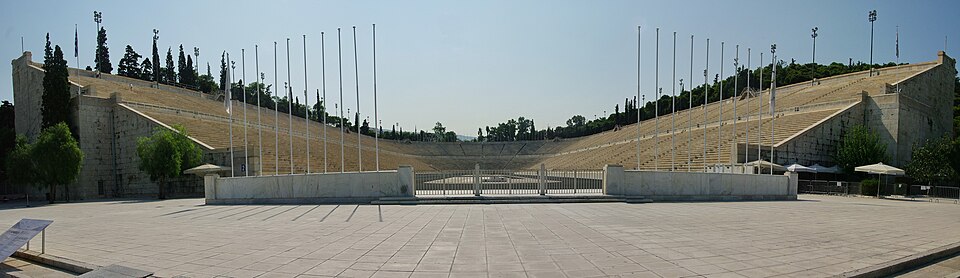
1896 · Anastasios Metaxas
Tiered seating and a running track built entirely of pale marble, the only stadium of its kind constructed completely from that stone.
A racecourse on this site was laid out by the Athenian statesman Lykourgos around 330 BC, mainly for the Panathenaic Games. Herodes Atticus, a Roman senator, rebuilt it in marble by AD 144, seating up to 50,000. It fell into disuse after Christianity's 4th-century rise, was excavated in 1869, and hosted the unofficial Zappas Olympics of 1870 and 1875. Refurbished under architects Anastasios Metaxas and Ernst Ziller, it staged the first modern Olympics' opening and closing ceremonies in 1896, held Olympic events again in 2004, and remains a marathon's finish point.
- It is the only stadium in the world built entirely of marble.
- It hosted the unofficial Zappas Olympics of 1870 and 1875, decades before the first modern Games.
- It is the last venue in Greece from which the Olympic flame is formally handed to a new host nation.
Photo: Bgabel (CC BY-SA 3.0)
Erechtheion
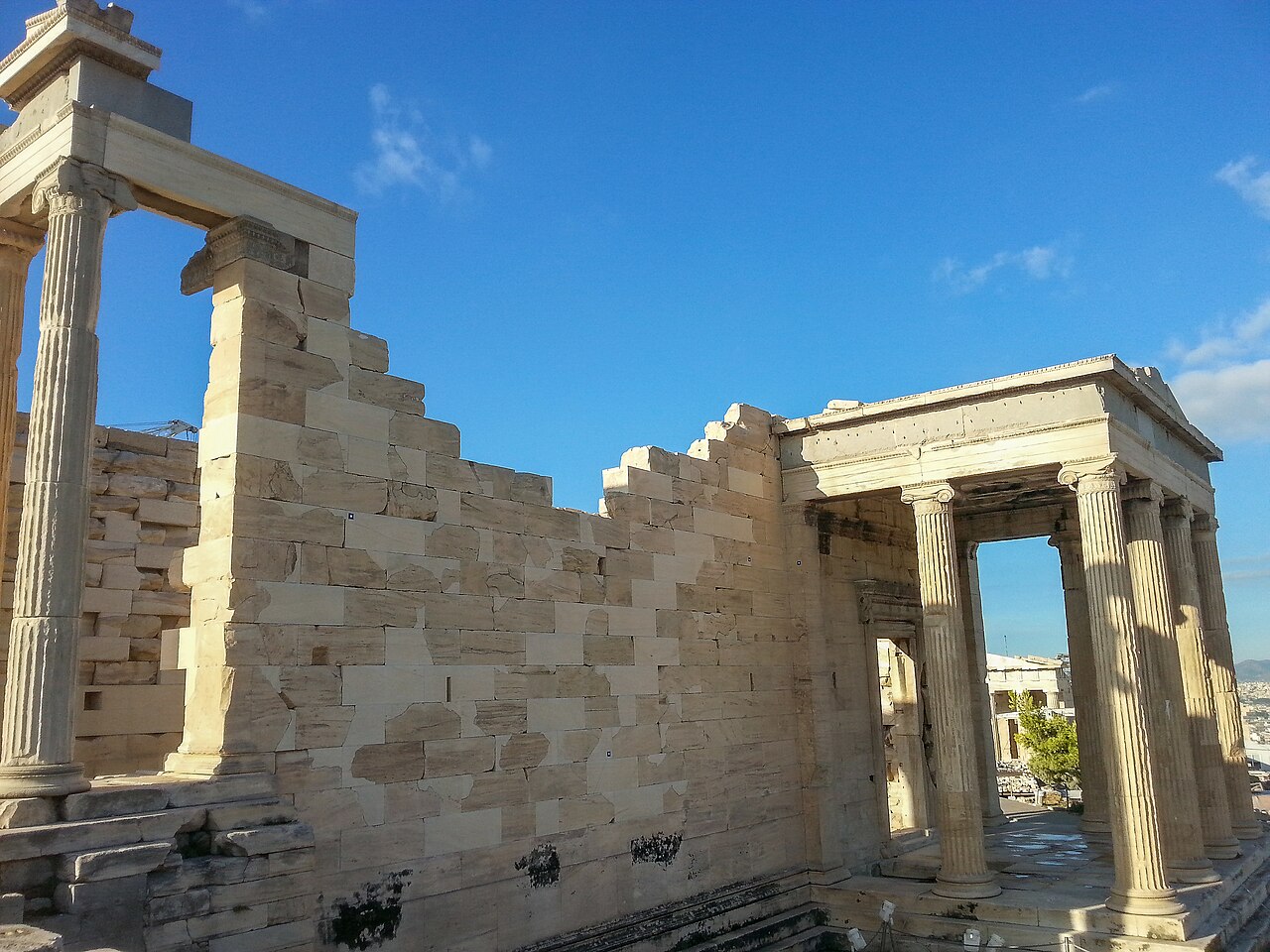
421–406 BC
An irregular, asymmetrical temple with a porch projecting from one side known as the Porch of the Maidens, breaking from the rectangular symmetry typical of Greek temple design.
An Ionic temple on the north side of the Acropolis, built to house the cult statue of Athena Polias alongside a sanctuary shared with Poseidon-Erechtheus, a joint cult traced back to references in Homer. Construction is traditionally dated to about 421–406 BC, though scholars have never settled on an architect; Mnesikles, Kallikrates and Iktinos have all been proposed. Its plan is asymmetrical, breaking from the rectangular symmetry typical of Greek temples, and includes a projecting porch known as the Porch of the Maidens. Fires damaged it in 377–376 BC and again around the 1st century BC.
- Some of its stonework was never finished: mouldings were left incomplete and the lifting bosses on certain blocks were never chiselled off.
- The identity of its architect remains unresolved; ancient and modern candidates include Mnesikles, Kallikrates and Iktinos, but no source confirms any one of them.
- The joint cult it once housed, of Athena and Poseidon-Erechtheus, is traced back to references in Homer.
Photo: HerrAdams (CC BY-SA 4.0)
Propylaea
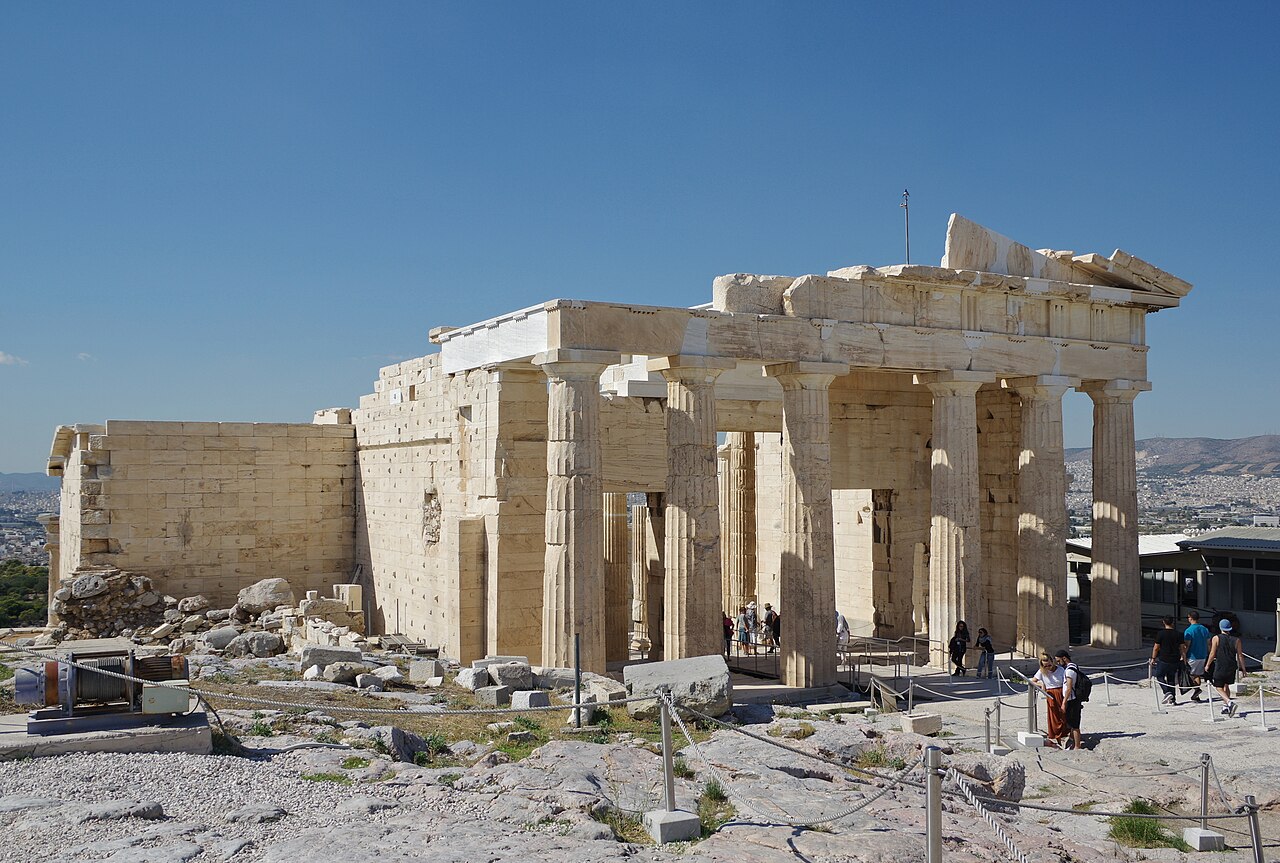
437–432 BC · Mnesikles
Its colonnade mixes outer Doric columns with Ionic columns inside its west hall, an unusual pairing for a single building. Its two flanking wings are asymmetrical: a north-east wing that held a picture gallery, the Pinakotheke, was finished in full, while the wing facing it was left a shortened, truncated version.
A monumental Doric gateway that replaced a series of earlier entrances to the Acropolis, the oldest traced to a Mycenaean-era wall on the same site. Mnesikles, later identified by Plutarch as the architect, planned five interconnected halls, but only three were finished before the project was abandoned unfinished in 432 BC, its stone surfaces left undressed. A marble stairway was added in the Roman period under Claudius. Later centuries turned its rooms to religious and military use in turn: a Byzantine-era chapel, a tenth-century church dedicated to the Taxiarches, a fortified medieval residence, and an Ottoman powder magazine.
- A Roman-era staircase added around 42 AD included a central ramp built specifically to lead sacrificial animals up to the sanctuary.
- Its entrance gate, the Beulé Gate, was built in the late third century AD from the dismantled stones of a separate monument, the Choragic Monument of Nikias.
- Under Ottoman rule it served as a gunpowder magazine and gun battery, and was damaged as a result.
Photo: Berthold Werner (CC BY-SA 3.0)
Academy of Athens
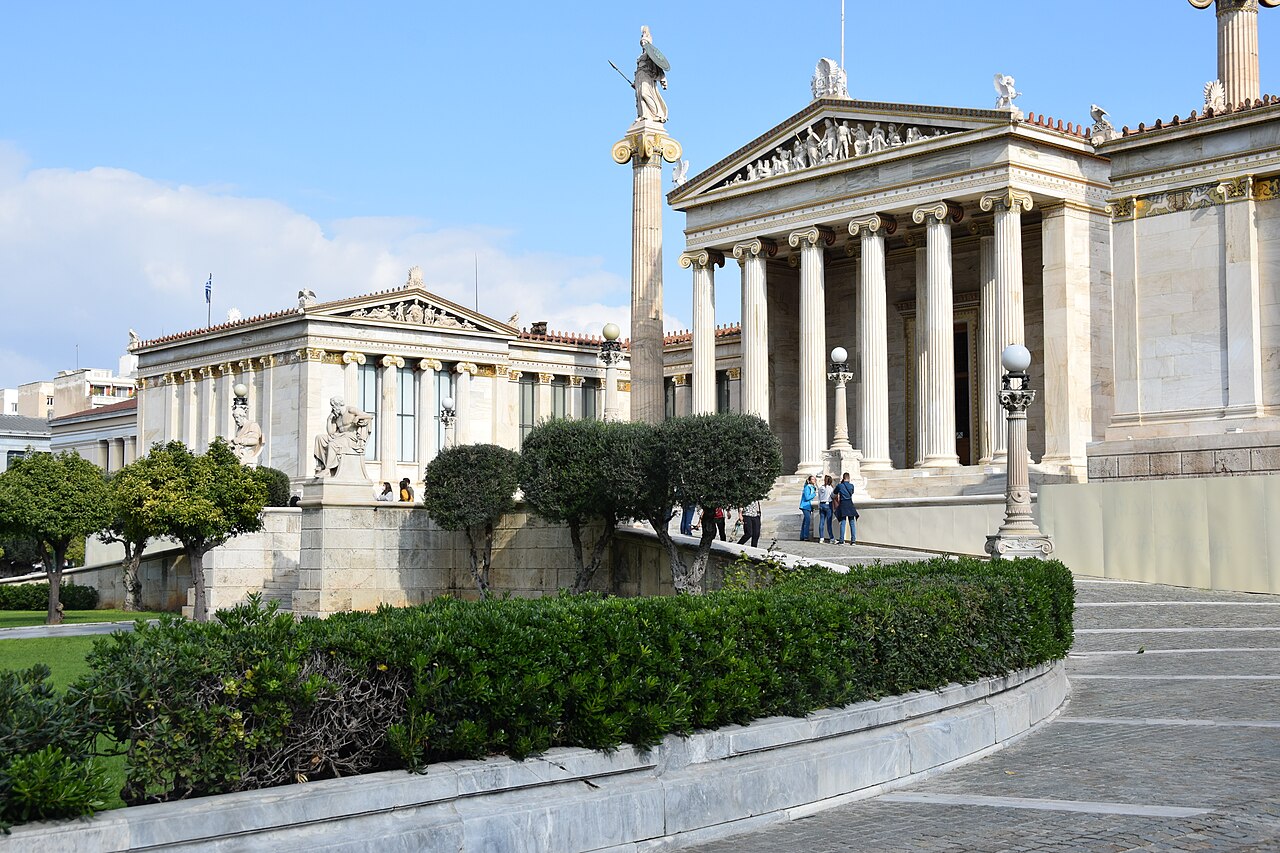
1859–1885 · Theophil Hansen
A pale stone neoclassical facade fronted by two tall columns each topped with a standing marble figure, and, before the entrance steps, two seated marble figures on separate pedestals; a crowded multi-figure relief fills the triangular pediment above.
A neoclassical building in central Athens, one of three designed in 1859 by the Danish architect Theophil Hansen alongside a university and a national library, funded chiefly by the magnate Simon Sinas. Construction, supervised after 1861 by Ernst Ziller, was disrupted by political unrest during King Otto's final years and halted for several years before finishing in 1885. Sculptor Leonidas Drosis carved its pediment relief of a deity's birth and its two column-top figures, plus the seated statues before its steps. After housing several museums in turn, the building became home to Greece's national academy, founded separately in 1926.
- Its pediment relief, depicting the birth of Athena from a design by the painter Carl Rahl, won first prize at the 1873 Vienna Exhibition.
- Before the Academy itself existed, the building housed the Numismatic Museum, then the Byzantine Museum and the State Archives.
- A Greek €100 commemorative coin minted for the 2004 Athens Olympics carries a close view of the building on its obverse.
Photo: Jean Housen (CC BY-SA 4.0)
Arch of Hadrian
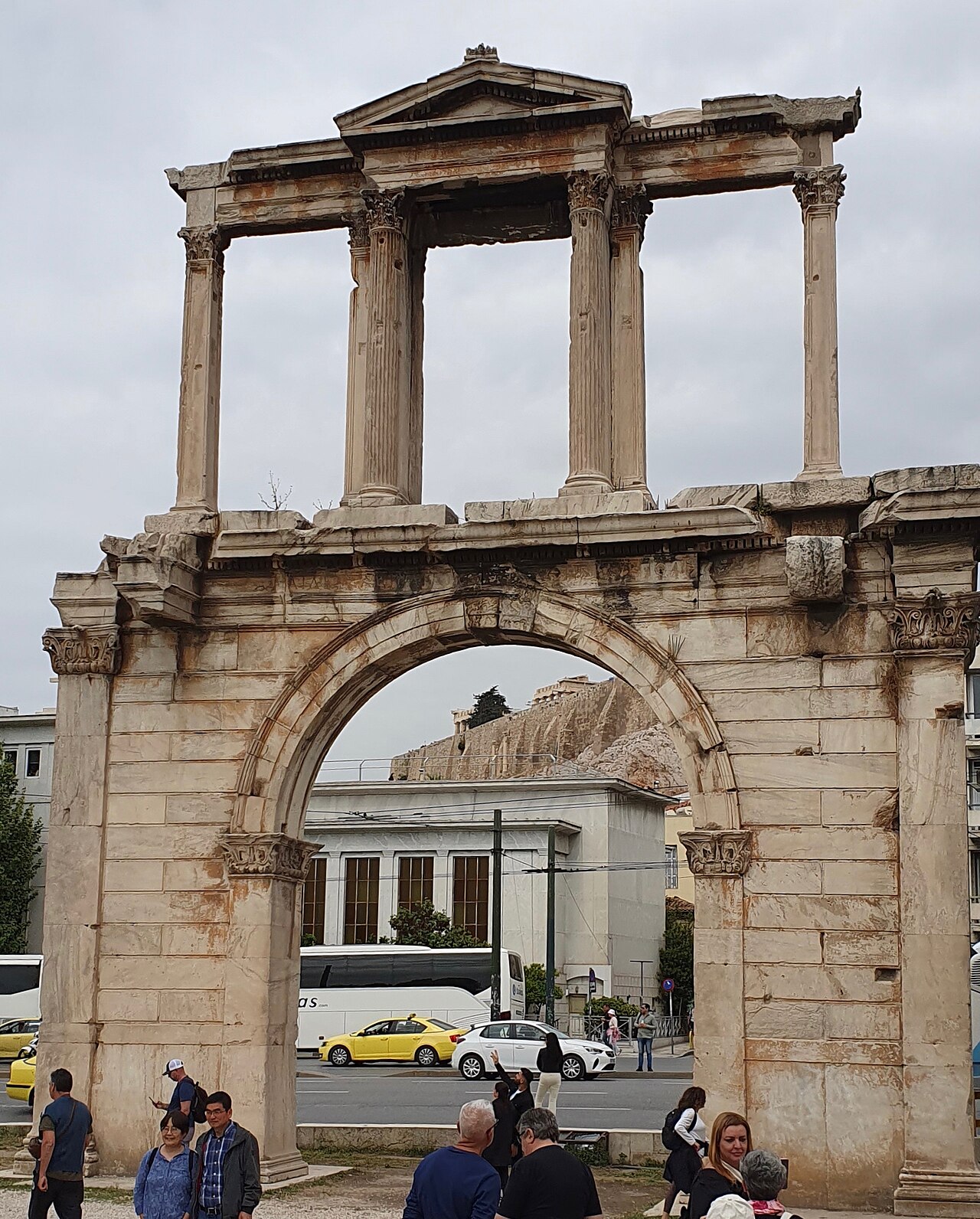
AD 131–132
A tall, symmetrical marble gateway in two storeys: a single round-arched passage below, flanked by columns, and an upper level of three rectangular openings divided by more columns, the centre one crowned by a triangular pediment.
A monumental gateway of white Pentelic marble, built without mortar and jointed only with metal clamps, that once stood where a road ran from the ancient city centre toward the Temple of Olympian Zeus. It is thought to mark the emperor Hadrian's honouring around AD 131 or 132, though no source names its architect, and it is not even certain who commissioned it. Two inscriptions on its architrave, facing opposite ways, name Theseus and Hadrian in turn as the city's founder; whether they described two separate districts remains disputed. Its recessed upper niche has stood empty since antiquity.
- Its two architrave inscriptions face opposite directions: one calls the city Theseus's, the other Hadrian's; the old theory that they marked a real boundary between two districts has since been disproved by excavation.
- It is built of Pentelic marble, the same stone used for the Parthenon, though of a lower grade with more visible inclusions.
- Its upper level was carved so thin and finely worked that, unlike typical Roman triumphal arches, it could not have supported heavy statuary such as a four-horse chariot on top.
Photo: Yair-haklai (CC BY-SA 4.0)
Syntagma Square
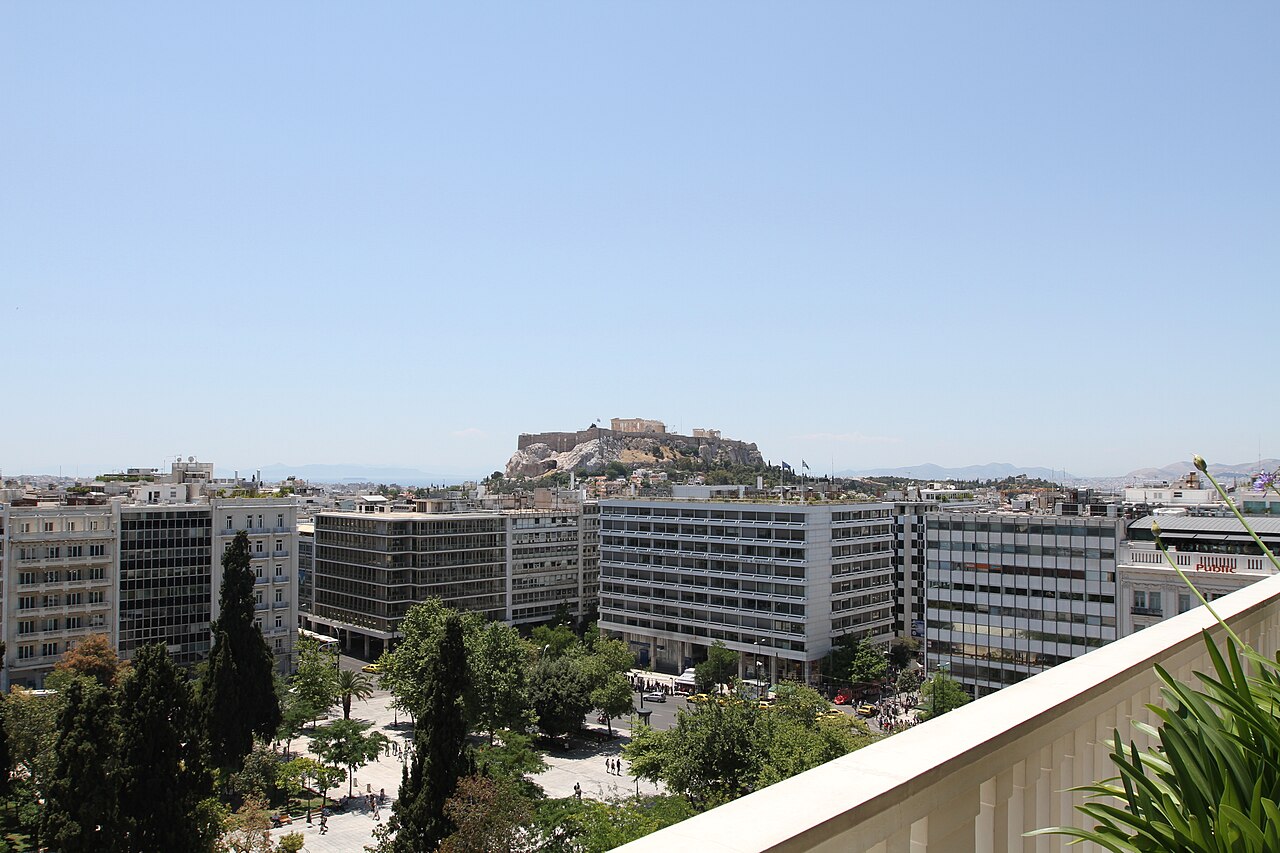
1834 (renamed 1843)
A broad paved square with two tree-planted gardens flanking a nineteenth-century fountain at its centre, its higher eastern side reached by a wide marble stairway that conceals a metro station entrance beneath it.
The city's central square, laid out in the early 1830s as one of two main plazas of a newly declared capital and first known as Palace Square, for the royal residence being built at its northern edge. In September 1843 a crowd gathered beneath the palace's windows and forced the king to grant a constitution, after which the square took its present name. A metro station lies beneath its raised eastern side, reached by a marble stairway, and the square has since hosted large political gatherings, including mass protests during the 2010–2012 debt crisis.
- In the summer of 1900, films were projected outdoors in the square's cafes, among the city's earliest public film screenings.
- Its metro station connects two lines beneath the square, forming one of the country's busiest transport hubs.
- Between 2010 and 2012, the square was the site of mass protests by crowds of many thousands during the Greek government debt crisis.
Photo: 7777777kz (CC BY 3.0)
Tower of the Winds
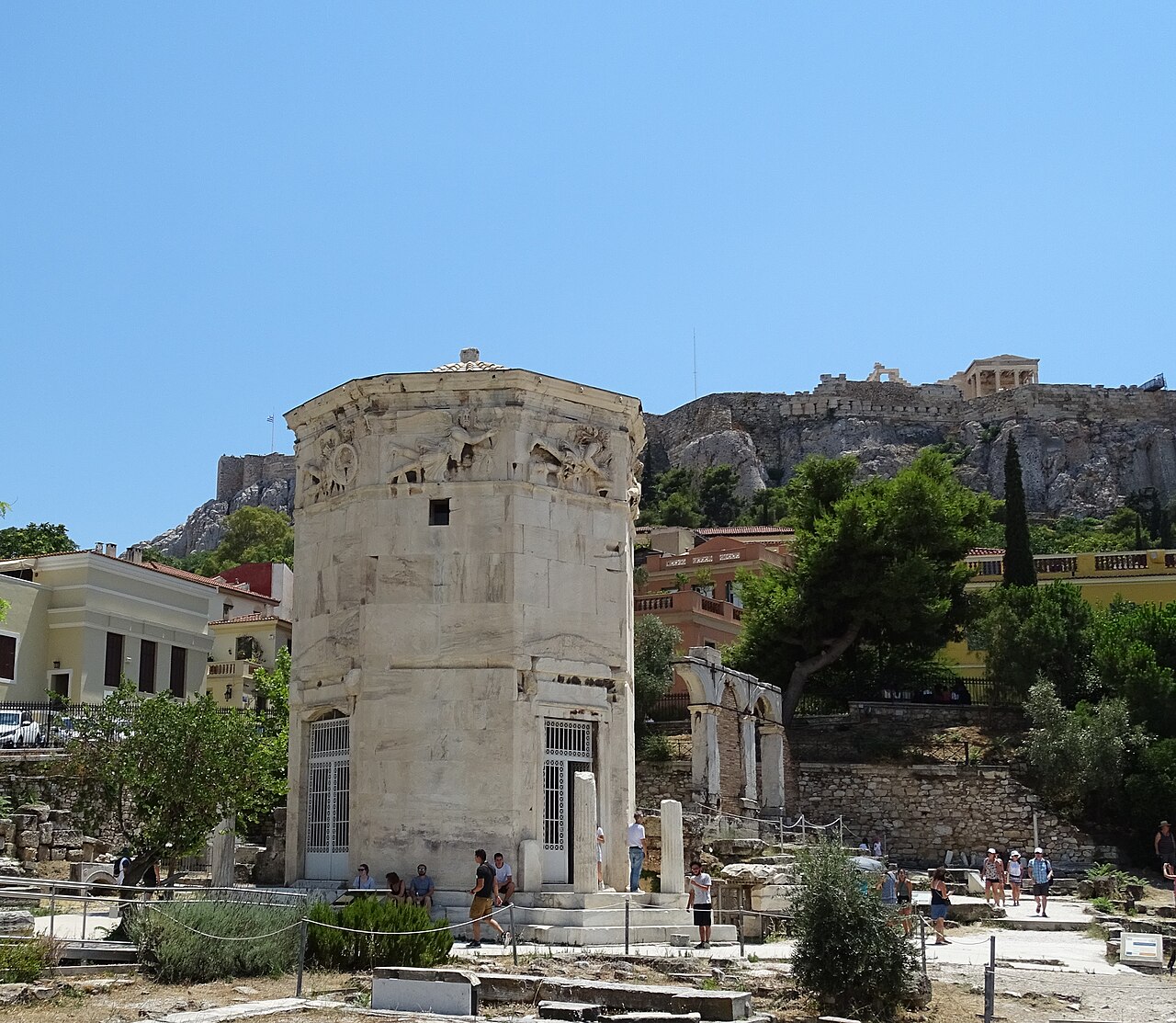
by 50 BC · Andronicus of Cyrrhus
An octagonal tower carved with eight over-life-size relief figures running below its cornice, one to each face, its stepped conical roof of triangular stone slabs still largely original and once topped by a bronze weather vane, now missing.
An octagonal marble tower in the old Roman marketplace, raised on three steps and carved with eight over-life-size reliefs of wind deities running below its cornice, one to each face, above eight sundials. Designed by Andronicus of Cyrrhus, it was already standing by about 50 BC, since a Roman writer referred to it a few decades later. Inside, a water clock driven by water piped down from higher ground told the time regardless of weather; a bronze weather vane, now lost, once turned above its stone roof. It is the only clock tower to survive intact from classical antiquity.
- Its capitals use a simplified form of Corinthian carving, without the usual volutes, now known as "Tower of the Winds Corinthian"; a porch at the Royal College of Physicians of Edinburgh copies the same design.
- The stone roof, made of 24 trapezoidal slabs held by a circular keystone, is essentially original — a rarity for any surviving ancient building.
- The Roman writer Vitruvius describes its lost bronze rooftop statue, a Triton, as holding a rod that swivelled with the wind to show its direction.
Photo: Ad Meskens You are free to use this picture for any purpose as long as you credit its author, Ad Meskens. Example: © Ad Meskens / Wikimedia Commons If you use this work outside of the Wikimedia projects, a message or a copy is very much appreciated. This image is not in the public domain. A statement such as "From Wikimedia Commons" or similar is not by itself sufficient. If you do not provide clear attribution to the author you do not comply with the terms of the file's license and you may not use this file. If you are unable or unwilling to provide attribution you should contact Ad Meskens to negotiate a different license. (CC BY-SA 4.0)
Temple of Athena Nike
The smallest temple on the Acropolis, built around 420 BC and dedicated to Athena and Nike. It stands on a steep bastion beside the Propylaea entrance, its parapet carved with a frieze of winged Nikai celebrating victory.
Old Royal Palace
Greece's first royal palace, a neoclassical building facing Syntagma Square, constructed between 1836 and 1843 for King Otto I. It served as the royal residence until 1910 and has housed the Greek Parliament since 1929.
Beulé Gate
A fortified Roman-era gate leading to the Propylaia, built largely from spolia taken from the demolished Choragic Monument of Nikias. It was later built into the Post-Herulian Wall, raised after the Heruli sacked the city in 267 or early 268 CE.
Ancient Agora of Athens
An ancient Greek agora northwest of the Acropolis, bounded by the Areopagus hill to the south and Agoraios Kolonos to the west. It began as a gathering place for commerce, assembly and residence.
Theatre of Dionysus
An ancient theatre on the south slope of the Acropolis, first laid out in the mid-to-late sixth century BC within the sanctuary of Dionysus. It reached a capacity of 25,000 under Lycurgus in the fourth century BC, then decayed until its nineteenth-century excavation.
National Archaeological Museum
A museum in the Exarcheia district holding artifacts from archaeological sites across Greece, from prehistory to late antiquity. Considered one of the world's greatest museums, it holds the richest collection of ancient Greek antiquities anywhere.
Kerameikos
An area northwest of the Acropolis that was once the city's potters' quarter, giving English the word ceramic, straddling both sides of the ancient Dipylon Gate. It also served as an important cemetery, with funerary sculptures lining the Sacred Way to Eleusis.
Choragic Monument of Lysicrates
A circular monument near the Acropolis, erected by the choregos Lysicrates after his win in the 335/334 BCE dithyramb contest of the City Dionysia. Known as the first use of the Corinthian order on a building's exterior, it has been widely copied since.
Zappeion
A large palatial hall beside the National Garden, used for meetings and ceremonies both official and private. It is one of the city's most renowned modern landmarks.
National Garden
A 15.5-hectare public park in the city center, laid out behind the Old Royal Palace and stretching south to the Zappeion, opposite the Panathenaic Stadium. It also encloses ancient ruins, including column drums and Corinthian capitals, along with busts of Greek statesmen and poets.
Stoa of Attalos
A covered colonnade in the Agora, built by King Attalos II of Pergamon, who ruled between 159 and 138 BC. Reconstructed from 1952 to 1956 by the American School of Classical Studies, it now houses the Museum of the Ancient Agora.
Philopappos Monument
An ancient Roman mausoleum on Mouseion Hill, southwest of the Acropolis, dedicated to Gaius Julius Antiochus Epiphanes Philopappos, a prince of the Kingdom of Commagene who lived from 65 to 116 AD.
Mount Lycabettus
A limestone hill rising 277 meters above sea level, the highest point in central Athens, reached by a funicular railway from Kolonaki. Its twin peaks hold a 19th-century chapel, a theatre and a restaurant.
National Observatory of Athens
Greece's oldest research organization, founded in 1842 and among the oldest observatories in southern Europe. Its building was designed by architects Eduard Schaubert and Theophil Hansen, funded by the banker Georgios Sinas after lobbying from astronomer Georgios Konstantinos Vouris.
Old Parliament House
A building on Stadiou Street in central Athens that served as home to the Greek Parliament from 1875 until 1935. It now houses the country's National Historical Museum.
Acropolis Museum
An archaeological museum dedicated to finds from the Acropolis, spanning the Greek Bronze Age through Roman and Byzantine times. Opened to the public on 20 June 2009, it stands over ruins of Roman and early Byzantine Athens and displays over 4,250 objects.
Numismatic Museum
One of Greece's most important museums, holding over 500,000 coins, medals, engraved gems and related artifacts spanning from 1400 BC to modern times. It occupies the former mansion of archaeologist Heinrich Schliemann, known as Iliou Melathron, near Syntagma Square.
Little Metropolis
A Byzantine church beside the Metropolitan Cathedral of Athens, formally known as the Church of St. Eleutherius or Panagia Gorgoepikoos. It stands on Mitropoleos Square in the city center.
Presidential Mansion
The official residence of the president of the Hellenic Republic, previously known as the New Royal Palace. It served as the monarchy's palace until the Greek monarchy was abolished by the 1974 referendum.
History
Construction on the Acropolis rock began in earnest in the fifth century BC, when Pericles coordinated the building of temples including the Parthenon, raised by Ictinus, with Callicrates and Phidias also credited, between 447 and 438 BC. The Parthenon later became a Christian church, then a mosque, until an Ottoman gunpowder store inside it was hit by Venetian bombardment in 1687 and exploded. South-east of the hill, a temple to Olympian Zeus begun in the 6th century BC by Athenian tyrants stood unfinished for over six centuries until Hadrian completed it in the 2nd century AD; it was pillaged after a Germanic invasion in 267 AD and later quarried for stone. On the Acropolis's slope, a stone theatre was completed in AD 161. A nearby ancient racecourse, rebuilt in marble by the 2nd century AD, was excavated in 1869 and refurbished for the first modern Olympics in 1896.