Landmarks in Heraklion
Venetian harbour defences and Bronze Age palace ruins frame a Cretan port city's skyline.
Heraklion's Old Town wraps a Venetian harbour, and its landmarks read as layers of the powers that held the port. The Koules fortress has guarded the harbour mouth since the early sixteenth century; a short walk inland, the Morosini Fountain and the civic hall known as the Loggia belong to the same Venetian building campaign, both dated to 1628. Ottoman rule left a domed, eclectic-style church raised as the Yeni Cami mosque in 1869, converted to Orthodox worship in 1925, and Agios Minas Cathedral, seat of the Archbishop of Crete, followed within the same half-century. Outside the modern centre, the ruins at Knossos, rebuilt after a destruction around 1700 BC, predate every other structure in the city by roughly three thousand years.
Koules Fortress
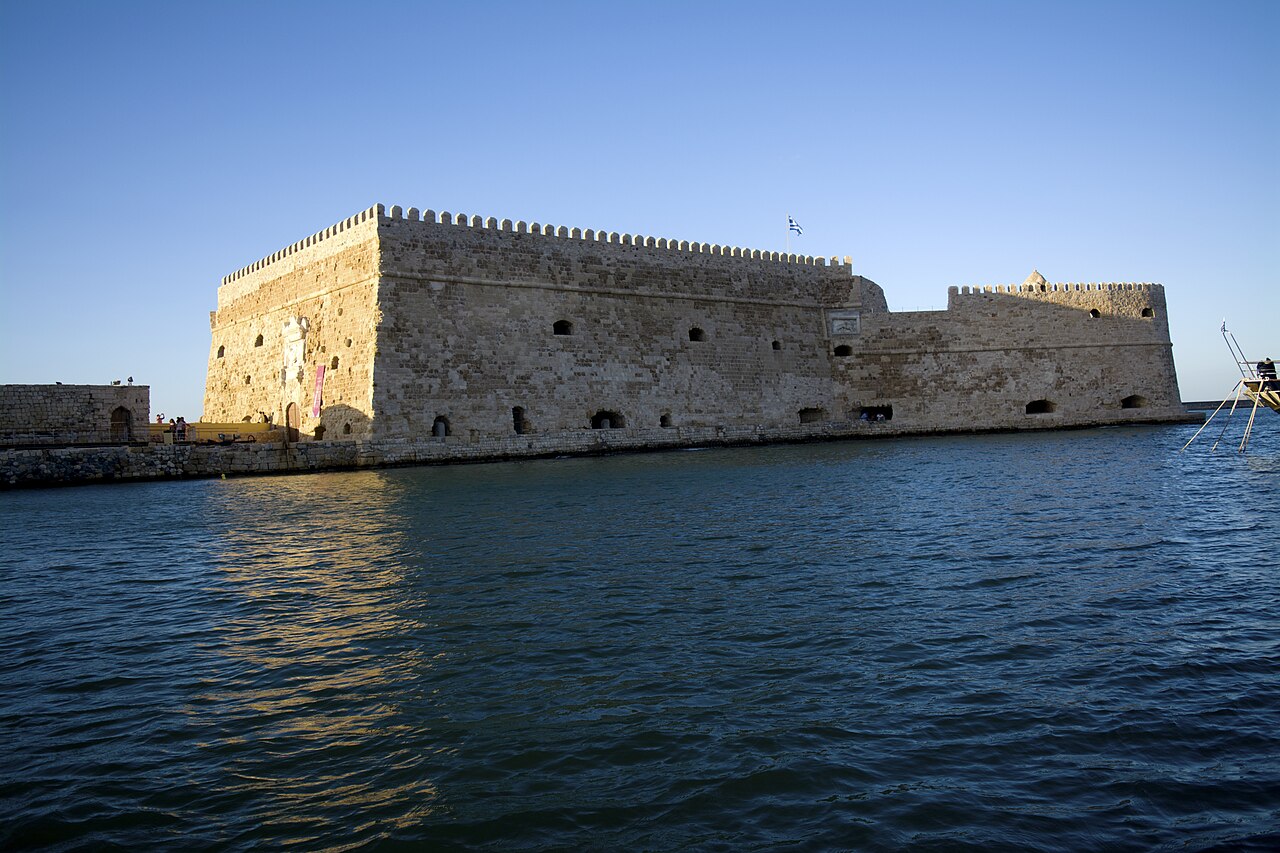
1523–1540 · Michele Sanmicheli
It sits apart from the shoreline, right at the harbour mouth, a squat fortress facing the open sea it was built to guard — the only fortification in the old port still standing intact.
The Koules Fortress stands at the mouth of Heraklion's old harbour, built by the Republic of Venice in the early sixteenth century as the Castello a Mare, or 'fort on the sea'. Michele Sanmicheli, the military engineer credited with its design, died in 1559. It was raised to control access to the port and defend the city against attack from the sea, and it has survived largely intact, remaining in good condition today.
- Its Italian name, Castello a Mare, translates simply as 'fort on the sea'.
Photo: Γεώργιος Γιαννόπουλος (CC BY-SA 3.0)
Knossos
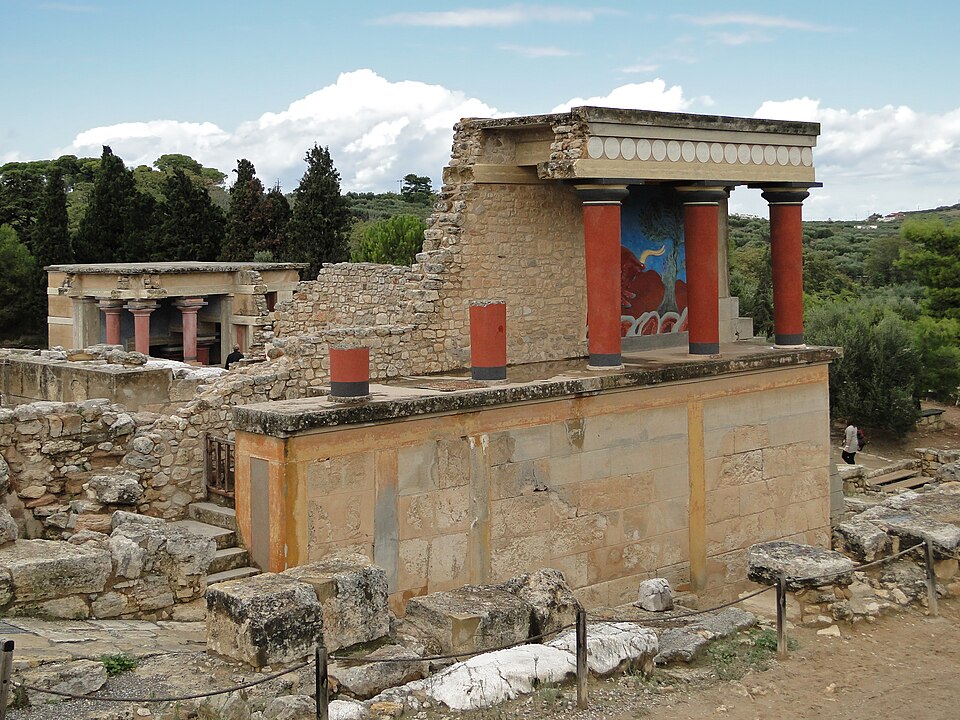
c. 1700 BC
A sprawling complex of low ruined walls, courtyards and storerooms spread across a hillside — the remains of a rebuilt palace whose scale marks it as closer to a small city than a single building.
Knossos is an archaeological site about five kilometres south of central Heraklion, occupied from the Neolithic period into the first millennium AD. Its monumental Palace of Minos is generally read as an administrative, economic, religious and ceremonial centre rather than a royal residence. First built around 1900 BC on a hill already settled for millennia, it was rebuilt and expanded after a major destruction around 1700 BC and remained the site's central monument until a final destruction around 1350 BC.
- Knossos is sometimes called Europe's oldest city, a claim resting on its Neolithic origins, Minoan importance and long continuous occupation.
- Among Greece's archaeological sites, only the Parthenon draws more visitors than the palace here.
Photo: Bernard Gagnon (CC BY-SA 3.0)
Morosini Fountain
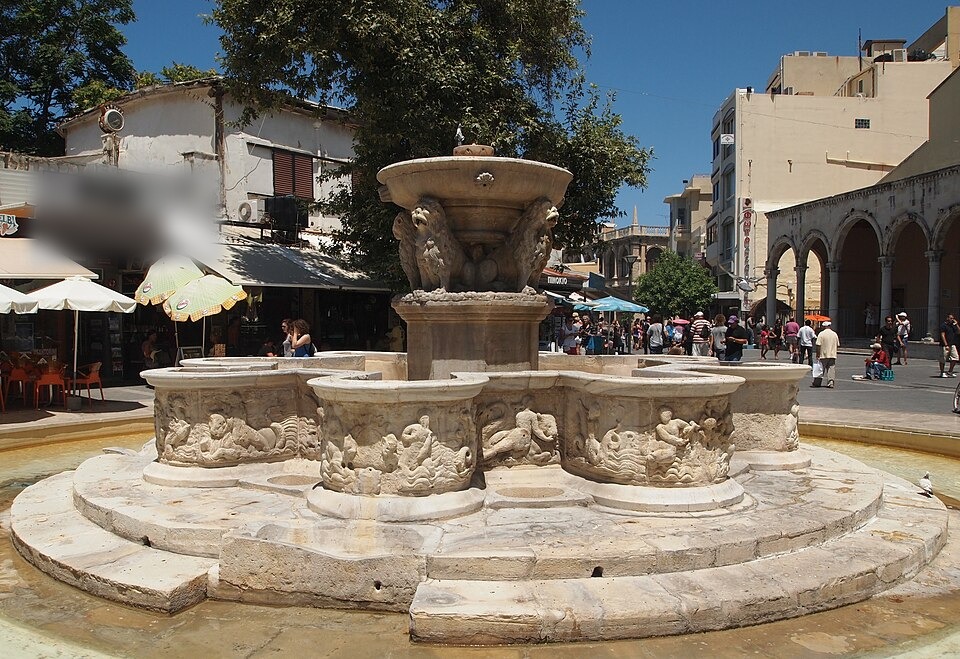
1628
A carved stone fountain dated to 1628, from the same wave of Venetian civic building that produced other monuments still standing in the city that same year.
The Morosini Fountain is a stone fountain in Heraklion, built in 1628 while the city was under Venetian rule. It survives as one of the more visible monuments from that period of the city's history.
Photo: Danbu14 (CC BY-SA 3.0)
Heraklion Loggia
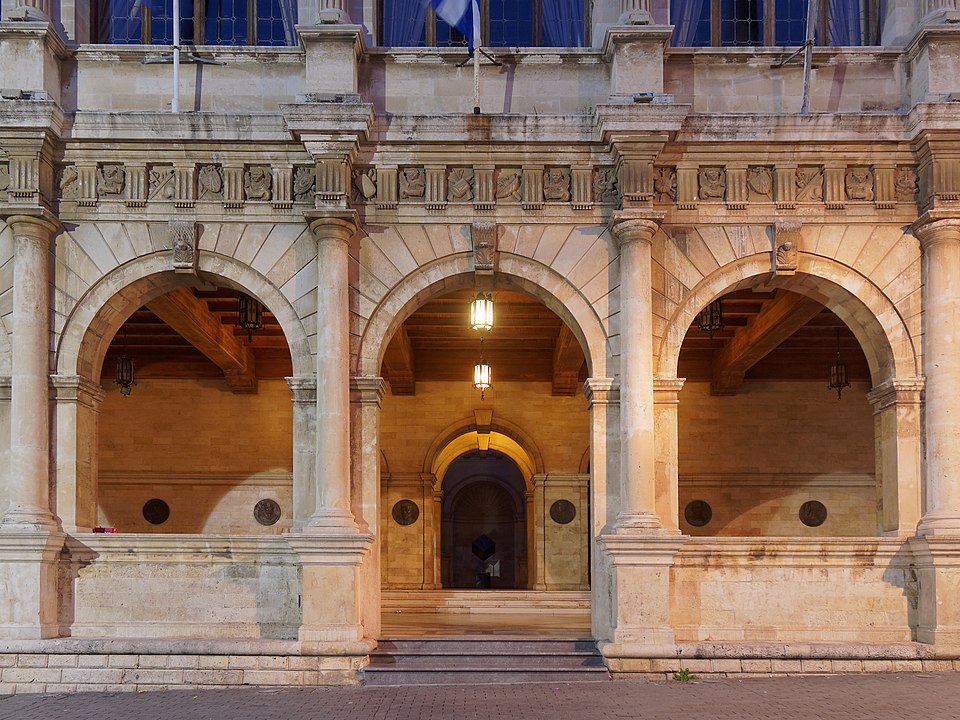
1628
Classified simply as a loggia — an open, arcaded hall — this civic building dates from 1628, the same year as other Venetian-era monuments still standing in the city.
The Heraklion Loggia is a Venetian civic building classified as a loggia, an open arcaded hall, and dated to 1628. It survives as one of the city's Venetian-era monuments, from the same building campaign that also produced the Koules Fortress and the Morosini Fountain nearby.
Photo: C messier (CC BY-SA 4.0)
Church of Saint Titus
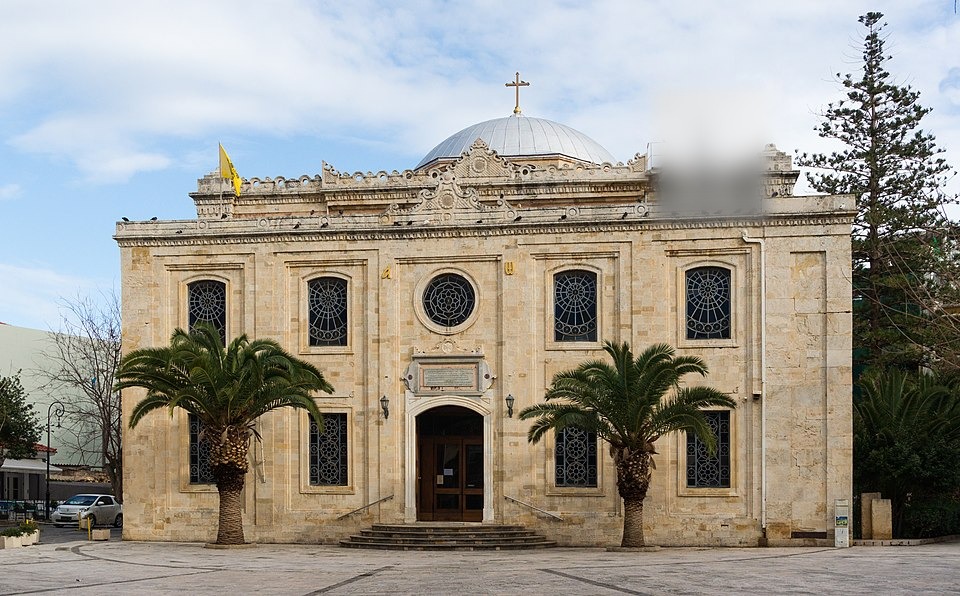
1869
A square-plan domed building in an eclectic style, its exterior broken by strong vertical lines and, at the top, a stone-carved apse.
Built in 1869 as the Yeni Cami, or 'New Mosque', this Heraklion church replaced an earlier building destroyed in the earthquake of 1856. It was converted to Christian use in 1925 and dedicated to Saint Titus, and in 2013 it was made a cathedral of the archdiocese of Crete. The structure is an eclectic-style square temple crowned by a dome, its exterior marked by strong vertical elements and, at the top, a stone-carved apse.
- Cathedral status came only in 2013, nearly ninety years after the building's 1925 conversion to Christian worship.
Photo: Jebulon (CC0)
Agios Minas Cathedral
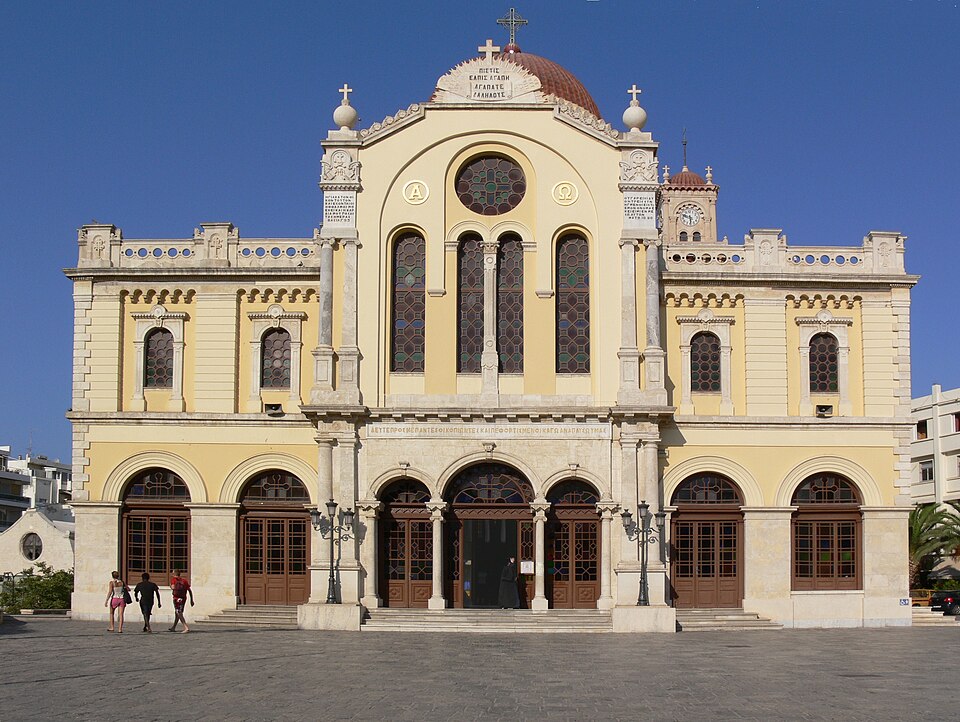
1862–1895
No architectural description survives in the record beyond its standing as the region's principal Orthodox cathedral; its silhouette and materials are not established here.
Agios Minas Cathedral is a Greek Orthodox cathedral in Heraklion, serving as the seat of the Archbishop of Crete. It is dedicated to Saint Minas, a soldier and martyr who died between 285 and 309 AD, venerated as the patron saint of the city. Construction is recorded under two dates, 1862 and 1895, a gap of more than thirty years that most likely spans the start of building work and its completion.
Photo: PawełMM (CC BY-SA 4.0)
Saint Mark's Basilica
A former Roman Catholic basilica on Eleftheriou Venizelou Square, built in 1239 during Venetian rule. Converted into a mosque after the Ottoman conquest of 1669 and used as one until 1915, it was restored after 1956 and reopened as a public art gallery.
Heraklion Archaeological Museum
One of Greece's largest museums, holding the world's most important and complete collection of Minoan art. It houses the great majority of the finds from the Minoan palace at Knossos and other Minoan sites across Crete.
Pankritio Stadium
A multi-purpose stadium completed on 31 December 2003 and opened in March 2004, with a capacity of 26,240 seats. It hosted football matches at the 2004 Summer Olympics and serves as home ground for Ergotelis, OFI, and the Greek national team.
Nikos Kazantzakis Stadium
A football stadium built in 1946 on the Martinengo bastion of Heraklion's fortifications, named for writer Nikos Kazantzakis. It was Ergotelis's home ground until the club moved to the Pankritio Stadium in 2004, and now houses the largest youth sports academy on Crete.
Phourni
An archaeological site holding a Minoan cemetery used from 2400 to 1200 BC, on a hill near Archanes in north-central Crete. Discovered in 1957 and excavated over 25 years from 1965 by Yiannis Sakellarakis, the 6,600-square-metre site contains 26 funerary buildings.
Amnisos
A Bronze Age settlement on Crete's north shore that served as the port to the palace city of Knossos. Excavations in 1932 uncovered a villa known as the House of the Lilies, named for a wall fresco depicting the flower.
Anemospilia
The archaeological site of an ancient Minoan temple on Crete.
Eileithyia Cave
A sacred cave dedicated to Eileithyia, goddess of childbirth, used from the Neolithic to the Roman era. Worship there flourished in the Late Minoan period, and the cave lies one kilometre south of the town of Amnisos.
Cultural and Conference Center of Heraklion
A performing arts centre inaugurated in 2019 after planning that spanned more than four decades. Built on a 5,670-square-metre plot with a total floor area of 28,487 square metres, it has a 750-seat auditorium and several smaller stages.
Natural History Museum of Crete
A natural history museum operating under the University of Crete, housed in a restored industrial building that once served as an electricity power plant. It studies, protects, and promotes the flora and fauna of the Eastern Mediterranean region.
Historical Museum of Crete
Founded in 1953 by the Society of Cretan Historical Studies, later expanded with a modern wing. Its collections trace Cretan art and history from the 4th century AD to the Second World War, and include two paintings by El Greco, his only works in Crete.
History
Occupation in the area goes back to at least 7000 BCE, and the palace complex at nearby Knossos, rebuilt after a destruction around 1700 BC, is central to its reputation as a candidate for Europe's oldest city. Little survives in the record from the centuries between that Bronze Age settlement and Venetian rule, when the Republic of Venice fortified the harbour with the Koules sea fort in the early sixteenth century and, by 1628, had added the Morosini Fountain and the Loggia as civic set-pieces of the same port district. Ottoman administration later replaced an earthquake-damaged church with the Yeni Cami mosque in 1869; it became the Orthodox Church of Saint Titus in 1925. Agios Minas Cathedral, seat of the Archbishop of Crete, went up across the following decades. In 2017, Heraklion was Europe's fastest-growing tourism destination, with international arrivals up 11.2 percent.