Landmarks in Beijing
Walled Ming and Qing palace, temple, and garden complexes anchor the old imperial core.
Beijing's oldest surviving monuments cluster around two former imperial cores: a walled palace and a ceremonial temple at the center of the historic city, and a garden estate of lakes and artificial hills in the northwest. The palace and the temple both date to the early fifteenth century, raised within a few years of each other as the new capital's political and ritual centers, and their enclosed courtyards and axial halls share that common origin. The garden estate belongs to a later, eighteenth-century phase of building, when landscape design rather than ceremonial symmetry set the plan: a hill built from lake-dredged soil, halls scattered along its slopes, and water covering most of the grounds. All three passed from private imperial use into public museums and UNESCO-listed sites over the twentieth century.
Forbidden City
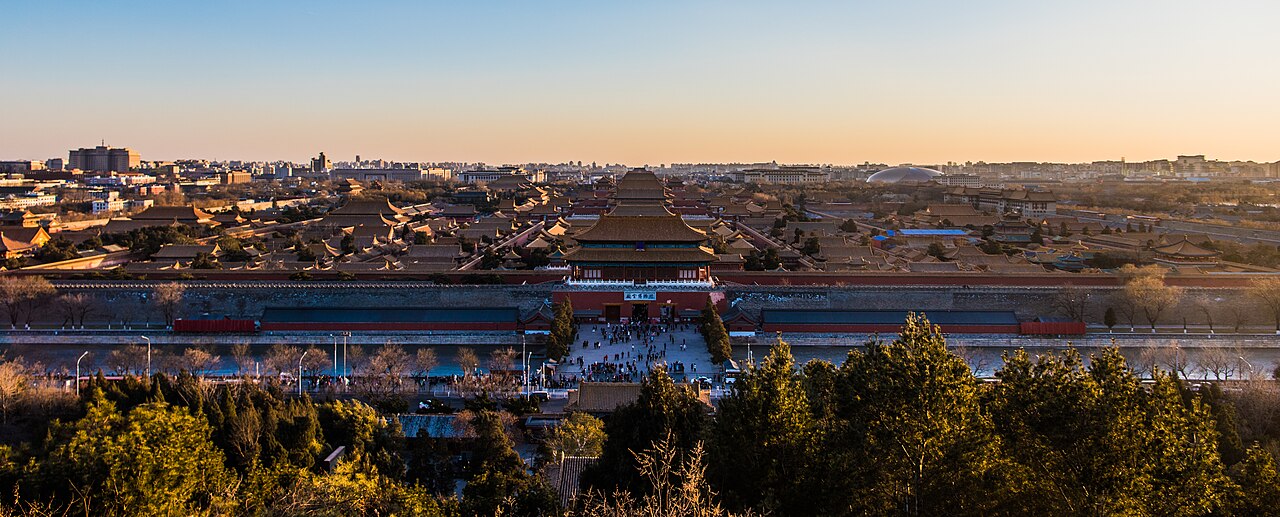
1406–1420 · Kuai Xiang
The largest preserved royal palace complex still standing anywhere: courtyard after courtyard of halls and chambers covering seventy-two hectares at the center of the old Imperial City, with a room count usually quoted as 9,999 though a careful count puts it at 8,886.
Construction ran from 1406 to 1420. The complex then served as the residence and seat of government for the emperors of China from the Ming dynasty's Yongle Emperor through the end of the Qing dynasty in 1924 — twenty-four rulers across two dynasties over more than five centuries. It is the largest preserved royal palace complex still standing anywhere, covering seventy-two hectares. Vacated in 1924, it reopened the following year as the Palace Museum, holding the imperial art collections built up under both dynasties, and was named a UNESCO World Heritage Site in 1987.
- The palace is traditionally said to hold 9,999 rooms, but a careful modern count puts the true figure at 8,886.
- It housed twenty-four emperors of two dynasties in unbroken succession for more than five hundred years.
Photo: Picrazy2 (CC BY-SA 4.0)
Temple of Heaven
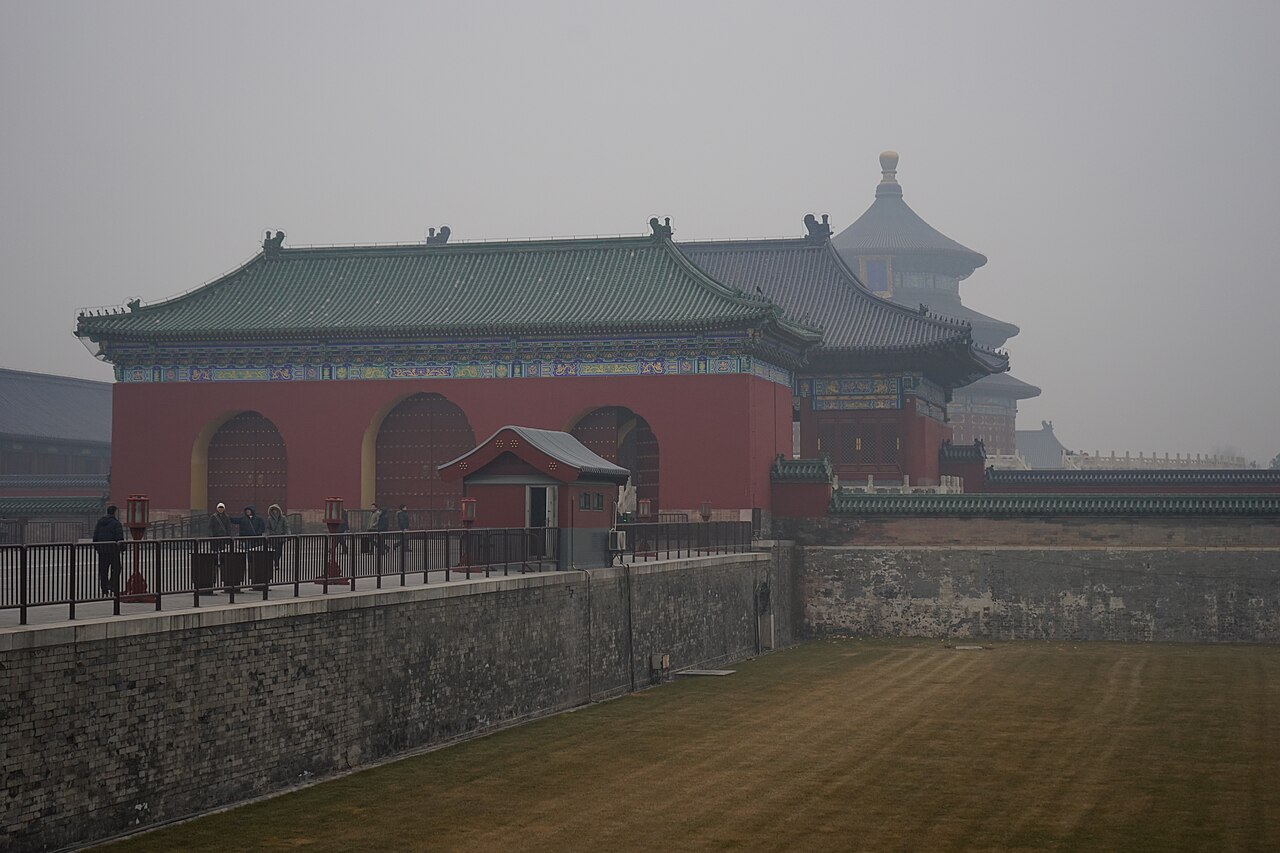
1420
A large park of separate religious buildings rather than a single structure, laid out on a symbolic plan considered important enough to be copied elsewhere in the region for centuries afterward.
A complex of imperial religious buildings in the southeastern part of central Beijing, used first by Ming emperors and later restored under the Qing dynasty for an annual rite of prayer to Heaven for a good harvest, along with other seasonal ceremonies. UNESCO listed it as a World Heritage Site in 1998, calling it a masterpiece of architecture and landscape design whose symbolic layout illustrates a cosmology of major importance to Chinese civilization, and noting that its arrangement went on to influence architecture and planning across the Far East for centuries.
- Its symbolic layout is credited with shaping architecture and planning across the Far East for centuries afterward.
Photo: Jan Bockaert (CC BY-SA 2.0)
Summer Palace
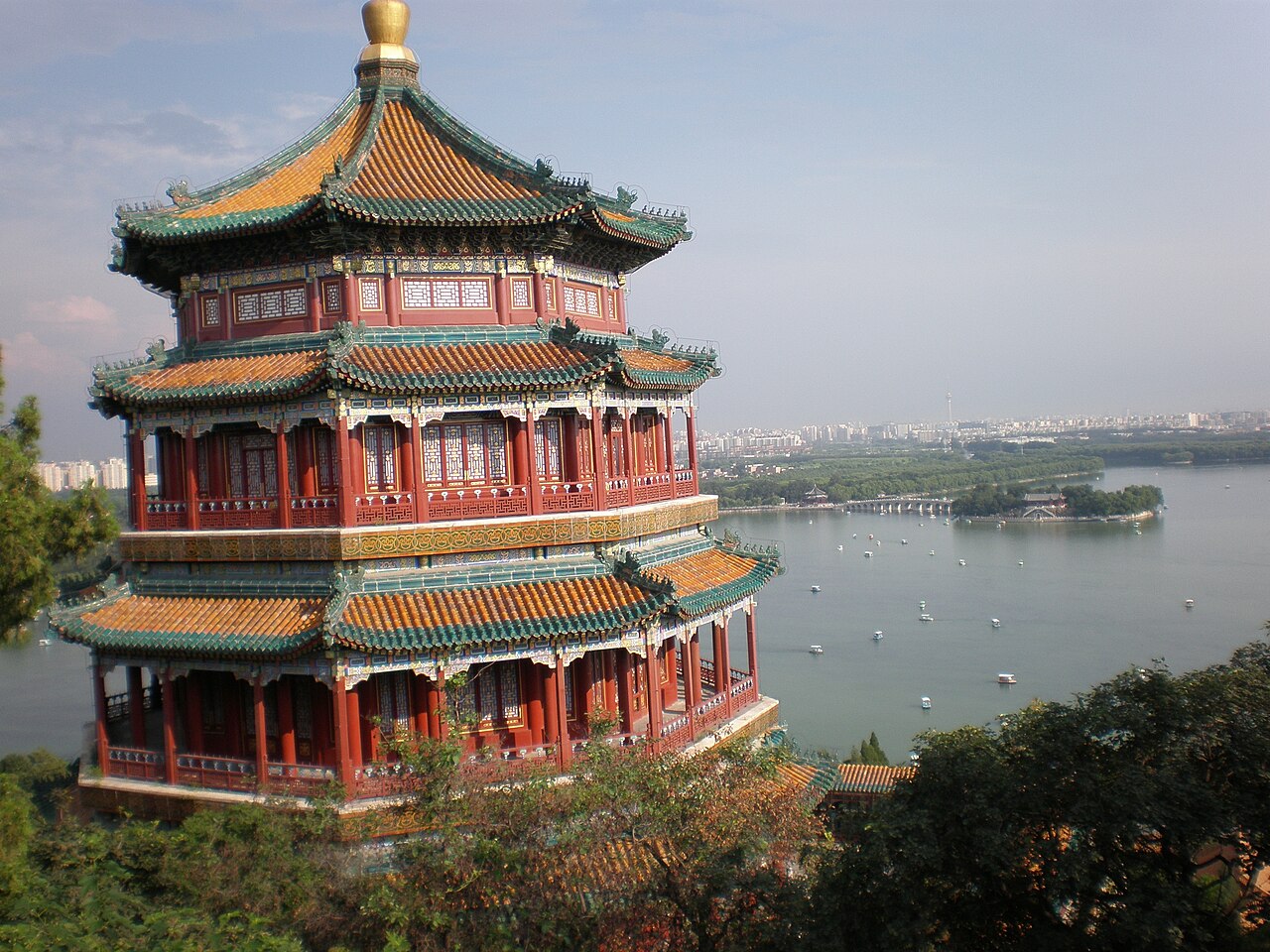
1764
A sixty-metre hill covered in halls and pavilions rises beside a lake that fills three-quarters of the grounds and is itself entirely artificial, its excavated soil having been used to build the hill; a long, many-arched stone bridge crosses the water to an island partway across.
An ensemble of lakes, gardens, and palaces on Beijing's northwestern edge, built as a retreat for quiet withdrawal and later associated with the Empress Dowager Cixi. The grounds cover 2.9 square kilometres, three-quarters of it water. Longevity Hill, about sixty metres high, was raised from soil excavated to create the adjoining Kunming Lake, and the estate holds more than 3,000 buildings housing a collection of over 40,000 historical relics from earlier dynasties. UNESCO listed it as a World Heritage Site in December 1998.
- Kunming Lake is entirely artificial — the earth dug out to create it was piled up to form the adjoining Longevity Hill.
- Its more than 3,000 buildings house a collection of over 40,000 historical relics from earlier dynasties.
Photo: Peretz Partensky from San Francisco, USA (CC BY-SA 2.0)
Tiananmen Square
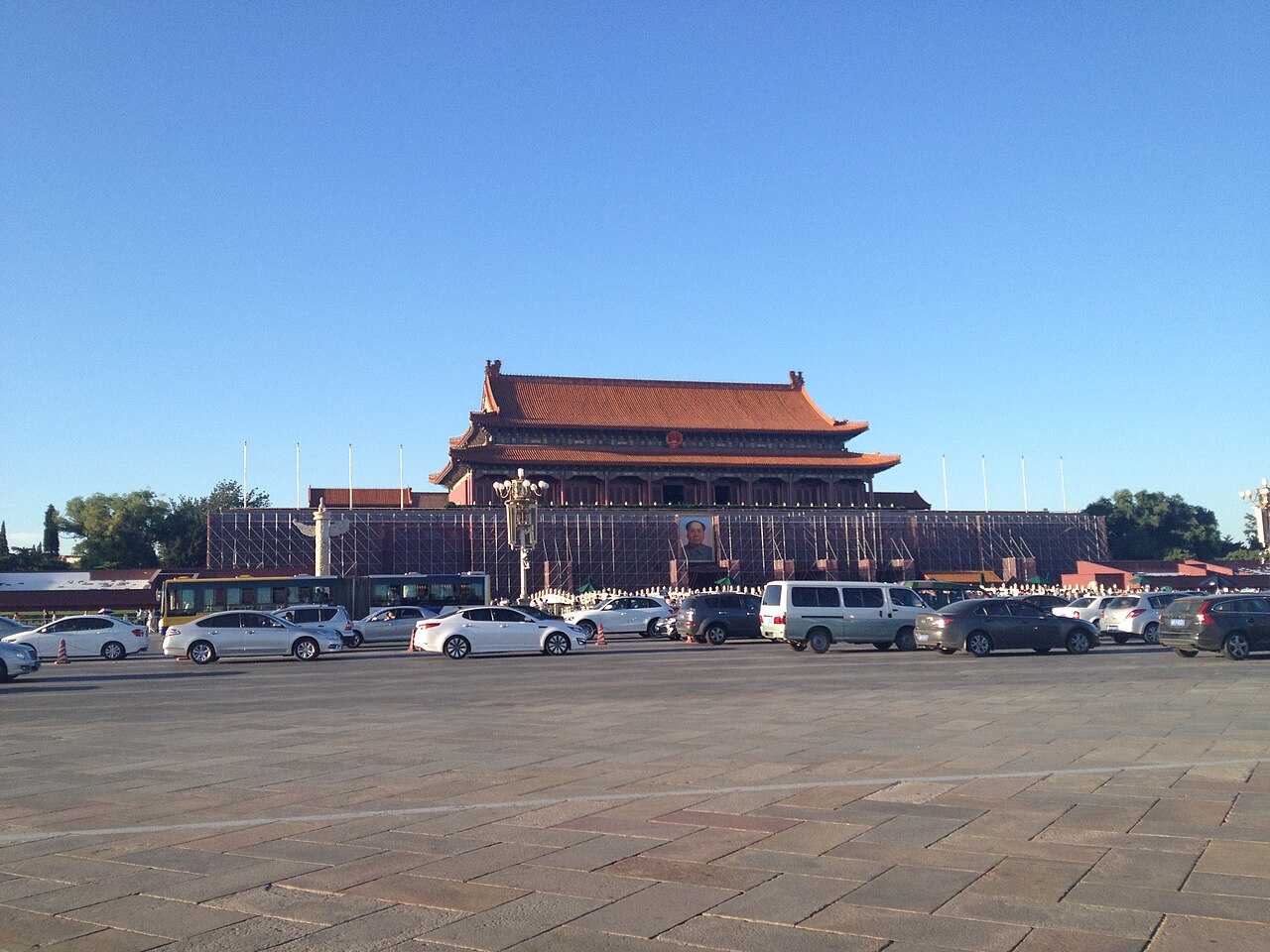
1651–1959
One of the largest public squares in the world, measuring 765 by 282 metres and bordered by a great hall of state, a national museum, and a heroes' monument; a national flagpole at its northern end is the site of flag-raising and flag-lowering ceremonies performed daily at sunrise and sunset.
The square was laid out in 1651, taking its name from a gate erected in 1417 to its north that separates it from the former imperial palace. It reached its present form after a 1950s expansion quadrupled its size to accommodate gatherings of over half a million people; a ceremonial archway that had stood at its centre was demolished in 1954 to make room. Mao Zedong proclaimed the People's Republic there in 1949, and UNESCO listed the square in 2024.
- The gate that gives the square its name was built in 1417, more than two centuries before the square around it was laid out in 1651.
- A hall of state and a national museum on the square's west and east sides were both raised in under a year for a republic's tenth anniversary in 1959.
- The square was the site of the May Fourth Movement demonstrations in 1919, decades before its 1950s expansion.
Photo: Rewindat(Pan Xuan) (CC BY-SA 3.0)
Great Hall of the People
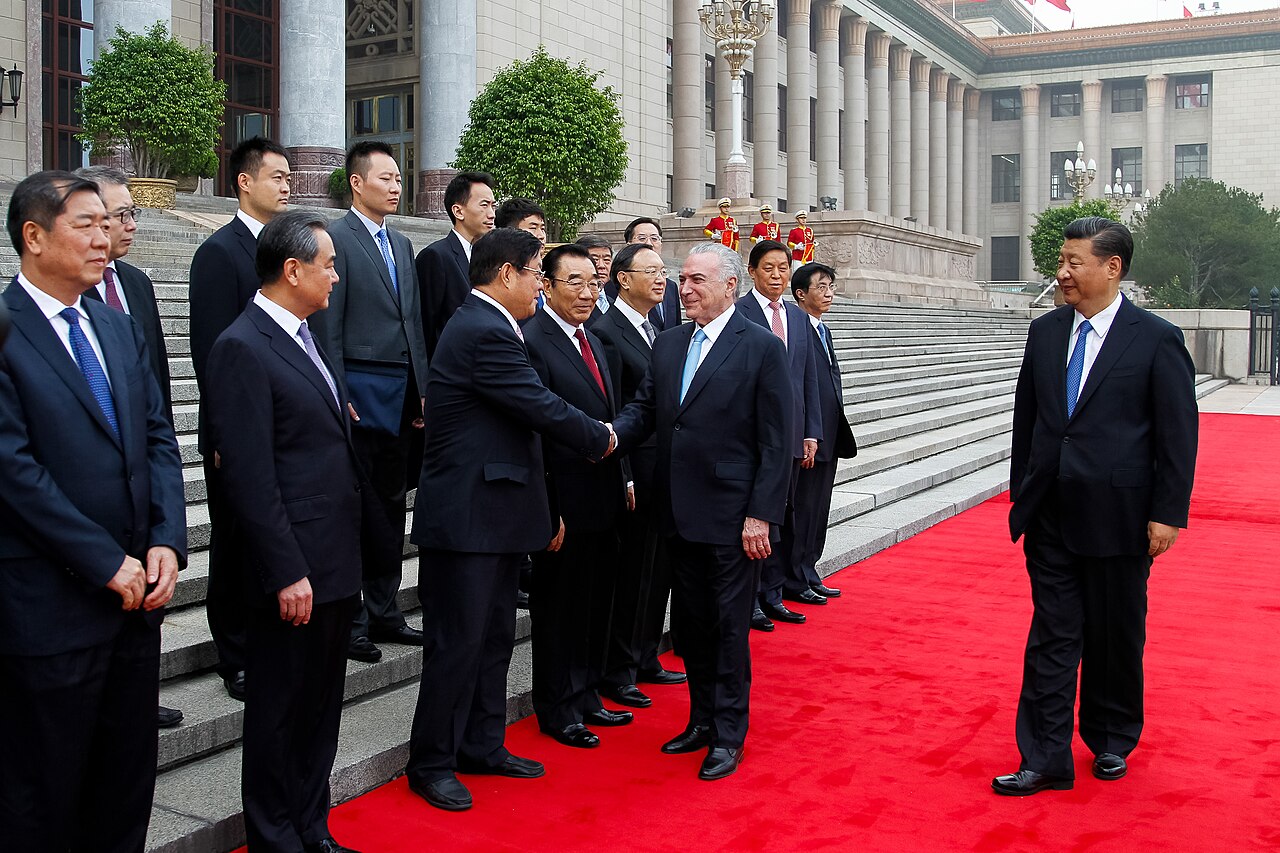
1958–1959 · Zhang Bo
A rectangular government building 356 metres long and 206.5 metres wide, its highest point reaching 46.5 metres, with a national emblem mounted at the eaves above its main entrance.
Built as one of the "Ten Great Buildings" marking the tenth anniversary of the People's Republic, the hall went up in about ten months after the politburo authorised construction in August 1958, employing 7,785 workers under chief architect Zhang Bo; the winning design had been chosen from competing proposals by architects Zhao Dongri and Shen Qi. It covers 171,801 square metres of floor space and today hosts the annual March session of the National People's Congress alongside the Communist Party's National Congress, held every five years since 1982.
- The Great Auditorium seats 10,000 people at once, its ceiling set with a red star at the centre surrounded by a pattern of lights representing water waves.
- The State Banquet Hall can seat up to 7,000 guests; 5,000 dined there at once during Richard Nixon's 1972 visit.
- Steel for the building's banquet and conference halls was supplied by the Anshan Iron and Steel works.
Photo: Michel Temer (CC BY 2.0)
National Stadium
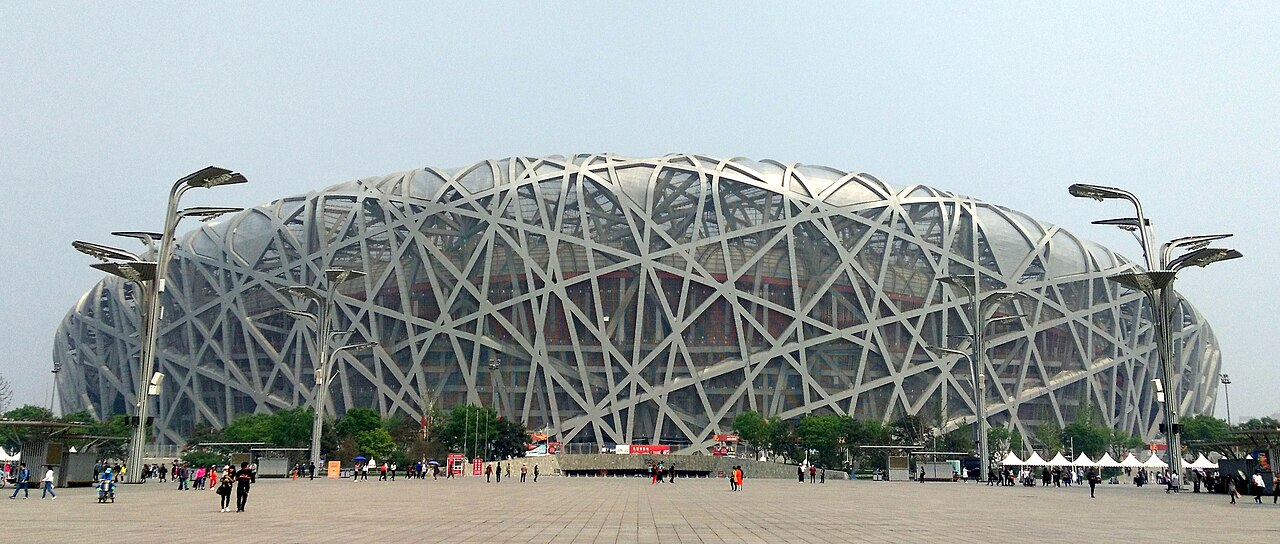
2003–2008 · Herzog & de Meuron
An irregular, densely woven lattice of steel beams wraps a red concrete seating bowl, the crisscrossing beams giving the exterior a nest-like appearance; twenty-four trussed columns, each weighing 1,000 tons, encase the inner bowl beneath the lattice.
Designed by the Swiss firm Herzog & de Meuron with artistic consultant Ai Weiwei, the stadium's design was chosen from thirteen entries in a competition inspired by the study of Chinese ceramics. Ground was broken in December 2003 and the stadium opened in June 2008, built for the 2008 Summer Olympics and Paralympics; it was also used, reconfigured, during the 2022 Winter Olympics and Paralympics. It covers 204,000 square metres and holds 80,000 spectators, or 91,000 with temporary seating added.
- The retractable roof that inspired the design was dropped after a roof collapse at Charles de Gaulle Airport prompted a safety review of major projects, also cutting 9,000 seats from the plan.
- In Chinese, a bird's nest is considered a delicacy eaten on special occasions — a detail the stadium's chief Chinese architect called a compliment embedded in its nickname.
- Once the temporary supporting columns were removed, the completed steel structure settled by about 27 centimetres before finishing work could begin.
Photo: Aaron Zhu (CC BY-SA 3.0)
Water Cube
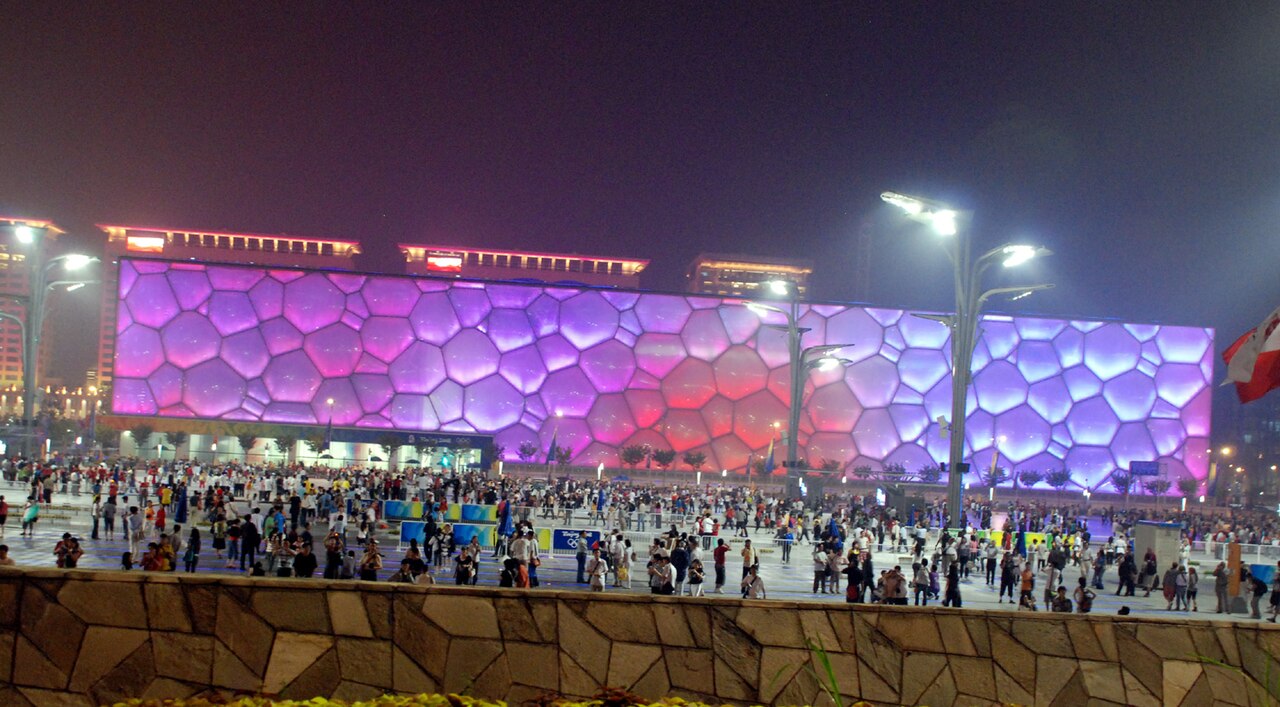
2003–2008 · PTW Architects
A cuboid building 178 metres square and 31 metres high, its entire exterior wrapped in roughly 4,000 translucent ETFE panels sized and shaped after the irregular, foam-like geometry of soap bubbles rather than a regular grid.
Chosen from ten proposals in a 2003 international competition, the aquatics centre was built by a consortium led by the Australian firm PTW Architects with the engineering group Arup and two Chinese design institutes, opening in time to host swimming, diving, and synchronised swimming at the 2008 Summer Olympics and Paralympics, where 25 world records were broken. Its steel frame is wrapped in around 100,000 square metres of ETFE plastic panels, each only 0.2 millimetres thick, chosen because the material lets in more light and heat than glass, cutting energy costs by roughly 30 percent.
- For the 2022 Winter Olympics the pool was converted into a curling rink and nicknamed the Ice Cube.
- A 2010 renovation added a 12,000-square-metre public water park, including seven-storey water slides and a wave machine.
- An LED light show added to the exterior in 2013 changes colour according to the mood of trending emoji use on a Chinese social media platform.
Photo: Jmex60 (CC BY-SA 3.0)
National Centre for the Performing Arts
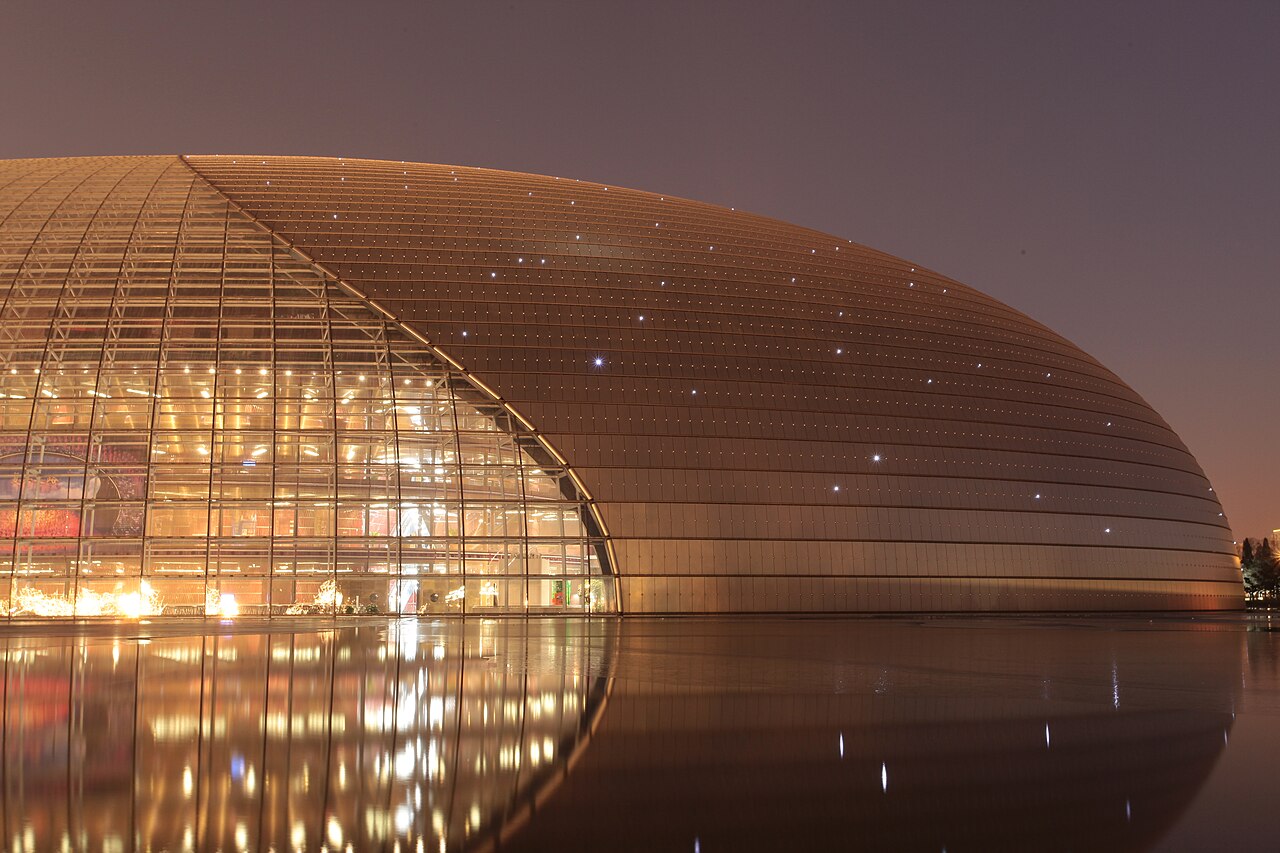
2007 · Paul Andreu
A vast titanium-clad half-ellipsoid dome, its shell built from more than 18,000 titanium panels around a central band of ultra-white glass, rises from the middle of an artificial lake that never freezes even in winter; visitors reach the halls inside through an 80-metre underwater passage.
Designed by the French architect Paul Andreu and opened in 2007, the centre is a semi-ellipsoidal shell of steel and more than 18,000 titanium panels, banded by over 1,200 panes of ultra-white glass, standing 46.285 metres tall, just under the height limit set by the neighbouring Great Hall of the People. Because Beijing's planning rules capped its height, roughly 60 percent of the building's area was built underground, reaching a depth of 32.5 metres. It holds an opera hall, a concert hall, a theatre and exhibition space, and remains Asia's largest theatre complex.
- The dome's titanium shell is coated with a nanomaterial finish that keeps rain from leaving stains and cuts dust build-up on its surface.
- The surrounding artificial lake is kept from freezing in winter by circulating constant-temperature groundwater across its surface.
- Groundwater beneath the site generates enough buoyancy to float a one-million-tonne aircraft carrier, so engineers built an underground concrete wall to hold back the pressure on the foundations.
Photo: Evilbish (CC BY-SA 3.0)
Yonghe Temple
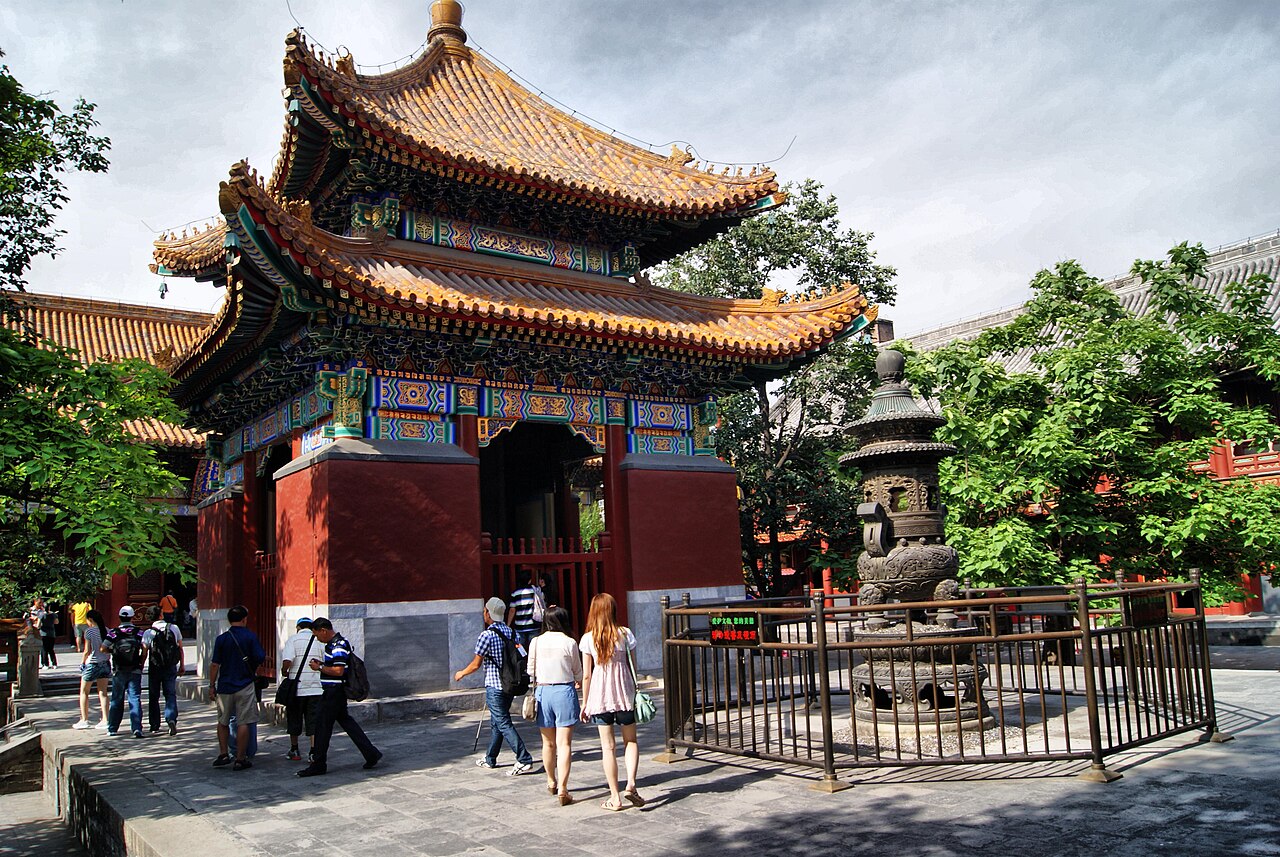
1694
A north-south sequence of gated courtyards and multi-tiered halls stretches nearly half a kilometre, its roofs covered in golden-yellow tiles — a colour once reserved for the emperor — combining Chinese temple form with Tibetan Buddhist statuary and murals inside.
Construction began in 1694 on the site of a former residence for court eunuchs. The Kangxi Emperor awarded the building in 1702 to his fourth son, who used it as a princely residence; when that prince ascended the throne as the Yongzheng Emperor in 1722, the residence was elevated in rank and its roof tiles changed from turquoise to imperial yellow. In 1744 the Qianlong Emperor issued an edict converting the palace into a monastery of the Gelug school of Tibetan Buddhism, and it became the Qing dynasty's national centre of Lama administration, blending Chinese and Tibetan architectural styles.
- The temple is said to have survived the Cultural Revolution thanks to the intervention of Premier Zhou Enlai.
- After the Yongzheng Emperor's death in 1735, his coffin lay in the temple for two years before burial.
- Closed as a national monument in 1949, the temple reopened to the public only in 1981, after 32 years.
Photo: Haluk Comertel (CC BY 3.0)
Chairman Mao Memorial Hall
The final resting place of Mao Zedong, built in the middle of Tiananmen Square soon after his death in 1976. It stands on the former site of the Gate of China, once the Imperial City's southern gate, and displays his embalmed body publicly.
National Museum of China
An art and history museum on the eastern side of Tiananmen Square, holding a collection of more than 1.4 million items across 48 exhibition halls. It occupies the largest single-building floor area of any museum in the world.
Monument to the People's Heroes
A ten-story obelisk in the southern part of Tiananmen Square, honouring martyrs of the revolutionary struggle of the 19th and 20th centuries. Built between 1952 and 1958, designed by architect Liang Sicheng with elements by his wife Lin Huiyin, it stands 37.94 metres tall.
Xinhuamen
The main gate of Zhongnanhai on West Chang'an Avenue, originally built as Baoyue Tower in 1758 under the Qianlong Emperor. Rebuilt in 1913 as the Presidential Palace's gate and renamed Xinhua Gate, it later carried Mao Zedong's slogan 'Serve the People' on its wall.
Beihai Park
A former imperial garden northwest of the Forbidden City, first built in the 12th century and among the largest surviving Chinese gardens. Part of the Imperial City, it opened to the public in 1925 and was designed to echo the scenery of Jiangnan.
Jingshan Park
An imperial park of 23 hectares immediately north of the Forbidden City, centred on the artificial hill Jingshan, or Prospect Hill. Once a private imperial garden, it opened to the public in 1928 and was formally established as a park in 1949.
Prince Gong's Mansion
A museum of large siheyuan-style mansions and gardens in Xicheng District, just north of Shichahai Lake. Built originally for the official Heshen, it was later renamed for Prince Gong, a Manchu prince and statesman who lived there in the late 19th century.
Imperial Ancestral Temple
A historic temple compound just outside the Forbidden City, where Ming and Qing emperors held ceremonies for the imperial ancestors. Its main hall stands on a three-tiered platform, one of only four in Beijing, marking it as the most sacred site in the imperial city.
National Art Museum of China
The national art museum of China and one of the largest in the country, built between 1958 and 1962 and opened in 1963. Covering 30,000 square metres, it was renovated between 2004 and 2005, adding a further 5,375 square metres of space.
Military Museum of the Chinese People's Revolution
The national military museum of China, located in Haidian District. Its collection centres on military equipment and relics reflecting the history of the People's Liberation Army, along with ancient and modern Chinese and world military history.
St. Joseph's Church
A Romanesque Revival Catholic church on Wangfujing Street in Dongcheng District, one of four historic churches of the Archdiocese of Beijing. First built by Jesuit missionaries in 1655, it was renovated and rebuilt so its current structure dates from 1904, making it Beijing's second-oldest church.
Railway Station
A passenger railway station in Dongcheng District, opened in 1959 as China's largest train station at the time. Though later surpassed in size, it remains the only station inside the old walled city, its gilded eaves and clock towers blending Chinese and socialist realist styles.
Zhenjue Temple
A Ming dynasty Buddhist temple in Haidian District, formally known as the Temple of the Great Righteous Awakening. It is commonly called the Five Pagoda Temple, or Zhenjue Temple for short.
White Cloud Temple
A Taoist temple and monastery, one of the Three Great Ancestral Courts of the Quanzhen School of Taoism. It carries the title 'The First Temple under Heaven'.
Niujie Mosque
The oldest mosque in Beijing, built in 996 CE during the Liao dynasty, destroyed during the Mongol conquest, and rebuilt and enlarged by the 17th century under the Kangxi Emperor. It remains the spiritual centre for the roughly 10,000 Muslims of Beijing's Niujie area.
Workers' Stadium
A football stadium in Chaoyang, opened in 2023 on the site of the original stadium, which was demolished in 2020. One of the largest football stadiums in China, it is home to Beijing Guoan of the Chinese Super League.
Church of the Saviour
A historic Catholic church in Xicheng District, also known as Beitang or the North Church. It has served as the cathedral of the Archdiocese of Beijing since renovations completed in 2018.
West Railway Station
A railway station in Fengtai District, opened in 1996 after three years of construction. It was the largest railway station in Asia at 510,000 square metres, until Shanghai Hongqiao station surpassed it in platform capacity, and it now serves 150,000 to 180,000 passengers a day.
History
Construction of the walled palace complex at the city's center ran from 1406 to 1420, built as the seat from which emperors of two successive dynasties ruled for slightly more than five hundred years. The nearby ceremonial temple rose in the same period, giving the new capital both its throne room and its site for the annual harvest rites that accompanied it. Building continued later, when a lakeside garden estate was laid out from 1764 on the northwestern edge of the city, its central hill raised from soil dug out to form the lake beside it. Imperial rule ended in 1924, when the last resident left the palace; it reopened as a museum the following year, and by the close of the century both the temple and the garden estate had joined it on UNESCO's World Heritage list.