Landmarks in Bratislava
Its castle, cathedral spire and lone surviving gate all stand within one small Old Town.
Bratislava's principal landmarks sit within a few hundred metres of one another in the Old Town, on the bank of the Danube where the Little Carpathians meet the river. A Gothic castle occupies a rocky hill above the water, its bulk visible across the city and, in clear weather, into Austria and Hungary. Below it, the medieval walled core survives through a single gate rather than its original four, topped with a baroque addition added long after the gate itself was built. The largest church, a stark Gothic cathedral with an 85-metre spire, rises where the town wall once ran and served for centuries as a coronation church. A smaller Art Nouveau church, faced in blue tile, stands apart in the eastern Old Town, from a later, calmer period.
Bratislava Castle
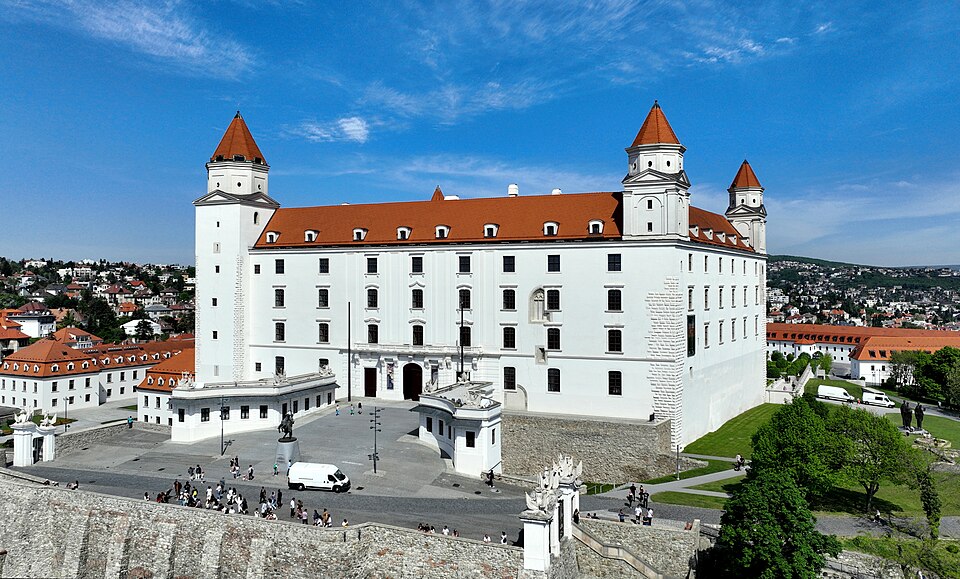
1431
A squat rectangular block with a tower at each corner tops an isolated rocky hill above the river, dominating the surrounding city just as it has for centuries.
The castle occupies an isolated rocky hill of the Little Carpathians directly above the river, its massive rectangular block flanked by a tower at each corner. A fortified site here is recorded as early as 907, but the structure visible today took its present Gothic form later, and its size and position have made it a dominant feature of the city for centuries. From the hill, the view extends over the city and, in clear weather, into Austria and Hungary. Numerous legends have attached themselves to the site over its long history.
Photo: C.Stadler/Bwag (CC BY-SA 4.0)
Michael's Gate
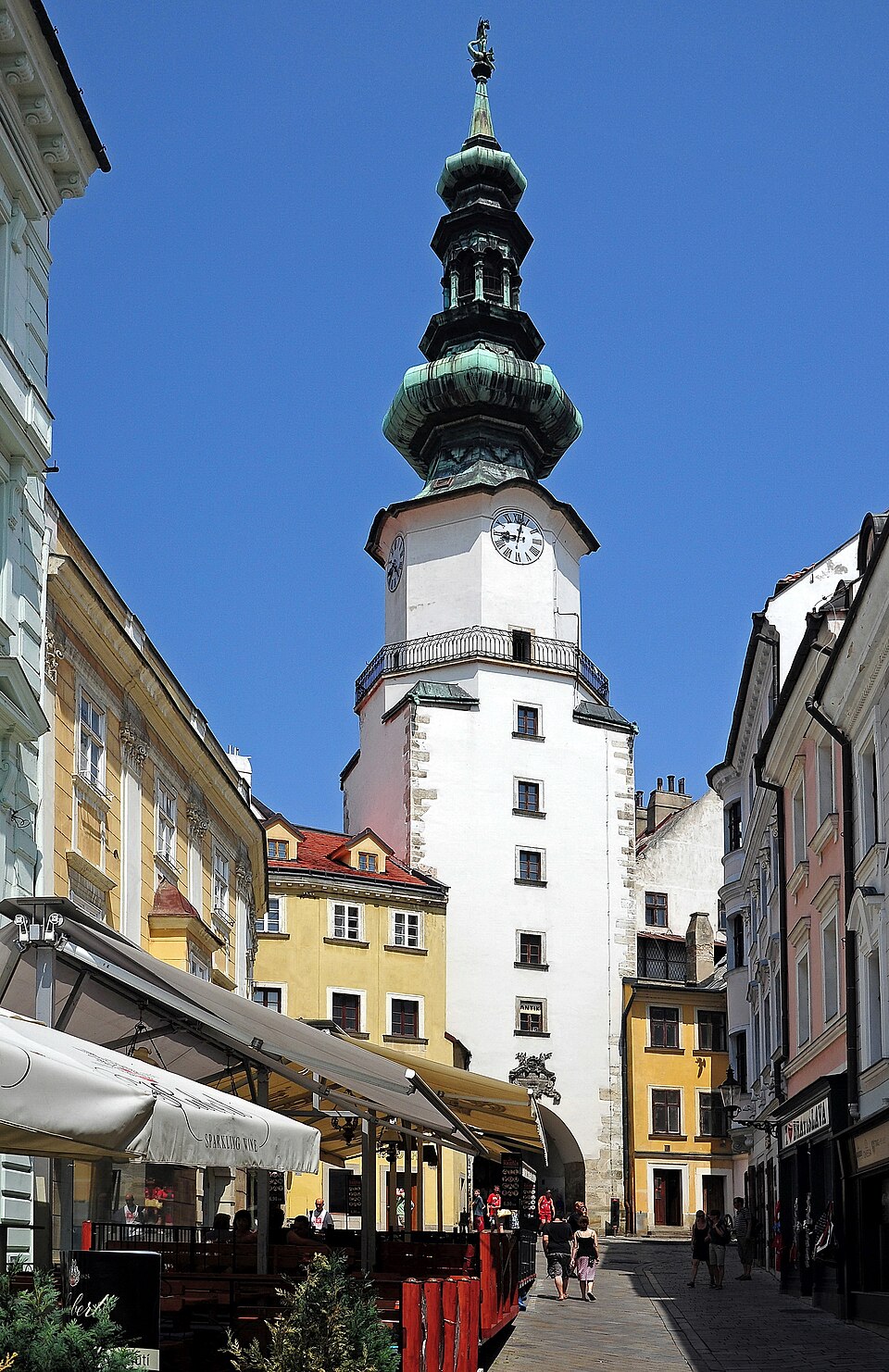
1300–1758
A tall gate-tower framing a narrow street is capped with a baroque spire and a statue of a saint spearing a dragon set at its very top.
Built around 1300, it is the only survivor of four gates that once studded the medieval town wall and is counted among the oldest buildings in the old town. The tower was given its present baroque form in 1758, when a statue of St Michael spearing a dragon was placed on its summit. Today the gate houses the city museum's exhibition of weapons, a use quite different from its original job of controlling who entered and left the fortified town.
- The smallest of the town's four original gates was used mainly by fishermen bringing their catch in from the river.
- A chapel dedicated to St Michael once stood outside this gate; when it was demolished, its stone was reused to extend the town walls.
Photo: LMih (CC BY-SA 3.0)
St. Martin's Cathedral
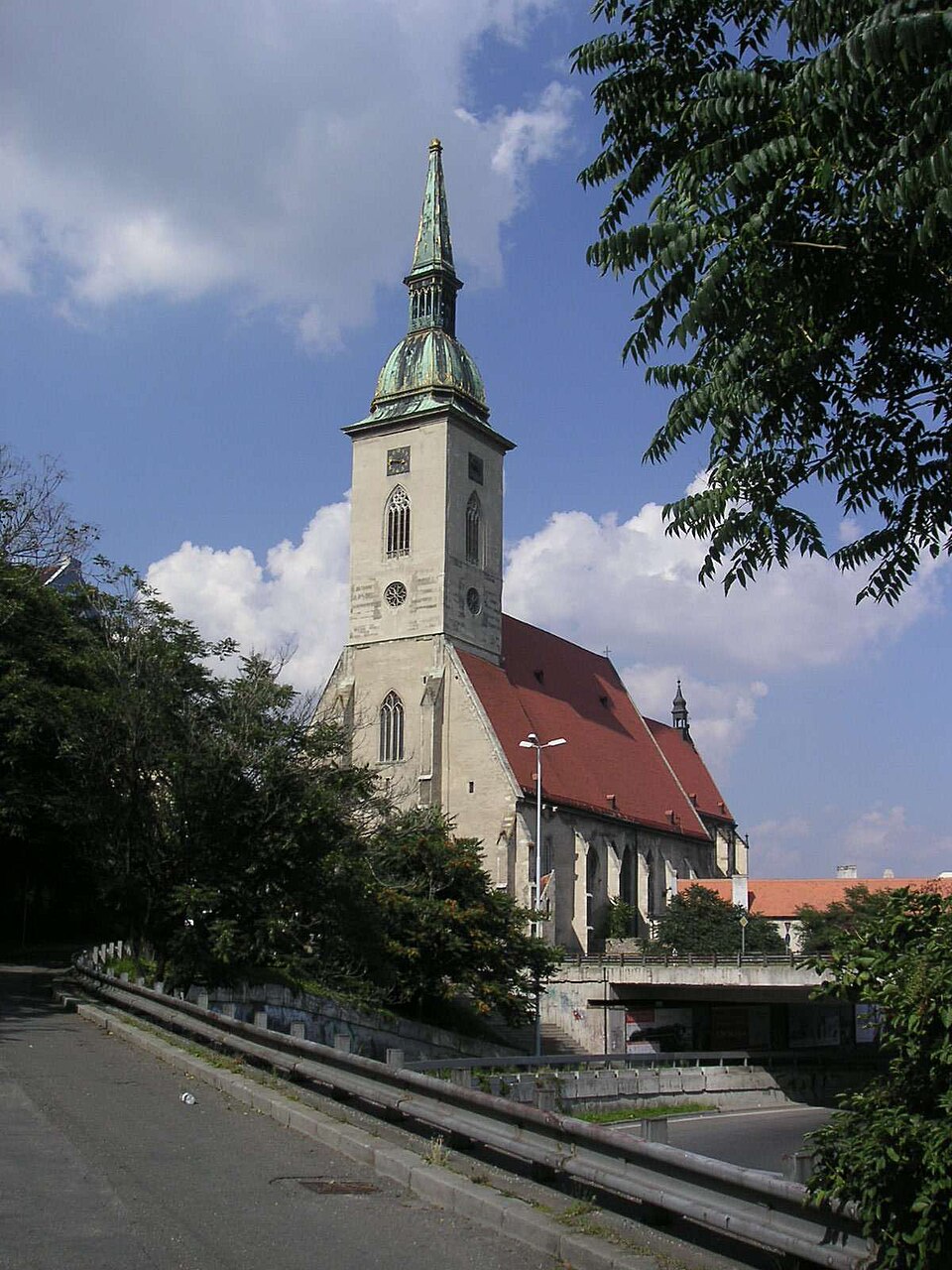
1452
A stark, pale Gothic tower topped by an 85-metre spire rises just below a castle hill, its plain lines and colouring setting it apart from the more decorated buildings around the old town, with a stepped, cobbled courtyard of ruined outbuildings at its base.
The largest and one of the oldest churches in Bratislava, it served for over two and a half centuries as the coronation church of the Kingdom of Hungary, hosting eleven kings and eight queens between 1563 and 1830. Its 85-metre Gothic tower and spire, stark in both line and colour, was raised into the town's own defensive walls and still dominates the old town skyline beside the castle hill. A stepped, cobbled courtyard scattered with the ruins of former outbuildings survives at its base, next to a working seminary.
- A monument beside the cathedral marks a synagogue that stood there for centuries until it was demolished, around 1970, to build the Nový Most bridge.
- The cathedral holds the remains of Saint John the Merciful.
Photo: Helix84 (CC BY-SA 3.0)
Blue Church
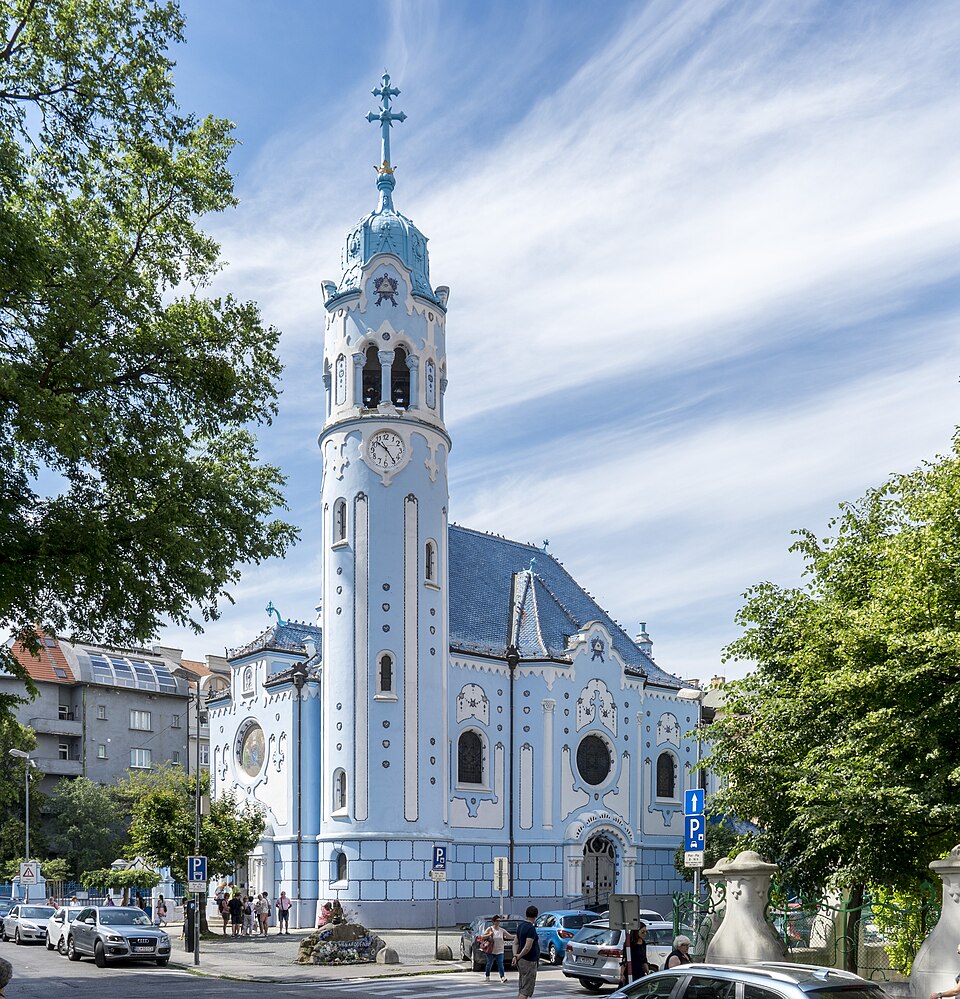
1913 · Ödön Lechner
A small church whose façade, mosaics, majolica tiles and glazed roof are all worked in the same pale blue, giving it its popular nickname.
Dedicated to Elisabeth of Hungary, a king's daughter who grew up in the nearby castle, this Art Nouveau Catholic church was built as the chapel of the neighbouring secondary school. Its façade, mosaics, majolica tiles and glazed roof are all worked in the same pale blue, which gave it its popular name. It stands apart from the older, Gothic and baroque landmarks of the old town, both in period and in colour.
- Its architect, Ödön Lechner, died in 1914, the year after the church was completed.
Photo: Thomas Ledl (CC BY-SA 4.0)
Devín Castle
A castle in Devín, a borough of Bratislava, the capital of Slovakia.
Most SNP
An asymmetrical cable-stayed road bridge over the Danube, popularly called the UFO Bridge, with a 303-meter main span and a total length of 430.8 meters. It is the world's longest single-pylon, single-cable-plane bridge, carrying four traffic lanes above bike and pedestrian paths below.
Slovak Radio Building
An upside-down pyramid, designed by architects Štefan Svetko, Štefan Ďurkovič and Barnabáš Kissling and completed in 1983 after a project begun in 1967. Standing 80 meters tall, it holds a 522-seat concert hall and serves as headquarters of Slovak Television and Radio.
Grassalkovich Palace
A Rococo, or late Baroque, summer palace on Hodžovo Square, near the Episcopal Summer Palace. It now serves as the residence of the President of Slovakia, set within its own French garden.
Primate's Palace
A neoclassical palace in the Old Town, built 1778-1781 for Archbishop József Batthyány to designs by Melchior Hefele. Its Hall of Mirrors hosted the signing of the fourth Peace of Pressburg in 1805, and it now serves as the seat of the city's mayor.
Manderlák Building
A high-rise residential and commercial building standing 45 meters tall with 11 floors, built between 1934 and 1935. It was the first high-rise in Slovakia and remained the country's tallest building until 1967.
Apollo Bridge
A road bridge over the Danube, built between 2003 and its opening in September 2005, named for an oil refinery once on the left bank. Its 5,240-ton, 231-meter steel structure, built with curved lines and inclined arches, was rotated into place across the river.
Kamzík TV Tower
A 196-meter television tower on Kamzík hill in the Little Carpathians, built in 1975 to replace an earlier structure. It has a public observation deck from which Austria, Hungary and the Czech Republic are visible in good weather.
University Library
Slovakia's oldest library, founded in Bratislava in 1919. It is today the country's largest and most visited library, serving as a universal state research institution.
Čumil
A bronze statue of a sewer worker peeking from a manhole in the city center, created by sculptor Viktor Hulík. One of Bratislava's most photographed sights, it is sometimes mistakenly described abroad as a soldier.
Franciscan Church
The oldest surviving religious building in the Old Town, consecrated in 1297 before King Andrew III of Hungary. Ferdinand I was elected King of Hungary here in 1526, though fires and earthquakes have left only a small part of the original structure, mainly the presbytery.
Tehelné pole
The national football stadium, completed in 2019 with a capacity of 22,500, replacing an older stadium of the same name demolished in 2013. It hosts home matches for ŠK Slovan Bratislava and the Slovak national football team.
Tipos aréna
An indoor arena also known as the Ondrej Nepela Arena, used mainly for ice hockey as the home venue of HC Slovan Bratislava. It has carried sponsor names including Orange Arena during the 2011 IIHF Championship and later Slovnaft Arena.
Janko Kráľ Park
One of the oldest municipal parks in Europe, laid out between 1774 and 1776 in Petržalka along the Danube. Its walks were originally set in an eight-pointed star under Baroque classicism, and the park reached its present form in 1839 before a 1970s revamp.
Hlavná stanica
The city's main railway station, handling about 60,000 passengers a day. Besides domestic services, it runs international trains to Austria, the Czech Republic, Germany, Hungary, Poland, Croatia, Serbia and Switzerland.
Pálffy Palace
A 17th-century palace of the Pálffy family on Zámocká Street, beneath Bratislava Castle, of which only the summer pavilion survives after partial demolition in the early 20th century. Wolfgang Amadeus Mozart performed a concert there during a visit to the city.
Mirbach Palace
A Baroque-Rococo, four-wing, two-story building in the historical zone, named after its last owner, Baron Emil Mirbach. It ranks among the most beautiful and best-preserved buildings of its style in Slovakia.
Episcopal Summer Palace
The former summer residence of the Archbishops of Esztergom, built as a 17th-century Renaissance summer seat after Pressburg became their base. Sculptor Georg Rafael Donner kept a studio in its garden for nearly ten years, and the palace now houses Slovakia's government.
Great Moravian Basilica
A 9th-century Great Moravian church that once stood at the Bratislava hillfort, on the site of today's Bratislava Castle.
St. Nicholas Church
An Orthodox church on castle hill, built in 1661 by Countess Frances, widow of Paul Pálffy, on the site of an earlier Gothic church. An early Baroque building dedicated to Saint Nicholas, patron of sailors, it is a protected cultural monument.
Heydukova Street Synagogue
An Orthodox synagogue and Jewish museum on Heydukova Street in the Old Town. It is the only synagogue remaining in the city.
Botanical Garden of the Comenius University
The city's only botanical garden, located in Karlova Ves beside the Old Town and the Lafranconi Bridge, covering 6.6 hectares with over 4,000 plant species, including 1,200 types of cacti. Run by Comenius University, it is also Slovakia's oldest public botanical garden.
City Fortifications
The medieval city fortifications, of which one gate and two sections of wall survive, alongside the separately fortified Bratislava Castle. Later defenses added over the centuries include World War I artillery works, interwar bunkers, and a Cold War network of over 8,600 air-raid shelters.
Statue of Svätopluk
A bronze equestrian statue of Svätopluk, the third ruler of Great Moravia, standing in the courtyard of Bratislava Castle. It was created by the Slovak sculptor Ján Kulich.
Hodžovo námestie
A major square at the edge of the Old Town, in front of the Slovak Presidential Palace, considered one of the city's two central points. Its centerpiece is the fountain Earth, Planet of Peace, with underpasses for cars and pedestrians dating from the 1970s.
History
Bratislava grew as a fortified river crossing where Austrians, Hungarians, Germans, Slovaks, Jews, Croats, Bulgarians and Czechs settled side by side, in a spot close enough to Vienna that the two capitals are the nearest pair in Europe. Its hilltop castle was fortified for centuries and later rebuilt in Gothic style; the walled medieval town below it had four gates, of which only one still stands, later given a baroque top. From 1536 to 1783 the city served as the coronation site, legislative centre and capital of the Kingdom of Hungary: eleven kings and eight queens were crowned in its Gothic cathedral, and Hungary's parliament met here from the seventeenth century into the Hungarian Reform Era. An Art Nouveau church added at the turn of the twentieth century belongs to a later, calmer chapter.