Landmarks in Zagreb
A hilltop medieval quarter of spires and a tower looks down on a Neoclassical lower town.
Zagreb's oldest landmarks sit together on the twin hill settlements now called the Upper Town: a parish church known for its patterned tiled roof, a fortified tower that once guarded a town gate, and a cathedral first raised in 1217. Stone construction, steep roofs and a defensive layout mark this medieval core, which predates the city's recognition as a free royal city in 1242. Downhill, on the flatter ground toward the Sava valley, nineteenth-century civic building added a different register: a Neoclassical theatre with a bright yellow façade, completed in 1895. The cathedral's present Neo-Gothic profile, with twin spires topping 108 metres, actually dates to a rebuild carried out after an 1880 earthquake rather than to its medieval origin.
Zagreb Cathedral
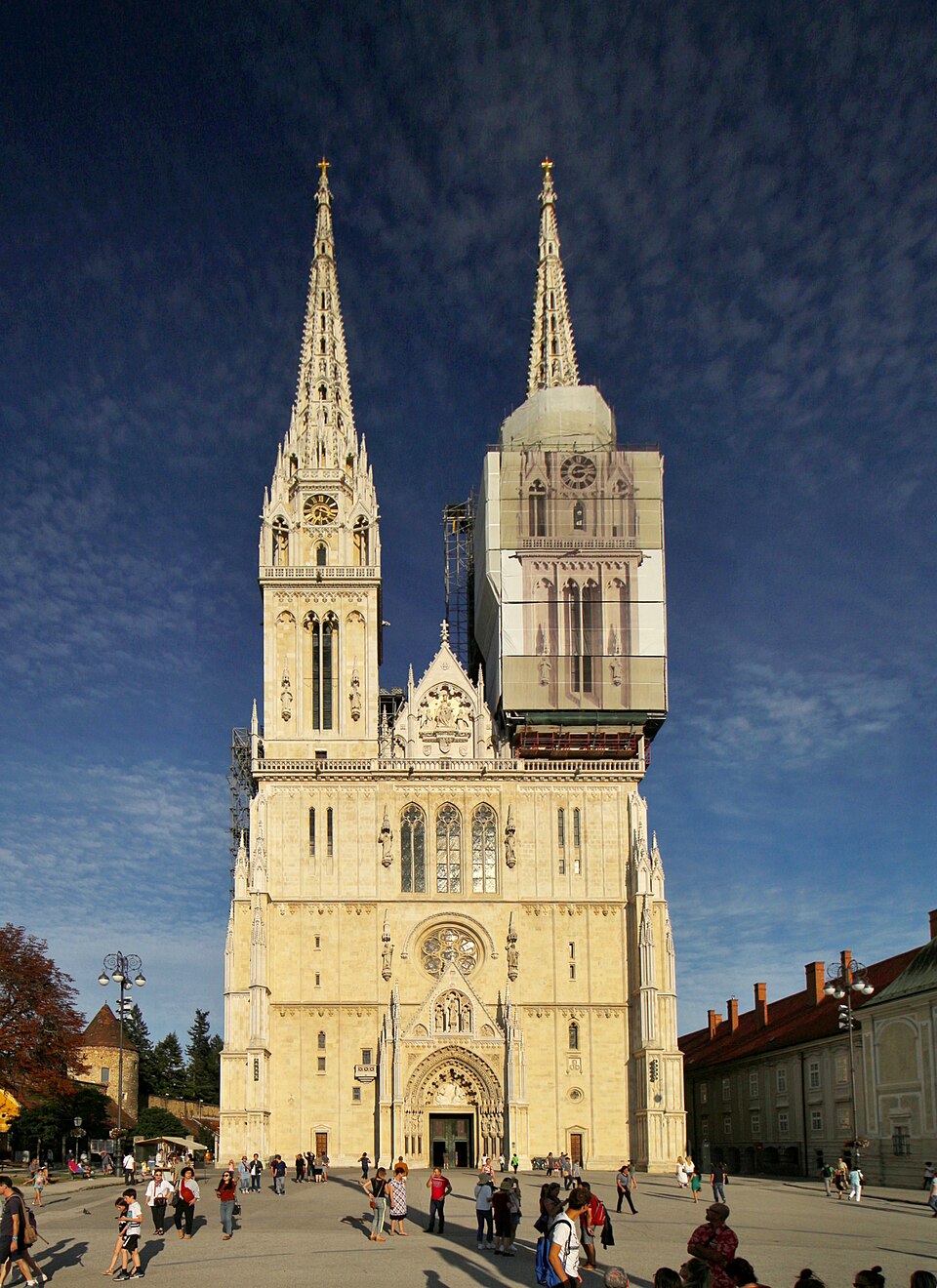
1217, rebuilt after 1880 · Hermann Bollé
Two matching Neo-Gothic spires rise side by side to just over 108 metres, visible from most of the surrounding city; the pale stone façade below them is dense with tracery, pinnacles and buttresses typical of a late-nineteenth-century Gothic Revival rebuild rather than a genuinely medieval one.
The original cathedral was completed in 1217 in Romanesque style but was heavily damaged during the Tatar invasion of 1242, after which it was rebuilt and expanded in Gothic style over the following centuries. A second disaster, the 1880 earthquake, destroyed large sections of the building. Architect Hermann Bollé led the restoration that followed, producing the Neo-Gothic structure seen today, including its paired spires. Dedicated to the Assumption of Mary and to two sainted kings, it was formally entered in Croatia's Register of Cultural Goods in 2013.
- It is described as the most monumental Gothic sacral building southeast of the Alps.
- The earthquake that forced its rebuild struck in 1880, more than six centuries after its first completion.
- It was only formally entered in Croatia's Register of Cultural Goods in 2013.
Photo: VitVit (CC BY-SA 4.0)
St. Mark's Church
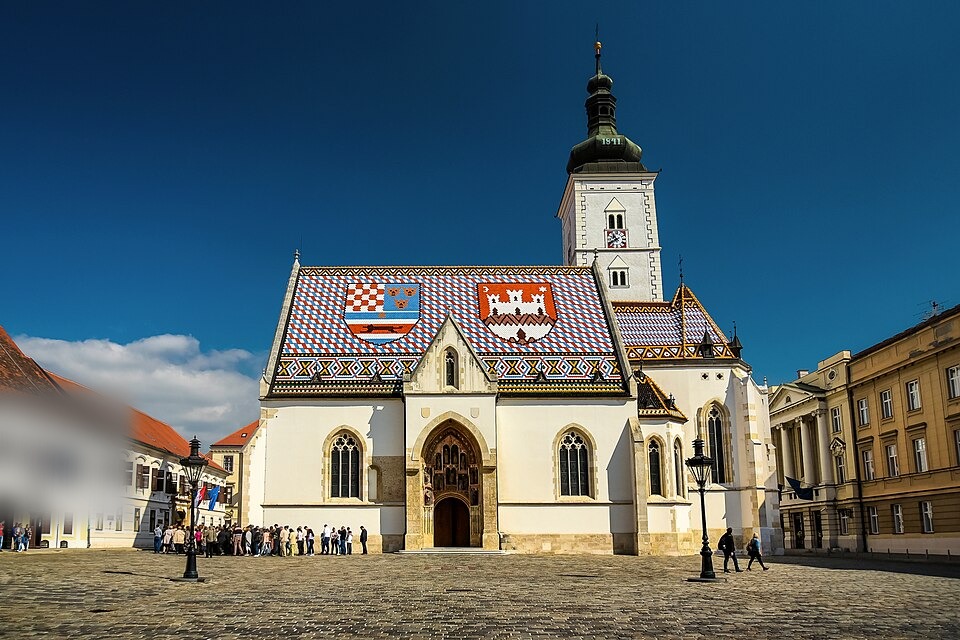
1256
A steeply pitched, tiled roof laid out in a bold checkerboard-and-shield pattern showing two coats of arms side by side, above an otherwise plain stone Gothic-Romanesque façade and bell tower on a small square.
This parish church stands on a square in the historic Upper Town and ranks among the oldest architectural monuments in the area, with origins dating to the 13th century. It combines Gothic and Romanesque elements. The building is best known for its patterned tiled roof, which depicts the coats of arms of three historic regions alongside the city's own emblem. It remains a working parish church and is listed among Croatia's protected cultural goods.
- Its tiled roof depicts the coats of arms of three historic regions plus the city's own emblem, laid out side by side in tile.
Photo: Jorge Franganillo (CC BY 2.0)
Croatian National Theatre
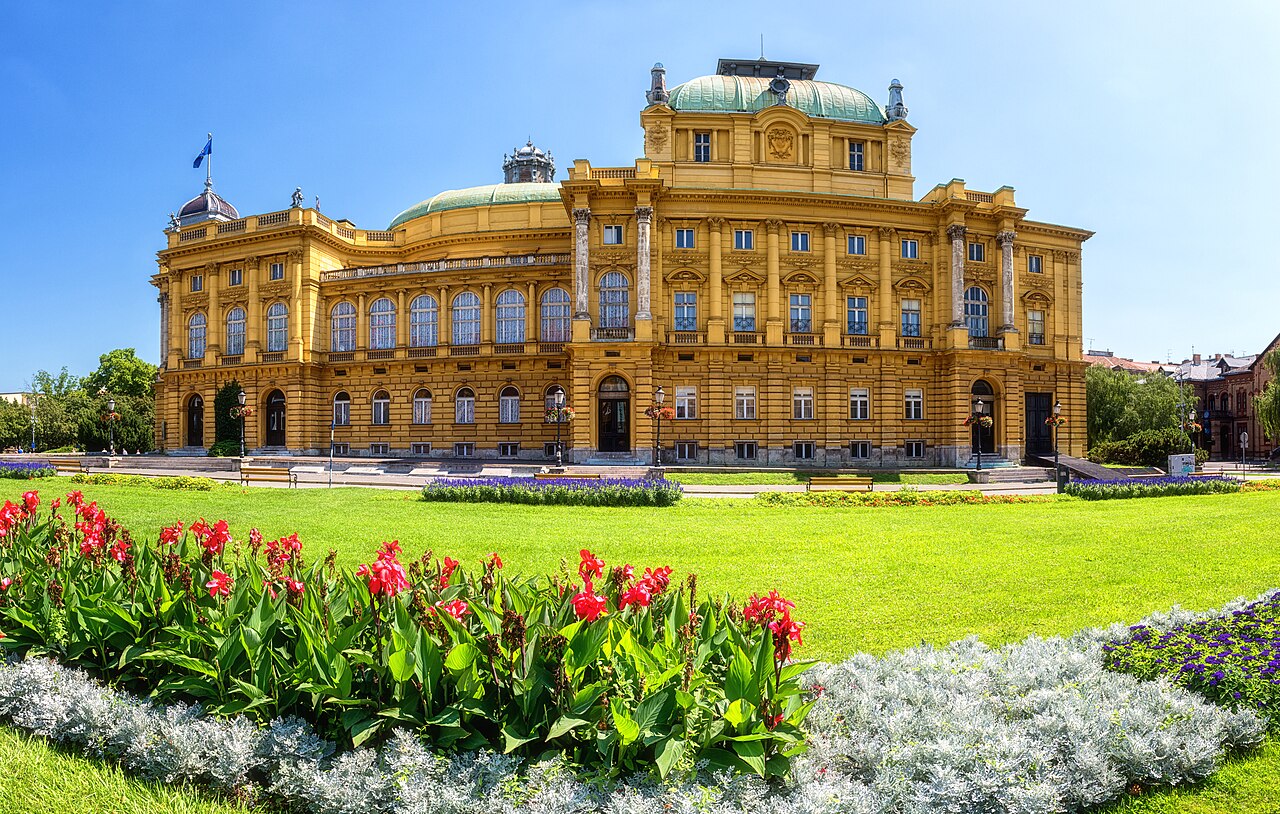
1895 · Fellner & Helmer
A pale yellow Neoclassical building with a columned front and pediment, standing at the centre of an open square; the strong yellow of its façade is one of the more recognisable notes in the city's civic architecture.
This theatre and opera house is the oldest Croatian theatre institution, having officially opened on 24 November 1860, though the present building was completed in 1895. It stands at the centre of a central city square and stages opera, ballet and drama drawn from domestic and international repertoire, with more than twenty premieres and repeat titles performed each season. It is one of seven national theatres in Croatia and belongs to international networks including Opera Europa and the European Theatre Convention.
- The theatre institution itself is older than its current building: it opened in 1860, 35 years before this structure was finished.
- It is one of seven national theatres in the country.
Photo: Diego Delso (CC BY-SA 3.0)
Lotrscak Tower
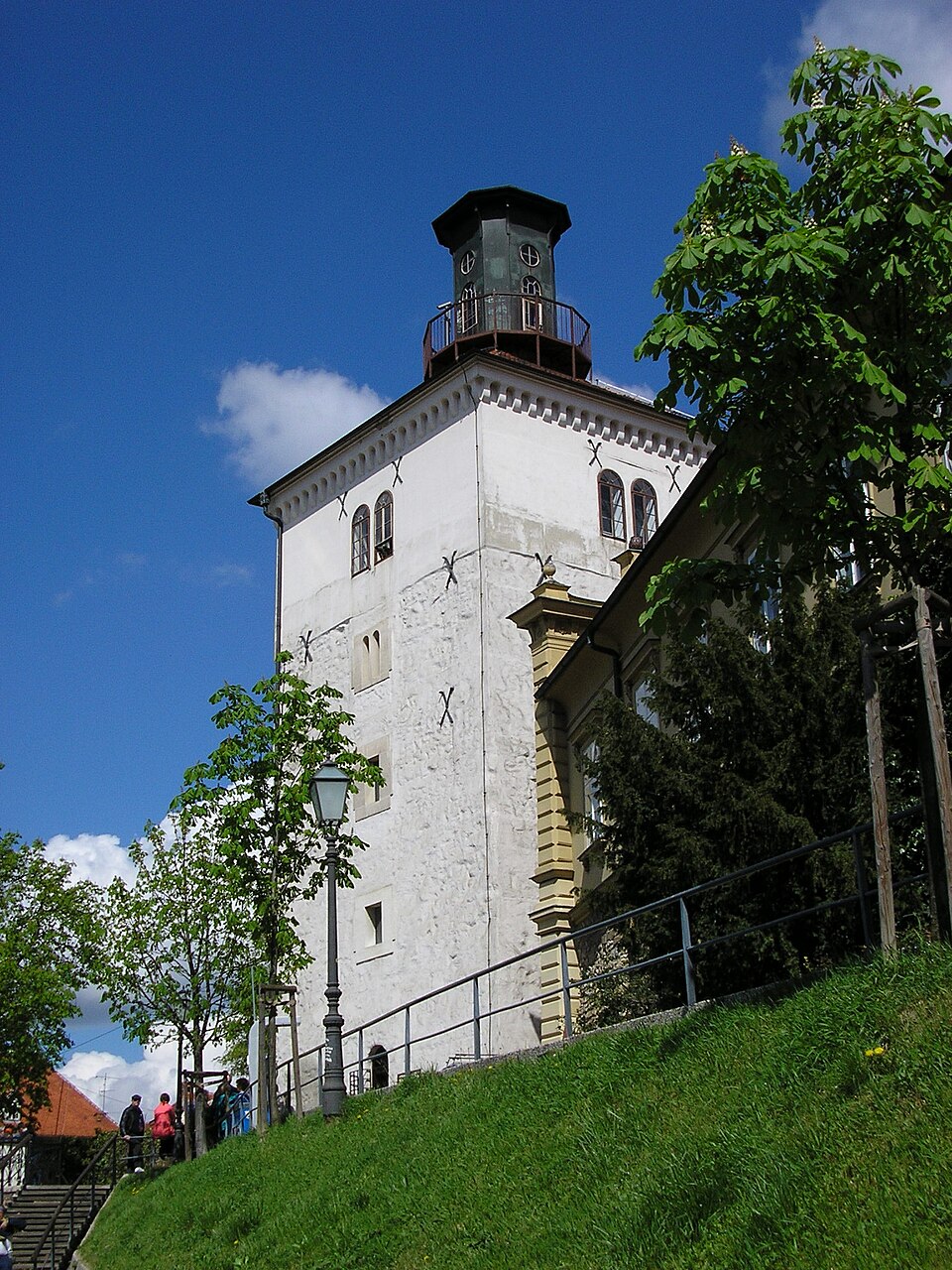
1266
A compact fortified stone tower standing on the line of a former town wall, at the point where its southern gate once stood, overlooking the streets on the lower ground below.
This fortified tower stands in the old hilltop quarter and dates to the 13th century, when it was built to guard the southern gate in the town wall of Gradec. Its name derives from the Latin campana latrunculorum, or "thieves' bell," a reference to a bell hung in the tower in 1646 to mark the nightly closing of the gates below. It survives as one of the area's few remaining medieval defensive structures and is protected as a cultural good.
- Its name translates as "thieves' bell," after a bell hung in the tower in 1646 to signal the nightly closing of the town gates.
Photo: dnik (CC BY-SA 4.0)
Ban Jelačić Square
The central square of Zagreb, officially Trg bana Josipa Jelačića and colloquially 'Jelačić plac,' named after ban Josip Jelačić. Located below the old city cores of Gradec and Kaptol, it is the center of Zagreb's downtown pedestrian zone and a commercial, social, and transportation hub.
Sabor Palace
A historic building in Gornji Grad that houses the Croatian Parliament, known as the Sabor. The site first held the parliament of Croatia, Dalmatia, and Slavonia in 1737, and the current building received its final expansion in 1911.
St. Catherine's Church
A Baroque-style church in the historic Upper Town of Zagreb. It is considered the best example of Baroque architecture in the city.
Meštrović Pavilion
A cultural venue on the Square of the Victims of Fascism, designed by Ivan Meštrović and built in 1938. It was converted into a mosque under the Independent State of Croatia, became the Museum of the Revolution in Yugoslavia, and reopened for exhibitions in 2006.
Art Pavilion
An art gallery on the Lenuci Horseshoe, on the north side of King Tomislav Square, established in 1898. It is the oldest gallery in Southeast Europe and the only gallery in Zagreb purpose-built for large-scale exhibitions.
Zagreb Funicular
A funicular on Tomić Street, operated by the Zagreb Electric Tram, connecting Ilica in the lower town with the Strossmayer promenade above. Its 66-meter track makes it one of the shortest public-transport funiculars in the world.
Maksimir Park
A 316-hectare park in eastern Zagreb, the oldest and largest in the city, founded by and named after Bishop Maksimilijan Vrhovac. Home to the Zagreb Zoo and five artificial lakes, it is considered one of Europe's best parks, alongside Hyde Park and Villa Borghese.
Banski dvori
A two-storey Baroque building on St. Mark's Square, home to Croatian bans from 1809 to 1918 and now the Croatian Government. Its residents included Ban Josip Jelačić, and during the Independent State of Croatia it served as the office of Poglavnik Ante Pavelić.
St. Mark's Square
A town square in Zagreb's old Upper Town, with St. Mark's Church at its center. It is ringed by governmental buildings including Banski dvori, Sabor Palace, and the Constitutional Court, along with the Museum of Broken Relationships.
Croatian Academy of Sciences and Arts
The national academy of Croatia, in the centre of Zagreb, founded under the patronage of bishop Josip Juraj Strossmayer as the Yugoslav Academy of Sciences and Arts. Strossmayer intended it as the central scientific and artistic institution for all South Slavic peoples.
Cibona Tower
A high-rise on Dražen Petrović Square in central Zagreb, built in 1987. At 92 meters (105 with its antenna), it is one of the tallest buildings in Zagreb and Croatia.
Kockica
A 10-story building at Prisavlje 14, designed by architect Ivan Vitić and built to house the Central Committee of the League of Communists of Croatia. Construction began in 1963 but was delayed by the 1964 Zagreb flood, finishing in 1968; it now houses two ministries.
Esplanade Hotel
A historic luxury hotel on Starčević Square, built in 1925 to accommodate passengers of the Orient Express train between Paris and Istanbul. It was the first luxury hotel in Croatia and remains one of Zagreb's main landmarks.
Zagreb TV Tower
A 169-meter TV and radio tower built of reinforced concrete on the summit of Sljeme, the 1,035-meter peak of the Medvednica mountain north of Zagreb.
Museum of Contemporary Art
A contemporary art museum on Dubrovnik Avenue, the biggest and most modern museum in Croatia. Vesna Meštrić has been its director since 2024, having taken over temporarily in late 2023 from Zdenka Badovinac.
Old City Hall
A complex of three adjacent buildings in the Gradec neighbourhood, joined together in the late 19th century. Since then it has served as the place where sessions of the city assembly are held.
National Home Palace
A palace at Opatička Street 18 in Gornji Grad, the old town of Zagreb. It is owned by the Croatian Academy of Sciences and Arts and hosts its Institute for the History of Croatian Literature, Theatre and Music.
Presidential Palace
The official workplace of the president of Croatia since late 1991, in Pantovčak, Zagreb, though the president does not reside there. It hosts welcoming ceremonies for foreign dignitaries, state functions, and post-election consultations, and is where outgoing and incoming presidents hold a joint press conference.
Museum of Arts and Crafts
A museum established in 1880 at the initiative of the Arts Society and its president Izidor Kršnjavi. Its building, constructed in 1888 by Hermann Bollé, was one of the first purpose-built edifices combining a museum with a school, founded alongside it in 1882.
Cathedral of the Transfiguration of the Lord
An Eastern Orthodox church in Zagreb, also known as the Zagreb Orthodox Cathedral. It falls under the Metropolitanate of Zagreb and Ljubljana of the Serbian Orthodox Church and serves as its cathedral.
Basilica of Saint Anthony of Padua
A minor basilica and Catholic parish church in the Sveti Duh neighbourhood of the Črnomerec district. It also serves as a monastery of the Friars Conventuals.
Church of Saint Blaise
A Catholic parish church in the Lower Town, dedicated to Saint Blaise and designed by architect Viktor Kovačić in an eclectic style. It is notable for its reinforced-concrete cupola, the first of its kind in the region.
Zagreb Mosque
The largest mosque in Croatia, built in the Borovje neighbourhood between 1981 and 1987 with funding from Sultan bin Muhammad Al-Qasimi, Emir of Sharjah. On completion it was the biggest religious building erected in Yugoslavia after Zagreb Cathedral, and it houses an Islamic secondary school.
1 Ilica Street
A building on Ilica Street overlooking Ban Jelačić Square, colloquially known as Neboder, or 'Skyscraper.' It was the first business skyscraper built in Croatia.
History
The city's earliest recorded core sits on two hills: Kaptol, referenced from 1094 and named in a document of 1134, and Gradec, granted status as a free royal city in 1242. Both produced the fortified, ecclesiastical architecture that still defines the Upper Town — the parish church of St. Mark, dated to the 13th century, and a fortified tower built the same century to guard Gradec's southern gate. The cathedral at Kaptol, completed in 1217, was badly damaged in the Tatar invasion of 1242 and rebuilt over following centuries in Gothic style. A second calamity, the 1880 earthquake, tore through it again; the Neo-Gothic reconstruction that followed, led by architect Hermann Bollé, gave the skyline its twin spires. Municipal life was formalised soon after, with the first mayor taking office in 1851, and expressed lower down the valley in Neoclassical civic building such as the theatre completed in 1895.