Landmarks in Guangzhou
A 2,200-year river port where Qing clan halls sit minutes from a 600-metre steel tower.
Guangzhou's landmarks span more than a century of building on the Pearl River delta. In the old city centre, the Chen Clan Ancestral Hall preserves a Qing-dynasty academic complex of nineteen buildings, its brick and timber halls carved and decorated in the southern Chinese style. A few kilometres away, the octagonal Sun Yat-sen Memorial Hall, raised in traditional Chinese form during the late 1920s, marks the Republican era with a pillar-free span of 71 metres. Across the Pearl River in Haizhu District stands the city's newest layer: the Canton Tower, a 600-metre lattice-steel structure completed for the 2010 Asian Games, its twisted hourglass profile now the skyline's most recognisable shape.
Canton Tower
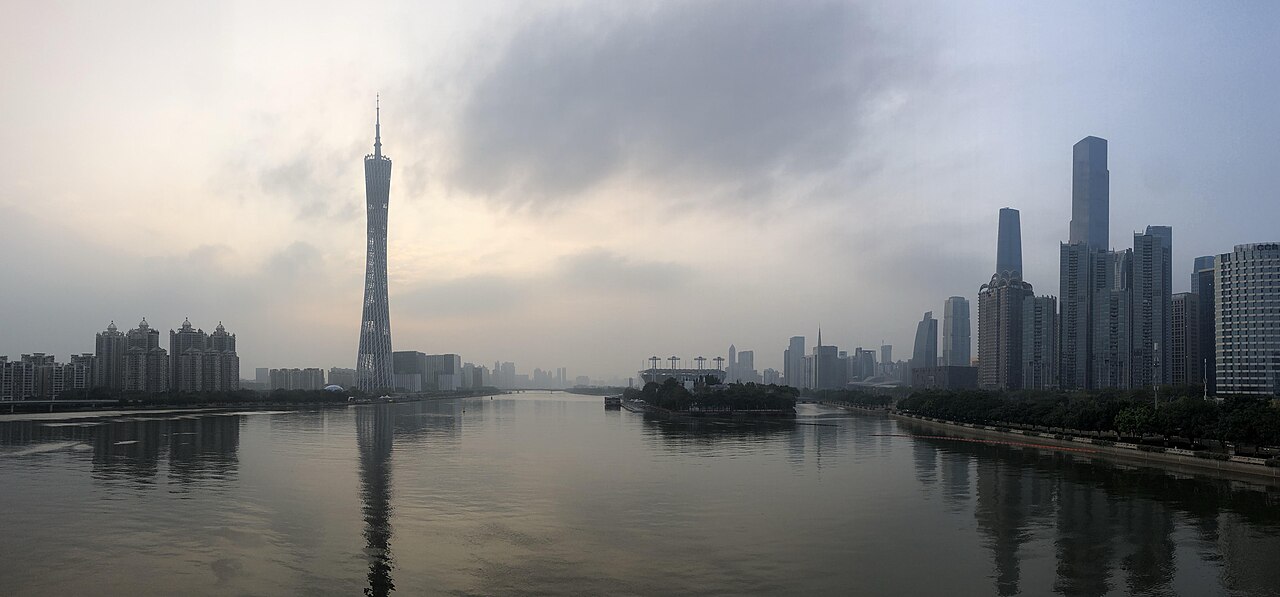
2010 · Information Based Architecture
A slender steel tower whose latticework is pinched into a twisted hourglass silhouette, widening again near the top where a ring of observation decks encircles the shaft before a slim spire completes the height.
A 600-metre multipurpose observation tower in Haizhu District, topped out in 2009 and opened on 29 September 2010 in time for the Asian Games held that year. Designed by Information Based Architecture, its hyperboloid lattice-steel shell briefly made it the tallest tower in the world, overtaking Toronto's CN Tower before Tokyo's Skytree surpassed it. It was mainland China's tallest structure until the Shanghai Tower topped out in 2013, and remains the country's second-tallest tower and the fifth-tallest freestanding structure worldwide.
- Briefly held the title of world's tallest tower, overtaking Toronto's CN Tower before Tokyo Skytree surpassed it.
- Remained mainland China's tallest structure until the Shanghai Tower topped out in 2013.
Photo: Josephua (CC BY-SA 4.0)
Chen Clan Ancestral Hall
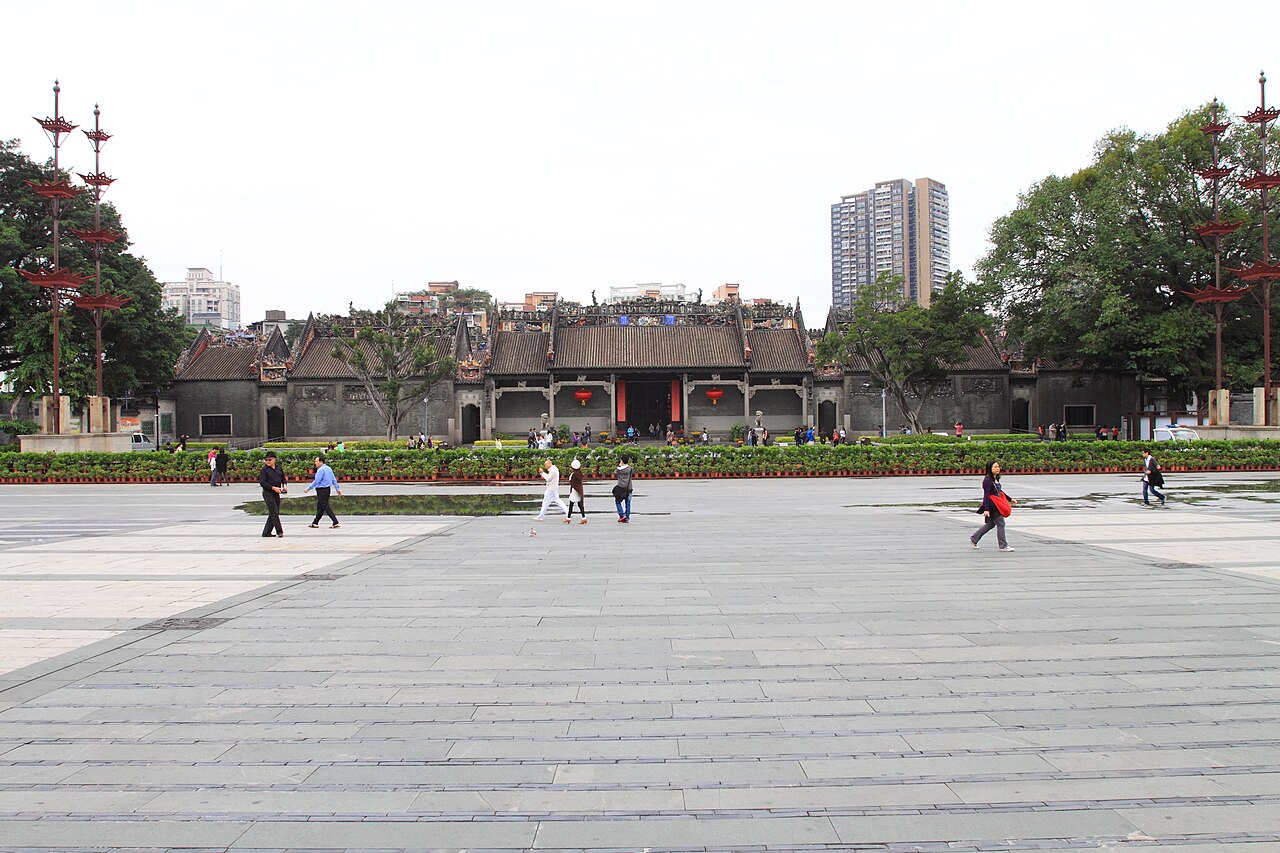
1894
A symmetrical walled complex of nineteen buildings arranged around nine halls and six courtyards, its brick and timber halls dense with carved wood, stone and pottery ornament in the southern Chinese decorative style.
Built in 1894 by 72 branches of the Chen clan to house descendants preparing for the imperial examinations, the complex later became the Chen Clan's Industry College and then a series of middle schools before its conversion into the Guangdong Folk Art Museum. Its nineteen buildings are arranged symmetrically along a north–south axis around nine halls and six courtyards, and hold a large collection of wood carvings and pottery. The complex was placed on the national list of protected cultural relics in 1988.
- Funded jointly by 72 branches of the Chen clan rather than by a single patron.
- Has served in turn as an exam-prep hall, an industrial college and a middle school before becoming today's folk art museum.
Photo: Zhangzhugang (CC BY-SA 3.0)
Sun Yat-sen Memorial Hall
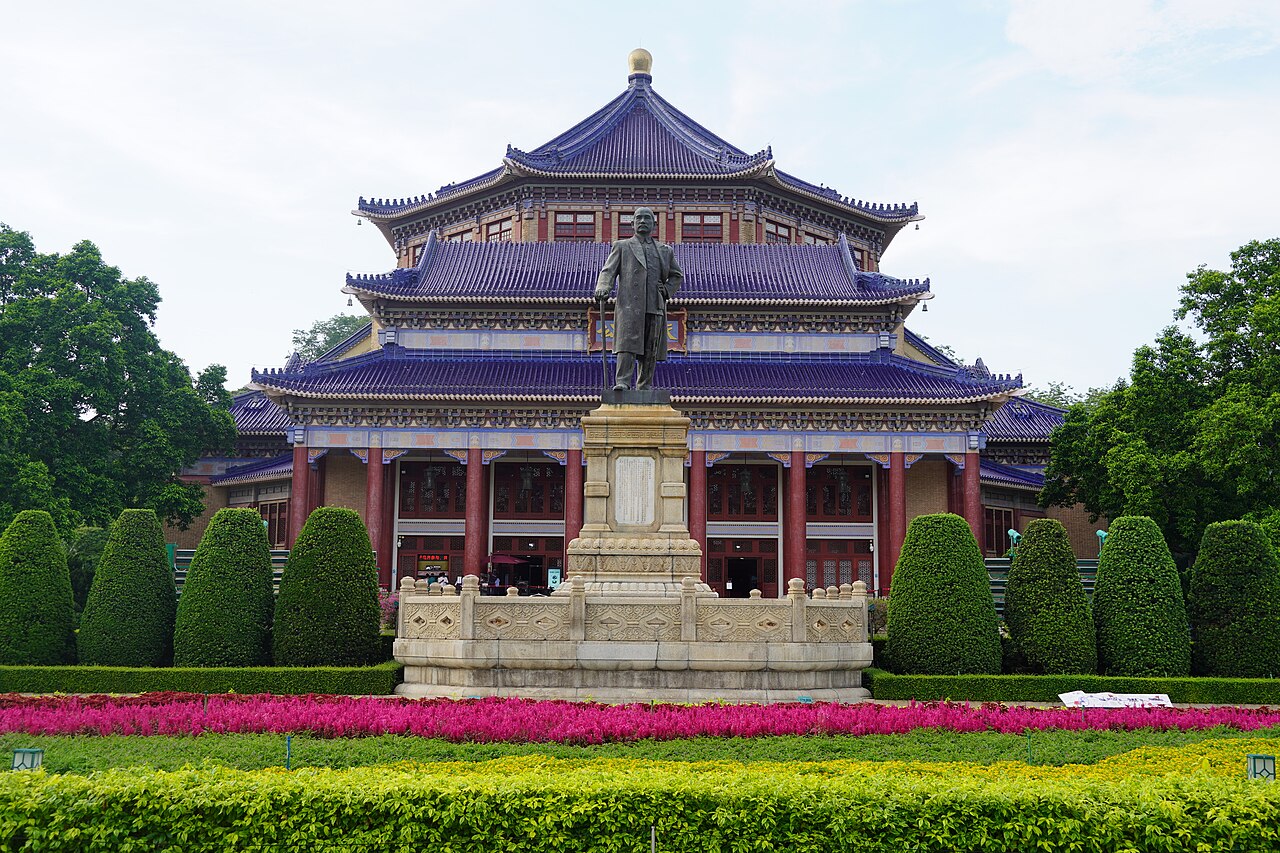
1931 · Lü Yanzhi
An octagonal hall built in traditional Chinese architectural style, its 71-metre span crossing without a single interior pillar to give the auditorium inside room for more than three thousand seats.
Designed by Lü Yanzhi, who died in 1929 before the building was finished, this octagonal hall was raised with donations from local and overseas Chinese communities in memory of Sun Yat-sen. Construction ran from 1929 to 1931. The structure spans 71 metres without a single interior pillar and holds a stage with seating for 3,240 people, and it stands within an urban park that today also serves as a convention venue.
- Its architect, Lü Yanzhi, died in 1929, the year construction began, and never saw the hall completed.
Photo: Wikiwakhan (CC0)
Huaisheng Mosque
The main mosque of the city, rebuilt many times; some texts claim a 7th-century founding, though scholars favor the Tang or Song dynasty. Its most distinctive feature is a plain, pointed 36-metre minaret, the Guangta, also read as meaning lighthouse.
Sacred Heart Cathedral
A Gothic Revival Roman Catholic cathedral on the Pearl River's north bank, known locally as the Stone Chamber or Stone House. It is one of the few cathedrals in the world built entirely of granite, including its walls, pillars, and twin towers.
Guangzhou Circle
A landmark building, headquarters of the Hongda Xingye Group and the Guangdong Plastic Exchange. The exchange is the world's largest trading center for raw plastic material, with more than 25 billion euros in annual turnover in 2012.
Pearl River Tower
A 71-storey, 309.6-metre clean-technology skyscraper in Tianhe, designed by Skidmore, Owings and Merrill with Adrian Smith and Gordon Gill. Built between 2006 and 2011, it functions as an office tower and is partly occupied by the China National Tobacco Corporation.
Guangzhou International Finance Center
A 103-storey, 438.6-metre skyscraper, one half of the Guangzhou Twin Towers, completed in 2010. Designed by WilkinsonEyre and used as offices, a hotel, and a conference center, it has held the world's highest rooftop helipad, at 438 metres, since 2023.
CITIC Plaza
An 80-storey, 391-metre office skyscraper in Tianhe District, completed in June 1997. It was the tallest concrete building in the world until Trump Tower Chicago surpassed it, and remains part of a complex that also includes two 38-storey residential blocks.
Guangxiao Temple
One of the oldest Buddhist temples in the city, long a stopover for Asian missionary monks and a center for spreading Chan, Shingon, and Pure Land Buddhism. Huineng, the sixth patriarch of Chan Buddhism, gave his first public lecture and was tonsured here.
Dafo Temple
A Buddhist temple in Yuexiu District with a history of more than a thousand years, built by Emperor Liu Yan between 917 and 971. Once ranked among the 'Five Largest Temples,' it was destroyed and rebuilt repeatedly, including a Kangxi-era reconstruction in 1663.
Temple of the Five Immortals
A former Taoist temple, once mistranslated as the Temple of the Five Genii. It stands beside the junction of West Huifu Road and Liurong Road.
Nanyue King Museum
An archaeology museum formed in 2021 by merging two earlier museums for the Nanyue King's mausoleum and the Nanyue Palace site. It spans 40,000 square metres over the king's tomb and palace ruins, holding relics of the Nanyue kingdom, which ruled Lingnan from 204-111 BC.
White Swan Hotel
A 28-storey luxury hotel on Shamian Island, overlooking the Pearl River and facing the White Swan Pool. It is reached by its own private causeway, 635 metres long.
Hoi Tong Monastery
A Buddhist temple and monastery on Henan Island, known by many other names. It shares its grounds with the city's Haichuang Park.
Wong Tai Sin Temple
A Taoist temple in Liwan District dedicated to the deity Wong Tai Sin, one of many temples honoring him worldwide. Temples to the same deity also stand elsewhere in China, Southeast Asia, and the United States, with the oldest located in Jinhua City, Zhejiang Province.
Guangdong Museum
A general museum of art, nature, culture, and history. It covers both local art and artifacts from Guangdong province alongside broader Chinese art.
Sun Yat-sen Library of Guangdong Province
The provincial library of Guangdong, established in 1912 in the provincial capital. It has grown into a large public library recognized as a national first-class library and a 'National Civilized Library,' open to foreign visitors as well.
People's Park
An urban public park in Yuexiu District, established in 1921 as the city's first public park. It occupies a site that had housed successive regional governments since the Sui dynasty, and is colloquially known as Central Park for its central location.
Yuexiushan Stadium
A multi-purpose stadium at the foot of Yuexiu Hill, rebuilt in 1950 to hold 35,000 people after an original ground opened there before 1926. Renovated with fixed seating in 2012, it now holds 18,000 and is used mainly for football and occasionally athletics.
Tianhe Stadium
A multi-purpose stadium in Tianhe District, officially the Tianhe Sports Centre Stadium. It is currently used for football matches.
Happy Valley
A shopping mall in Zhujiang New Town, in the Tianhe District.
Peasant Movement Training Institute
A school operated from 1923 to 1926 during the First United Front between the Nationalists and Communists, housed in a former Confucian temple built in the 14th century. The site now holds a museum devoted to the city's revolutionary history.
History
Guangzhou has traded on the Pearl River for more than 2,200 years, growing wealthy as a terminus of the Silk Road and, for long stretches, the only Chinese port open to European merchants. That mercantile wealth funded the clan institutions of the late imperial period: the Chen Clan Ancestral Hall, completed in 1894, was built jointly by 72 branches of one family to house students preparing for the imperial examinations. The early twentieth century brought a different kind of monument, as local and overseas Chinese communities raised funds for the octagonal Sun Yat-sen Memorial Hall, completed in 1931 after the fall of the Qing dynasty. The more recent skyline reflects the city's role as a regional hub: the Canton Tower rose on the Pearl River's southern bank in 2010, built for the Asian Games and briefly the tallest tower on Earth.