Landmarks in Shenzhen
A skyline built almost entirely since the 1980s, when a fishing county became a boomtown.
Shenzhen's skyline is concentrated in a handful of central districts and almost entirely recent: nothing here predates the late twentieth century. Its tallest structures are supertall office and mixed-use towers clad in glass and steel, built in successive waves as the city competed for height records — Shun Hing Square held the national record briefly in 1996, before the Ping An Finance Centre, completed in 2017, became Shenzhen's tallest at 599 metres. Alongside these commercial towers stands a large government complex built as the centrepiece of a planned civic district, its axis stretching two kilometres between a hill and an exhibition hall. The result is a city whose architecture reads less as accumulated history than as compressed, deliberate growth.
Ping An Finance Centre
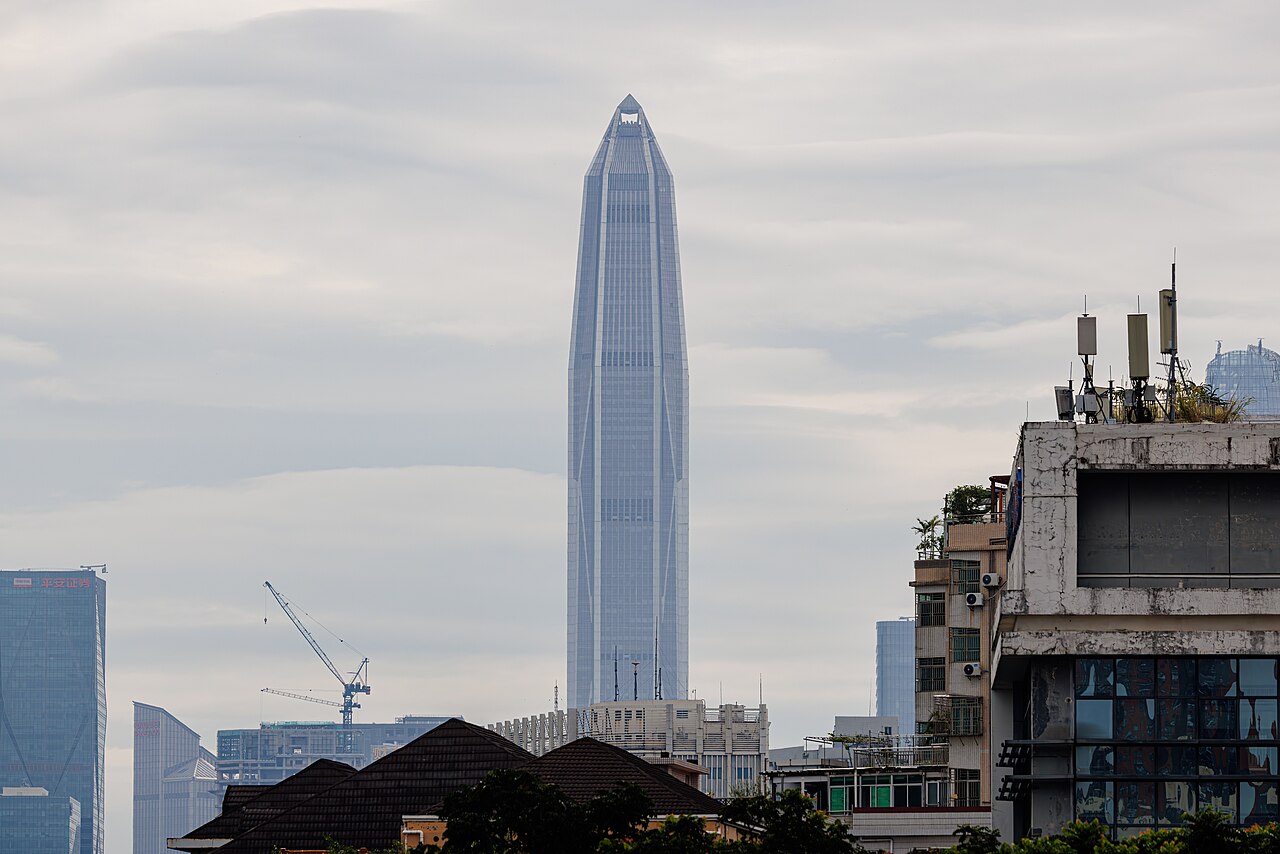
2017 · Kohn Pedersen Fox
A sheer glass shaft of 115 storeys rising 599 metres — one of the five tallest buildings in the world — with a shopping mall, hotel and conference centre stacked into its lower floors.
The Ping An Finance Centre is a 115-storey supertall skyscraper designed by Kohn Pedersen Fox in a postmodern idiom and completed in 2017. At 599.1 metres it is the tallest building in Shenzhen, the second-tallest in China after the Shanghai Tower, and the fifth-tallest in the world. Beyond office space, it contains a hotel, a conference centre and a high-end shopping mall, combining several functions within a single supertall structure rather than standing as a purely commercial tower.
Photo: Dinkun Chen (CC BY-SA 4.0)
Shun Hing Square
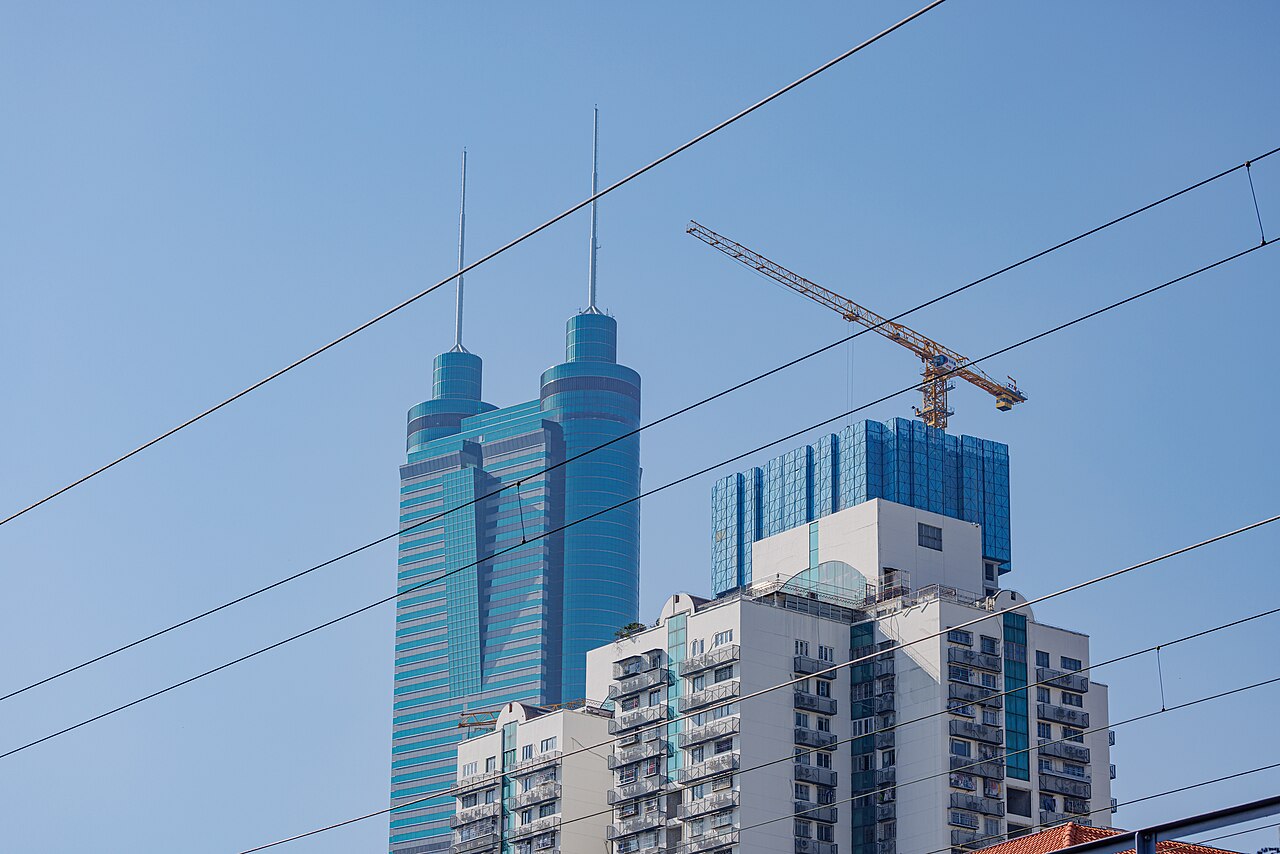
1996
A slender 384-metre office tower, plain beside its taller neighbours, notable chiefly for the sheer height that let it outstrip every other building in the country for about a year.
Shun Hing Square is a 384-metre skyscraper completed in 1996. On completion it became the tallest building in China, a record it held for roughly a year until Guangzhou's CITIC Plaza surpassed it in 1997. It is built as a tower block combining office and other floors. No architect is recorded for the building in available sources, though it remains one of the milestones of Shenzhen's early skyscraper boom.
- It is also widely known by a second name, Di Wang Tower.
Photo: Dinkun Chen (CC BY-SA 4.0)
Shenzhen Civic Center
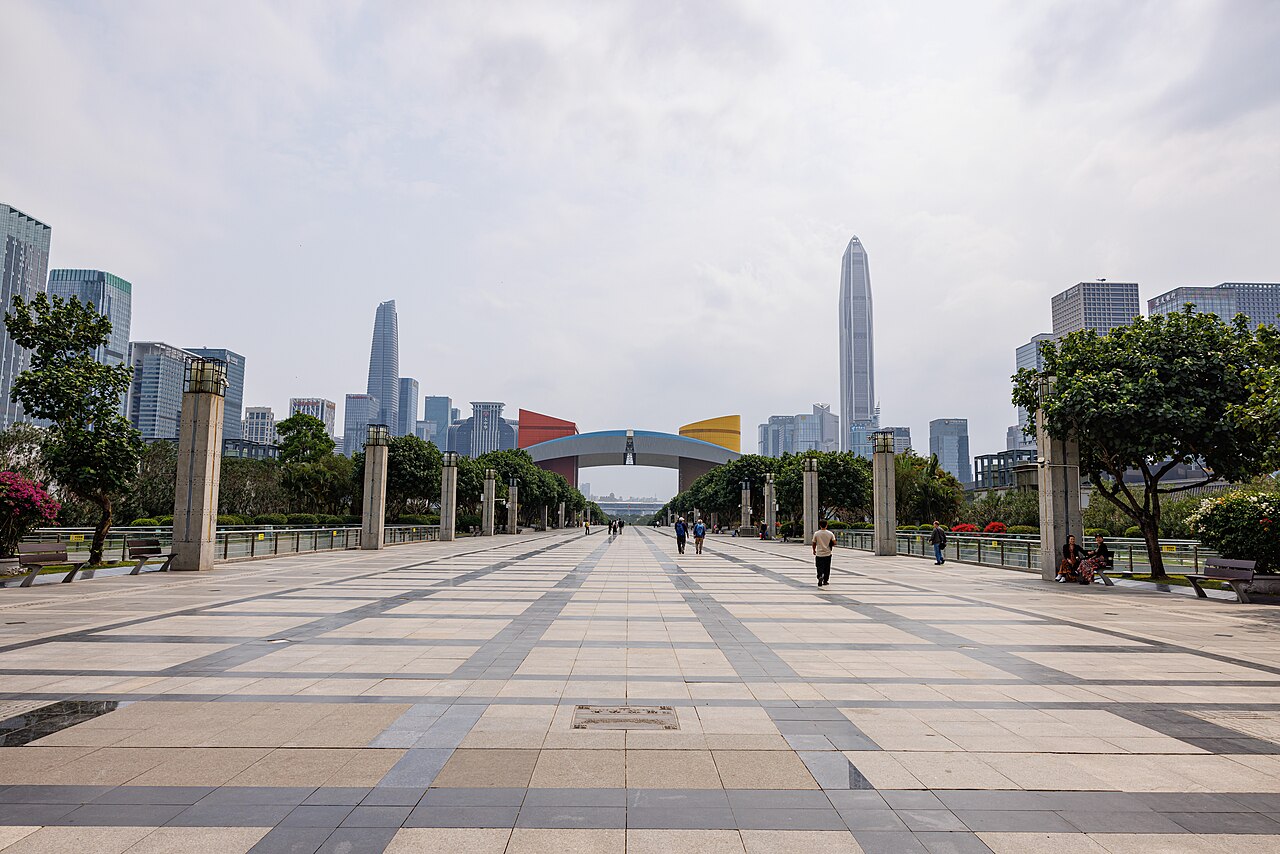
2004 · John Ming-Yee Lee
A large government complex whose design draws on traditional Asian architectural themes, forming the centrepiece of a masterplanned civic axis rather than standing as an isolated building.
The Shenzhen Civic Center is a government building designed by John Ming-Yee Lee and completed in 2004 at a cost of CNY 2.172 billion. It was the centrepiece of the Futian Central District master plan, sited on a two-kilometre axis running from Lianhua Mountain in the north, through the Civic Center, to the Exhibition Center in the south. Its design is described as attentive to traditional Asian themes and traditions, within a planned district covering roughly a hundred city blocks.
- The surrounding master plan's projected floor space was described as five times the size of the original World Trade Center towers.
Photo: Dinkun Chen (CC BY-SA 4.0)
KK100
A 100-story supertall skyscraper standing 442 meters tall, formerly known as Kingkey 100 and Kingkey Finance Tower.
SEG Plaza
A skyscraper completed in 2000 at the junction of Shennan Road and the Huaqiangbei Electronics Market, originally 356 meters tall including its since-removed antenna. Named for the Shenzhen Electronics Group headquartered there, its 69th-floor observation deck has since been converted into office space.
Horizontal Skyscraper – Vanke Center
A mixed-use building in Dameisha, designed by Steven Holl Architects and completed in 2009, raised on eight cores to stay under a 35-meter height limit. This created space for a large tropical garden beneath it, with a public path linking the hotel, apartments, and offices.
Guomao Building
An office tower 160 meters tall with 50 floors, built in just 37 months between 1982 and 1985, a pace that coined the term 'Shenzhen speed.' It was the tallest building in China on completion, and still has a revolving restaurant and a rooftop helipad.
Fairy Lake Botanical Garden
A 1,349-acre botanical garden and arboretum at the foot of Wutong Mountain, beside the Shenzhen Reservoir. It was named a national AAAA-level tourist site in 2007 and a national key park in 2008.
Stadium
A multi-purpose stadium in Futian, built in June 1993 at a cost of 141 million RMB. It had a seating capacity of 32,500 and served as the home ground of Shenzhen F.C.
Convention and Exhibition Center
The largest single structure building in Shenzhen, covering 280,000 square meters and measuring 540 meters long and 60 meters tall, completed in 2004. Designed by the German firm Gerkan, Marg and Partners, it has hosted almost 300 exhibitions and more than 1,350 conferences.
North railway station
A major high-speed rail station in Longhua District, with 11 platforms and 20 tracks, serving the Guangzhou–Shenzhen–Hong Kong Express Rail Link among other lines. Renamed from several earlier working titles in 2008, its metro interchange and high-speed rail platforms both opened in 2011.
Museum
A public municipal museum founded in 1981, though not formally opened until 1988, holding more than 20,000 historical and cultural relics. It now comprises four sites across the city, including the Museum of Ancient Art and the Museum of History and Folk Culture.
Art Museum
A public art museum founded in 1976 as the Shenzhen Exhibition Hall and renamed Shenzhen Art Museum in 1987. Its main venue is now in Longhua District, while its earlier Donghu venue remains listed in Luohu District.
International Garden and Flower Expo Park
A 660,000-square-meter public park in Futian District, officially opened on 23 September 2004. Besides garden and flower exhibits, it hosts arts and science programming and a solar power installation, and was named a National Key Park in 2008.
Lianhuashan Park
A hill and urban park inaugurated in 1997 at the northern end of the Futian Central Business District. It covers 150 hectares and is within walking distance of the Children's Palace metro station.
Hongfa Temple
A Buddhist temple located within the Fairylake Botanical Garden in Luohu District.
Happy Valley
A theme park in Nanshan District, opened in 1998 as the first of the Happy Valley chain, covering 350,000 square meters across nine themed areas. One of them, the Playa Maya Water Park, is themed after Mayan civilization and opens only from May to October.
Sea World Culture and Arts Center
A waterfront cultural center in Shekou, completed in 2017 as a joint venture between China Merchants Group and Britain's V&A Museum. Designed by Japanese architect Fumihiko Maki, his first building in China, it combines a museum podium with cantilevered volumes housing a theater and restaurant.
Safari Park
A zoo near Xili Lake covering 1.2 million square meters, the first in China to keep its animals uncaged. It holds more than 300 species and 10,000 animals, including endangered giant pandas and South China tigers.
History
Until 1979, Shenzhen was a largely rural area on the border with Hong Kong. Deng Xiaoping's reform and opening-up policies made it China's first special economic zone in the early 1980s, drawing foreign investment and migrant workers on a scale that turned the settlement into a city within a decade. That compressed growth produced a skyline built almost entirely from scratch: Shun Hing Square, finished in 1996, briefly stood as the tallest building in the country. Continued expansion produced the Shenzhen Civic Center in 2004, a government complex anchoring a purpose-built civic axis, and eventually the Ping An Finance Centre in 2017, now the city's tallest building. Each generation of towers replaced the previous height record, tracing the pace of the city's economic rise.