Landmarks in Johannesburg
Its Edwardian civic core rose within decades of an 1886 gold rush across open farmland.
Johannesburg's oldest surviving landmarks cluster in and around its original mining-era core, raised within a few decades of the 1886 gold strike that turned open farmland into a boomtown. City Hall, the Rand Club and the Rissik Street Post Office are all dressed in the solid, formal manner of the Edwardian period, in place of the tents and shacks that had stood a generation earlier. They were built for administration, postal service and the city's mining elite respectively, at a moment when the population had already passed 100,000 within a decade of the city's founding. Later apartheid-era planning pushed growth outward into separate townships, leaving this compact historic centre comparatively undisturbed, though not undamaged: fire and disuse have since claimed parts of it.
Johannesburg City Hall
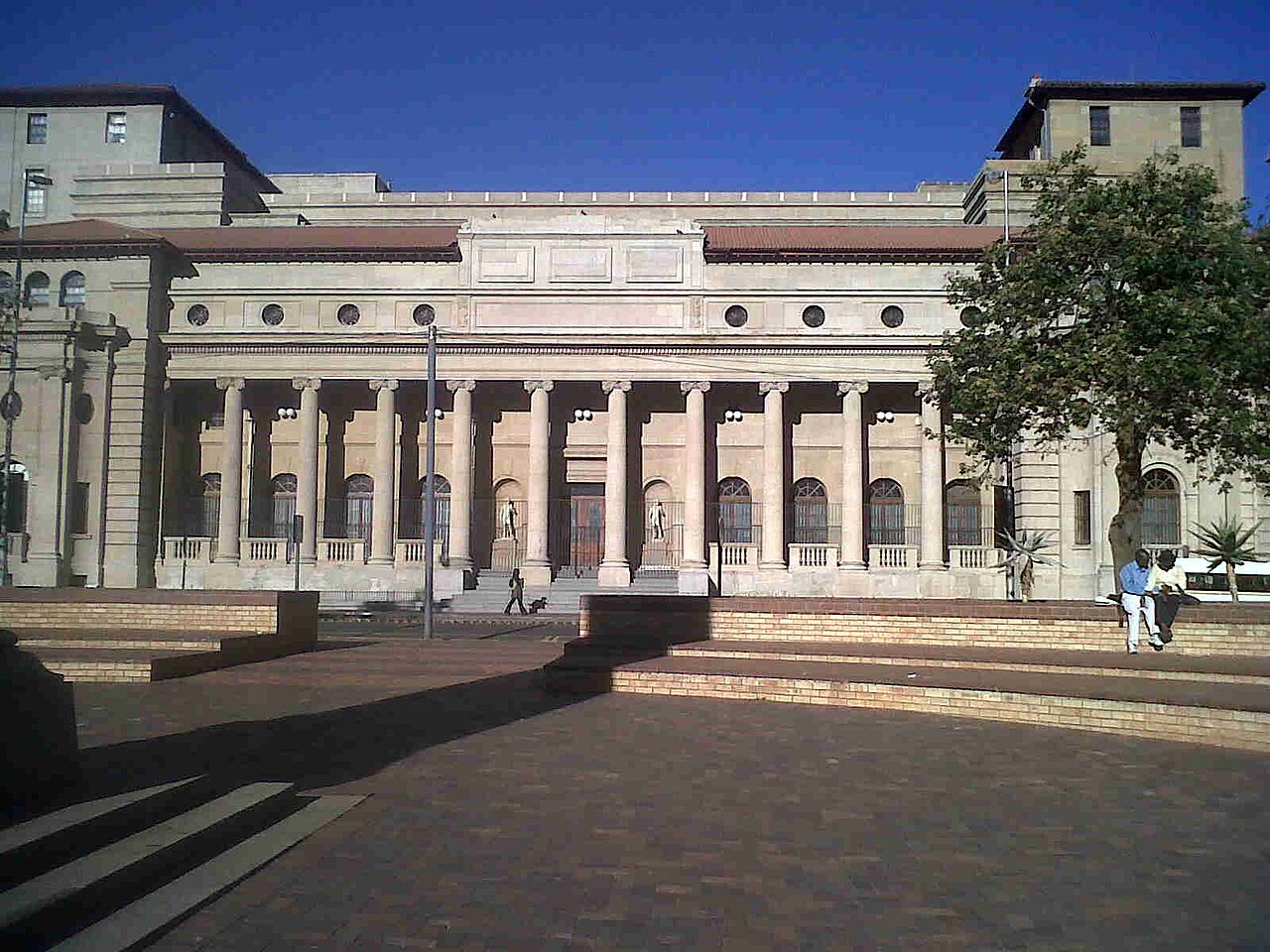
1914
Recognisable as an Edwardian civic hall whose formal facade and front steps have witnessed protest gatherings and a 1988 bomb blast, and which today houses a provincial legislature rather than a city council chamber.
Johannesburg City Hall is an Edwardian civic building completed in 1914, its plans drawn in 1910 and construction carried out by the Hawkey and McKinley firm over the following three years. Built as the seat of municipal government, it later passed to a provincial legislature, which still occupies it. Its steps have served as a stage for public life beyond council business, including protest meetings and a bomb blast in 1988, making the building as much a record of the city's political history as of its architecture.
- A bomb blast struck its steps in 1988, decades after it opened as a seat of municipal government.
- Though built as a city hall, it is today occupied by a provincial legislature rather than any municipal body.
Photo: Sdnxumalo (CC BY-SA 3.0)
Rissik Street Post Office
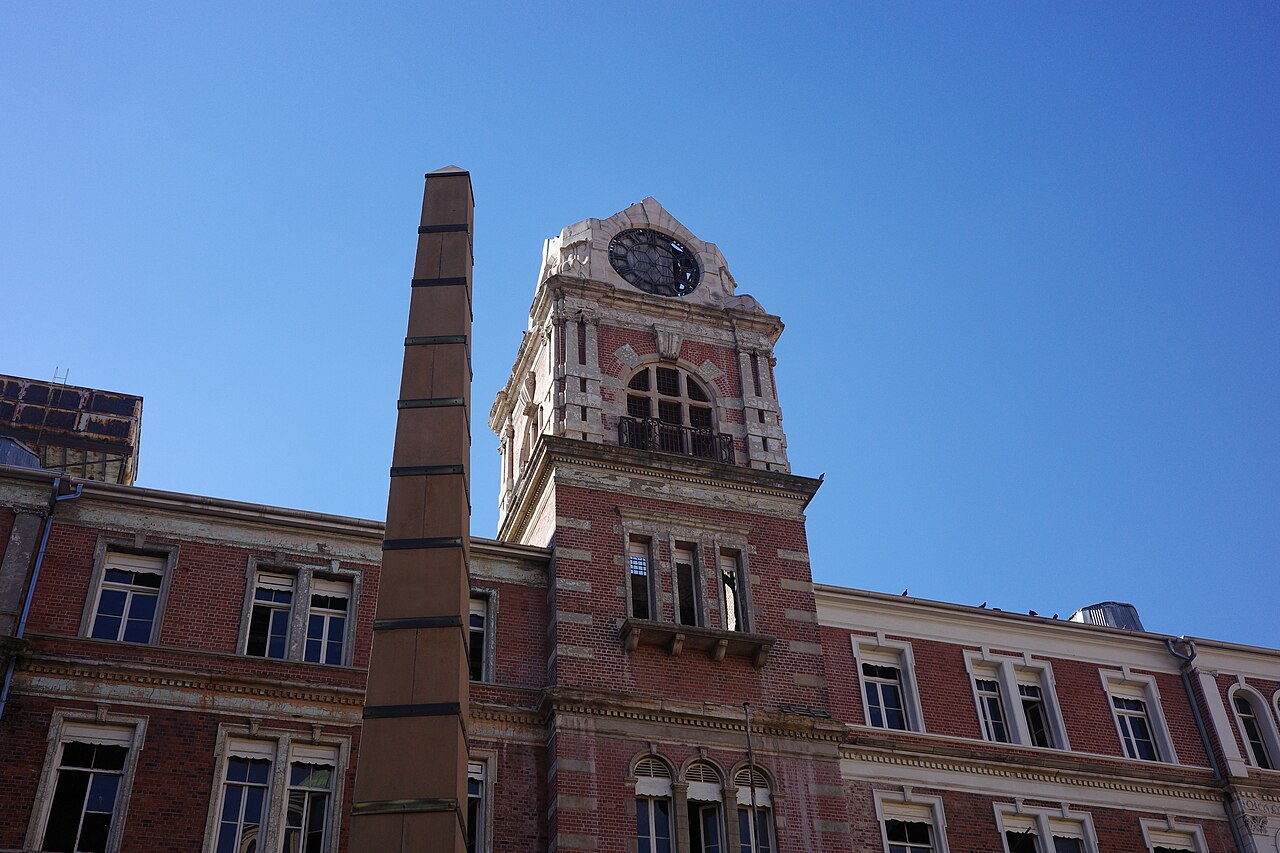
1897 · Sytze Wierda
Identifiable by its unusual height for a building of its age — 102 metres, once the tallest in the city — and, since a 2009 fire gutted it, by the visible signs of long-term disrepair and the restoration under way since 2016.
Designed by Sytze Wierda, architect to President Paul Kruger, the Rissik Street Post Office opened in 1897 and briefly stood as the tallest building in Johannesburg at 102 metres. It served as a working post office for almost a century before the Post Office vacated it in 1996. Declared a national monument in 1978, the building was gutted by fire in 2009 and left derelict for years; a reconstruction estimated at R147 million began in 2016 to restore it.
- At 102 metres, it was briefly the tallest building in Johannesburg.
- It sat gutted and empty for years after a 2009 fire before a roughly R147 million restoration began in 2016.
Photo: Nick-D (CC BY-SA 4.0)
Rand Club Building
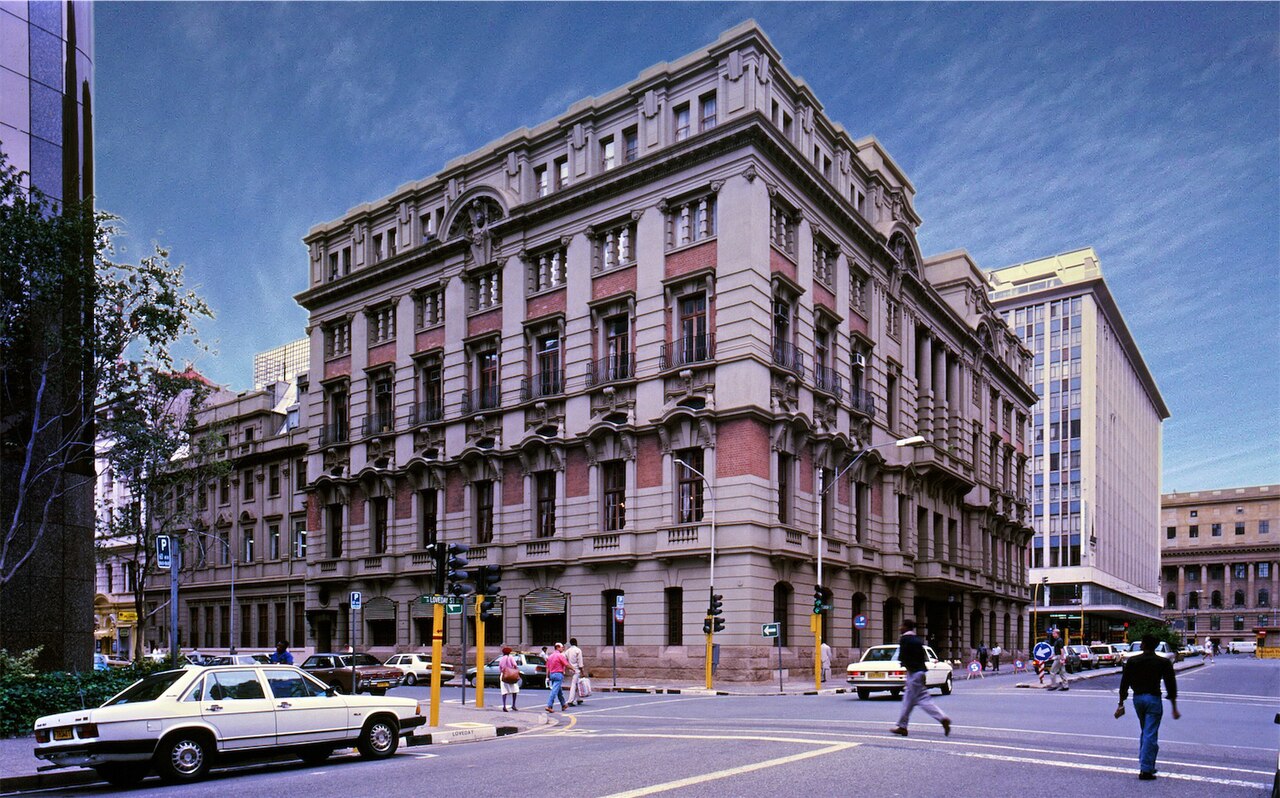
1904 · Leck & Emley
Recognisable less by outward ornament than by its unbroken function since 1904 as a private members' club — the third clubhouse built for a society founded in 1887 — set apart from public civic buildings nearby by its continued private use.
The Rand Club is a private members' club founded in October 1887, only months after Johannesburg itself. Its present clubhouse, the third built for the club, was designed by Leck & Emley in 1902 and completed in 1904 on a site Cecil Rhodes helped select. For more than a century membership was restricted; only in 2016 did the club change its rules to admit members regardless of race or gender, a shift that marked a break from its origins among the city's mining-era elite.
- Cecil Rhodes helped choose the site for the clubhouse.
- The club did not open membership to people of any race or gender until 2016.
Photo: Janek Szymanowski (CC BY-SA 3.0)
FNB Stadium
Also known as Soccer City or the Calabash, a football and rugby stadium in Nasrec bordering Soweto. Designed as the main venue for the 2010 World Cup, it became Africa's largest stadium with a capacity of 94,736, capped at 84,490 during the tournament.
Ponte City
A 55-storey cylindrical skyscraper in Berea, built in 1975 to a height of 173 metres, Africa's tallest residential building for 48 years. Its open centre, called "the core," rises above an uneven rock floor, and its rooftop neon sign is the Southern Hemisphere's largest.
Carlton Centre
A 50-storey skyscraper and shopping centre on Commissioner Street, at 223 metres Africa's tallest building for 46 years from 1973 until 2019. Its towers' foundations extend down to bedrock 35 metres below street level, and over 46 percent of its floor area lies underground.
Hillbrow Tower
Officially the Telkom Joburg Tower, a telecommunications tower in Hillbrow standing 269 metres tall, Africa's tallest tower for 50 years until 2021. Construction began in June 1968 and finished three years later, and it remains the tallest telecommunications tower on the continent.
Nelson Mandela Bridge
The fourth of five bridges crossing the railway lines west of Johannesburg Park Station, completed in 2003 at a cost of R38 million. Built to link Braamfontein and Newtown, it was Southern Africa's longest suspension bridge for 21 years until the Msikaba Bridge overtook it.
Ellis Park Stadium
A rugby and football stadium that hosted the 1995 Rugby World Cup final, won by the Springboks. Upgraded in 1982 to hold nearly 60,000, it was named for J. D. Ellis, who made the site available, and later took on sponsorship naming as Coca-Cola Park.
Carlton Hotel
A historic hotel opened in 1972 as part of the Carlton Centre complex, closed since 1998. Its closure has been linked to the district's decline, a crime wave, and the exodus of corporate offices to areas like Sandton and Rosebank, leaving rooms unfilled.
Constitution Hill
A precinct in Braamfontein near Hillbrow that is seat of the Constitutional Court of South Africa, comprising the court, the Old Fort Prison and a museum. In 2024 it became a World Heritage Site, known as one of the Nelson Mandela Legacy Sites.
Wanderers Stadium
Also known as the Bullring, a cricket stadium just south of Sandton in Illovo, hosting Test, One Day and First-class matches. It serves as the home ground for the Imperial Lions and the Joburg Super Kings.
Cathedral of Christ The King
A Catholic cathedral in Johannesburg, South Africa.
St Mary's Cathedral
Officially the Cathedral Church of Saint Mary the Virgin, the cathedral of the Anglican Diocese of Johannesburg.
Brixton Tower
Officially the Sentech Tower, previously the Albert Hertzog Tower, a 237-metre concrete tower near the Brixton Ridge. A well-known landmark alongside its architectural cousin, the Hillbrow Tower, it carried only FM radio until the 1970s despite being built for both radio and television.
Johannesburg Art Gallery
An art gallery in Joubert Park, completed in 1915 to a design by Sir Edwin Lutyens, comprising 15 exhibition halls and sculpture gardens. Once the largest gallery on the continent, its collection of over 9,000 works exceeds Cape Town's Iziko South African National Gallery.
MuseuMAfricA
A historical museum in Newtown, formerly known as the Africana Museum.
Market Theatre
A theatre in Newtown, opened in 1976 as an independent, anti-racist theatre during apartheid, named for a market once on the site. Two stages are named for founders Barney Simon and Mannie Manim, and its Main Theatre was renamed the John Kani Theatre in 2014.
Kerk Street Mosque
Also known as the Jumah Mosque, one of the oldest mosques and places of worship in the city.
Central Methodist Church
A prominent Methodist church at the corner of Pritchard and Smal Streets in the inner city. It has served as both a religious centre and a site of social activism, particularly in support of the urban poor and refugees.
Great Park Synagogue
An Orthodox Jewish synagogue in Houghton, its present building consecrated in 2000 after the congregation left its Wolmarans Street home in Hillbrow in 1994. That earlier building, the city's mother synagogue, hosted major Jewish events and the seat of the chief rabbi for eighty years.
Johannesburg Botanical Garden
A garden in Emmarentia that grew from a rose garden established in 1964 and expanded from 1969 to cover about 125 hectares. Administered by Johannesburg City Parks and bordered by the Emmarentia Dam, its main attraction is the Rose Garden, with over 10,000 roses.
Johannesburg Zoo
A 55-hectare zoo established in 1904, traditionally owned and operated by the Johannesburg City Council. It houses about 2,000 animals across 320 species and has since become a registered Section 21 non-profit organisation.
Chancellor House
A law office at 25 Fox Street in Ferreirasdorp, once home to the Mandela and Tambo firm, and now a provincial heritage site. Planned for purchase by the Johannesburg Heritage Trust in 2004, it instead fell into ruin before full restoration in May 2011.
Ansteys Building
An Art Deco building named for original owner Norman Anstey, founder of one of the city's best-known department stores and mayor from 1913 to 1915. His Norman Anstey and Company store occupied the building's four-storey podium, which features a curved facade addressing the street corner.
Johannesburg City Library
An Italianate library building in the central business district, designed by John Perry and first opened in 1935. It holds over 1.5 million books and items and has more than 250,000 members.
Johannesburg Gas Works
Also known as Egoli Gas Works, a defunct gas facility established in 1892, among the city's most significant industrial sites. Its intact machinery and structurally sound buildings still show the process of turning coal into gas, and its tanks remain a major city landmark.
History
Johannesburg did not exist before 1886, when the discovery of gold on the Witwatersrand turned open farmland into a mining camp; within ten years its population passed 100,000. The wealth that followed built solid Edwardian-style institutions in place of the original tents and shacks: a private club for the mining elite completed in 1904, a post office finished in 1897 that briefly stood as the tallest building in the young city, and a city hall finished in 1914 on the eve of the First World War. Twentieth-century apartheid policy then reorganised the wider city into racially segregated townships and suburbs, leaving this original core as an administrative and commercial centre. Some of its Edwardian buildings survived intact; others did not, including a fire that gutted the post office in 2009.