Landmarks in Nairobi
A colonial mosque, a 1930s library and a 1970s brutalist tower share Nairobi's skyline.
Nairobi's catalogued landmarks split across two distinct eras. A Central Business District mosque, founded in 1902 and built up between 1925 and 1933, and a memorial library opened in 1931 belong to the colonial decades, when the city's civic and religious institutions were first raised in permanent stone and marble. The 1973 Kenyatta International Convention Centre, a thirty-two-storey brutalist tower raised after independence, represents the opposite instinct: exposed concrete built to hold government offices and international conferences rather than congregations or reading rooms. For years it stood as the tallest structure in view, before later office towers overtook it, a shift that mirrors the city's growth into East Africa's financial hub.
Kenyatta International Convention Centre
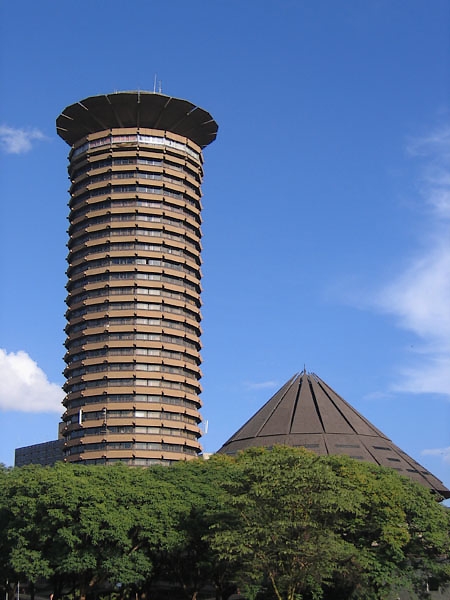
1973 · Karl Henrik Nøstvik
A plain, thirty-two-storey brutalist tower of exposed concrete, part of a City Square complex, one of the earliest high-rises in view and for years the tallest silhouette on the skyline.
The Kenyatta International Convention Centre is a thirty-two-storey building completed in 1973 to a design by Karl Henrik Nøstvik, in the brutalist style. Standing in the City Square in central Nairobi, it houses government offices, including those of elected Senators, and has ranked among the continent's leading conference venues. After completion it was the city's tallest building until the construction of Teleposta Towers; it has since been surpassed by the UAP Old Mutual Tower, Times Tower and the Britam Tower, the tallest in the city as of 2020.
Photo: Original uploader was Mkimemia at en.wikipedia (CC BY-SA 3.0)
Jamia Mosque
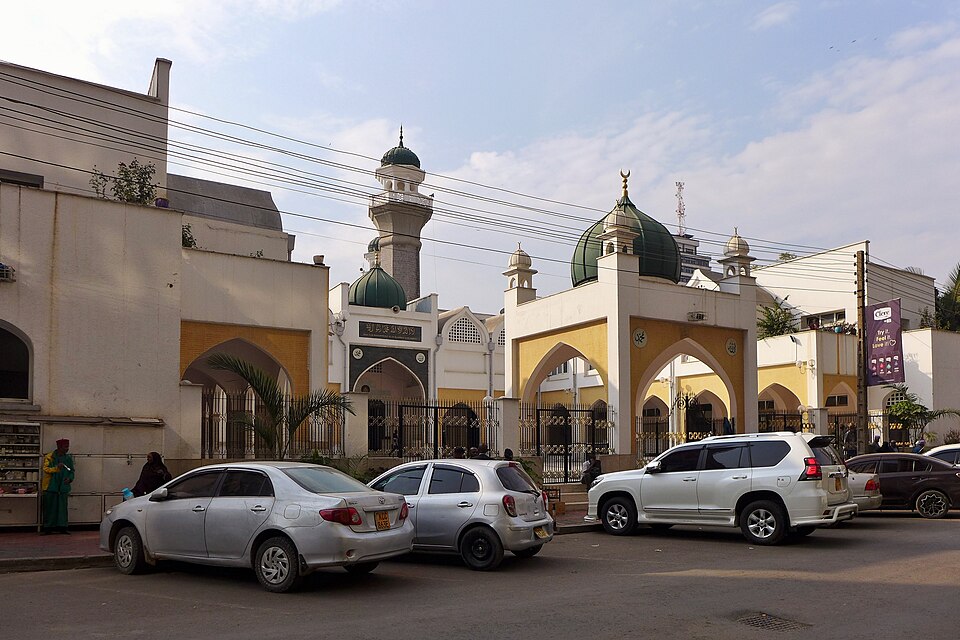
1925–1933
Three silver-coloured domes and twin minarets crown a marble-faced building in a classic Arabic Islamic style, with Quranic inscriptions on its facade and a row of shopfronts built into one side of the complex.
Jamia Mosque was founded in 1902 by Syed Maulana Abdullah Shah and built up between 1925 and 1933 on Banda Street, in Nairobi's Central Business District. It serves the city's Muslim community, particularly for Friday prayers, and was a centre of Muslim religious organisation through the colonial and post-independence periods, hosting discussions among religious, political and community leaders. A modern wing added in 1998 holds a library, a multipurpose hall and offices for a bulletin and a television station. A row of shops along the complex, including a clinic and pharmacy, provides rental income for its upkeep.
- A modern wing added in 1998 houses offices for a bulletin and a television station alongside the mosque's own library and hall.
- A row of shops built into the complex, including a clinic and pharmacy, funds the mosque's upkeep through rental income.
Photo: Bahnfrend (CC BY-SA 4.0)
McMillan Memorial Library
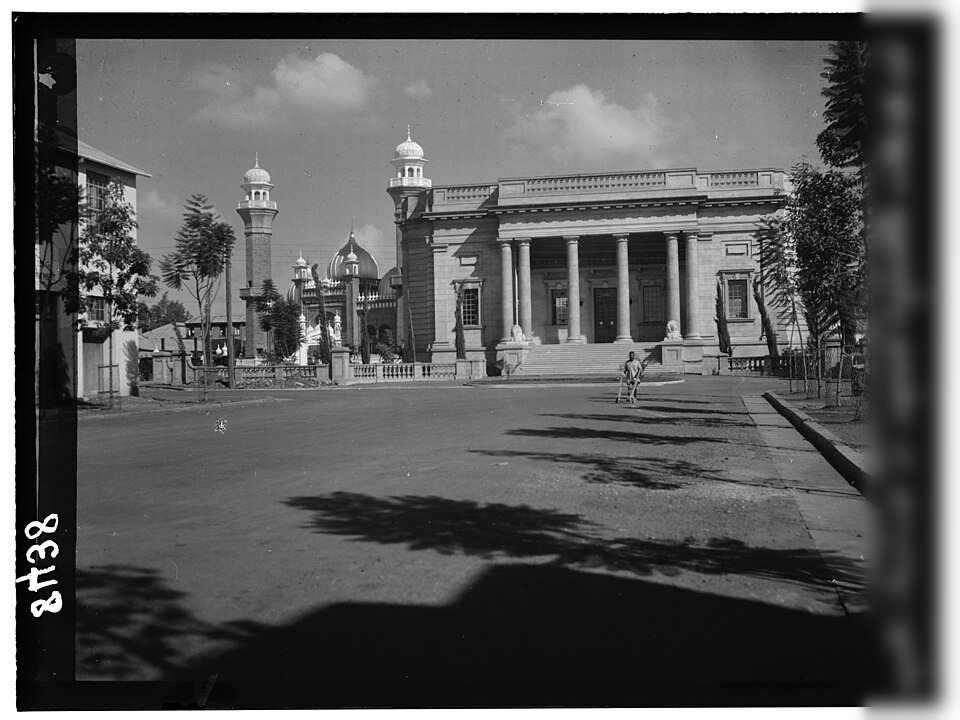
1931
Granite-clad columns run along the facade above a broad white marble stairway that narrows as it rises to the portico, with a stone lion seated on either side of the entrance. The walls are smooth rendered stone under a flat roof, pierced by tall steel casement windows.
Built by the family of William Northrup McMillan, an American-born settler who died in 1925, and financed largely by the Carnegie Corporation of New York, close friends of the family. It opened on 5 June 1931 and was reserved for European readers, a restriction later written into law by the McMillan Memorial Library Act of 1938 — which made it the only building in Kenya protected by its own Act of Parliament. The city council took it over in the late 1950s and opened it to everyone in 1962. It holds more than 400,000 books.
- The two stone lions at the entrance were donated by cousins of the man the library commemorates.
- Its newspaper and periodical holdings reach back to 1901.
- A documentary about the building's restoration premiered at the Sundance Film Festival in 2025.
Photo: Matson Collection (Public domain)
Nairobi National Park
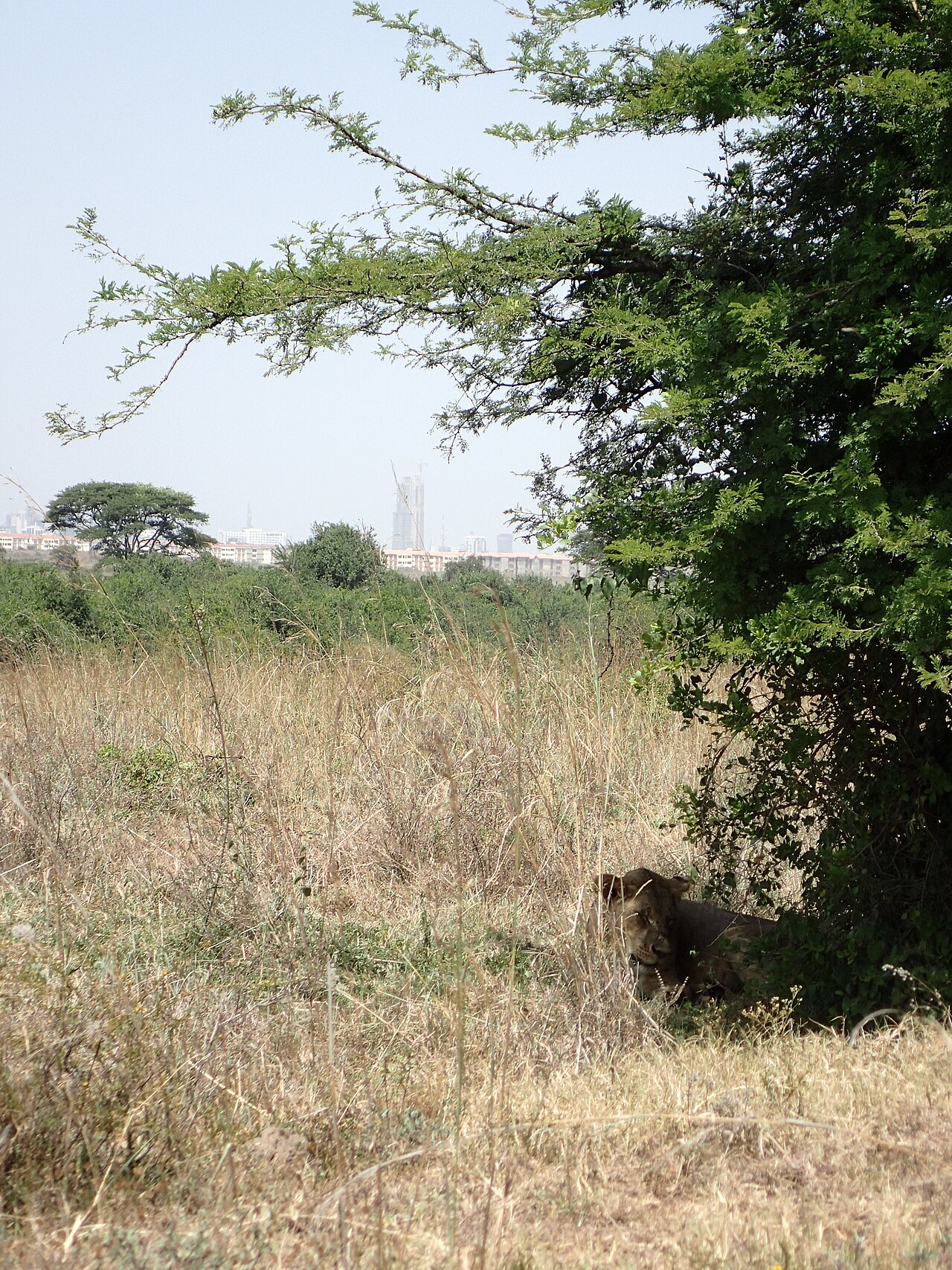
1946
Open grass plains scattered with acacia bushes, backed by highland dry forest to the west and riverine forest along the southern river, with rocky valleys and gorges cutting through parts of the terrain; sightings of black rhinoceros here are close to guaranteed.
Nairobi National Park was established in 1946 as Kenya's first national park, roughly seven kilometres from the city centre. Electric fencing encloses it on three sides; the fourth, marked by the Mbagathi River, stays open so wildebeest and zebra can move between the park and the plains beyond during seasonal migrations. It holds lion, leopard, black rhinoceros, giraffe and elephant among its wildlife, and is considered one of Kenya's most successful rhinoceros sanctuaries. A nearby sanctuary run by the David Sheldrick Trust, opened in 1963, hand-rears orphaned elephant and rhino calves before their release.
- In 1989, Kenyan President Daniel arap Moi burned twelve tons of confiscated ivory within the park, a gesture that helped rehabilitate the country's conservation reputation.
- The park is sometimes called Kifaru Ark, Swahili for Rhinoceros Sanctuary.
Photo: Nero2022 (CC BY-SA 4.0)
Karen Blixen Museum
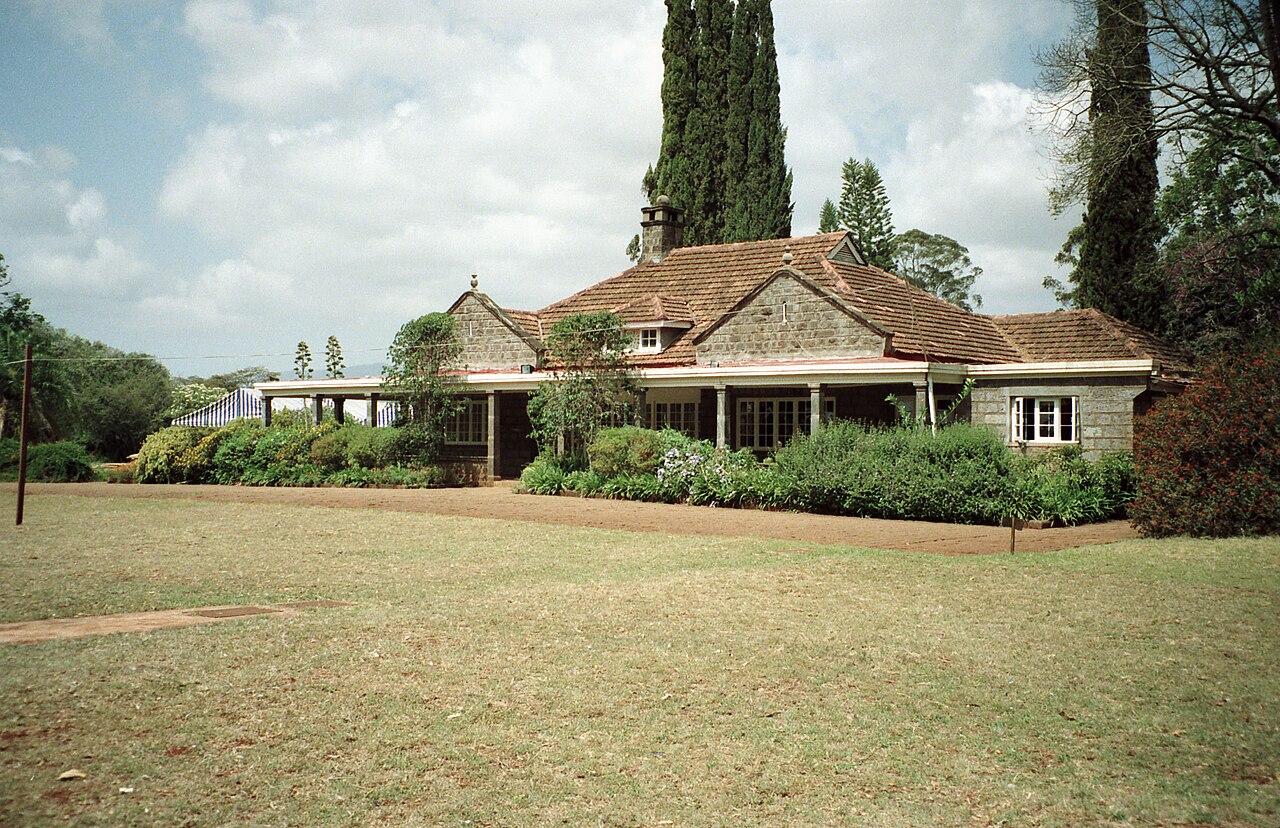
1912 · Åke Sjögren
A single-storey bungalow-style house at the foot of a range of hills, surrounded by grounds that once formed a coffee plantation and are kept much as they appear in the owner's own writing about the estate.
The Karen Blixen Museum occupies a bungalow-style house built in 1912 by the Swedish engineer Åke Sjögren, at the foot of a range of hills outside Nairobi. Its Danish owner bought the house and surrounding land in 1917 for a coffee plantation and lived there until returning to Denmark in 1931. The Danish government later donated the property to Kenya as an independence gift, and it opened to the public as a national museum in 1986, following a surge of interest sparked by a 1985 film based on the owner's memoir.
- The 1985 film based on the owner's memoir was not shot at this house but at her earlier, nearby farmhouse.
- The upscale suburb that now surrounds the museum takes its name from the property's former owner.
Photo: Rworsnop at English Wikipedia (Public domain)
Uhuru Park
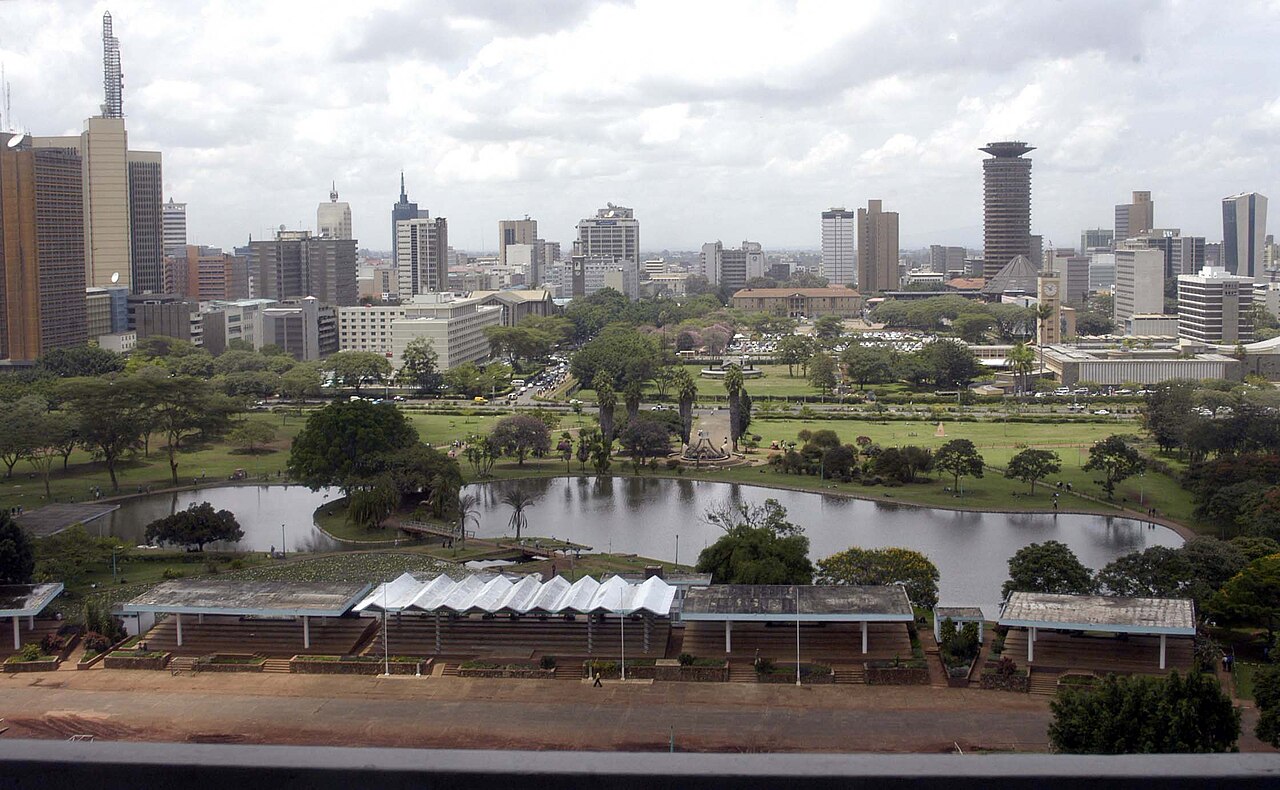
1969
Landscaped grounds centred on an artificial lake, with a paved assembly ground that draws skateboarders on weekends, sitting directly against the tower blocks of a business district skyline.
Uhuru Park is a 12.9-hectare park beside Nairobi's central business district, opened to the public in 1969 by Jomo Kenyatta. Its grounds include an artificial lake, several national monuments, and a paved assembly ground now popular for skateboarding as well as political and religious gatherings; a 1989 protest here by Wangari Maathai helped block construction of a planned 60-storey tower. The park was fenced off in November 2021 during a renovation that a court halted over environmental concerns, and reopened to the public, free of charge, in March 2024.
- In 1996 a Catholic archbishop led a protest at the park that burned a pile of condoms.
- A 2010 bomb blast at the park, during a rally on a constitutional referendum, killed six people and injured over a hundred.
- The park's assembly ground has hosted a best-trick skateboarding competition as part of the city's growing skateboarding scene.
Photo: DEMOSH (CC BY 2.0)
State House
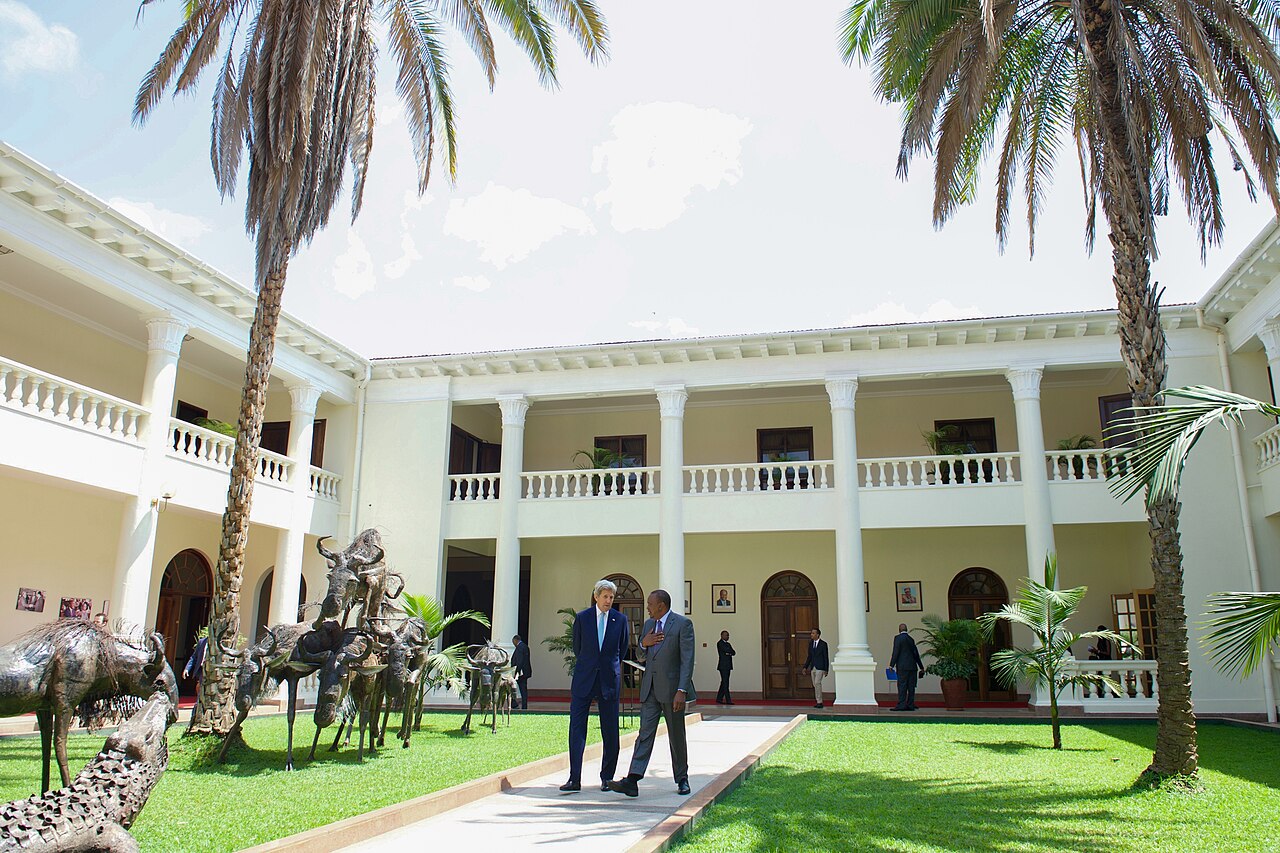
1907 · Herbert Baker
A Palladian-style residence set within a walled 3-square-kilometre private estate on the edge of the capital, about a ten-minute drive from the city centre, comparable in scale and style to the country's other, smaller state houses in Mombasa and Nakuru.
This official residence was built in 1907 as the Government House of British East Africa's colonial governor, designed in the Palladian style by the architect Herbert Baker. At independence it became the residence of Kenya's prime minister, and when the country became a republic on 12 December 1964 the premiership was abolished and the building was renamed State House, becoming both the residence and workplace of the president. It stands on a 3-square-kilometre estate about ten minutes from central Nairobi; smaller State Houses also exist in Mombasa and Nakuru.
- An earlier Government House, predating this one, had stood in Mombasa since 1879.
- In October 2025, a man was arrested outside the residence's main gate after fatally shooting a security officer with a bow and arrow.
Photo: U.S. Department of State from United States (Public domain)
Giraffe Manor
A small boutique hotel in the Lang'ata suburb that, together with the adjoining AFEW Giraffe Centre, is home to a number of endangered Nubian giraffes. It runs a breeding programme aimed at reintroducing breeding pairs into the wild to help secure the subspecies' future.
Fairmont The Norfolk Hotel
A historic hotel managed by Fairmont Hotels and Resorts, built as five low-rise blocks of one to two stories. It has 170 rooms and three restaurants, and has kept its signature Tudor-style architecture since it was first built.
Cathedral Basilica of the Holy Family
The seat of the Archdiocese of Nairobi, built between 1960 and 1963 on the site of the city's first stone building, a smaller 1904 church. It was blessed and opened on 6 July 1963 and designated a basilica in 1982.
Stanley Hotel
Now called the Sarova Stanley, this was Nairobi's first luxury hotel, established in 1902 by businesswoman Mayence Bent when the city was a railway halt. Named for explorer Henry Morton Stanley, it became a traditional gathering point for safari-goers, hosting royalty, politicians, and film stars.
Parliament Buildings
The seat of the Kenyan Parliament, located in Nairobi.
Uhuru Gardens
A 68-acre commemorative park in Lang'ata, Kenya's largest urban memorial park, marking where the country's flag was first raised on 12 December 1963. Declared a National Monument in 1966, it was redeveloped by Kenya's military and reopened as a museum complex in December 2021.
Karura Forest
An urban forest gazetted in 1932, the second largest in the world after Rio de Janeiro's Tijuca Forest. Spanning 1,041 hectares, it is home to some 200 bird species along with bushbucks, bush pigs, genets, civets, and honey badgers.
Muthaiga Country Club
A country club in the Muthaiga suburb, about 15 minutes from the city centre, opened on New Year's Eve in 1913. It became a gathering place for colonial British settlers in what was then British East Africa, renamed the Colony of Kenya in 1920.
Nairobi Railway Museum
A railway museum next to Nairobi railway station, opened in 1971 with exhibits from the defunct East African Railways. Its collection includes steam and diesel locomotives, among them number 301, which appeared in the 1985 film Out of Africa.
Khoja Mosque
A mosque originally known as the Nairobi Town Jamatkhana. It stands at the junction of River Road and Moi Avenue, at the edge of the central business district.
BAPS Shri Swaminarayan Mandir
The first traditional stone-and-marble Hindu temple built on the African continent, constructed by the BAPS Swaminarayan Sanstha. It was opened on 29 August 1999 by Pramukh Swami Maharaj, the denomination's fifth spiritual leader.
Gikomba market
An open-air market selling a wide range of goods, from food to clothing. It is particularly known for its secondhand clothing, or mitumba, sellers, reportedly more than at any other market in the country.
Kipande House
A historical building at the intersection of Kenyatta Avenue and Loita Street, designed in 1889 by Indian-born entrepreneur Sardar Gurdit Singh Nayer. Completed in 1913 and originally called the Nayer Building, it later became known as Kipande House.
Teleposta Towers
The eighth-tallest building in Nairobi, a 120-meter, 27-story tower on Kenyatta Avenue completed in 1999 after construction began in 1996. Designed by Dr. Paul Ndarua, it houses Telkom Kenya along with Kenya's Ministries of Information and Communications and of Trade.
Nairobi Kenya Temple
The first temple of the Church of Jesus Christ of Latter-day Saints built in Kenya and East Africa, announced in 2017. Built on a 3.4-acre site in Mountain View with a Portuguese limestone exterior, it features an agapanthus flower motif reflecting Kenya's flower exports.
Moi International Sports Centre
A multi-purpose stadium in Kasarani built in 1987 for the All-Africa Games held in Nairobi. It includes a 48,063-seat athletics stadium, a competition swimming pool, an indoor arena, and a 108-bed hotel.
History
Its name comes from the Maasai Enkare Nyirobi, “place of cool waters”. Nairobi grew from a colonial-era settlement into the seat of Kenya's Parliament, State House and Supreme Court, and into the region's leading financial centre, host today to the United Nations Environment Programme and to the Nairobi Securities Exchange, one of the continent's oldest bourses. That path shows in the older buildings: Jamia Mosque, founded in 1902 by Syed Maulana Abdullah Shah and built up through 1933, and the McMillan Memorial Library, opened in 1931, both belong to the years of colonial civic building. Independence brought a different kind of landmark: the Kenyatta International Convention Centre, completed in 1973, was raised as a brutalist government and conference tower and held the record as the city's tallest building until later office towers overtook it.