Landmarks in Nassau
Coral-rock colonial buildings and a carved limestone stair crown Nassau's harbour hills.
Nassau's landmarks cluster on the low hills above the harbour, each built within a few years of the others in the late eighteenth and early nineteenth centuries. Fort Fincastle occupies a hilltop overlooking the town and the sea approaches; the Queen's Staircase, cut straight down through solid limestone, links it to the streets below. Government House stands on a neighbouring rise, a stuccoed coral-rock mansion in the Georgian colonial style that Loyalist arrivals from the southern United States brought with them in the 1780s. Coral rock and limestone, quarried close to where they were used, are the common materials; louvred wood shutters and brightly painted walls are the recurring Bahamian touches on an otherwise European frame.
Government House
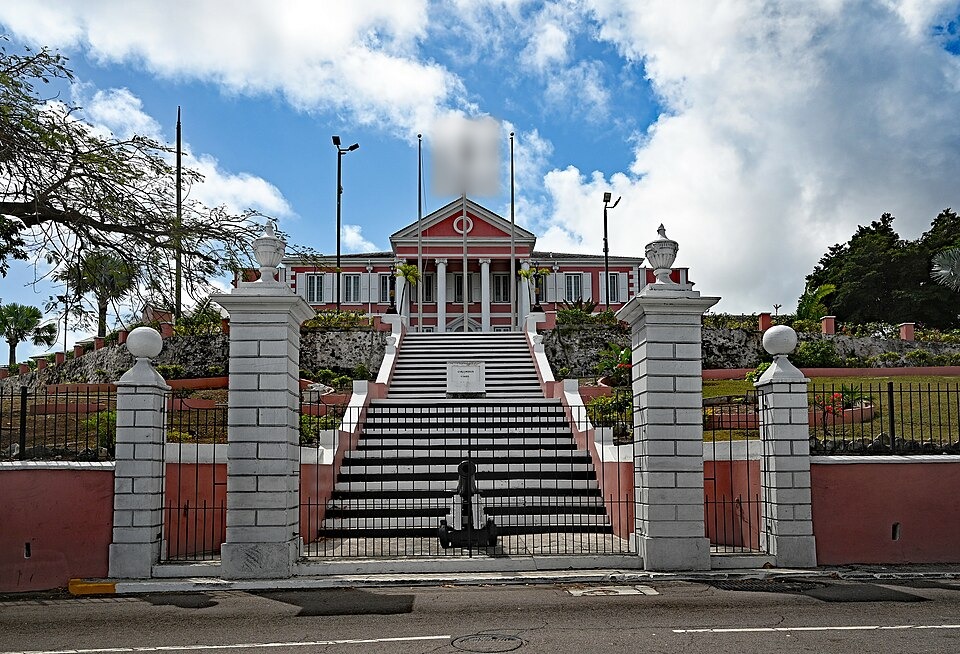
1806
A large stuccoed coral-rock mansion in the Georgian colonial style, standing on high ground above the town, its brightly painted exterior set off by louvred wood shutters.
Government House has served as the official residence of the Bahamas's governor, and since 1973 its governor-general, since it was completed in 1806 on a rise known as Mount Fitzwilliam. Built of stuccoed coral rock in the Georgian colonial style, its neoclassical, stone-built form reflects the Loyalists who reached Nassau from the southern United States in the 1780s, a marked change from the painted timber buildings common before them. Louvred wood shutters and a brightly painted exterior remain typically Bahamian touches on an otherwise European design.
- In 1825 the Oriental Herald called it the best building of its kind in the West Indies.
- In 1814 the Spanish scholar and soldier Antonio de Alcedo wrote admiringly of its effect.
- Its Georgian style is a direct result of Loyalist refugees who reached Nassau from the southern United States in the 1780s.
Photo: P. Hughes (CC BY 4.0)
Queen's Staircase
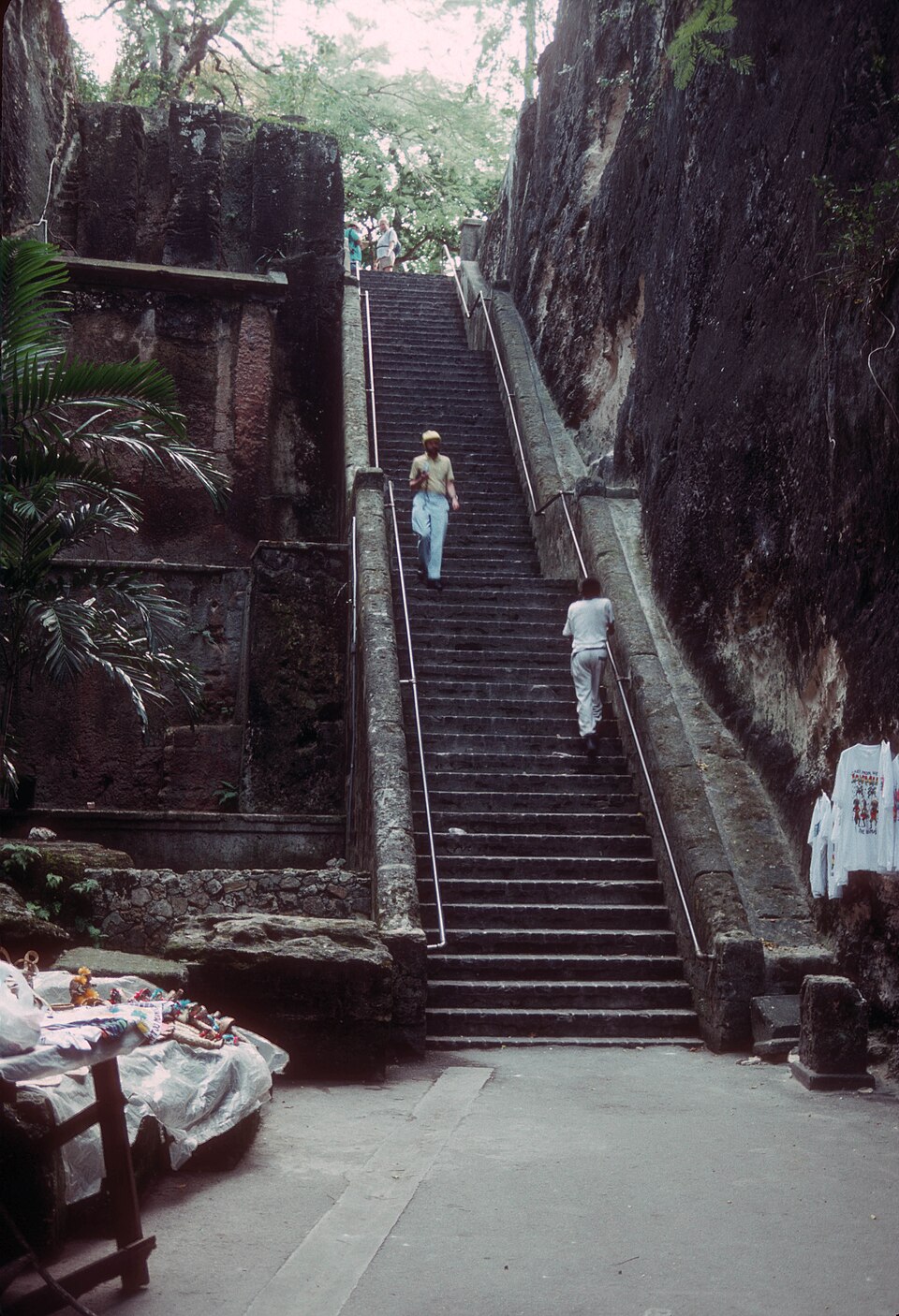
1793–1794
A narrow, open-air staircase enclosed by sheer limestone walls, its sixty-five stone steps rising in a single cut through the rock face from a hilltop fort down to the town.
The Queen's Staircase, 65 steps today though originally 66, was carved directly out of solid limestone between 1793 and 1794 to give a direct route from Fort Fincastle down into Nassau. The work was done by 600 enslaved people, cutting the steps straight through the rock face rather than building a structure on top of it. It gained its present name later, in the nineteenth century, after Queen Victoria, and remains one of Nassau's best-known landmarks.
- Cut by 600 enslaved people between 1793 and 1794.
- Originally had 66 steps; one has since been lost, leaving 65.
- Named for Queen Victoria only after it was already decades old.
Photo: JERRYE AND ROY KLOTZ MD (CC BY-SA 3.0)
Fort Fincastle
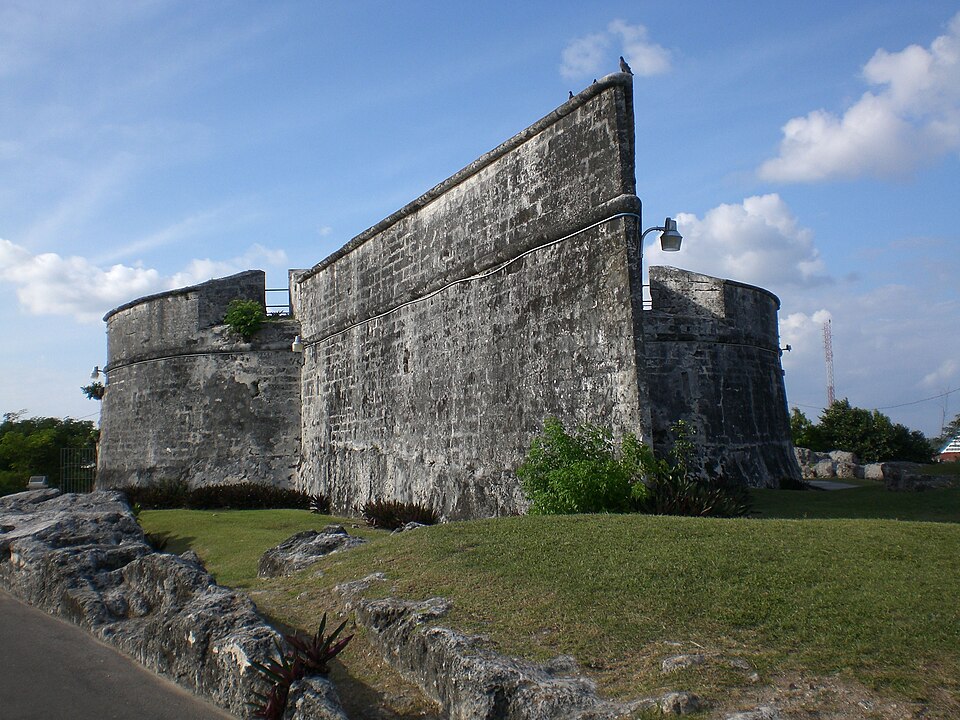
1793
A small hilltop fort built to the outline of a paddle steamer, with a pointed, bow-like end facing the sea and thick stone walls overlooking the harbour and town below.
Fort Fincastle was built in 1793 on Society and Bennet's Hills at the order of Lord Dunmore, who named it after his own secondary title, Viscount Fincastle. Laid out in the outline of a paddle steamer, it mounted two 24-pounders, two 32-pounders, two 12-pounder cannons and a howitzer to defend Nassau against pirate raids. From completion until September 1817 it doubled as a lighthouse, after which a new light on Paradise Island took over and the fort continued instead as a signal station.
- Shaped in the outline of a paddle steamer.
- Named after Lord Dunmore's secondary title, Viscount Fincastle.
- Served as a lighthouse until 1817, before the role passed to a new light on Paradise Island.
Photo: Taugenichts80 (CC BY-SA 3.0)
Atlantis Paradise Island
An ocean-themed casino resort on Paradise Island, spanning 154 acres around the Aquaventure waterscape and a cluster of hotel towers including the Royal, Coral, Cove and Reef. Its design weaves in the legend of Atlantis, and the casino displays glass sculptures by artist Dale Chihuly.
National Art Gallery of the Bahamas
An art museum announced in 1996 by then-Prime Minister Hubert Ingraham, the first institution of its kind in the country's history. It collects, preserves and exhibits Bahamian art as a non-profit body, partly funded by government subvention but run independently by its own board.
Baha Mar
A 1,000-acre resort complex on New Providence island, opened in April 2017 and owned by Hong Kong–based Chow Tai Fook Enterprises. It includes three hotels with 2,200 rooms, a casino, a spa, and a golf course designed by Jack Nicklaus.
St. Andrews Presbyterian Kirk
A historic church in downtown Nassau.
St. Francis Xavier Cathedral
A Roman Catholic parish church on West Street, seat of the Metropolitan Archdiocese of Nassau and mother church of the Bahamas. It is dedicated to St. Francis Xavier, a Spanish missionary and close associate of Ignatius of Loyola, founder of the Society of Jesus.
St. Matthew's Anglican Church
A historic church holding the distinction of the oldest church building in the Bahamas. It is also thought to be, potentially, the oldest surviving building on New Providence island.
Fort Montagu
A small fort mounting four cannon on the eastern shore of New Providence Island. Construction began in 1741 under Peter Henry Bruce, built to defend the British possession from Spanish invaders.
Jamaa' Ahlus Sunnah Bahamas Mosque
A mosque located in Nassau, New Providence.
French Cloister at Versailles Gardens
A 14th-century Augustinian cloister dismantled in Europe and imported by William Randolph Hearst, later bought in pieces from his estate by Huntington Hartford. Reassembled stone by stone in the Versailles Gardens on Paradise Island, it overlooks Nassau Harbor and the Ocean Club resort.
Bahamian Parliament Building
A coral pink building on Parliament Square, home to the House of Assembly of the Bahamian Parliament. Built in 1815 by Loyalist refugees from the newly independent United States, its British colonial style is often compared to American Federal architecture.
Nassau Public Library
The largest and oldest of the Bahamas' five public libraries, founded in 1837 and formalized in 1847. Its building began as a colonial jail in 1797, later converted into a library in 1873, its former cells now holding colonial documents, books and charts.
History
Fort Fincastle went up in 1793, ordered by Lord Dunmore to guard Nassau against pirate attack; built to the shape of a paddle steamer, it carried cannon and a howitzer and briefly doubled as a lighthouse until 1817. That same period, enslaved labourers spent 1793 and 1794 cutting a staircase of sixty-six steps straight down through the limestone hillside to link the fort to the town, a route later named for Queen Victoria. Government House followed a little later. Its neoclassical, stuccoed-stone design reflects the Loyalists who had reached Nassau from the southern United States in the 1780s, replacing the painted timber that had dominated earlier Bahamian building; the house was completed in 1806 and has served every governor and, since 1973, governor-general since.