Landmarks in Santo Domingo
Coral-limestone Gothic churches and Spanish fort walls raised here from 1502 onward.
Every landmark here stands inside the same walled quarter above the river mouth that Spanish colonists fortified from 1502, within a few streets of each other. The fortress came first, guarding the harbour entrance; a palace for the family of the colony's administrators followed within a decade; the cathedral, begun in the same years, took until mid-century to finish. All three are built of stone rather than the timber of later colonial towns, faced in places with a golden-tinted coral limestone, and mix Gothic forms with the Renaissance detailing then current in Spain. That combination of a fortress, a residence and a cathedral built almost simultaneously reflects a settlement establishing military, civil and religious authority at once, as the first permanent seat of Spanish rule in the New World.
Cathedral of Santo Domingo
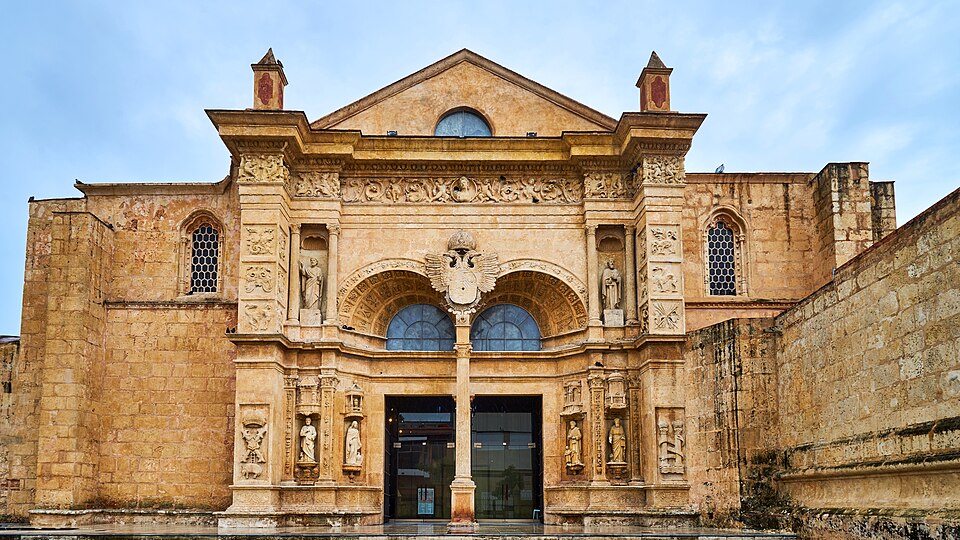
1504–1550
Its façade is cut from golden-tinted coral limestone, and pointed Gothic arches with ribbed vaulting run through the interior, one of the few authentic examples of that style built outside Europe.
Begun in 1504 and completed in 1550, this is the oldest cathedral still standing in the Americas, the second built anywhere in the New World after Greenland's Garðar Cathedral. It serves as the seat of the Archbishop of Santo Domingo, who holds the honorary title Primate of the Indies. Built in a genuine Gothic style unusual outside Europe, it holds a treasury of woodcarvings, funerary monuments, silver and jewellery gathered over the centuries. It stands between Calle Arzobispo Merino and Isabel la Católica, beside Columbus Park, dedicated to St Mary of the Incarnation.
- It ranks as the second cathedral built anywhere in the New World, after Greenland's Garðar Cathedral.
Photo: Georg Karl Ell (CC BY-SA 4.0)
Alcázar de Colón
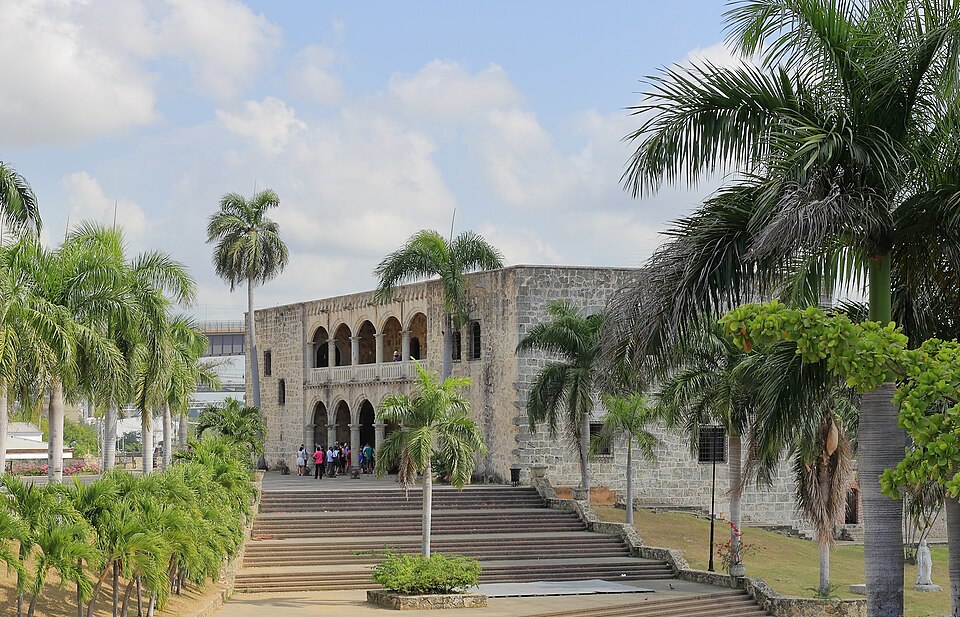
1511–1514
A stone palace whose Gothic structure carries Renaissance detailing, restored after two centuries of ruin and now hung inside with a rare collection of Flemish tapestries.
Built between 1511 and 1514, this stone palace mixing Gothic structure with Renaissance detailing was the first fortified European residence raised in the Americas. It was the home of Diego Columbus, son of Christopher Columbus, whose children were born within its walls; his widow, María Álvarez de Toledo, remained there until her death in 1549. Left empty after the family's three generations there, the palace fell into ruin by the mid-eighteenth century and stood abandoned until a 1957 restoration turned it into a museum, now the city's most visited, holding tapestries woven by the Flemish Van Den Hecke family.
- It is the only known residence of a member of Christopher Columbus's family anywhere in the New World.
- It stood abandoned for roughly two centuries before its 1957 restoration.
Photo: Martin Falbisoner (CC BY-SA 4.0)
Fortaleza Ozama
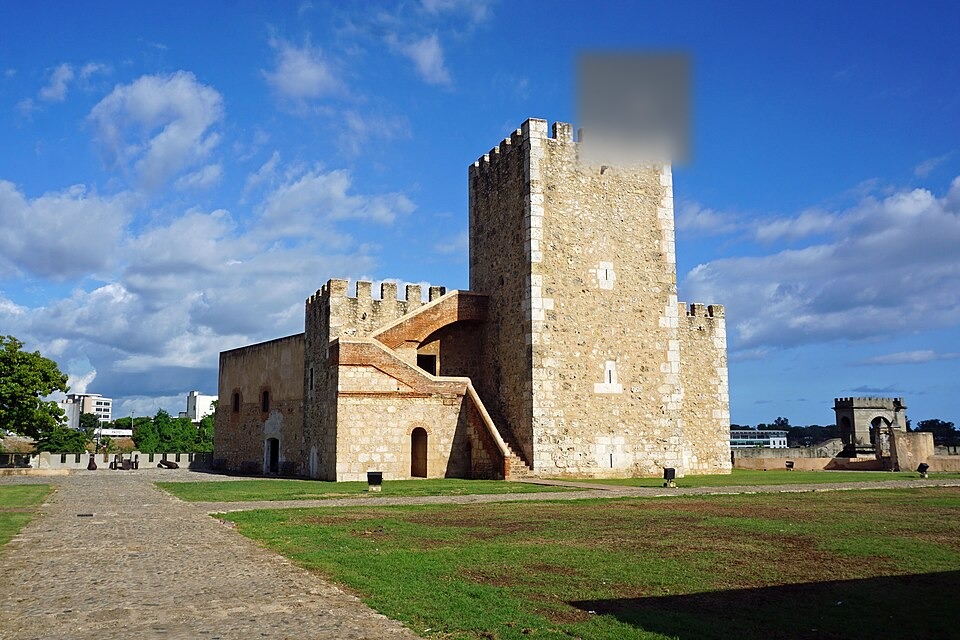
1502–1508
An 18-metre stone tower rising from thick fortress walls above the riverbank, its interior riddled with tunnels and dungeon cells cut into the stone.
Constructed between 1502 and 1508 under governor Nicolás Ovando, this stone fortress guards the entrance to the colonial quarter above the Ozama River, for which it is named. UNESCO recognises it as the oldest surviving military construction of European origin in the Americas. Its 18-metre tower was, in the sixteenth century, the tallest structure the Spanish had built anywhere in the New World. Tunnels and dungeons survive beneath it, among them a cell where Christopher Columbus himself was once held prisoner. A concrete addition was made along the riverside in 1938.
- Christopher Columbus was once imprisoned within its walls.
- For much of the sixteenth century, its tower was the tallest structure built by Europeans anywhere in the Americas.
Photo: Mariordo (Mario Roberto Durán Ortiz) (CC BY-SA 4.0)
Columbus Lighthouse
A mausoleum monument to Christopher Columbus, built from 1986 to a 1931 design by Scottish architect J.L. Gleave and inaugurated in 1992 for the 500th anniversary of his first voyage. Its powerful light beams form a cross shape visible as far away as Puerto Rico.
Puerta del Conde
The main gate into the fortified city, named for the count who saved it from an English siege in 1655. Part of the Baluarte del Conde fort, it is where Francisco del Rosario Sánchez proclaimed Dominican independence and raised the first flag in February 1844.
National Pantheon of the Dominican Republic
A former Jesuit church built between 1714 and 1746 by the Spaniard Geronimo Quezada y Garçon in neoclassic-renaissance style. It now stands as a national symbol and final resting place for the Republic's most honored citizens.
Monastery of San Francisco
A monastery built between 1508 and 1560 with the arrival of the Franciscan fathers, now standing in ruins as one of the most important in the city. UNESCO recognizes it as the first and oldest monastery built in the Americas.
National Palace
A building housing the offices of the executive branch, including the presidency and vice presidency, of the Dominican Republic.
Plaza de España
A public square in the Ciudad Colonial, flanked by the Alcázar de Colón, dating to 1514, on one side and the Museo de las Casas Reales, built in 1511, on the other. Its large size makes it a popular venue for concerts and festivals.
Altar de la Patria
A white marble mausoleum holding the remains of the three founding fathers of the Dominican Republic, known as Los Trinitarios. It contains statues of the founders carved by Italian sculptor Nicholas Arrighini and an eternal flame, and stands as the main attraction of Independence Park.
Parque Colón
The central square of the Ciudad Colonial, renamed in 1887 for the statue of Christopher Columbus at its center. It is bordered by the Catedral de Santa Maria la Menor and the Palacio Borgella, once home to the country's parliament.
Félix Sánchez Olympic Stadium
An open-air stadium opened in 1974 for the Central American and Caribbean Games, now the largest in the Dominican Republic. Renamed in 2005 for hurdler Félix Sánchez after his 2004 Olympic gold, it seats 24,863 for sports and up to 50,000 for concerts.
Estadio Quisqueya
A baseball stadium seating 13,186, with foul poles at 335 feet and center field at 411 feet. It is one of two stadiums in the Caribbean hosting two different teams, the Tigres del Licey and the Leones del Escogido.
Santo Domingo Dominican Republic Temple
The first Latter-day Saints temple built in the church's Caribbean Area and its 99th worldwide, with groundbreaking in August 1996. Faced in white granite with a single tower topped by a statue of the angel Moroni, it was dedicated in September 2000.
Los Tres Ojos National Park
A 50-yard open-air limestone cave in Mirador del Este park, featuring a series of three lakes known as ojos. It is one of the country's most popular tourist attractions.
Eduardo Brito National Theater
The centerpiece of the Plaza de la Cultura complex, opened on 16 August 1973 as the National Theater of Santo Domingo. Renamed in 2006 after baritone Eduardo Brito, it hosts opera, ballet and classical music with a capacity of 1,700 seats.
Atarazanas Reales
A waterside building begun in 1509 that housed the shipyards, warehouses and customs house of the old port, property of the Spanish Crown. The oldest building of its type still standing in the Americas, it reopened as a museum of underwater archaeology in December 2019.
Memorial Museum of Dominican Resistance
A museum preserving the history of Dominican resistance during the dictatorship of Rafael L. Trujillo, including its background and consequences. In 2009, UNESCO declared its collection part of the Memory of the World Programme.
Al-Noor Mosque
A mosque in the National District.
Episcopal Cathedral of the Epiphany-Union Church
A Protestant church serving as the seat of the Episcopal Diocese of the Dominican Republic. It also functions as home to an interdenominational congregation.
Centro Israelita de República Dominicana
A Jewish congregation and synagogue whose Chabad Lubavitch movement was established in the country in 2008. It has no permanent rabbi, relying instead on visiting rabbis mostly from Miami and Colombia.
History
Spanish colonists founded the settlement in 1496 and began building in stone within a few years, well ahead of most other European footholds in the Americas. A fortress at the harbour mouth went up between 1502 and 1508 under governor Nicolás Ovando, guarding the young town from the water. A stone palace followed between 1511 and 1514 as a residence for the family running the colony's affairs, while a cathedral begun in 1504 took until 1550 to complete. Construction slowed after this first burst, and later centuries saw decline rather than rebuilding: the palace stood in ruins by the mid-eighteenth century and was not restored until 1957. Because so little was rebuilt over the walled quarter, its early sixteenth-century stone core survives largely intact and is now protected as a UNESCO World Heritage Site.