Landmarks in Nicosia
The last divided capital in Europe, still ringed by its Venetian walls.
Nicosia's historic landmarks cluster inside a single ring: the old town enclosed by walls the Republic of Venice rebuilt in 1567, shortly before the Ottoman Empire took the island. That building campaign also produced the Famagusta Gate, which still stands on today's Greek Cypriot side of the line that divides the city. North of that line, a Gothic cathedral raised in 1326 was converted into a mosque after the 1571 conquest, and the Ottomans built the Büyük Han caravanserai the following year to house merchants passing through their new territory. A medieval church, a merchant inn and a fortress wall all sit within a short walk of a modern political division.
Venetian Walls
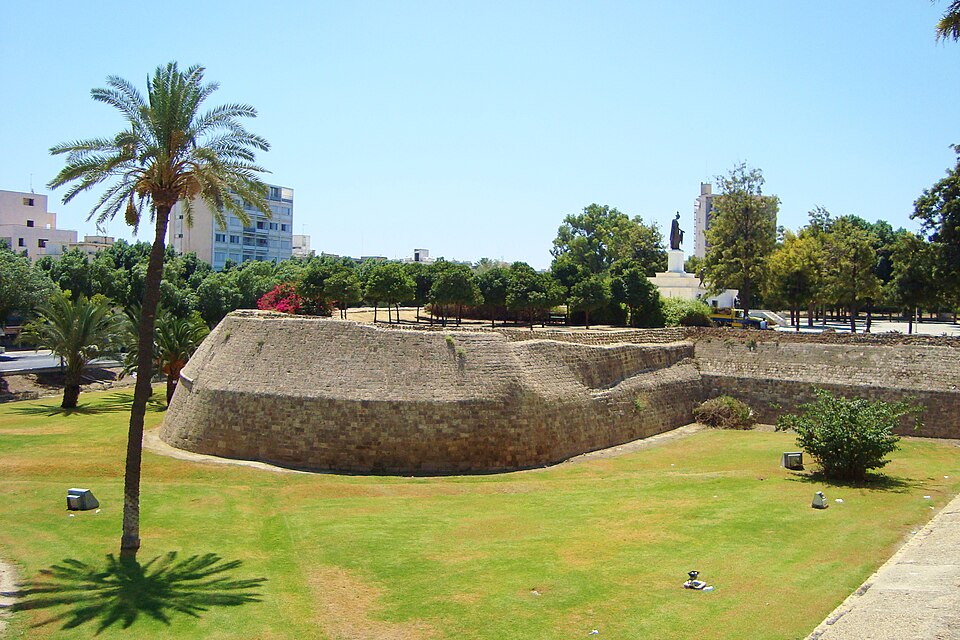
1567
An unbroken ring of Renaissance-era ramparts still encircling the old town almost entirely intact, ranked among the best-preserved fortifications of its kind anywhere in the Eastern Mediterranean.
These are the defensive walls encircling Nicosia's old town, rebuilt entirely in their present form in the mid-16th century when the Republic of Venice was preparing for war with the Ottoman Empire. They replaced an earlier medieval circuit that had stood since the Middle Ages. Well preserved today, they are counted among the best-surviving Renaissance defensive walls in the Eastern Mediterranean and remain a major attraction in the old town.
- Their design and the layout of the town inside them have been compared to two other planned Renaissance fortress towns, Palmanova in Italy and Valletta in Malta.
- The current walls replaced an entirely separate medieval circuit that was demolished to make way for them.
Photo: AncientNicosia (CC BY-SA 3.0)
Selimiye Mosque
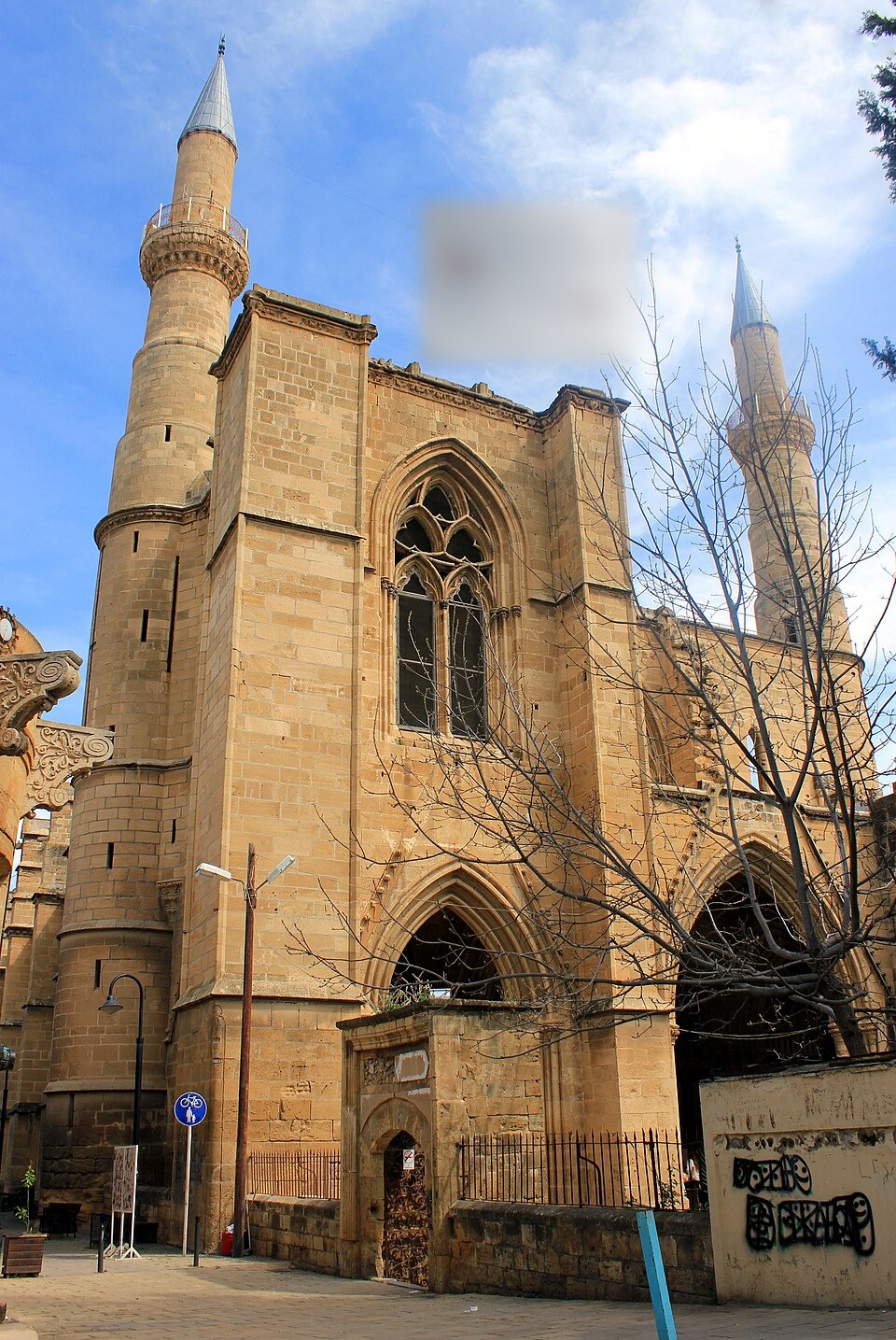
1326
A large Gothic-style church building — at 66 by 21 metres the largest and oldest of its kind still standing on the island — that continues in use today as a mosque, its scale making it the single largest historic building in the city.
Built in 1326 as the cathedral of Saint Sophia, this is the largest and oldest Gothic church to survive on the island, possibly raised over an earlier Byzantine church on the same site. It served as the coronation church of the kings of Cyprus. After the Ottoman conquest it was converted into a mosque and given its present name, and it remains the main mosque used on the island, with room for 2,500 worshippers across 1,750 square metres of prayer space.
- It may have been the largest church built anywhere in the eastern Mediterranean in the thousand years between the rise of Islam and the late Ottoman period.
Photo: Julian Nyča (CC BY-SA 3.0)
Famagusta Gate
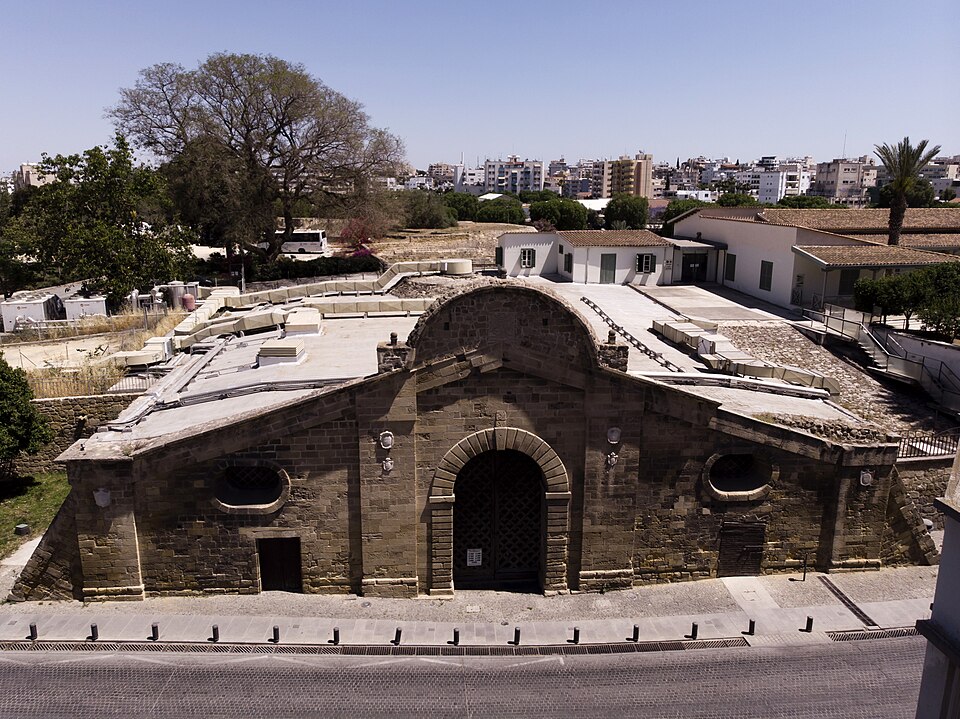
1567
Its facade facing the town is imposingly elaborate, in sharp contrast to a plain, weathered outer doorway set into the angle of a bastion, where the old arch stones are damaged and the original doors are gone.
This is the chief gate through Nicosia's fortified walls, built in 1567 in the Venetian style and modelled directly on the Lazaretto Gate at Candia, on Crete, designed earlier in the 16th century by Michele Sanmicheli. Historically also known as the Porta Giuliana, it opens onto a vaulted passage roofed with an 11-metre dome lit by a circular oculus, in the manner of the Pantheon in Rome. Wide enough for two vehicles side by side, its facade facing the town is far more elaborate than its plain, weathered outer face.
Photo: Iakovos Hatzistavrou, European Commission (CC BY 4.0)
Büyük Han
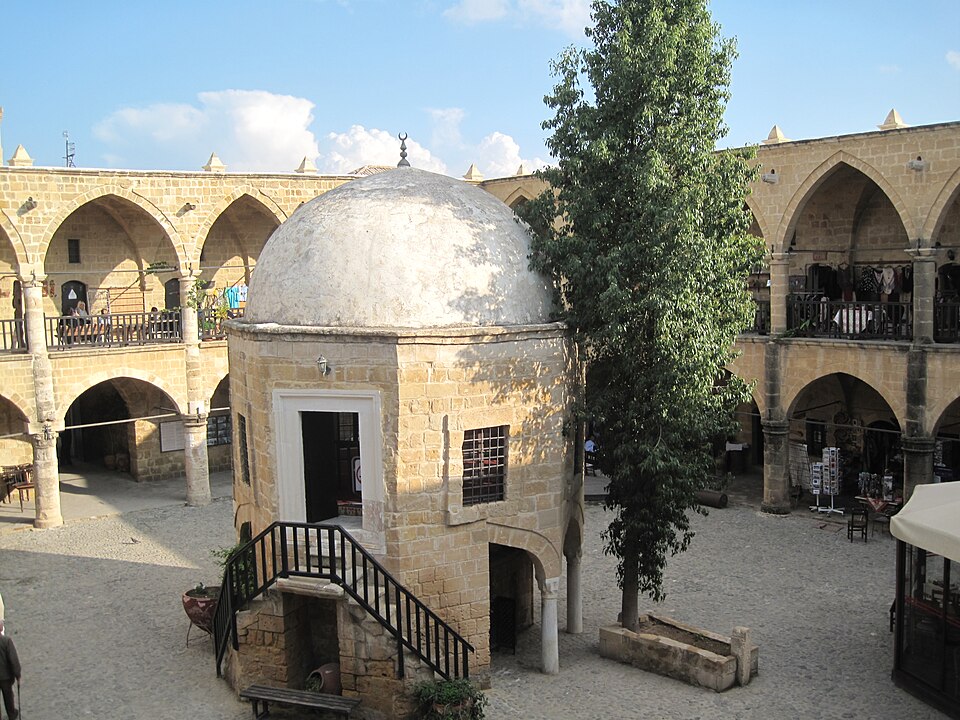
1572
Built around an open courtyard with a small, freestanding mosque and ablution fountain at its centre, it is the largest caravanserai on the island and now houses galleries, workshops, cafes and souvenir shops instead of the travelling merchants it once sheltered.
Built by the Ottomans in 1572, a year after they took the island from the Venetians, this is the largest caravanserai in Cyprus and reckoned among the finest buildings on the island. Merchants and their pack animals once lodged around its open courtyard, at the centre of which stands a small mosque with a fountain for washing before prayer. Under British administration it became the city's first prison. Restored through most of the 1990s, it now operates as an arts centre with galleries, workshops, courtyard cafes and souvenir shops.
Photo: Dickelbers (CC BY-SA 3.0)
Kyrenia Gate
A gate in the Nicosia city walls, built by the Venetians in 1567 and used for transport north toward Kyrenia. The Ottomans restored it in 1821, adding a lookout, and it now serves as a tourism information office.
Eleftheria square
The main square in central Nicosia, formed where Ledra and Onasagorou streets meet several avenues including Stasinou and Evagorou. It is counted among Zaha Hadid's top 35 projects.
Presidential Palace
The official residence and workplace of the president of Cyprus, located in the Strovolos area and surrounded by pine woodland. The building was formerly known as Government House.
Ledra Palace Hotel
A hotel in central Nicosia designed by Benjamin Günsberg and built between 1947 and 1949, opening on 8 October 1949 with 94 bedrooms rated de luxe. Until 1974 it was one of the capital's largest and most glamorous hotels.
Bedesten
A building beside the Selimiye Mosque that began as a sixth-century church dedicated to Saint Nicholas and was expanded and rebuilt between the twelfth and sixteenth centuries. The Ottomans converted it into a covered market, or bedesten, and it now functions as a cultural centre.
Ömeriye Mosque
A mosque in the walled city's southern section, which gained significance as one of the most important Muslim worship sites in the island's non-Muslim area after the Turkish invasion of Cyprus. It remains an active mosque, open to both worshippers and visitors.
Hadjigeorgakis Kornesios Mansion
A historic mansion in Nicosia also known as the Konak, today housing the Cyprus Ethnological Museum.
Archbishop's Palace
The official residence of the Archbishop of Cyprus, built between 1956 and 1960 in neo-Byzantine style next to the 17th-century Old Archbishop's Palace. It is closed to the public, but its grounds hold the Byzantine Museum, Folk Art Museum and National Struggle Museum.
St. John's Cathedral
The main church of the Church of Cyprus, built in the fourteenth century on the site of a Catholic Benedictine abbey. Archbishop Nikiphoros rebuilt it in the seventeenth century, marked by a marble slab dated 30 April 1662 over its western entrance.
Ledra Street
A shopping thoroughfare in central Nicosia, named for the ancient city-kingdom of Ledra, established in 1050 BC. Its barricade across the UN buffer zone symbolised the city's division until removed in April 2008, making the street a crossing point between north and south.
Shacolas Tower
A high-rise in Nicosia's old town, completed in 1959 as the Manglis Tower and the tallest building in Cyprus until 1978. Its 11th-floor observatory and museum offers a panoramic view of the old city, with telescopes and a recorded history of the capital.
Bayraktar Mosque
A mosque in Nicosia's southern sector, administered by the Republic of Cyprus.
Haydar Pasha Mosque
A mosque in North Nicosia converted from the former St. Catherine's Church, the city's most important Gothic building after Ayia Sophia. Historian Harry Charles Luke described it as one of the finest examples of Gothic architecture on the island.
Cyprus Museum
The oldest and largest archaeological museum in Cyprus, on Museum Street in central Nicosia. It holds the world's most extensive collection of Cypriot antiquities, displaying only artefacts discovered on the island.
Lusignan Palace
A Gothic-style royal residence built in the 15th century, seat of the Kings of Cyprus and later Venetian and Ottoman governors. It stood on Sarayönü Square until the British demolished it in 1904, replacing it with the Nicosia Law Courts building that still stands there.
Sarayönü Square
A square in North Nicosia, officially named Atatürk Square, that served as the island's administrative centre for centuries. An Ottoman governor's mansion, once a Lusignan and later a Venetian palace, stood in its southwest corner until the British destroyed it in the early 20th century.
Arab Ahmet Mosque
A mosque in North Nicosia's Arab Ahmet Quarter, built in the late 16th century and named for a commander of the 1571 Ottoman army. Renovated in 1845, it is Cyprus's only mosque with a typical Turkish dome, its central cupola about six metres across.
Notre Dame de Tyre
Also known as the Armenian church, it stands in Nicosia's Arab Ahmet Pasha quarter on Salahi Şevket Street.
Dervish Pasha Mansion
A two-storey mansion and ethnographic museum in Nicosia's Arab Ahmet quarter, built in 1801 on the site of an earlier Gothic building. Repaired in 1869, when its carved wooden ceilings were added, it is considered one of the finest examples of Ottoman architecture in Cyprus.
Ömeriye Hamam
A historic Ottoman bathhouse built by Lala Mustafa Pasha in the 1570s as part of the Ömeriye Mosque complex, reusing the site of a 14th-century Augustinian church damaged in the Ottoman siege. Restored in 2002–2004, it still functions today as a bathhouse and spa.
Law Courts
A historic building on central Sarayönü Square, in what is now North Nicosia.
Leventis Municipal Museum
A municipal museum in Nicosia holding an extensive collection of Cypriot artifacts and heritage objects. The collection spans archaeological finds, costumes, photographs, medieval pottery, maps, engravings, jewels and furniture.
Armenian Genocide Monument
A monument to the martyrs and survivors of the Armenian genocide of 1915–1923, in the Armenian complex on Armenia Street in Strovolos. The same complex holds the Sourp Asdvadzadzin cathedral, the Nareg Armenian School, a marble khachkar and a statue of Gregory of Nareg.
History
Continuously inhabited for more than five thousand years, Nicosia has been Cyprus's capital since the 10th century, and its old town still shows the marks of successive rebuilding rather than a single plan. Its largest surviving medieval structure, the Gothic cathedral of Saint Sophia, went up in 1326. When Venice took over the island's defence, it tore down the older town walls entirely and built the present, still-intact circuit in 1567, bracing for war with the Ottoman Empire. The Ottomans took the city in 1571 anyway: the cathedral became a mosque, and a large caravanserai went up nearby the following year. Almost four centuries later, in 1974, a Turkish invasion split the city along a line it has not crossed since.