Landmarks in Osaka
A castle from Japan's unification wars, a sixth-century temple, a 1955 steel tower.
The city's oldest landmark, a Buddhist temple founded in 593, has been rebuilt many times over the centuries, most recently in 1963, so its five-story pagoda and grounds reflect a twentieth-century reconstruction rather than the sixth-century original. Osaka Castle, raised in 1583 during the wars that unified Japan, anchors the historic core and carries three separate national heritage designations. Away from these older monuments, the Shinsekai entertainment district holds a different register: Tsutenkaku, a steel observation tower built in 1955, still carries advertising for the Hitachi company from its perch above the district. Between temple, castle and tower, the surviving landmarks span thirteen centuries of continual rebuilding rather than a single architectural era.
Osaka Castle
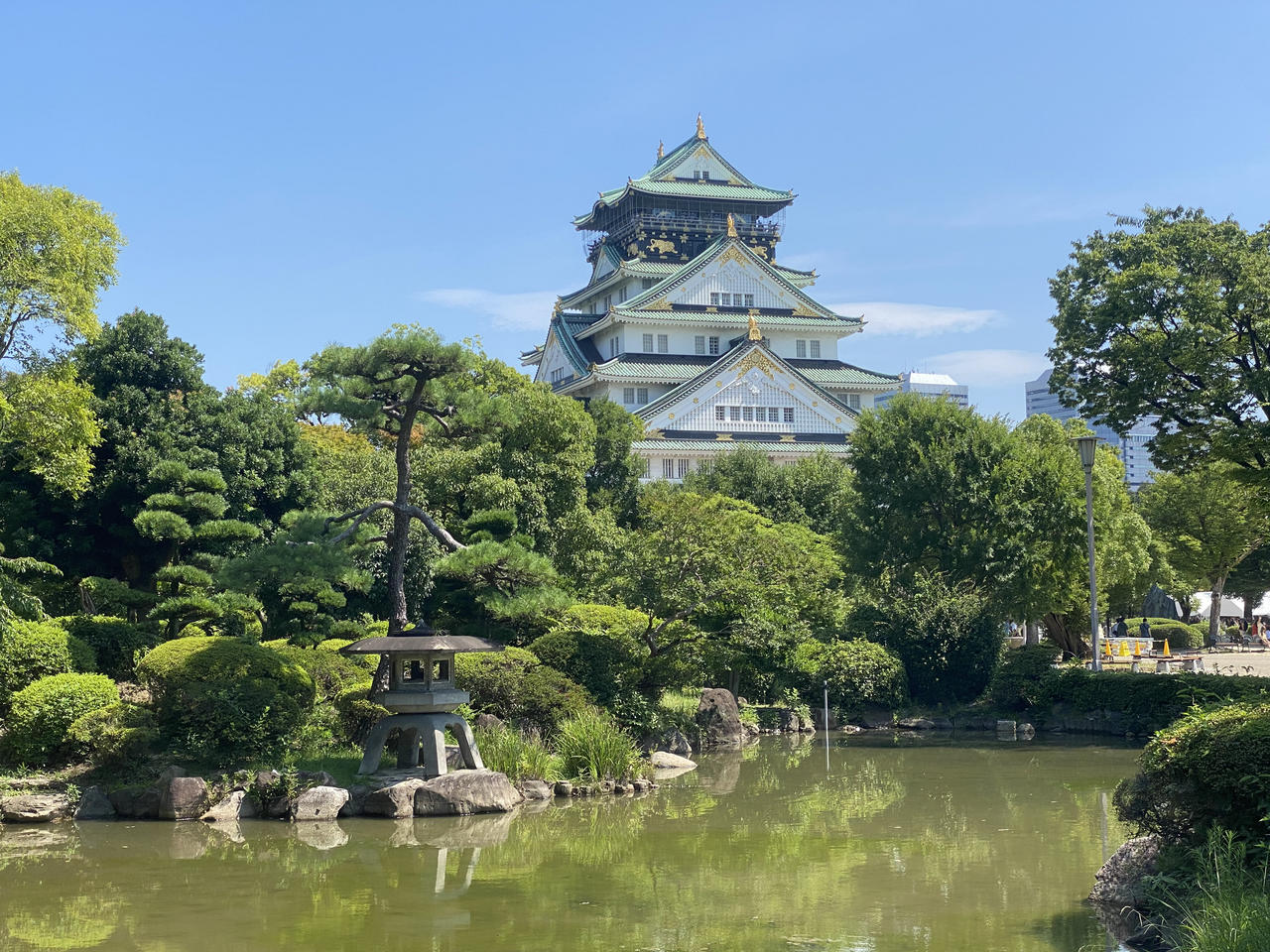
1583
A Japanese castle whose grounds carry three separate heritage designations at once — Important Cultural Property, Historic Site and Special Historic Site — among the highest concentrations of official protection given to any single site in the country.
Osaka Castle is a Japanese castle built in 1583, during the wars that ended in the unification of the country under one ruler in the sixteenth century. It is counted among Japan's most famous landmarks and is protected under three separate heritage designations at once: Important Cultural Property, Historic Site and Special Historic Site. No architect is recorded for the structure, and the available record does not describe what has happened to the building since, beyond its continuing role as one of the country's most heavily protected historic sites.
- It carries three separate national heritage designations at once: Important Cultural Property, Historic Site and Special Historic Site.
Photo: AndrewTheWiki (CC0)
Tsutenkaku
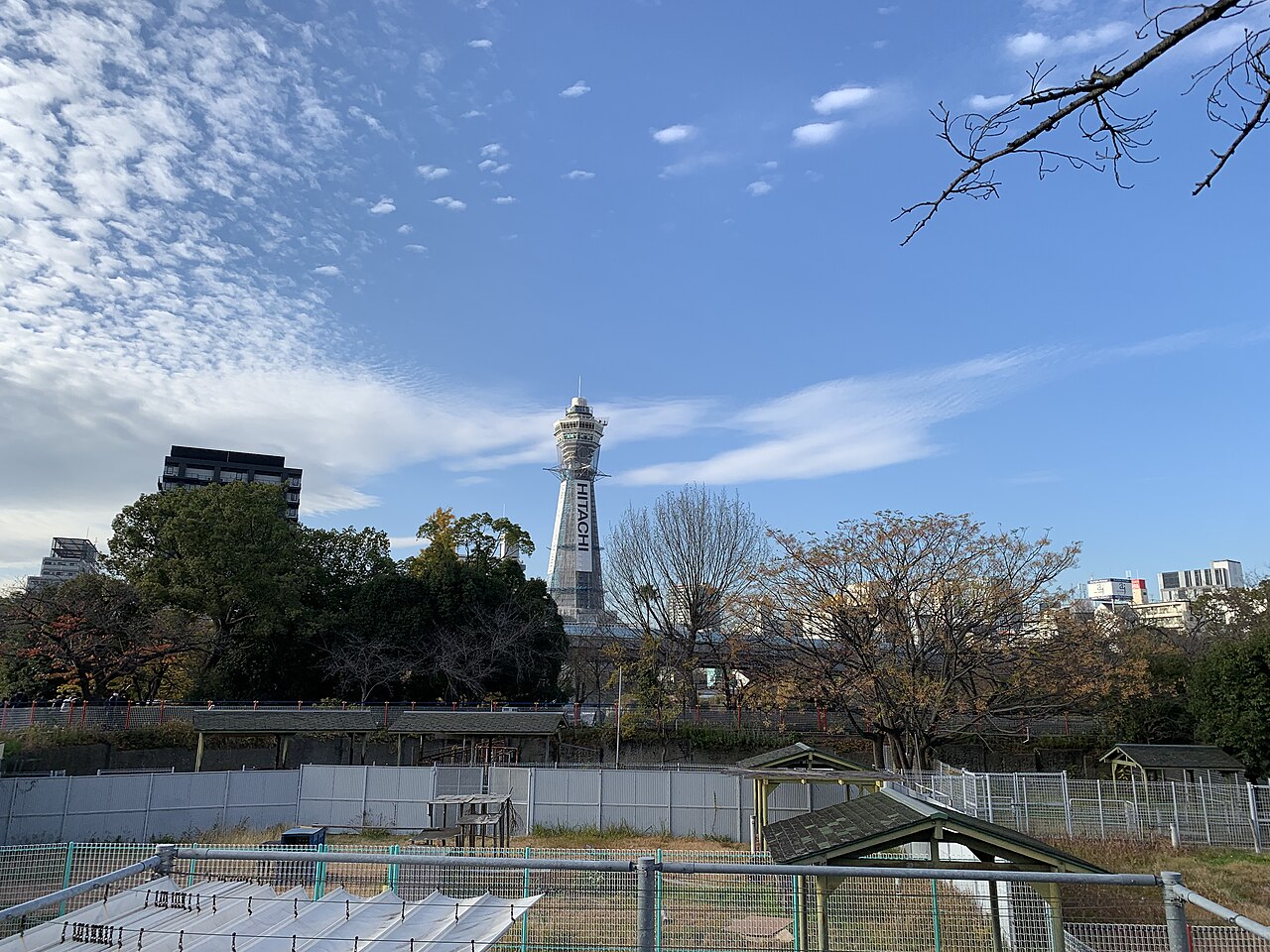
1955 · Tachū Naitō
A tower reaching 108 metres total, its public observation deck set near the top at about 91 metres, distinguished by advertising for the Hitachi company mounted on the structure — a fixture of the Shinsekai district it rises above.
Tsutenkaku is an observation tower in Osaka's Shinsekai district, in Naniwa-ku, built in 1955 to a design by Tachū Naitō. It reaches a total height of 108 metres, with its main observation deck set at 91 metres, and carries advertising for the Hitachi company on its structure. Owned by Tsūtenkaku Kanko Co., Ltd., the tower is registered as a Tangible Cultural Property of Japan, a designation marking it as architecturally or historically significant enough to warrant protection.
- Its name, Tsūtenkaku, translates literally as "Tower Reaching Heaven."
Photo: inunami (CC BY 2.0)
Shitenno-ji
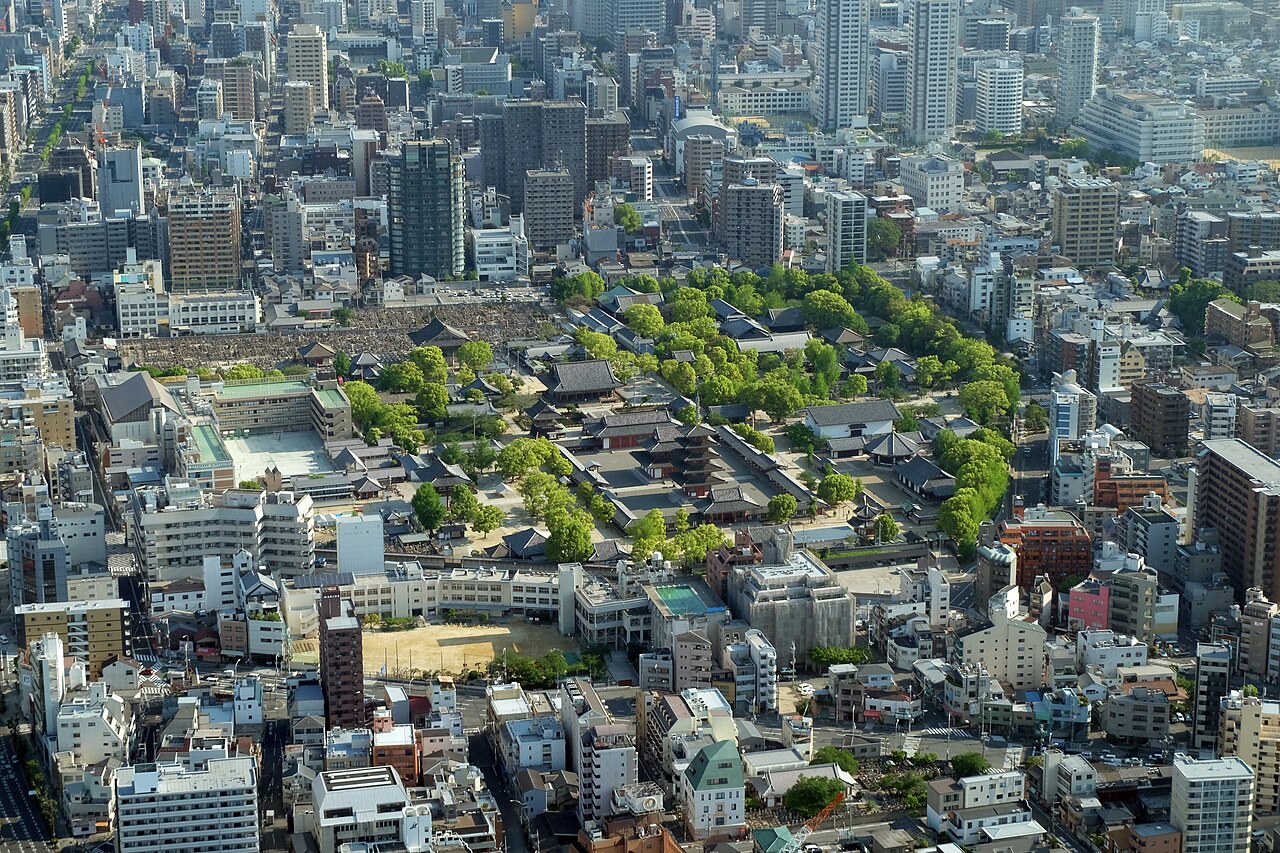
593–1963
A five-story pagoda anchors temple grounds that also hold statues and turtle ponds, laid out in the distinct arrangement known as Shitennō-ji style, though the buildings standing today date from a 1963 reconstruction rather than the sixth-century original.
Shitennō-ji is a Buddhist temple founded in 593, sometimes considered the first Buddhist temple to be officially administered in Japan. Also known as Arahaka-ji, Nanba-ji, Naniwa-daiji or Mitsu-ji, its buildings follow a distinct arrangement known as Shitennō-ji style and have been reconstructed repeatedly over the centuries, most recently in 1963. After the Second World War it separated from its parent Tendai sect to form its own Wa sect of Buddhism, and its grounds today include a five-story pagoda, statues and turtle ponds.
- It is also known by four other historic names: Arahaka-ji, Nanba-ji, Naniwa-daiji and Mitsu-ji.
- After the Second World War it broke from its parent Tendai sect to found its own, the Wa sect of Buddhism.
Photo: Nesnad (CC BY 4.0)
Universal Studios Japan
A theme park that opened on March 31, 2001, the first Universal Studios park built outside the United States. In 2024 it drew 16 million visitors, making it the third-most-visited theme park in the world and the most-visited in Asia.
Dōtonbori
A nightlife and entertainment district along the Dōtonbori canal in Namba, historically a theater quarter known for its illuminated signboards. Its best-known feature is an illuminated Glico billboard of a runner crossing a finish line, often seen as an icon of Osaka.
Umeda Sky Building
A two-tower, 40-story skyscraper in Kita-ku, designed by Hiroshi Hara and completed in 1993. The towers are linked at the top by glass sky bridges spanning an open atrium, reaching a combined height of 170 meters.
Sumiyoshi-taisha
The main shrine of all Sumiyoshi shrines in Japan, lending its name to the Sumiyoshi-zukuri style of shrine architecture. Known locally as Sumiyoshi-san, it draws large crowds each New Year's Day for hatsumōde and enshrines the three Sumiyoshi deities along with Empress Jingū.
Abeno Harukas
A 300-meter, 62-story skyscraper completed on March 7, 2014, that was Japan's tallest building until 2023. It combines a Kintetsu department store, a Marriott hotel, university campuses, and offices, doubling as the alternative station building for Ōsaka Abenobashi Station.
Aquarium Kaiyukan
An aquarium near Osaka Bay that, on opening in 1990, was the largest public aquarium in the world. It stands next to the Tempozan Ferris Wheel and is about a five-minute walk from Osakako Station.
Gate Tower Building
A 16-floor office building in the Fukushima-ku area of Osaka. It is notable for the offramp of the Ikeda Route expressway, which passes directly through the structure.
Tempozan Ferris Wheel
A Ferris wheel at Tempozan Harbor Village, next to the Osaka Aquarium Kaiyukan, one of the largest aquariums in the world. It stands 112.5 meters tall with a diameter of 100 meters.
HEP
A shopping mall and entertainment center in the Umeda district, made up of HEP Five and HEP Navio. Its name stands for 'Hankyu Entertainment Park,' and it is co-owned by the Hankyu REIT and Hankyu Realty Co.
Prefectural Government Sakishima Building
A 256-meter skyscraper near Osaka harbor, the third-tallest building in Osaka and known until 2023 as the Osaka World Trade Center Building. It houses the working office of the Osaka Prefecture governor, plus a museum, restaurants, and an observation deck inside a rooftop inverted pyramid.
Shinsekai
A neighborhood created in 1912 south of downtown Osaka, modeled on Coney Island in its southern half and Paris in its north. Its centerpiece is Tsutenkaku Tower, built where the Luna Park amusement park once stood until it closed in 1923.
Tennōji Zoo
An 11-hectare zoo in Tennōji Park, opened on January 1, 1915, as the third zoo built in Japan. It lies just southwest of Shitennō-ji, the first Buddhist temple built in Japan.
Isshin-ji
A Pure Land Buddhist temple where, since the Meiji period, thirteen images have been formed each incorporating the ashes of tens of thousands of devotees. Its annual burial ceremony on 21 April draws tens of thousands of worshippers.
National Museum of Art
A subterranean art museum on the island of Nakanoshima, between the Dōjima and Tosabori rivers. Its official Japanese name translates as the 'National Museum of International Art,' and it is also known by the acronym NMAO.
Tezukayama Kofun
A keyhole-shaped burial mound from the Kofun period, located in the Tezukayama neighborhood of Sumiyoshi-ku. It was designated a National Historic Site of Japan in 1963.
Kyocera Dome
A baseball stadium opened in 1997 under the official name Osaka Dome, home to the Orix Buffaloes since their 2005 merger with the Osaka Kintetsu Buffaloes. The Hanshin Tigers play there for season openers and August home games, while Koshien Stadium hosts high school tournaments.
Museum of History
A history museum in Chūō-ku, opened in 2001 on the site of the former Naniwa Palace. Designed by César Pelli & Associates and Nihon Sekkei, it traces the city's history over four floors with a collection that grew past 138,000 objects by 2016.
National Bunraku Theatre
A performance complex of two halls and an exhibition room in the Nipponbashi district, opened in 1984. It became the country's fourth national theatre and now serves as the headquarters of bunraku, Japan's traditional puppet theatre.
Museum of Oriental Ceramics
An art museum known for one of the best ceramics collections in the world, focused on East Asian pieces mainly from ancient China and Korea. Its holdings include the world-famous Ataka Collection, donated by 21 Sumitomo Group companies, along with the Rhee Byung-Chang Collection.
Prefectural Nakanoshima Library
A major library in the Nakanoshima section of Osaka, established in 1904. It is today one of two libraries supported by the Osaka Prefectural government.
Minato Bridge
A double-deck cantilever truss bridge opened in 1974, carrying the Hanshin Expressway's Osakako Line above and Bayshore Line below. Its span is the third-longest cantilever truss in the world, after Canada's Quebec Bridge and Scotland's Forth Bridge.
History
Osaka was traditionally considered Japan's economic hub, a role with roots stretching back to the Kofun period (300–538), when it had already grown into an important regional port. In the seventh and eighth centuries it served briefly as the imperial capital, and through the Edo period (1603–1867) it continued to flourish, becoming known as a center of Japanese culture. The Meiji Restoration brought rapid expansion and industrialization, and Osaka became the country's industrial hub through the Meiji and Taishō eras as its population grew alongside its factories. In the postwar period the city contributed to redevelopment, urban planning and zoning standards, work that helped set the layout of the modern city that grew up around its older temples and castle.