Landmarks in Padua
Eight medieval buildings share one UNESCO listing for their fourteenth-century frescoes.
Padua's landmarks sit inside the loop the river Bacchiglione draws around the old centre, with the Brenta still touching the northern districts and the Euganaean Hills rising beyond the plain to the south west. The oldest buildings are civic and religious: a market hall and law court begun in the early thirteenth century, and a basilica built as an international shrine in the same period, both later reworked in Renaissance style. The following century brought a Gothic clock tower to the main square and, nearby, a small chapel whose frescoes changed how walls were painted across the region. The cathedral seen today is the newest of the group, a Baroque and Renaissance rebuilding raised over a church founded many centuries earlier.
Basilica of Saint Anthony
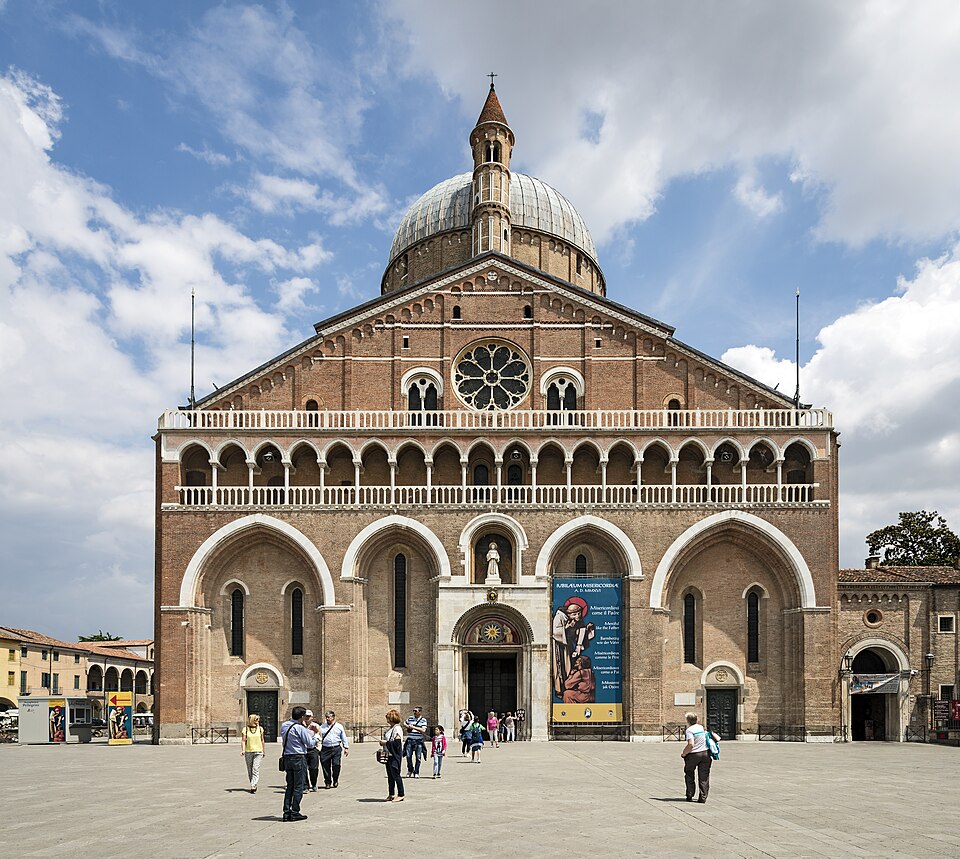
1238–1310
Two of its side chapels hold fourteenth-century fresco cycles as part of a shared shrine complex large enough to include a full convent alongside the church itself.
This minor basilica and its adjoining convent function as an international shrine recognised directly by the Holy See, holding basilica rank through a privilege of immemorial custom rather than a papal decree. It is not Padua's cathedral, which carries a separate dedication elsewhere in the city. Two of its chapels, the Cappella di San Giacomo and the Cappella del Beato Luca Belludi, were inscribed on the UNESCO World Heritage List in 2021 as part of a shared listing covering the city's fourteenth-century fresco cycles.
- It holds basilica rank through a privilege of immemorial custom, a status recognised directly by the Holy See.
- It is known locally as "il Santo" even though it is not the city's cathedral.
Photo: Didier Descouens (CC BY-SA 4.0)
Palazzo della Ragione
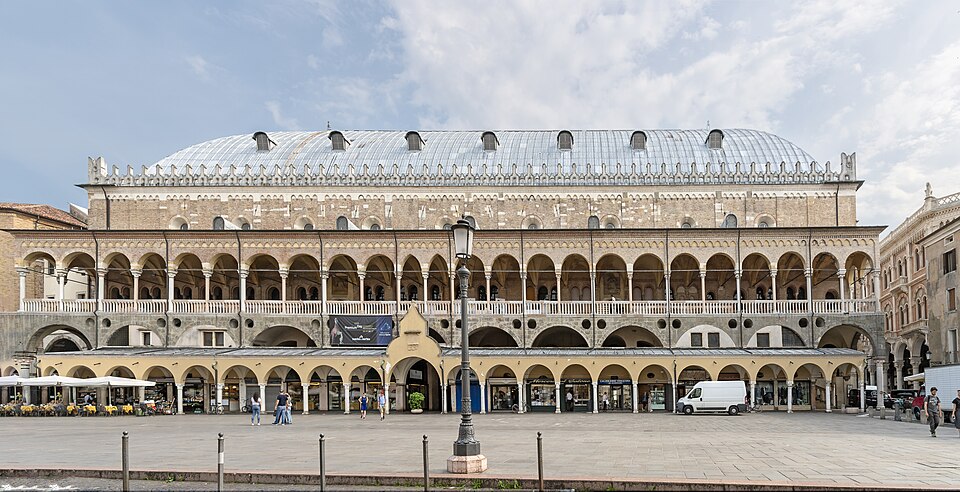
1219
The building sits lengthwise between two market squares, its ground floor still trading as a covered market beneath the upper storey once used for civic and judicial business.
Built as a combined market hall, town hall and law court, the building still divides its functions by floor: the upper level once handled town and judicial administration, while the ground floor has never stopped serving as covered market space. It separates Piazza delle Erbe from Piazza dei Frutti, the two squares it was built to sit between, and is popularly known as il Salone, "the big hall." It joined the UNESCO World Heritage List in 2021 as part of Padua's fourteenth-century fresco cycles.
- Its nickname, il Salone, simply means "the big hall."
- Its ground floor has functioned as a market since the Middle Ages and still does.
Photo: Didier Descouens (CC BY-SA 4.0)
Torre dell'Orologio
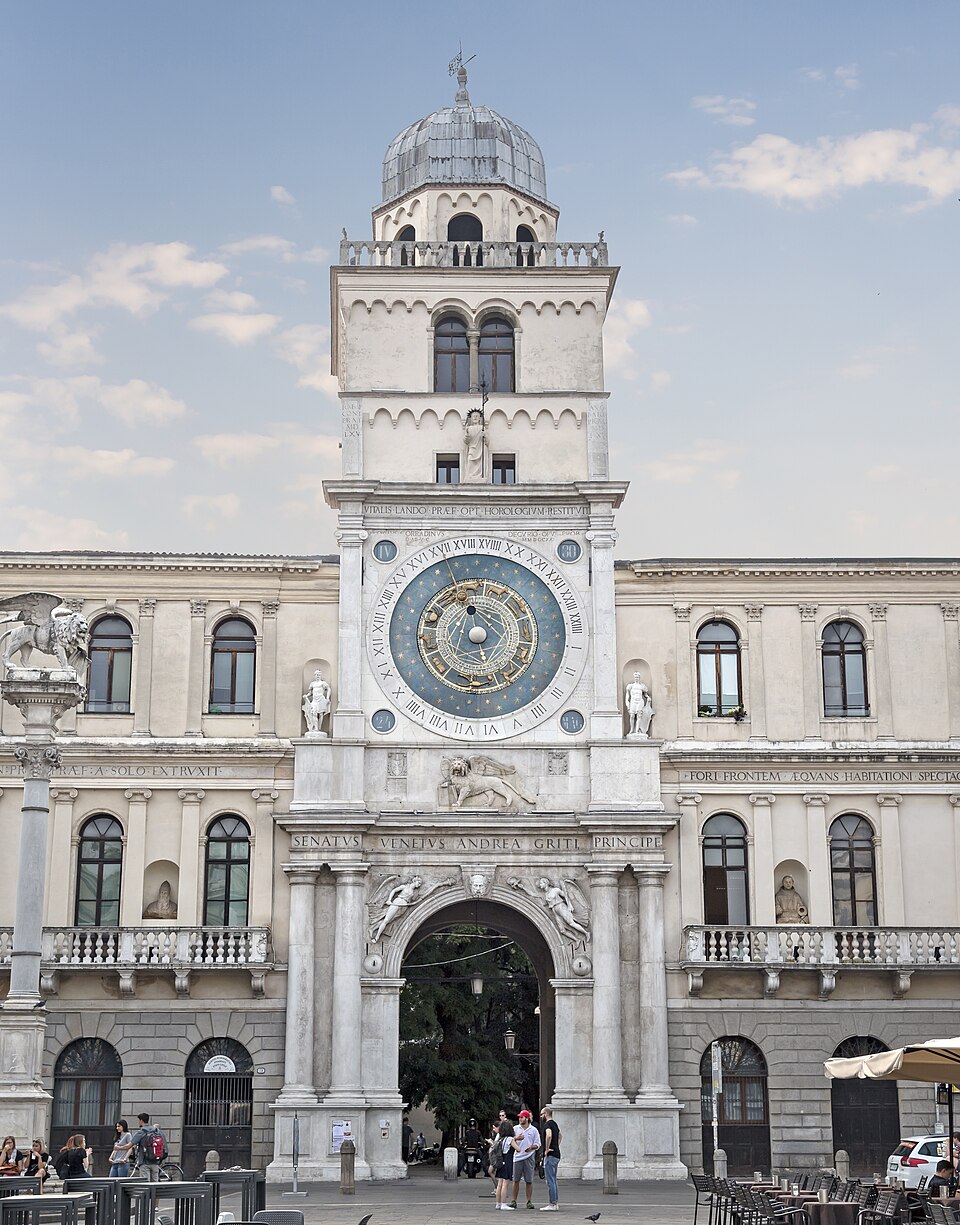
1437 · Giovanni Dondi dell'Orologio
It stands wedged between two adjoining palaces on the square, with a monumental triumphal arch inserted at its base in the sixteenth century.
Rising on Piazza dei Signori between two adjoining palaces, the tower was commissioned to carry an astronomical clock for the ruling Carraresi family. Construction began in 1426; the clock mechanism, overseen by physician and engineer Giovanni Dondi dell'Orologio with Gian Petro Dalle Caldiere, was finished in 1434, and the tower was inaugurated in 1437. A triumphal arch, designed by Giovanni Maria Falconetto, was added at its base in 1531. Volunteers now keep the clock open to visitors.
- On the original clock, the zodiac dial left out Libra, following an older system that merged it with Scorpio.
- A volunteer group called Salvalarte now keeps the tower open to the public.
Photo: Didier Descouens (CC BY-SA 4.0)
Scrovegni Chapel
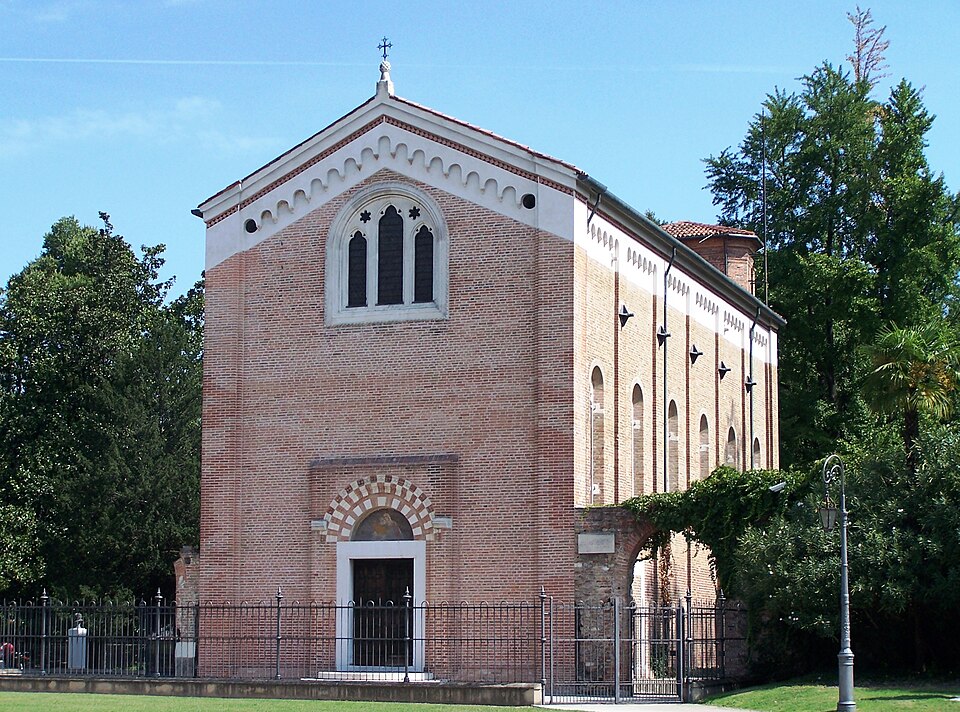
1305
The interior is covered edge to edge by a single fresco campaign rather than work added in different periods, giving the small chapel a uniform, densely painted appearance unusual for a building its size.
This small church, built beside the Augustinian monastery now folded into the city's civic museums, owes its fame to the fresco cycle painted across its interior, finished around 1305. The cycle is considered one of the works that began a revolution in mural painting, reshaping fresco technique, style and subject matter for a century afterward. In 2021 the chapel was inscribed on the UNESCO World Heritage List jointly with seven other buildings, as Padua's fourteenth-century fresco cycles.
- It is also known as the Arena Chapel.
- Its 2021 UNESCO listing covers it jointly with seven other buildings, not on its own.
Photo: Andrea Piroddi (CC BY-SA 3.0)
Padua Cathedral
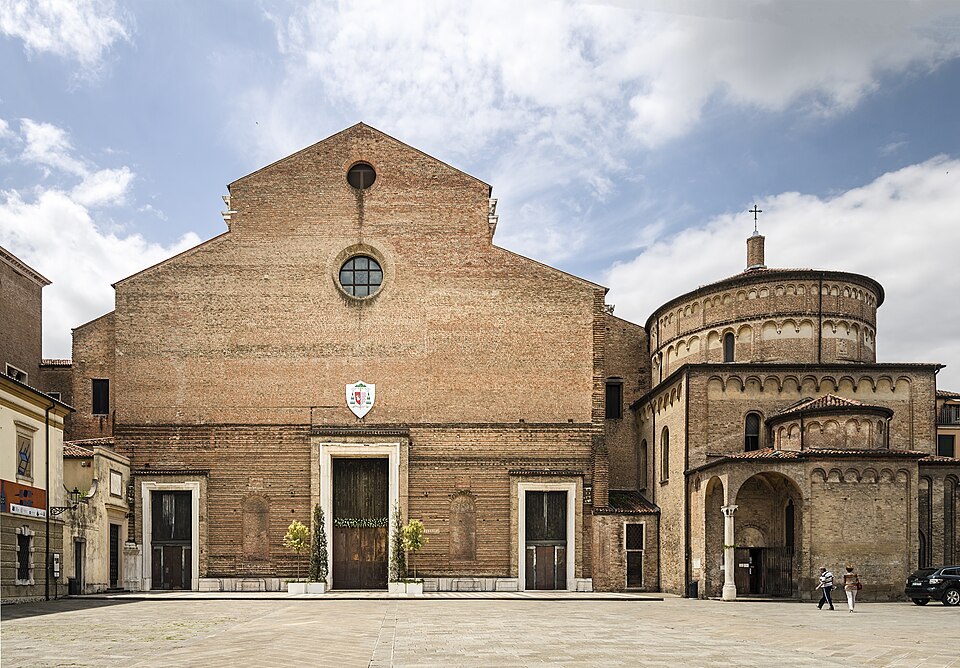
1754
Its façade and interior combine Renaissance planning with Baroque execution, standing at the end of its square directly beside the bishop's palace.
Seat of the Bishop of Padua and dedicated to the Assumption of the Virgin Mary, the cathedral stands at the east end of its square, beside the bishop's palace. A church has occupied the site since the fourth century, when it was first raised as a cathedral, but the building has been reconstructed repeatedly since; its present Baroque and Renaissance form was completed in 1754. It is distinct from the city's other major basilica, dedicated to a different saint.
Photo: Didier Descouens (CC BY-SA 4.0)
Orto botanico di Padova
The world's oldest academic botanical garden still on its original site, founded in June 1545 by the Venetian Republic. Covering roughly 22,000 square metres, it is operated by the University of Padua and known for its historical design and special plant collections.
Prato della Valle
A 90,000-square-metre elliptical square, the second largest in Italy and one of the largest in Europe. At its centre lies the green island of Isola Memmia, ringed by a canal and two rows of statues.
Equestrian statue of Gattamelata
A bronze equestrian sculpture by Donatello, dated 1453, standing on the Piazza del Santo. It portrays the condottiere Erasmo da Narni, nicknamed Gattamelata, and is the first full-size equestrian statue of the Italian Renaissance.
Abbey of Santa Giustina
A 10th-century Benedictine abbey complex facing the Prato della Valle. Its adjoining basilica church of Santa Giustina was originally built in the 6th century, though its present form dates from a 17th-century reconstruction.
Pedrocchi Café
A café founded in the 18th century in central Padua, its rooms decorated in an eclectic mix of styles by architect Giuseppe Jappelli. It played a role in the 1848 riots against Habsburg rule and drew visitors from Stendhal to Lord Byron.
Santa Sofia
The oldest church structure in Padua, built in the 10th century on the presumed site of a Mithraeum. Its Romanesque stone-and-brick facade was raised between 1106 and 1127, though the apse may be older, and the interior is now largely bare.
Synagogue
An Orthodox synagogue completed in 1548, on San Martino e Solferino street. It is the only one still in use of the several synagogues that served Padua's Jewish community from the Renaissance through World War II.
Baptistery
A baptistery dedicated to St John the Baptist, standing beside the cathedral on Piazza del Duomo. It preserves a 14th-century fresco cycle by Giusto de' Menabuoi and forms part of the UNESCO-listed Padua fresco cycles, inscribed in 2021.
Piazza delle Erbe
A historic market square in central Padua which, together with the neighbouring Piazza della Frutta, has hosted one of Italy's largest markets for centuries. Long the site of folk festivities rather than civic ceremony, it is dominated by the Palazzo della Ragione.
Church of the Eremitani
A former Augustinian church in Gothic style, built in the 13th century. It stands beside the Cappella Scrovegni and its Giotto frescoes, and is itself part of the UNESCO-listed Padua fresco cycles, inscribed in 2021.
San Michele Oratory
A chapel in Padua whose interior is painted with a fresco cycle on the life of the Virgin Mary by Jacopo da Verona. It forms part of the UNESCO World Heritage Site of Padua's fourteenth-century fresco cycles, inscribed in 2021.
Anatomical Theatre
The first permanent anatomical theatre in the world, preserved inside the Palazzo del Bo and inaugurated in 1595 by Girolamo Fabrici of Acquapendente. Its design became the model for anatomical theatres built across European universities during the following century.
Oratory of San Giorgio
A Gothic-style prayer hall notable for its frescoed interior. It is part of the UNESCO World Heritage Site of Padua's fourteenth-century fresco cycles, inscribed in 2021 as an exceptional example of monumental painting.
Santa Maria dei Servi
A 14th-century Roman Catholic church facing Via Roma, governed by the Servite Order. It houses notable artworks, including a wooden crucifix by Donatello.
Scuola del Santo
The headquarters of the Archconfraternity of St Anthony, built in 1427 beside the saint's basilica and expanded in 1504 with an upper floor of frescoed rooms. Three of its scenes, painted in 1511, were the young Titian's first large-scale independent work.
Basilica del Carmine
A 16th-century Roman Catholic church on piazza Francesco Petrarca. It was elevated to the status of minor basilica in 1960 by Pope John XXIII.
Villa Molin
A patrician villa south of Padua in Mandria, designed by Vincenzo Scamozzi for the Venetian noble Nicolò Molin and completed in 1597. Its once-agricultural surroundings of pasture and orchards have since become a residential suburb.
Villa Giusti
A villa in Mandria, outside Padua, where the armistice ending the First World War's Italian Front was signed. It served as King Victor Emmanuel III's command post from November 1917 to January 1918, and belonged to Count Vettor Giusti del Giardino.
History
Building in Padua accelerated once the city became a seat of learning, with its university founded in 1222. Civic administration needed a public hall, and by 1219 the Palazzo della Ragione stood between the two market squares that still flank it, its upper floor given over to justice and its ground floor to trade. A shrine to house the relics of a Franciscan friar followed, growing into a basilica with the status of an international sanctuary. Carraresi rule over the city in the fourteenth century left the astronomical clock tower on Piazza dei Signori, engineered by Giovanni Dondi dell'Orologio and finished with a triumphal arch added in 1531. The same century saw Giotto fresco the Scrovegni Chapel, work later recognised alongside seven other buildings as a single UNESCO listing. The cathedral, founded in the fourth century, reached its present Baroque form in 1754.