Landmarks in San Marino
Medieval hilltop towers and a nineteenth-century civic quarter share one narrow ridge.
San Marino's landmarks sit within a few hundred metres of each other, strung along the ridge and summit of Monte Titano above the town below. Two stone towers survive from the medieval period, the older raised around 1100 and the second added roughly a century and a half later, each occupying its own high point and built for observation rather than habitation. Lower on the ridge, the seats of civil and religious life were rebuilt in the nineteenth century in Revival styles fashionable across Italy at the time: a Renaissance Revival city hall replaced an older public palace in 1894, and a Neoclassical basilica with a Corinthian-columned porch replaced an older parish church in 1836. Medieval fortification and nineteenth-century civic ambition sit within sight of each other on the same narrow crest.
Guaita
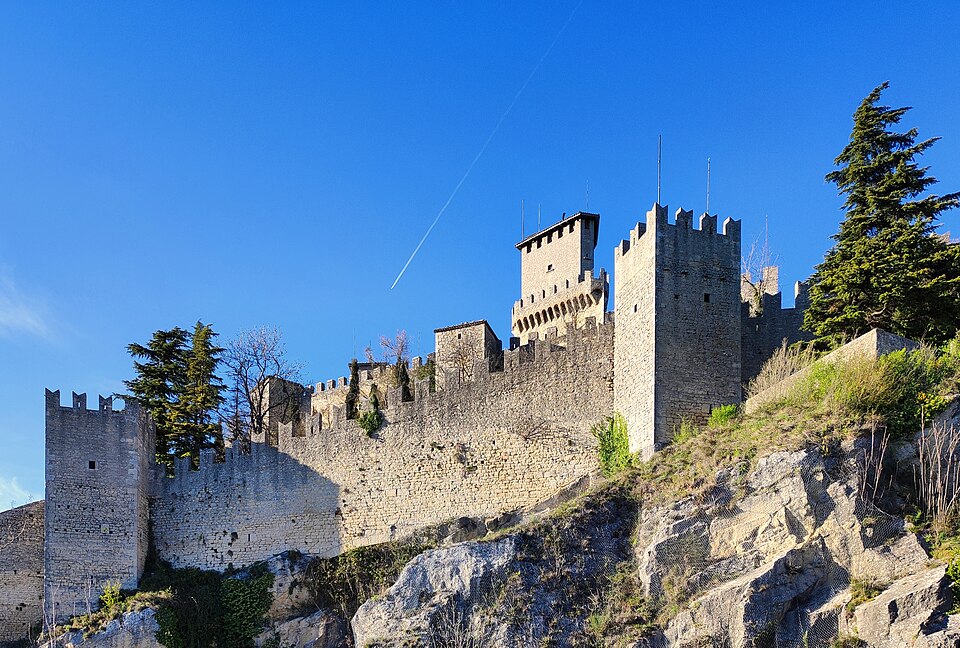
1100
Known locally as the Rocca, it is the older of two separate towers spaced along the same ridge, occupying its own summit and identifiable as the first and best known of the pair rather than by any distinguishing shape recorded here.
The Guaita, also called the Rocca, is the older of two fortified towers built along the ridge above the City of San Marino, the other being the Cesta. Raised around 1100, it predates its neighbour by roughly a century and a half and occupies its own separate summit on the same crest. Together the towers formed a chain of lookout points over the surrounding countryside, each treated as architecturally and historically distinct despite standing within sight of the other.
Photo: Terragio67 (CC BY-SA 4.0)
Cesta
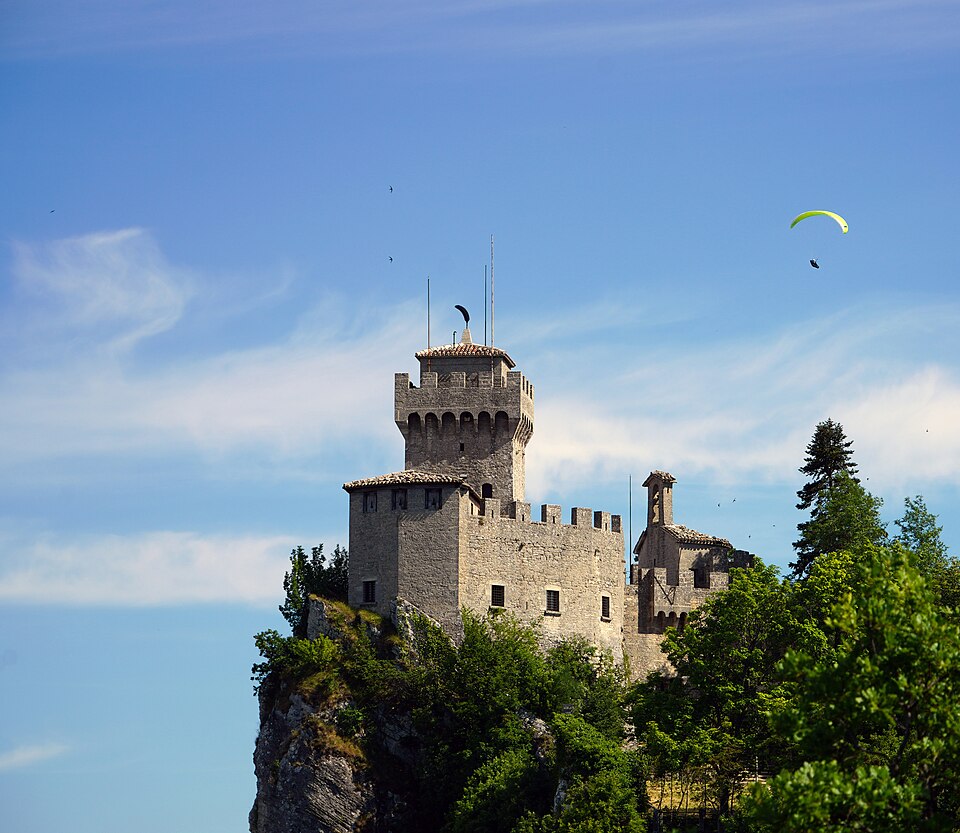
1253
Built about a century and a half after its neighbour, the Guaita, it stands on its own summit along the same ridge and today houses a small history museum rather than serving any defensive purpose.
The Cesta, also known as the Fratta, is the second of two towers built along the ridge above the City of San Marino, standing apart from the earlier Guaita. It was raised in 1253, roughly a century and a half after its neighbour. It no longer serves any military function: the tower now operates as a history museum, one of the uses found for the ridge's older fortifications once they ceased to guard anything.
Photo: Commonists (CC BY-SA 4.0)
Palazzo Pubblico
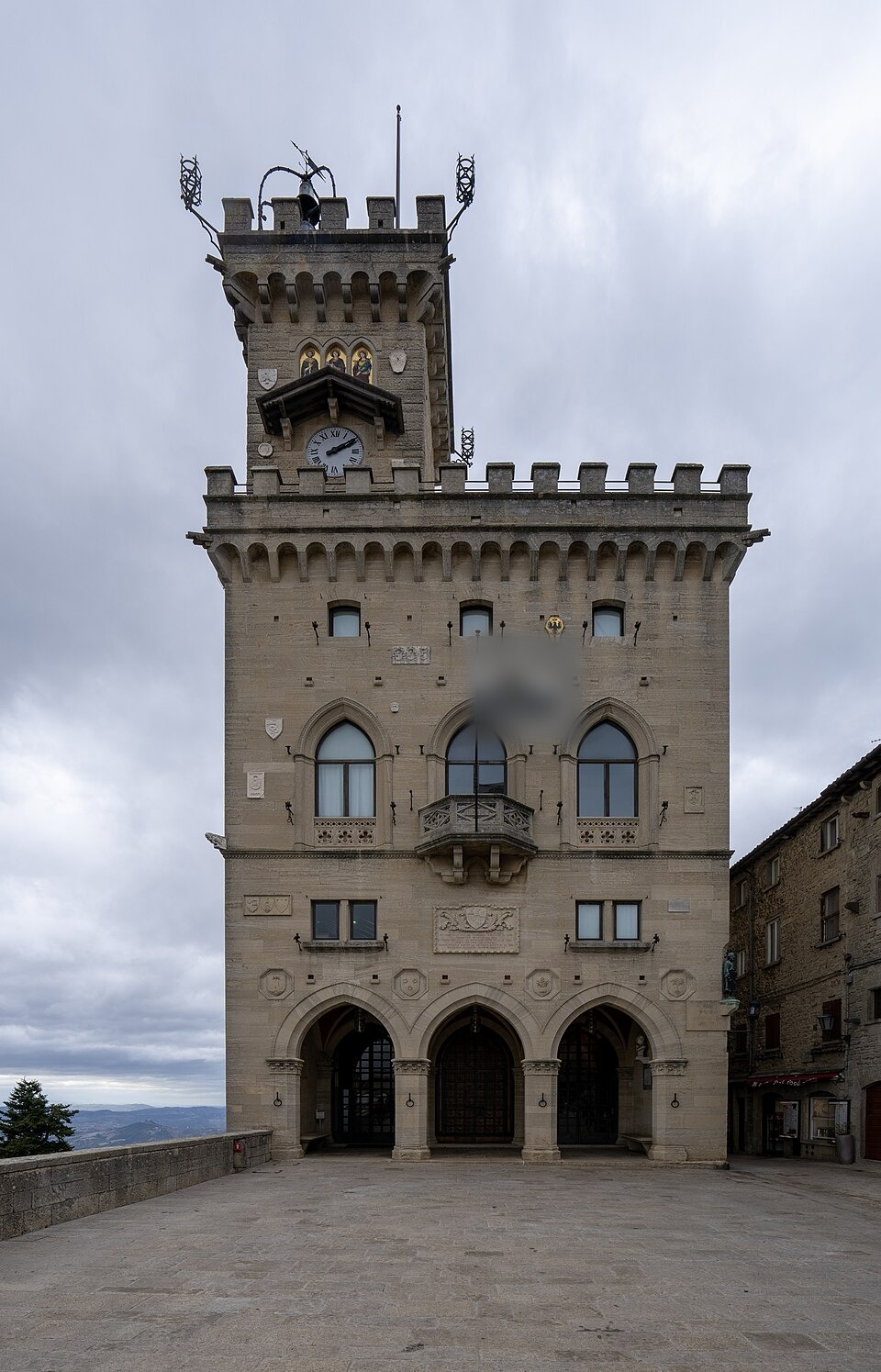
1894
Built in the Renaissance Revival style and completed in 1894, it is recognisable as the formal seat of the republic's institutions: the building where state ceremonies are held and where its principal governing bodies each carry out their functions.
The Palazzo Pubblico is the city hall of the City of San Marino, rebuilt in 1894 in the Renaissance Revival style then fashionable across Italy. It houses the country's principal institutions: the two Captains Regent, the Grand and General Council, the Council of Twelve and the Congress of State all carry out their functions here, and official state ceremonies take place within it. The building serves simultaneously as parliament, city hall and ceremonial palace for a state whose entire government fits inside one address.
- Four separate organs of state — the Captains Regent, the Grand and General Council, the Council of Twelve, and the Congress of State — all operate from this one building.
Photo: Fiat 500e (CC BY 4.0)
Basilica of San Marino
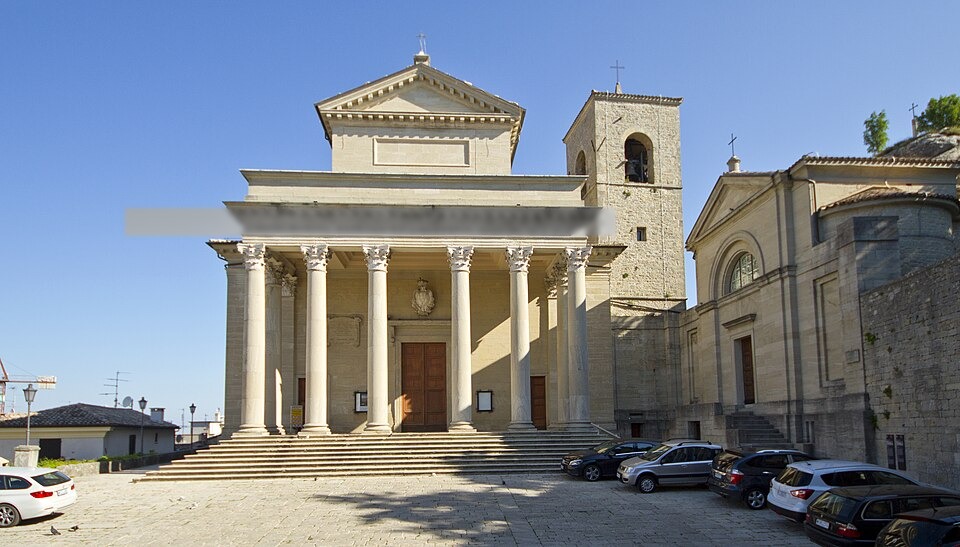
1836
The building is fronted by a portico of eight Corinthian columns, the clearest identifying feature of its Neoclassical rebuilding in 1836, standing at the edge of the town beside a smaller neighbouring church.
The Basilica of Saint Marinus is the main church of the City of San Marino and a co-cathedral of the Diocese of San Marino-Montefeltro. The present building was completed in 1836 in the Neoclassical style, with a porch of eight Corinthian columns, replacing an earlier church on the same site that dated to the seventh century. It stands on Piazzale Domus Plebis at the northeastern edge of the town, next to the Church of Saint Peter, and holds relics of Saint Marinus, the founder after whom the republic is named. It forms part of the city's UNESCO World Heritage listing.
- The church replaced a predecessor that had stood on the same site since the seventh century.
- It holds relics of Saint Marinus, the stonemason the republic is named after.
Photo: trolvag (CC BY-SA 3.0)
Funivia di San Marino
An aerial cable car linking Borgo Maggiore to the City of San Marino, running every fifteen minutes for a two-minute ride. Renowned for its views over the Adriatic Sea, it carries about 500,000 passengers a year and is considered a defining symbol of the country.
San Marino Shrine
A Shinto shrine in Serravalle, established as the first official Shinto shrine in Europe. It was supported by the Association of Shinto Shrines when founded.
History
The republic traces its founding to Marinus, a stonemason who, according to tradition, fled persecution under the Roman emperor Diocletian and established a small monastic community on Monte Titano, building a chapel there; the state dates itself from AD 301 and describes itself as the oldest surviving sovereign state and the oldest constitutional republic. That claim to continuity shapes what stands on the ridge today: watch-towers were added over the twelfth and thirteenth centuries to guard the summit its founder had chosen, while the buildings of government and church were rebuilt on their older footprints in the nineteenth century rather than relocated elsewhere. Governance itself remains unusual: an elected Grand and General Council appoints two Captains Regent every six months to share the head of state's role, a system said to be matched only by Switzerland's collective Federal Council.