Landmarks in Port of Spain
A financial capital whose grandest landmarks were all rebuilt within a single generation.
Port of Spain's landmarks sit within a compact administrative core built up over roughly a century, rather than around any single historic quarter. Holy Trinity Cathedral, raised for the Anglican diocese between 1816 and 1823 in Gothic Revival style, is the oldest of the three. Civic and educational building followed later: the Red House, seat of parliament, was rebuilt in Beaux-Arts style in 1907 after fire destroyed an earlier building on the site, and Queen's Royal College took its ornate German Renaissance form in 1904, decades after the school itself was founded. The pattern is one of replacement and expansion rather than survival: a city that grew as a colonial retail, financial and administrative centre kept rebuilding its principal institutions in whichever style was current.
Red House
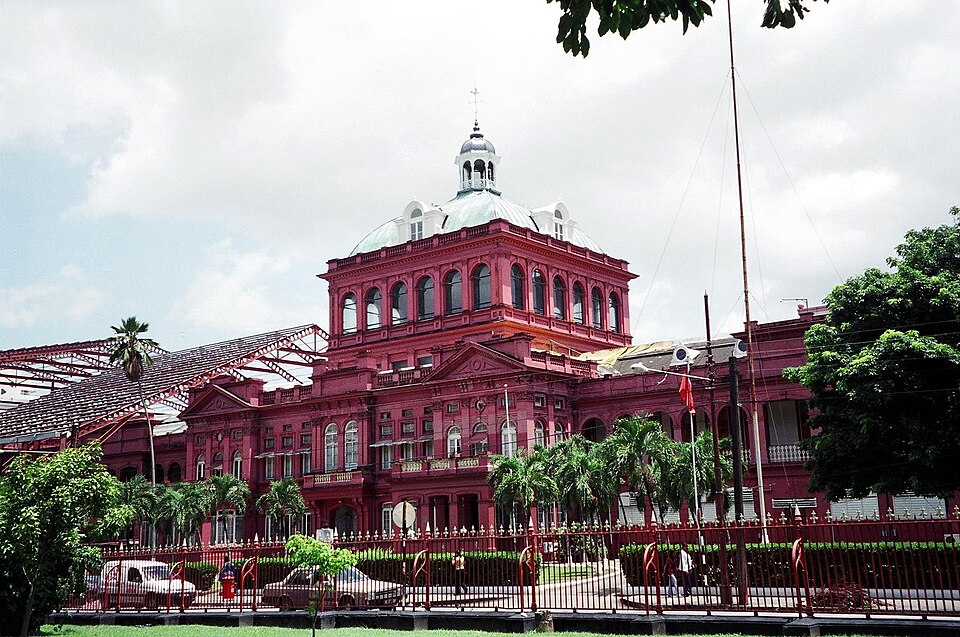
1907
A large, formally symmetrical Beaux-Arts building at the centre of the city, built for legislative use and still the working seat of parliament.
The Red House is the seat of the Trinidad and Tobago Parliament, standing centrally in the capital and built in the Beaux-Arts style. An earlier building on the site was destroyed during the 1903 Water Riots, and this one was completed in 1907. It remains in continuous use for parliamentary sittings, elections and other political business, making it one of the country's oldest working seats of government.
- In July 1990, an armed group called the Jamaat al Muslimeen stormed the building and held the prime minister and other officials hostage for six days; twenty-four people died before the crisis ended.
Photo: Random 00021 at English Wikipedia - Anthony Mendenhall (CC BY-SA 3.0)
Holy Trinity Cathedral
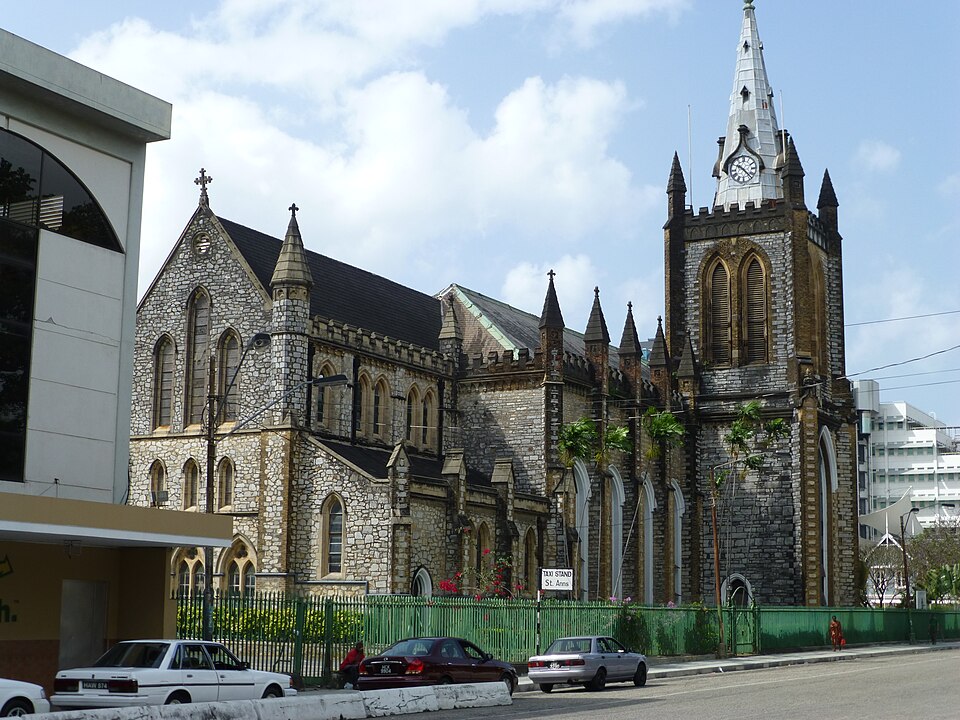
1816–1823
A Gothic Revival Anglican cathedral, its pointed arches and vertical massing setting it apart from the more classical civic buildings nearby, and serving as the seat of a diocesan bishop.
Holy Trinity Cathedral is the principal Anglican cathedral in Trinidad and Tobago, constructed between 1816 and 1823 in the Gothic Revival style. It serves as the seat of the Bishop of the Diocese of Trinidad and Tobago, a role it has held since completion. It is the oldest of the capital's three landmark buildings, predating the German Renaissance-style school building and the reconstructed seat of parliament by the better part of a century.
Photo: Grueslayer (CC BY-SA 3.0)
Queen's Royal College
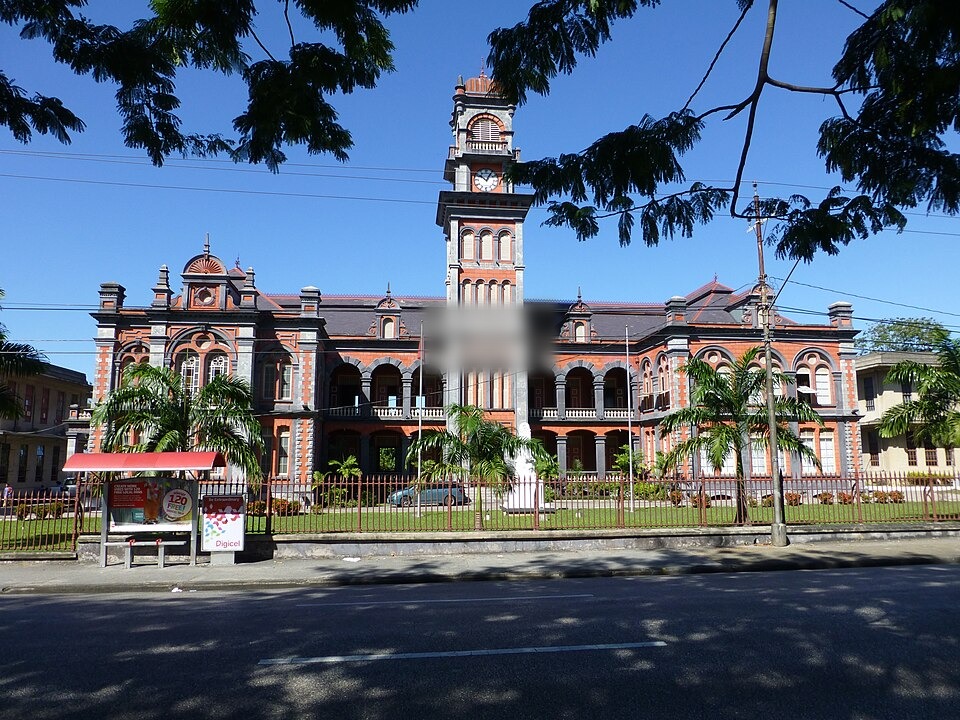
1904
A secondary school building distinguished by ornate German Renaissance detailing, a decorative style uncommon among the capital's plainer civic buildings.
Queen's Royal College, known for short as QRC, is a selective, secular secondary school in Trinidad and Tobago, originally run as a boarding and grammar school. Its building, noted for elaborate German Renaissance architecture, took its present form in 1904, decades after the institution itself was founded in 1859. The college has built a strong academic reputation, and its alumni have gone on to prominence in sports, politics and science both in Trinidad and Tobago and abroad.
- The school's roots as an institution go back to 1859, forty-five years before the German Renaissance building recognisable today was completed.
Photo: Grueslayer (CC BY-SA 4.0)
Magnificent Seven
Seven mansions built between 1902 and 1910 on former government stock-farm land west of the Queen's Park Savannah. Each was designed in a different style, from French Colonial to Scottish baronial, and Stollmeyer's Castle is said to be modeled after a wing of Balmoral Castle.
Queen's Park Savannah
The city's largest open space, known locally simply as the Savannah, covering about 260 acres of level ground. Its perimeter measures roughly 2.2 miles, or 3.5 kilometres, around.
Cathedral of the Immaculate Conception
A Catholic cathedral and seat of the Archdiocese of Port of Spain, built between 1816 and 1851. In the year of its completion it was also given the honorary status of a minor basilica.
Queen's Park Oval
A cricket ground that opened in 1896 and seats about 20,000, the second-largest capacity in the West Indies. It has hosted more Test matches than any other Caribbean venue, 60 by January 2018, beginning with a Test against England in February 1930.
Fort San Andres
The last surviving fortification from Trinidad's Spanish colonial period, which ended with the British capture of the island in 1797. First planned in 1733 to replace an earthen redoubt near the site of today's Royal Bank, it was not finished until 1787.
National Museum and Art Gallery
Trinidad and Tobago's national museum, at the top of Frederick Street opposite Memorial Park and just south of Queen's Park Savannah. It was established in 1892 as the Royal Victoria Institute, and its building is an example of British West Indian Victorian colonial style.
National Academy for the Performing Arts
A cultural and performing arts complex established in 2009, providing facilities for education, rehearsals and performances. It has won multiple awards, recognized both for its architectural design and its impact on the local arts scene.
Emperor Valley Zoo
The only public zoo in Trinidad and Tobago, opened on 8 November 1952 with just ten cages holding 127 animals. It now houses more than 2,300 animals from over 200 species, and takes its name from the blue emperor butterfly once common in the valley.
History
Port of Spain has been Trinidad's capital since 1757 and grew into the island's main retail, financial and administrative centre, home to major regional banks and a container port that ships bauxite trans-shipped from Guyana alongside local agricultural and manufactured goods. For a few years in the mid-twentieth century it also served as the de facto capital of the West Indies Federation, which briefly united several Caribbean territories. Its built landmarks reflect a history of rebuilding more than survival. Holy Trinity Cathedral, completed for the Anglican diocese between 1816 and 1823, is the oldest to remain standing. The Red House, seat of parliament, burned during the 1903 Water Riots and was reconstructed in Beaux-Arts style by 1907. Queen's Royal College, founded in 1859, did not take the ornate German Renaissance building it is now recognised by until 1904.