Landmarks in Caracas
Neoclassical civic monuments crowd a colonial grid pressed against a 2,200-metre ridge.
Caracas' oldest landmarks cluster around Plaza Bolívar, the historic core laid out after the city's colonial founding: the neoclassical Caracas Cathedral closes the square's eastern side, and the Federal Legislative Palace stands just southwest of it. Both are nineteenth-century civic monuments, built when President Antonio Guzmán Blanco remade central Caracas along European academic lines, replacing older colonial fabric with neoclassical facades and domes. The National Pantheon, on the old town's northern edge, was raised over the ruins of an eighteenth-century church during the same building wave. This historic center sits low in the Caracas Valley, hemmed in by the 2,200-metre Cerro El Ávila to the north and further hills to the south; far taller construction has since risen around it.
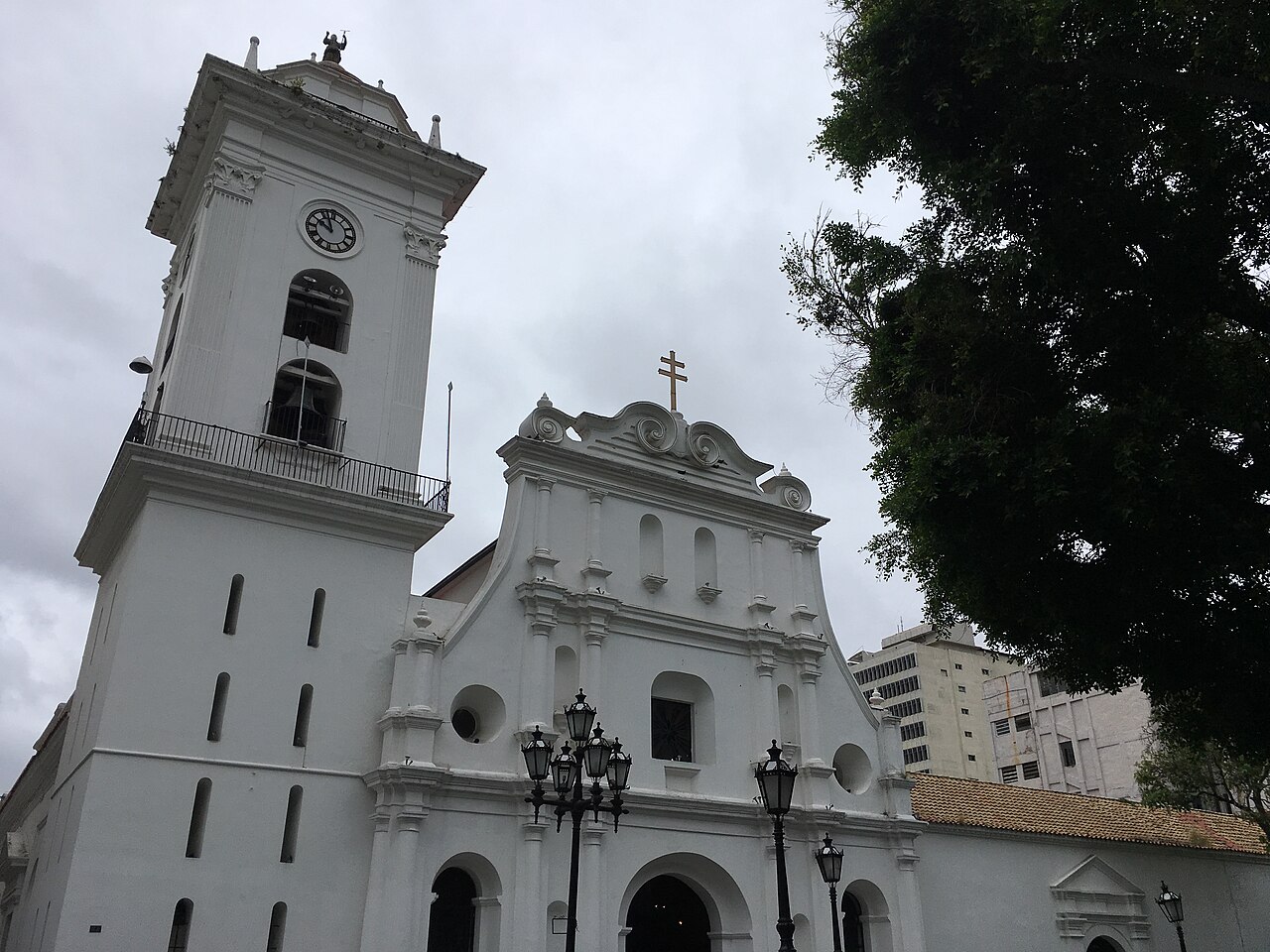
Caracas Cathedral
1674
Its neoclassical facade closes the eastern side of the city's colonial main square, beside a courtyard walled on three sides and open only toward the church; a small chapel of the Holy Trinity holds the tombs of Simón Bolívar's parents and wife.
The Caracas Cathedral, also called the Metropolitan Cathedral of Saint Anne, is the seat of the Roman Catholic Metropolitan archdiocese of Caracas, built in 1674 on Plaza Bolívar. Its chapel of the Holy Trinity holds the tombs of Simón Bolívar's parents and wife. Beside it lies a colonial square walled on three sides and open only where it faces the cathedral. The building is protected as a national historical monument of Venezuela and remains an active parish church.
- Its chapel of the Holy Trinity holds the remains of Simón Bolívar's parents and wife, though Bolívar himself is entombed at the National Pantheon.
Photo: Veronidae (CC BY-SA 3.0)
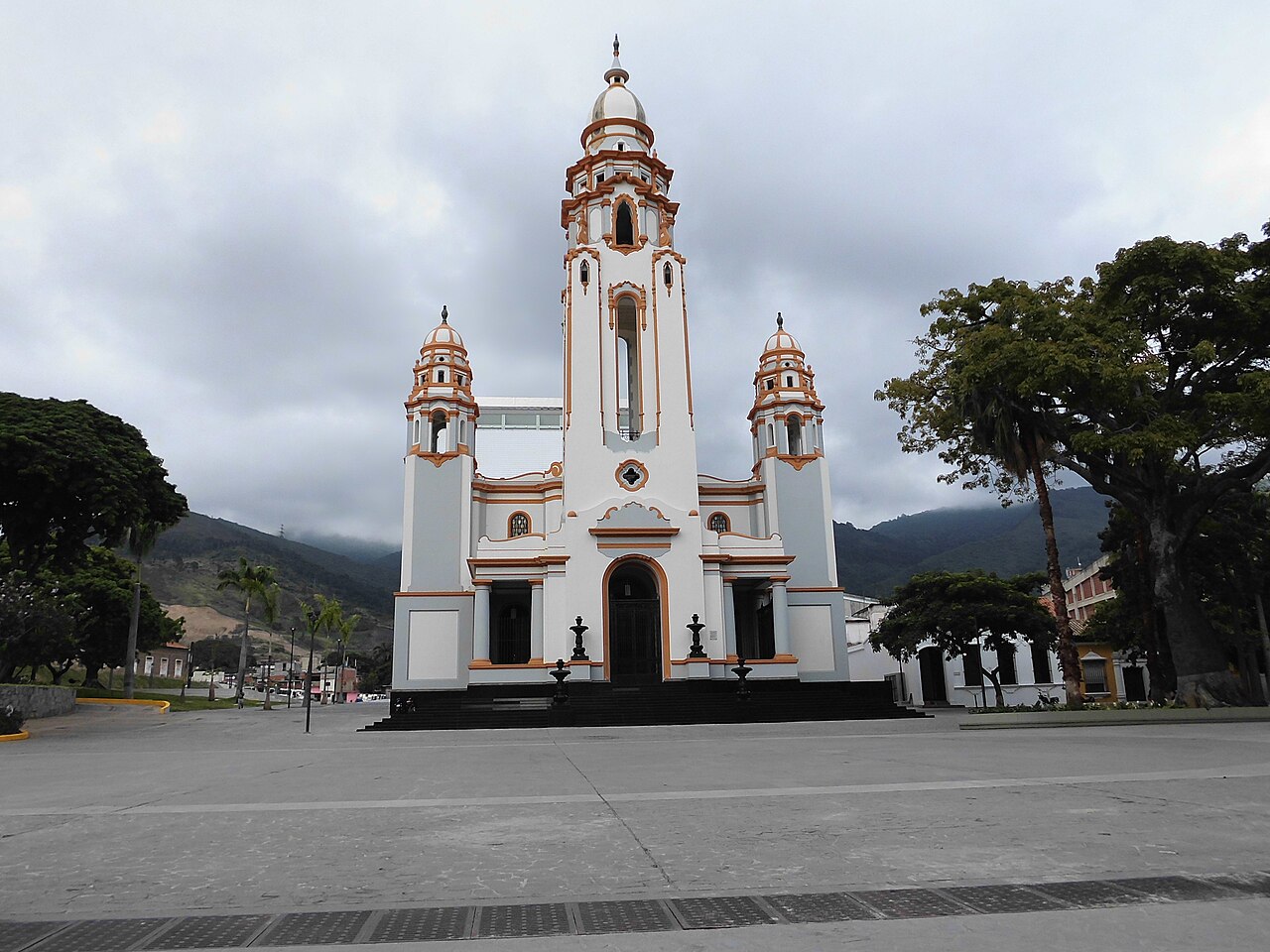
National Pantheon of Venezuela
1875
A large crystal chandelier hangs over the central nave, where Simón Bolívar's bronze sarcophagus stands at the altar beneath a vault painted in the 1930s with scenes from his life, while lesser Venezuelan heroes are buried along the side aisles.
The National Pantheon of Venezuela is the final resting place of the country's national heroes, created in the 1870s on the site of the ruined Santísima Trinidad church, built in 1744. Its central nave is dedicated entirely to Simón Bolívar, whose bronze sarcophagus takes the altar's place, while other honored figures rest in the aisles. The building's crystal chandelier was hung in 1883, and its painted vault added in the 1930s. It reopened in 2013 after a three-year restoration and expansion.
- The pantheon stands on the ruins of the Santísima Trinidad church, built in 1744.
- Its crystal chandelier was installed in 1883, the centennial of Simón Bolívar's birth.
Photo: Wilfredor (CC BY-SA 4.0)
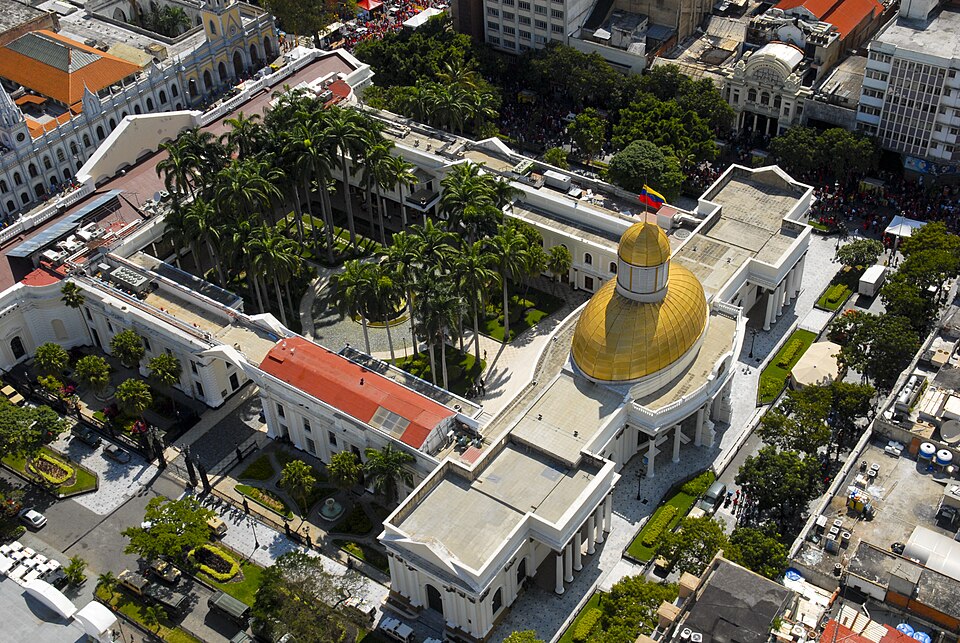
Federal Legislative Palace
1872–1877 · Luciano Urdaneta
A golden dome caps the elliptical Salón Elíptico of this neoclassical palace, standing southwest of the city's colonial main square.
Also known as the Capitolio, the Federal Legislative Palace houses Venezuela's National Assembly southwest of Plaza Bolívar. President Antonio Guzmán Blanco had it built between 1872 and 1877 to a design by the architect Luciano Urdaneta. Its Salón Elíptico, the elliptical hall used for formal assembly sessions, opened in 1877 beneath a golden dome. The building remains the seat of Venezuela's legislature.
- The palace is also known as the Capitolio, though it has always housed the legislature rather than a presidency.
Photo: PAULINO MORAN (CC BY-SA 2.0)
Miraflores Palace
The official dispatch and head office of the president of Venezuela. It stands on Urdaneta Avenue in the Libertador Bolivarian Municipality.
Parque Central Complex
A mixed-use development in El Conde whose twin towers, the tallest buildings in Caracas, have anchored the skyline since the West Tower opened in 1979. They held the record as tallest in Latin America until 2003, when Mexico City's Torre Mayor overtook them.
National Assembly of Venezuela
The seat of Venezuela's federal legislature, first elected in 2000 under the 1999 constitution. It is a unicameral body whose members are chosen partly by direct election in state districts and partly by state-based party-list proportional representation.
Yellow House
A 19th-century neoclassical building on Plaza Bolívar, originally the headquarters of the Royal Jail of Caracas and the City Council. It served as the government palace and presidential residence from 1877 to 1904, and has housed the Ministry of Foreign Affairs since 1912.
Palacio de las Academias
A Neo-Gothic building on Avenida Universidad, built on the site of a 1684 Franciscan convent and given its Neo-Gothic facade in 1876 for the Universidad de Caracas. It has housed the National Academies since the university relocated in 1952.
Teresa Carreño Cultural Complex
The most important theatre in Venezuela, built on a 22,000-square-metre lot in the Bellas Artes district and named after pianist Teresa Carreño. It is the second-largest theatre in South America and houses two concert halls, the José Félix Ribas and the Ríos Reyna.
Centro Simón Bolívar Towers
A pair of 32-storey towers, each 103 metres tall, in the El Silencio district, also known as the Towers of Silence. Built during the presidency of Marcos Pérez Jiménez, they opened to the public on 6 December 1954.
Basilica of Santa Capilla
A Roman Catholic basilica on Avenida Urdaneta, built from 1883 by architect Juan Hurtado Manrique for President Antonio Guzmán Blanco, modeled on Paris's Sainte-Chapelle. It replaced an earlier hermitage on the site, founded in 1568, which earthquakes in 1667 and 1812 had repeatedly damaged.
Teatro Municipal of Caracas
An opera house inaugurated by President Guzmán Blanco in 1881. It was initially named after the president himself.
Bolívar Square
The central square of Caracas since the city's founding as Santiago de León de Caracas in 1567. It is ringed by landmark buildings including the Cathedral, the Archbishop's Palace, City Hall, the Yellow House and, to the southwest, the Federal Legislative Palace.
Birthplace of Simón Bolívar
A 17th-century house near Plaza San Jacinto where Simón Bolívar was born, one of the few colonial-era houses surviving in central Caracas. An adjoining Bolivarian museum displays memorabilia, weapons and furniture from the Venezuelan War of Independence.
Humboldt Hotel
A hotel at the summit of Cerro Ávila, built in just six months between May and November 1956. It is named after the German naturalist Alexander von Humboldt, who explored and recorded the surrounding mountains.
Centro Financiero Confinanzas
An unfinished skyscraper, also called Torre de David, whose construction began in 1990 and halted in 1994 during Venezuela's banking crisis. The country's third-tallest building after the Parque Central towers, it remains incomplete and was further damaged by earthquakes in 2018 and 2026.
María Lionza (statue)
A statue of María Lionza riding a tapir, its replica standing on the Francisco Fajardo freeway. Sculptor Alejandro Colina made the original in 1951; moved to the highway in 1953, it was illicitly taken to Sorte mountain in 2022 and replaced by a 2004 cast.
Cuartel de la Montaña
A barracks built between 1904 and 1906 under President Cipriano Castro, renamed Cuartel de la Montaña 4 de Febrero in 2002. It has served as the Military History Museum since 1981 and also houses the mausoleum of former president Hugo Chávez.
Parque Cristal
An office and recreation building on Avenida Francisco de Miranda, constructed in 1977. At the time it was seen as a symbol of the country's development.
National Art Gallery
An art museum in the Plaza Morelos area, opened in May 1976. In 2009 it moved into a new building designed by Carlos Gómez de Llerena, Venezuela's largest museum building.
Caracas Museum of Contemporary Art
A modern and contemporary art museum in the Parque Central Complex, founded on 30 August 1973 by journalist and art patron Sofía Ímber and opened in 1974. Its collection of 5,000 pieces, including 700 sculptures, includes works by Picasso, Monet and Kandinsky.
Basilica of St. Teresa
A Catholic church at the corner of La Palma and Santa Teresa, Caracas's main center of Easter veneration for the Nazarene image. Formed of two neoclassical churches joined under a shared dome, one facade dedicated to Santa Ana and the other to Santa Teresa.
Quinta de Anauco
A colonial house built in 1797 that hosted Simón Bolívar in 1827 and was declared a National Historic Monument in 1978. Since 1958 it has been home to the Caracas Museum of Colonial Art.
Teleférico de Caracas
A gondola lift, or cable car, that climbs El Ávila Mountain. It runs within the boundaries of El Ávila National Park.
History
Caracas was founded in the sixteenth century in a valley separated from the Caribbean by a steep mountain range. Its cathedral, raised in 1674 facing what is now Plaza Bolívar, is the oldest landmark surviving from the colonial town. The buildings that most define the historic center instead date from the 1870s, when President Antonio Guzmán Blanco pursued a program of civic construction: the Federal Legislative Palace, seat of the National Assembly, and the National Pantheon, built over the ruins of a 1744 church to hold the remains of the republic's founding figures. The Pantheon's decoration came in stages, gaining its chandelier in 1883 and a painted vault in the 1930s before a 2013 restoration. Oil wealth later financed the service economy and high-rise construction that now surrounds this nineteenth-century core.