Landmarks in Regensburg
A Roman fort's medieval core survives intact where the Danube meets the Naab and Regen.
Regensburg's landmarks cluster inside the medieval city that UNESCO listed in 2006 as the largest such site north of the Alps. Building here began as a Roman river fort at the point where the Naab and Regen run into the Danube, and the settlement grew inward from that confluence rather than outward, so the old core stayed compact and stone-built. The Stone Bridge, raised from 1146, tied the town to its far bank and stood as the only Danube crossing here for roughly eight hundred years. Gothic work replaced Romanesque building over the following centuries, most visibly in the cathedral's nave and west front, while monastic complexes on the fringes were later absorbed into residential and civic use.
Regensburg Cathedral
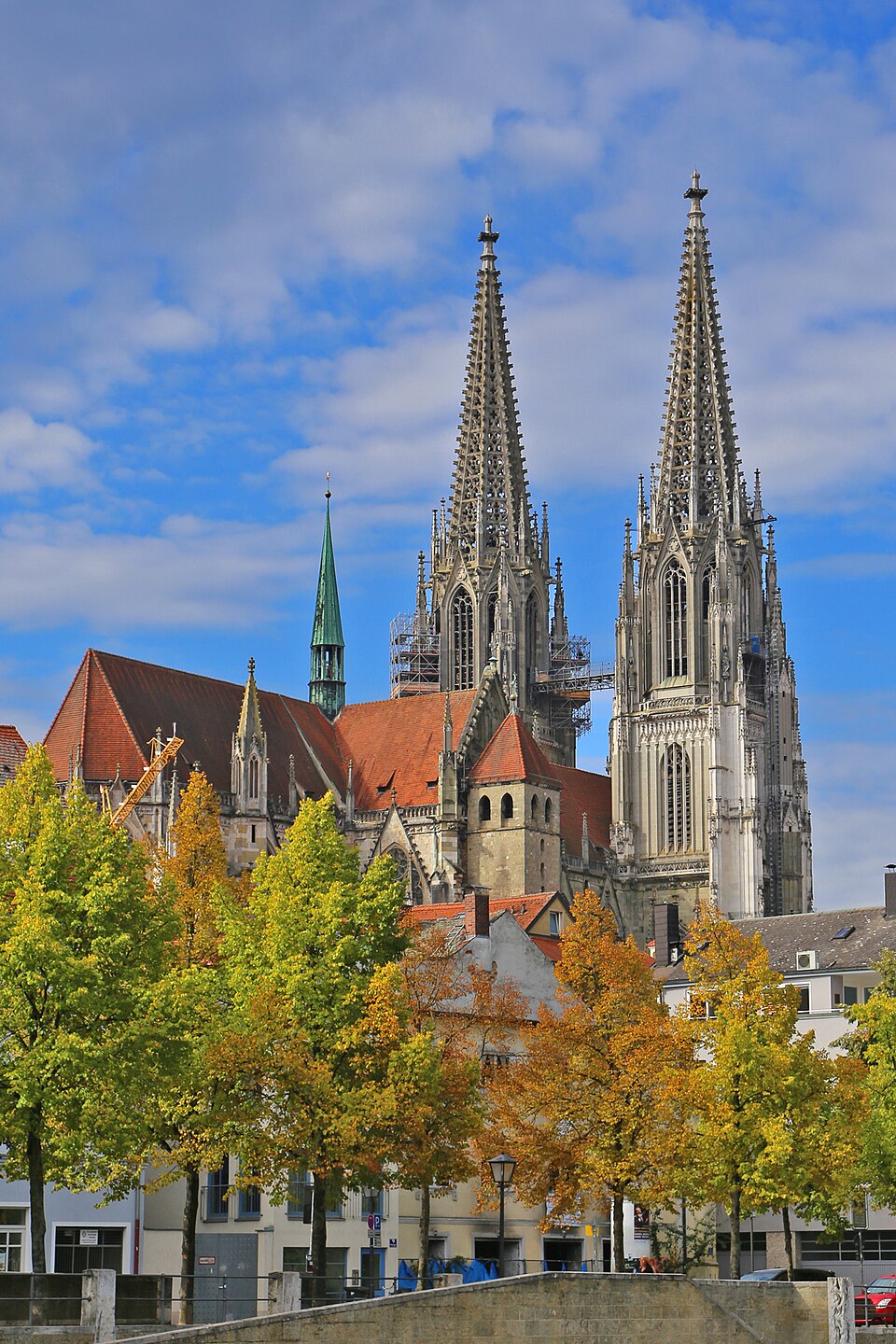
1520 · Mathes Roriczer
Its Gothic form -- pointed arches, ribbed vaults and a tall, narrow nave -- was essentially in place by 1520, the profile that still identifies the building today.
Regensburg Cathedral is a Catholic cathedral built largely in the Gothic style, its nave and west front substantially finished by 1520 under master builders including Mathes Roriczer and Conrad Roritzer, who worked on the site through the fifteenth century. It serves as the seat of the Catholic Diocese of Regensburg. The building was later restored and altered, work associated with the nineteenth-century architects Franz Joseph Denzinger and Friedrich von Gärtner, and more recently studied by the architectural historian Manfred Schuller. It is registered as an architectural heritage monument in Bavaria.
- Its five credited architects span roughly five centuries, from a fifteenth-century master mason to a present-day architectural historian.
Photo: W. Bulach (CC BY-SA 4.0)
Stone Bridge
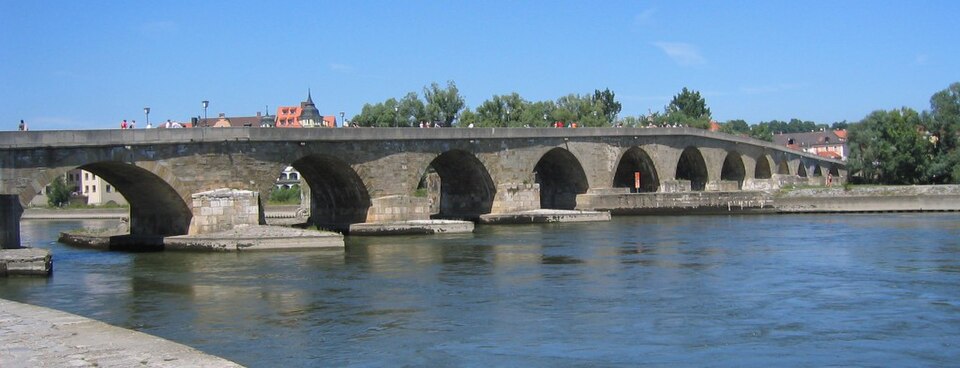
1146
Built almost entirely of stone with a run of rounded arches, it carries a roadway across the Danube, low and long against the water.
The Stone Bridge is a medieval arch bridge across the Danube, built from 1146 to link the old town with the district on the opposite bank. For more than eight hundred years, until new crossings were added in the 1930s, it remained the only bridge over the river at this point. Built almost entirely of stone, it is regarded as a major feat of medieval engineering and remains protected as an architectural heritage monument in Bavaria.
- It was the only bridge across the river here for more than 800 years, until new crossings appeared in the 1930s.
Photo: Hytrion at German Wikipedia (CC BY-SA 3.0)
Old Town Hall
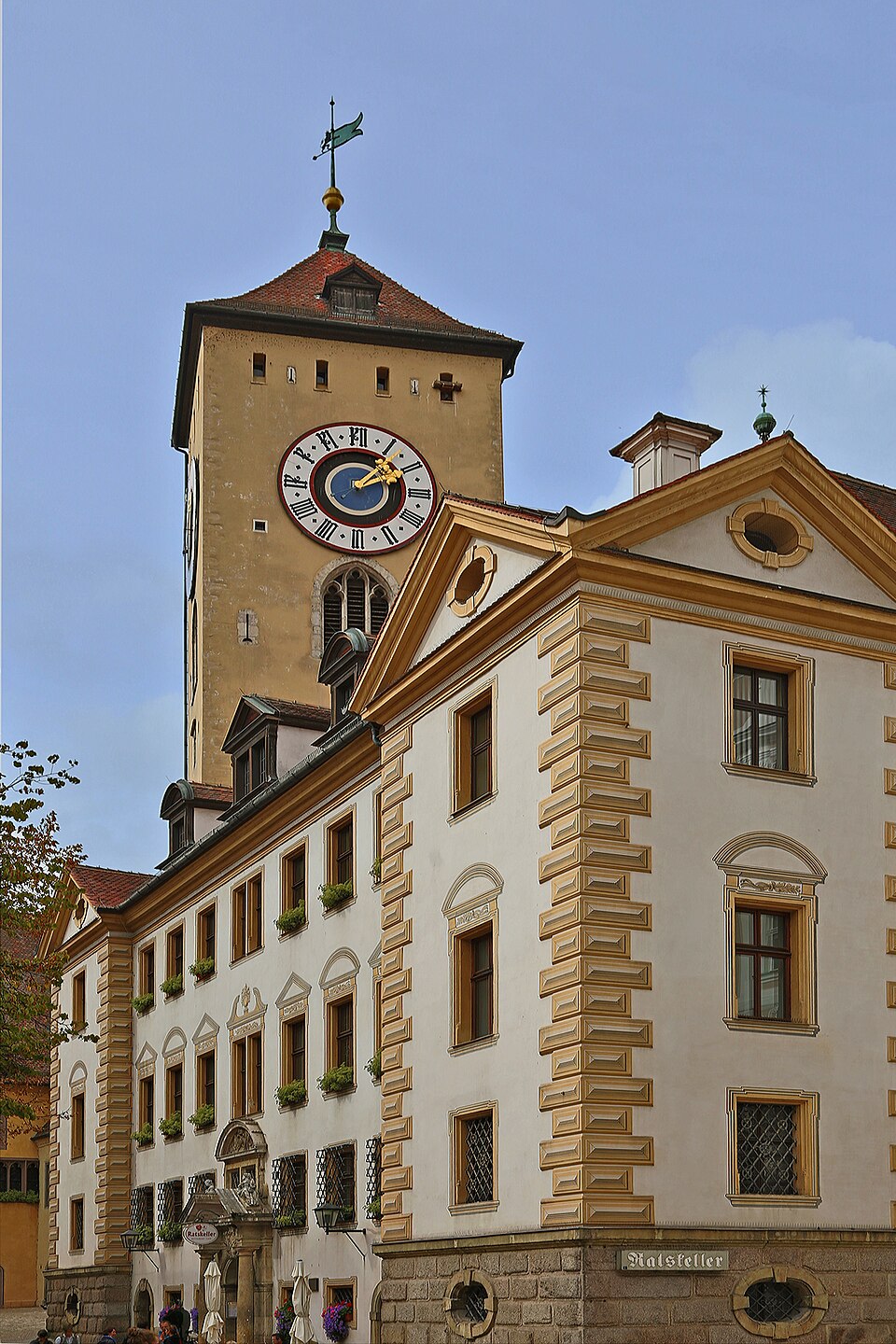
1245
A stone civic building in the Gothic style, dating from the thirteenth century, built to house the city's council rather than a church or a residence.
The Old Town Hall is Regensburg's Rathaus, the historic seat of municipal government, raised in the Gothic style beginning in 1245. Wikidata classifies it simply as a Rathaus, without further detail here on its builders or the sequence of its construction. It survives today as part of the protected medieval town centre and is listed as an architectural heritage monument in Bavaria, a formal status marking its historical and architectural significance within the city.
Photo: W. Bulach (CC BY-SA 4.0)
St. Emmeram's Abbey
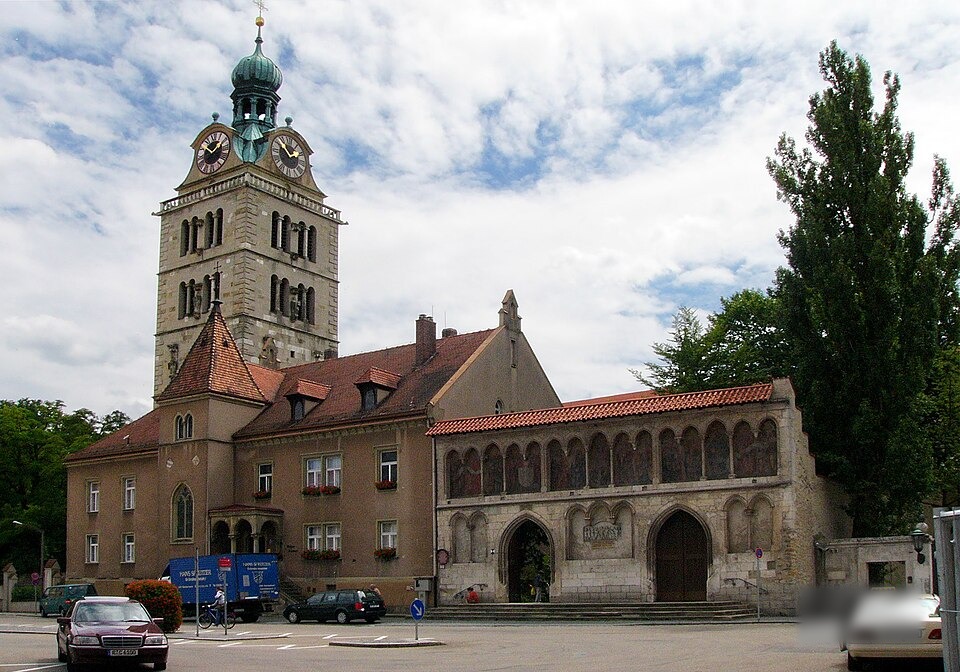
739
The former abbey church survives separately as a parish church, while the rest of the monastic complex was absorbed into a large residence still used by a princely family.
Saint Emmeram's Abbey was a Benedictine monastery founded around 739 in Regensburg, established at the grave of Saint Emmeram, a Frankish bishop who had died around 650. Its original abbey church survives as a parish church known as Saint Emmeram's Basilica. The remaining monastic buildings form a large complex, known as Schloss Thurn und Taxis or Schloss St. Emmeram, which has served since the early nineteenth century as the main residence of the Thurn und Taxis princely family. It is registered as an architectural heritage monument in Bavaria.
- It was founded at the grave of a bishop who had died roughly ninety years earlier.
- Its monastic buildings became, and remain, the residence of a princely family.
Photo: Nikater (Public domain)
Scots Monastery
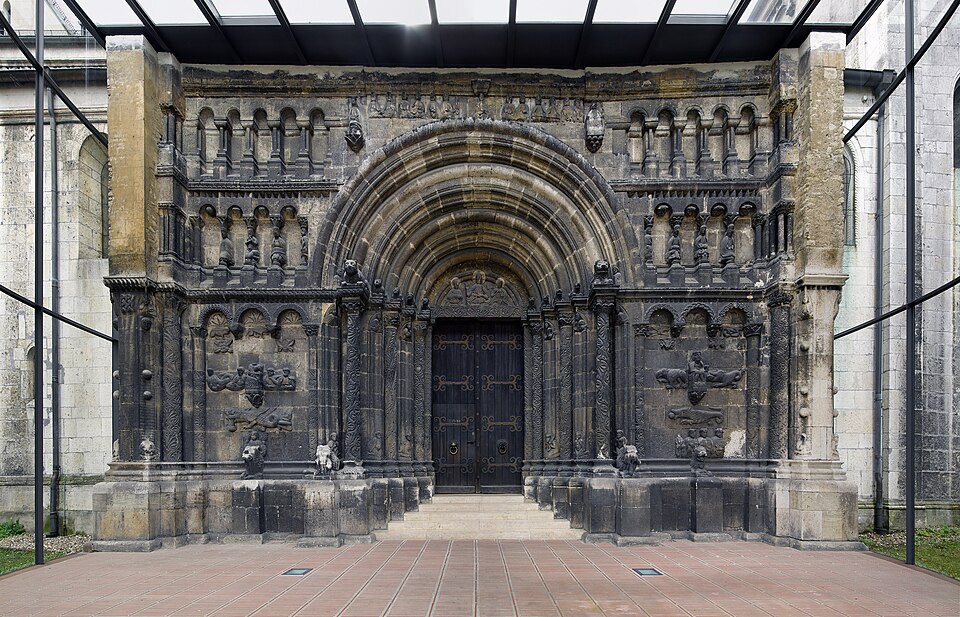
11th century
A Romanesque church building, the most prominent survivor of a former Benedictine abbey, still known by a German name recalling its Irish and Scottish monks.
The Scots Monastery, known in German as Schottenkirche, Schottenkloster or Schottenstift, was the former Benedictine Abbey of St James in Regensburg. It was founded in the eleventh century by Irish missionaries and was later held, for most of its history, by first Irish and then Scottish monks. Its name preserves an older, broader use of the Latin word Scotti for the Gaelic peoples of Ireland and Scotland alike, rather than distinguishing between the two nations. The church survives today as a Romanesque church building and heritage monument in Bavaria.
- Its name reflects an older use of the Latin word for 'Scots', which covered Gaels from both Ireland and Scotland without distinction.
- Its full official name translates as the Irish Benedictine Abbey Church of St. James and St. Gertrude.
Photo: Richard Bartz (CC BY-SA 3.0)
Walhalla
A hall of fame monument in Bavaria honouring distinguished figures in German history, conceived in 1807 by Crown Prince Ludwig I of Bavaria. Named after the Valhalla of Norse mythology, it has inducted only Germans or German-speakers since 1890.
Historische Wurstkuchl
A restaurant built as the construction office for the Regensburg stone bridge in 1135, converted into a cookshop when the bridge was finished in 1146. The present building dates from the 17th century, and it may be the oldest continuously open public restaurant in the world.
Regensburg Synagogue
An Orthodox synagogue whose predecessors, completed in 1227, 1841, and 1912, were each destroyed, most recently by the Nazis during Kristallnacht in 1938. A new Modernist synagogue, designed by Volker Staab, opened on the site in 2019.
Theater Regensburg
The city's main theatrical organisation, staging operas, musicals, ballets, plays, and concerts. It operates across several performance venues throughout Regensburg.
Basilica of the Nativity of Our Lady
The oldest Catholic place of worship in Bavaria, part of an abbey dedicated to the Virgin and founded by Emperor Henry II in 1002. Its 18th-century Baroque decoration, in the style of the Wessobrunn school, ranks among Europe's rococo masterpieces.
Niedermünster
A former house of canonesses that was, at its height, one of the wealthiest and most influential in Bavaria. The church still serves today as the parish church of Regensburg Cathedral.
Württembergisches Palais
An early 19th-century Neoclassical palace in Regensburg's Western District, also known as the Herzogspalais. Its grounds include the Herzogspark, with a Renaissance garden and the medieval Prebrunnturm tower, and the palace now houses the Natural History Museum of East Bavaria.
Prüfening Abbey
A Benedictine monastery on the outskirts of Regensburg, also known since the early 19th century as Prüfening Castle. Its surviving dedicatory inscription, commemorating the abbey's founding in 1119, was made by printing and is a unique document of medieval typography.
Regensburg Museum of Danube Shipping
A maritime museum devoted to shipping on the Danube and other rivers, with art collections and material on boatmen's work and training. Its main exhibits are the steam tugboat Ruthof and the diesel tug Freudenau.
Donaustauf Castle
A ruined hill castle standing 424 metres above sea level, overlooking the Danube near the village of Donaustauf, which grew up under its medieval fortifications. The municipality has owned the ruins since 1986 and renovated them from 1997.
Public Observatory Regensburg
An astronomical observatory whose history dates to 1774, when St Emmeram's Abbey dedicated two towers to observation. Now run by a non-profit association, it is open to visitors on Friday evenings.
Protestant Central Cemetery
A historic Lutheran cemetery owned and operated by the church, laid out on the northern slope of the Galgenberg hillside. It runs between Friedensstrasse and Bischof-Konrad-Strasse in Regensburg.
Schloss Höfling
A Baroque castle in Regensburg owned by the House of Thurn and Taxis. In 1985 it was leased to the Walderdorff family for a term of one hundred years.
Prüll Charterhouse
A former Carthusian monastery in Regensburg, previously known as Prüll Abbey.
History
The city's building history starts with a Roman garrison fort at the Danube's northernmost point, a site chosen for the rivers meeting there. Christian foundations followed early: Saint Emmeram's monastery was founded around 739 at the grave of a Frankish missionary bishop, and Irish monks built their own abbey, later known by its German name Schottenkirche, in the eleventh century. The Old Town Hall dates from 1245, raised as Regensburg grew into the political centre of the surrounding region under the Holy Roman Empire. The cathedral's Gothic nave and west front were substantially complete by 1520, replacing earlier work on the same site. Saint Emmeram's later became the residence of the Thurn und Taxis family, its monastic buildings converted into a palace in the nineteenth century.