Landmarks in Weimar
Ducal Baroque palaces neighbour the Art Nouveau school building that became the Bauhaus.
Four of Weimar's recorded landmarks were built for the dukes of Saxe-Weimar within a compact area beside the Ilm river: a city palace rebuilt in Neoclassical stone after repeated fires, a ducal library that opened to the public in the late seventeenth century, and a Baroque summer palace with French and English gardens on the town's edge. These began as court buildings, later turned over to museums, archives and collections once ducal government ended. A different material and period appear only once, in the Art Nouveau school building Henry van de Velde designed for the art academy that later became the Bauhaus. Weimar's landmark stock is therefore small, closely spaced, and weighted toward the seventeenth-to-early-nineteenth-century ducal court rather than any later industrial rebuilding.
Goethe's House
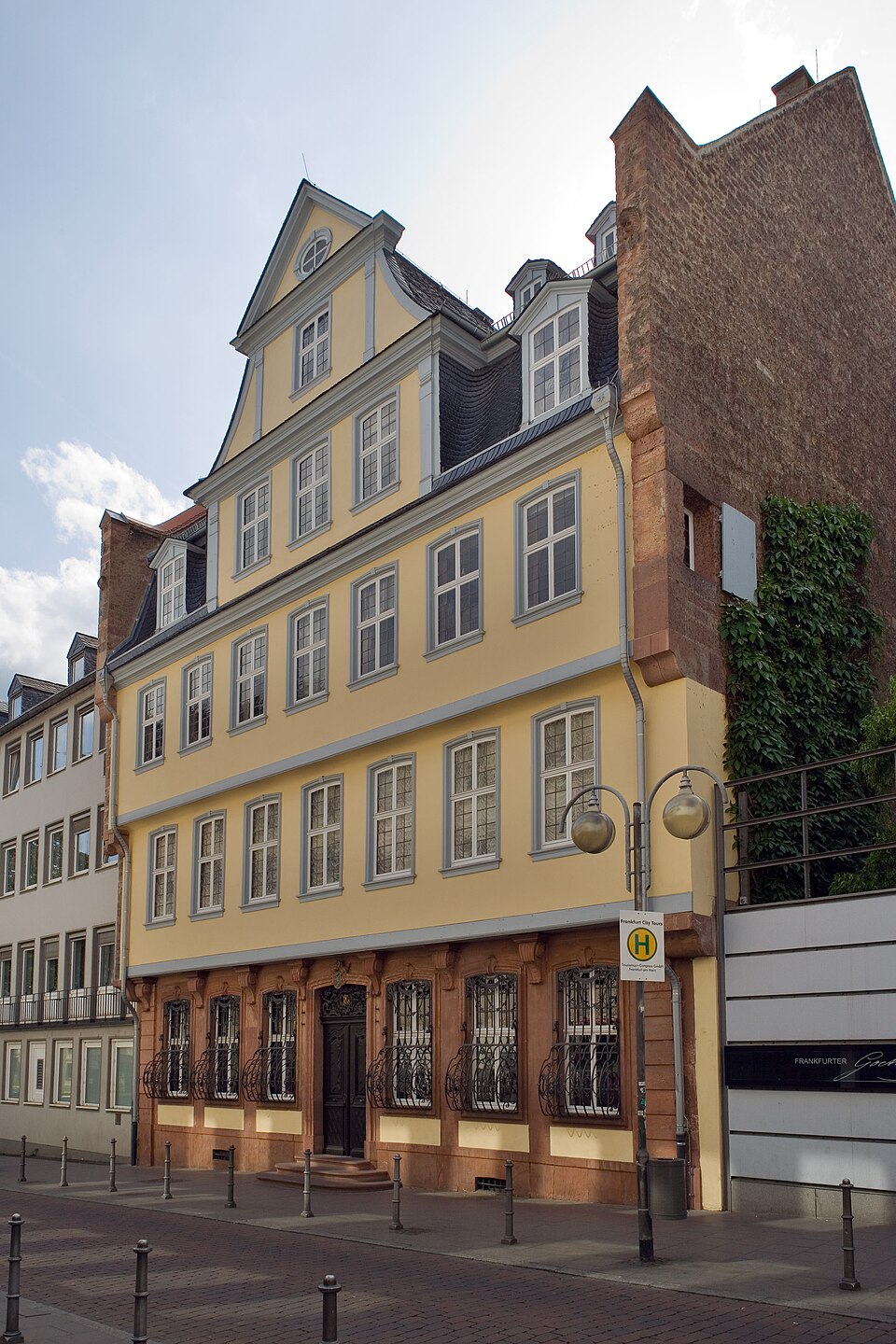
1709 · Georg Caspar Helmershausen
Beside the house is a garden that once grew produce for the household - asparagus, artichokes, apricots and grapes - extended eastward in 1817 to add a small pavilion built to hold a mineral collection.
This was Goethe's main residence in Weimar, where he lived from 1782 to 1832, though he occupied other houses in the town too. Built in 1709 by Georg Caspar Helmershausen, its rooms were redesigned once Goethe moved in, to reflect the ideals of Weimar Classicism, a movement in which he was a leading figure. Many original furnishings survive. An adjoining garden supplied the household with asparagus, artichokes, apricots and grapes; extended eastward in 1817, it gained a pavilion for Goethe's mineral collection. The house now holds the Goethe-Nationalmuseum and was added to the UNESCO World Heritage list in 1998.
- The adjoining garden originally grew asparagus, artichokes, apricots and grapes for the household.
- A pavilion added to the garden in 1817 was built to store Goethe's mineral collection.
- Goethe lived in the house for fifty years, from 1782 to 1832, though he occupied other houses in Weimar as well.
Photo: Mylius (CC BY-SA 3.0)
Duchess Anna Amalia Library
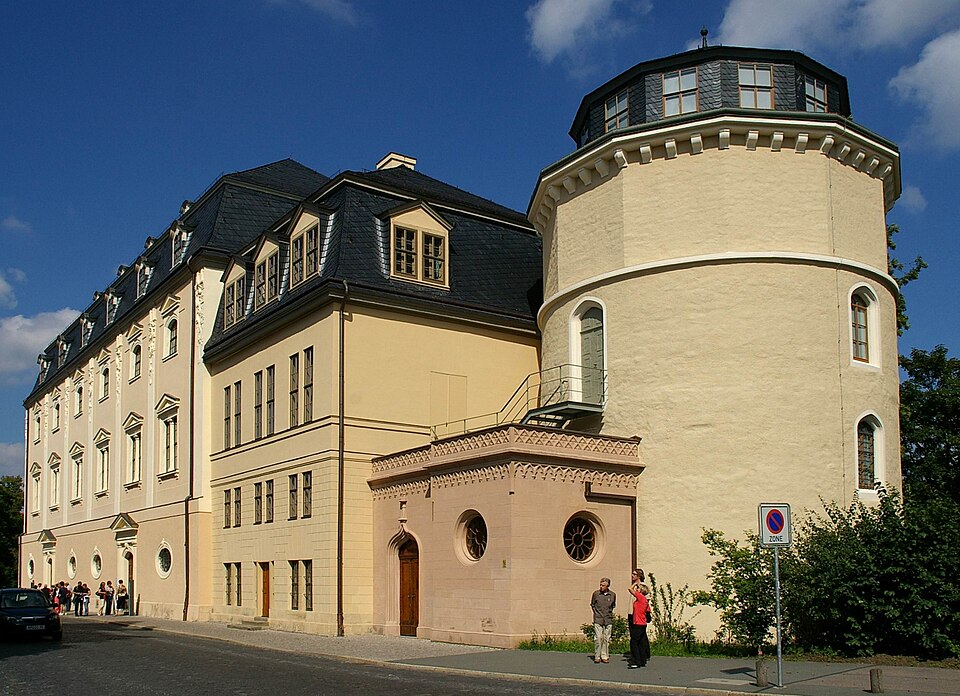
1691
The library is remembered as much for the 2004 fire that gutted its main wing as for its holdings: restoration of the salvaged volumes was not finished until 2015.
This is a public research library specialising in German literature from the Classical and late Romantic periods, its holdings built up under the Dukes of Saxe-Weimar with stock supplied by the Weimar bookseller Hoffmann and the Strasbourg publishing house Bauer, Treuttel and Würtz. It opened to the public in 1691 and was renamed for Duchess Anna Amalia in 1991, the tricentennial of that opening. Listed as part of the Classical Weimar UNESCO World Heritage Site, it lost its main wing and part of its collection to a 2004 fire; restoration of the surviving books took until 2015.
- It was renamed for Duchess Anna Amalia in 1991, exactly three hundred years after it first opened to the public.
- Its collection was built up partly with volumes from a Strasbourg publishing house, Bauer, Treuttel and Würtz.
Photo: Rudolf Klein at de.wikipedia.) Later version(s) were uploaded by Most Curious at de.wikipedia. (CC BY-SA 3.0 de)
Weimar City Palace
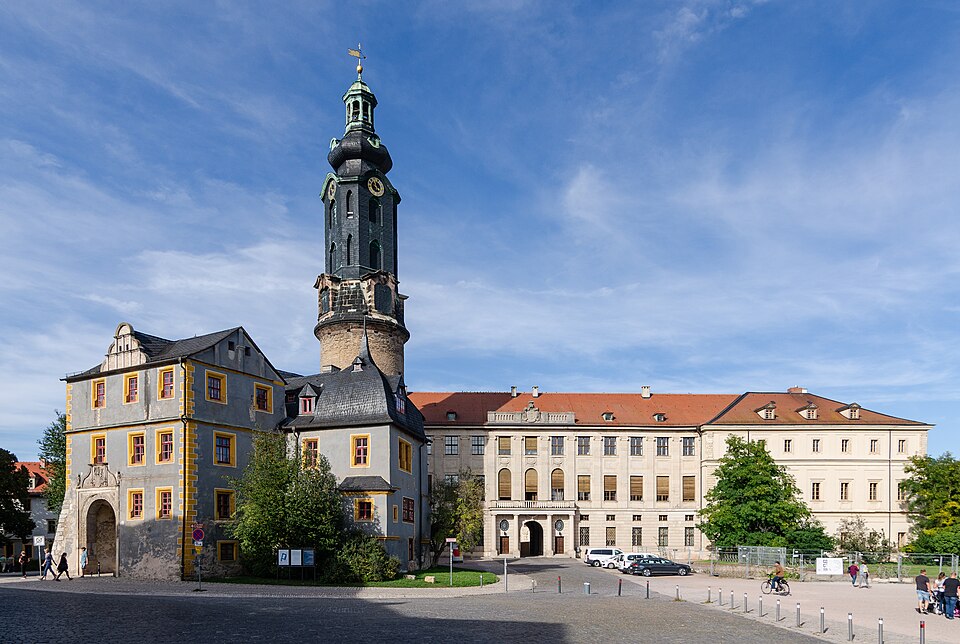
1803
A Neoclassical palace of restrained, symmetrical stonework stands at the edge of a riverside park, its plain lines a contrast with the ornate Baroque building that stood on the site before a fire.
Weimar's dukes had their principal residence here from the mid-sixteenth century, known variously as the Grand Ducal Palace or City Castle. A Baroque range associated with the architects Johann Moritz Richter and Johann Adolf Richter burned in 1774 and was replaced by the Neoclassical building that stands today, completed in 1803. It stands at the north end of Park an der Ilm, beside the Ilm river. Four rooms commemorate the poets Goethe, Herder, Schiller and Wieland, and since 1923 the palace has held the Schlossmuseum, with paintings from the fifteenth and sixteenth centuries and works related to the city.
- Works by Johann Sebastian Bach were premiered in the palace's chapel before that Baroque building burned down.
- It has been destroyed by fire and rebuilt more than once over its history.
Photo: Steffen Schmitz (more photos) (CC BY-SA 4.0)
Bauhaus University Main Building
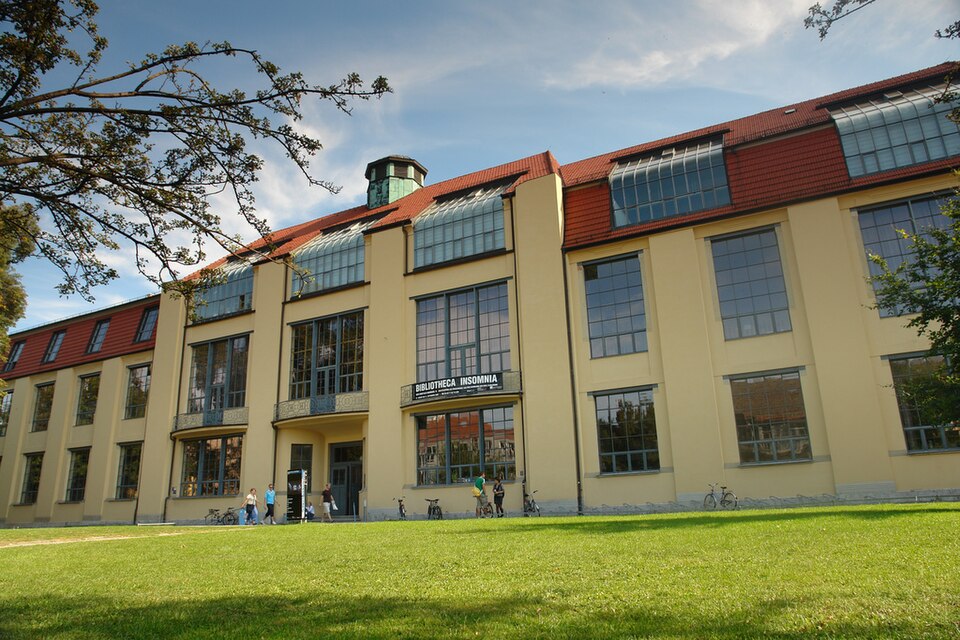
1911 · Henry van de Velde
Curving lines and organic, plant-based ornament mark the facade as Art Nouveau, unlike the symmetrical classicism of the ducal buildings elsewhere in the city.
Designed by Henry van de Velde and completed in 1911, this Art Nouveau building housed what began in 1860 as the Great Ducal Saxon Art School. The school gained collegiate status in June 1910, and in 1919 its new director Walter Gropius renamed it Bauhaus; it took its current name in 1996. It now serves a public university specialising in art and technical fields, with more than four thousand students enrolled, around 27 percent of them international.
- The university marked its 150th anniversary as an art school in 2010, and the centenary of the Bauhaus itself in 2019.
- It has changed its name more than once, taking its present title only in 1996.
Photo: Ralf Herrmann (CC BY-SA 2.0 de)
Belvedere Palace
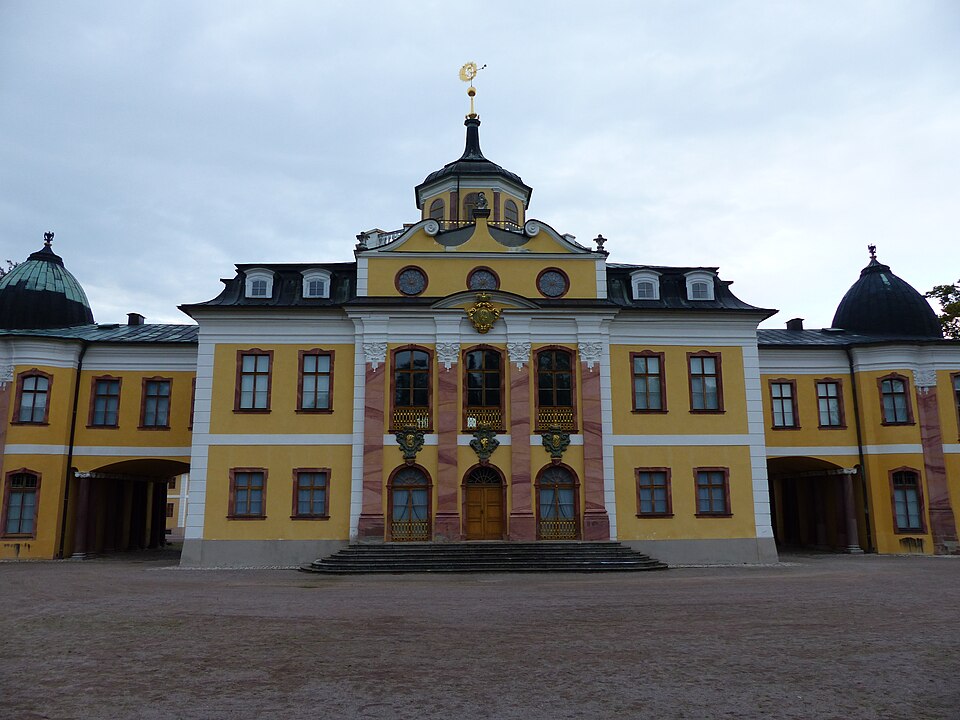
1724-1732 · Gottfried Heinrich Krohne and Johann August Richter
A low, symmetrical Baroque block with matching pavilions on either side stands in landscaped grounds that combine formal French parterres with informal English planting.
This Baroque pleasure house was built in 1724-1732 for Ernst August, Duke of Saxe-Weimar, as a venue for house-parties outside the town, its main block flanked by two symmetrical pavilions. Formal French-style gardens were laid out in 1728-1748, and much of the surrounding parkland was reworked as an English landscape garden after 1811. The palace now displays porcelain, faience, furniture and eighteenth-century paintings, and an Orangery wing holds a collection of historical carriages. It was added to the UNESCO World Heritage list in 1998 as part of the Classical Weimar site.
- A catalogue of its plant collection was published in 1820 as Hortus Belvedereanus.
- Grand Duke Carl Friedrich, for whom the gardens were remade in the English style after 1811, died at the palace in 1853.
Photo: Dr. Bernd Gross (CC BY-SA 3.0 de)
Goethe and Schiller Monument
A bronze double statue of Goethe and Schiller by Ernst Rietschel, unveiled in 1857 and cast substantially larger than life-size. Described as one of the most beloved monuments in Germany, it inspired dozens of later Goethe and Schiller monuments across Europe and the United States.
Haus am Horn
A house designed by Georg Muche and built for the 1923 Bauhaus exhibition in Weimar, the first building based on Bauhaus design principles. Inscribed in 1996 as part of the UNESCO World Heritage Site covering the Bauhaus sites in Weimar, Dessau, and Bernau.
Deutsches Nationaltheater und Staatskapelle
The most significant arts organisation in Weimar, uniting the German National Theatre with the Weimar State Orchestra. Together they perform across six stages throughout the city.
St. Peter und Paul
The most important church in Weimar, known as the Herderkirche after Johann Gottfried Herder and distinguished from the courtly Schlosskirche as the town church. It has served a Lutheran parish since 1525 and forms part of the Classical Weimar World Heritage Site, inscribed in 1998.
Schloss Ettersburg
A palace with an extensive park on the Ettersberg, near Weimar. Since 1998 it has formed part of the Classical Weimar World Heritage Site.
Jacobsfriedhof
The oldest surviving burial ground in Weimar, with burials dating to as early as the 12th century, on land once used to house pilgrims travelling to Santiago de Compostela. It was the city's only cemetery from 1530 to 1818, after which many graves were levelled.
Bauhaus Museum
A museum dedicated to the Bauhaus design movement, presenting the Weimar collections of the State Bauhaus, founded in the city in 1919. Originally opened in 1995, it has occupied a new building near the Weimarhallenpark since April 2019.
Park an der Ilm
A large landscaped park created in the 18th century under the influence of Johann Wolfgang von Goethe, preserved largely unchanged since. It forms part of the Classical Weimar World Heritage Site, recognising the city's role in the Weimar Classicism movement.
City Museum
The oldest museum in Thuringia, located on Karl-Liebknecht-Straße in central Weimar.
Monument to the March Dead
An expressionist monument in Weimar's Central Cemetery, designed in 1920 by Walter Gropius with Fred Forbát to memorialize workers killed in the Kapp Putsch. Built between 1920 and 1922, it was destroyed by the Nazis in 1936 and reconstructed in 1946.
Tiefurt House
A small stately home on the Ilm river, about four kilometres east of central Weimar, that served as the summer residence of Duchess Anna Amalia of Brunswick-Wolfenbüttel. It was inscribed on the UNESCO World Heritage List in 1998 as part of the Classical Weimar site.
Tempelherrenhaus
A venue in the Park an der Ilm that emerged in the 18th century. It was left in ruins after a bombing during the Second World War.
Nietzsche Archive
The first organisation dedicated to archiving the life and work of philosopher Friedrich Nietzsche, founded in 1894 in Naumburg before settling permanently in Weimar. Long led by his sister Elisabeth Förster-Nietzsche, it was criticized for altering documents to serve ideological ends.
History
Weimar's dukes held their city palace from the mid-sixteenth century. A Baroque range burned in 1774 and was replaced by the Neoclassical building that stands today, with rooms later dedicated to the poets Goethe, Herder, Schiller and Wieland. Duke Ernst August built a Baroque summer retreat at Belvedere in 1724-1732, its formal gardens later reworked in the English landscape style. The ducal library opened to the public in 1691, was renamed for Duchess Anna Amalia in 1991, and lost part of its collection to a fire in 2004, with restoration finished in 2015. A ducal art school founded in 1860 gained collegiate status in 1910, moved into Henry van de Velde's Art Nouveau building, and was renamed Bauhaus in 1919. Weimar's other twentieth-century turn came after the First World War, when Germany's first democratic constitution was signed here, giving the postwar republic its name.