Landmarks in Reykjavik
A small stone-and-wood capital under one soaring 20th-century church spire.
Reykjavik's older landmarks share a similar scale and setting. The Parliament House, a plain classical structure raised from hewn Icelandic dolerite between 1880 and 1881, stands at Austurvöllur square beside Reykjavík Cathedral, the parish church of the old city centre, completed in 1796 as the seat of the Bishop of Iceland. On Lækjargata, the stately Government House began in 1771 as the country's first penitentiary before its conversion into a seat of public administration. All three are modest, low buildings dating from when the settlement was still a small trading town. Hallgrímskirkja breaks that pattern: not finished until 1986, its curved Gothic Revival and expressionist spire rises 74.5 metres, making it the largest church and second-tallest building in the country, a single monumental structure rising over an otherwise low-built old town.
Hallgrimskirkja
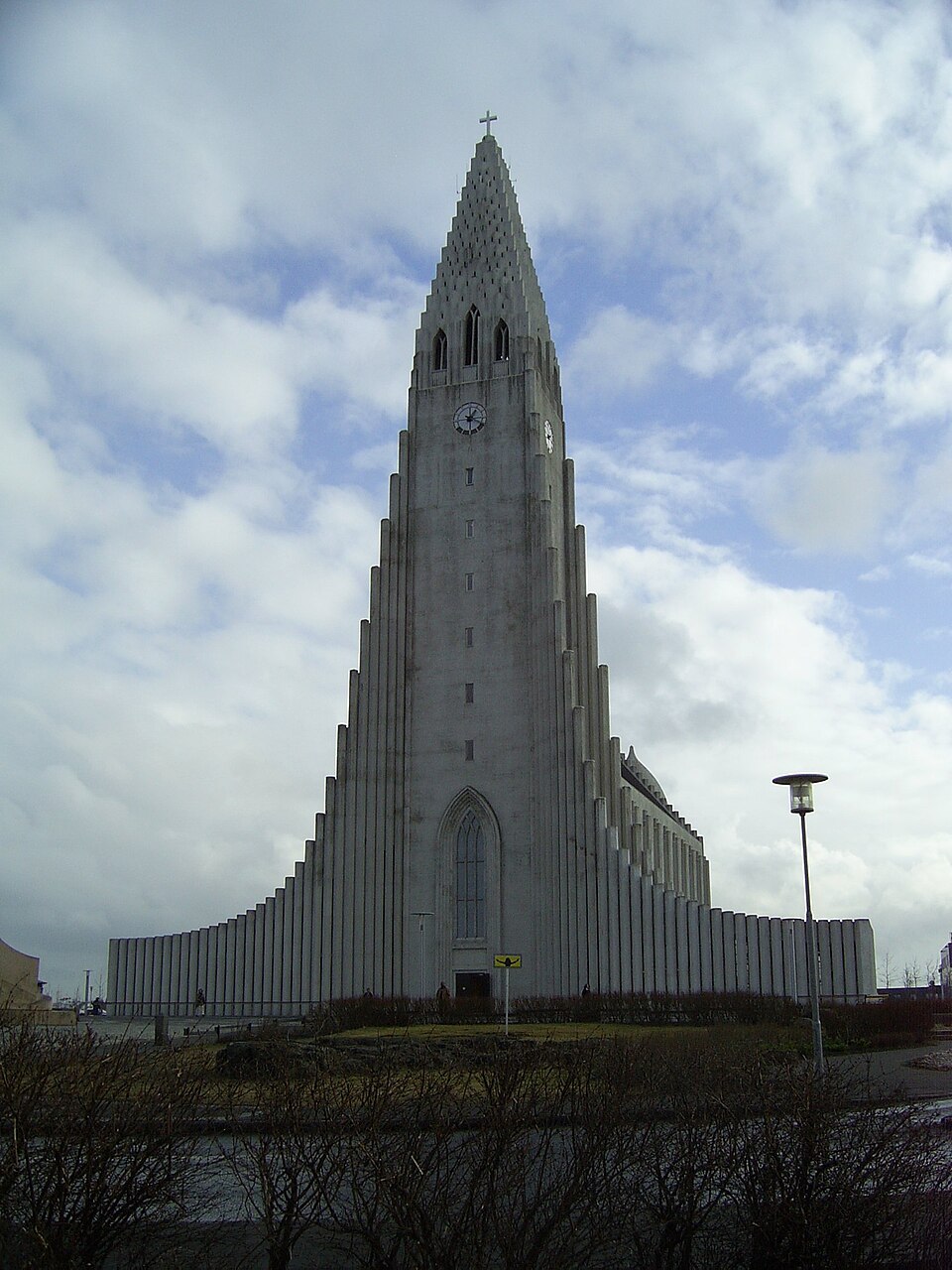
1986 · Guðjón Samúelsson
A curved spire flanked by stepped side wings gives it a silhouette unlike a conventional church; at 74.5 metres it is the country's largest church and its second-tallest building of any kind.
Hallgrímskirkja is a Lutheran parish church of the Church of Iceland, standing 74.5 metres tall — the largest church in the country and its second-tallest building overall. Its curved spire and stepped side wings were designed by Guðjón Samúelsson, who died in 1950, decades before the building was finished in 1986. It commemorates the poet and cleric Hallgrímur Pétursson (1614–1674), author of the Passion Hymns, after whom it is named.
- The architect who designed its curved spire, Guðjón Samúelsson, died in 1950, thirty-six years before the church was finished.
Photo: Photograph: Guðmundur D. Haraldsson. Building: Guðjón Samúelsson (CC BY-SA 3.0)
Reykjavik Cathedral
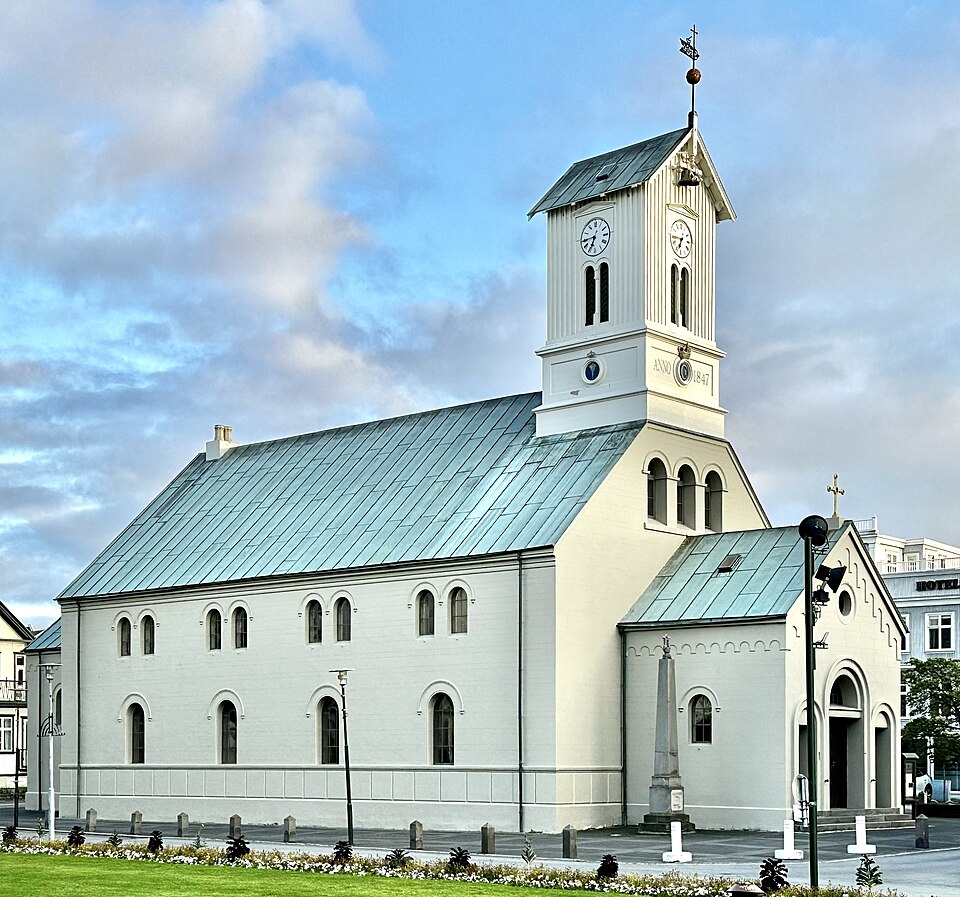
1796
A modest historicist-style building on the old city centre's main square, distinguished less by scale than by standing immediately beside the country's parliament house.
Reykjavík Cathedral is the seat of the Bishop of Iceland and mother church of the Evangelical Lutheran Church of Iceland, as well as the parish church of the old city centre. Built in the historicist style, it stands at Austurvöllur square immediately beside the parliament house and was completed in 1796. Since the Alþingi was resurrected in 1845, every parliamentary session has opened with a Mass here, after which the dean has led members of parliament next door to begin their business.
Photo: APK (CC BY-SA 4.0)
Parliament House
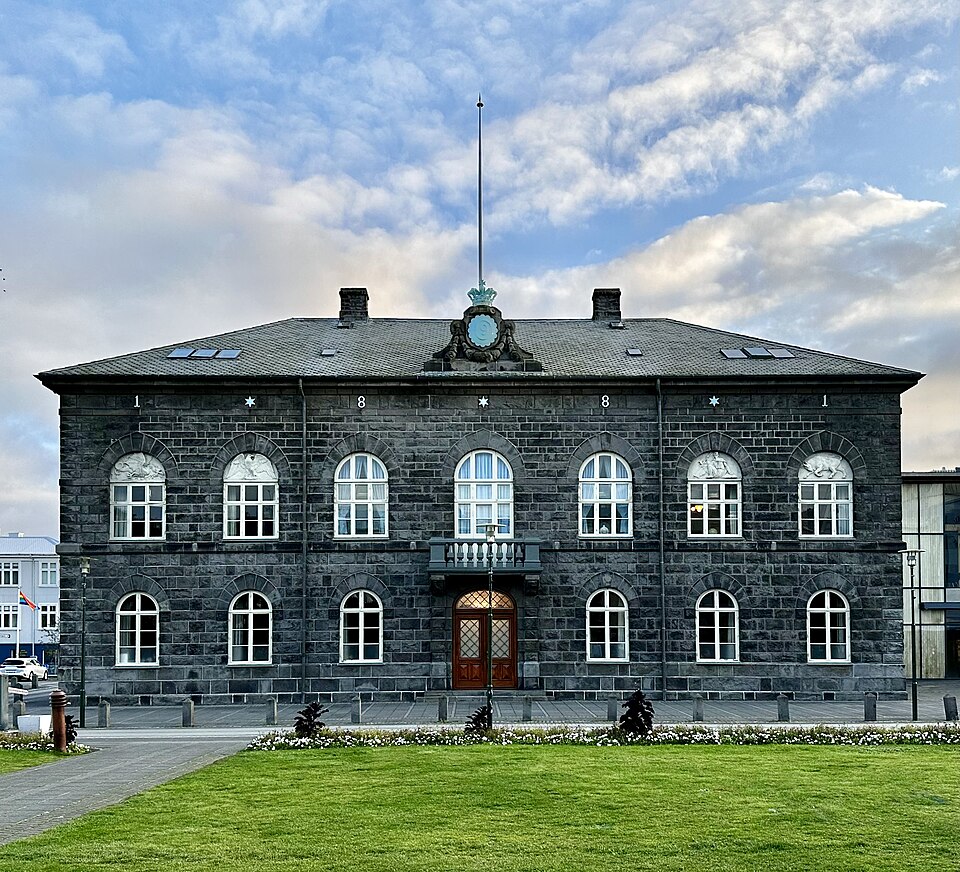
1880–1881 · Ferdinand Meldahl
Built from massive blocks of hewn dark dolerite in a plain classical style, its facade carries four tympanum reliefs above the first-floor windows depicting a dragon, a vulture, a giant and a bull.
Alþingishúsið, a classical structure built from hewn Icelandic dolerite, was designed by Ferdinand Meldahl and raised between 1880 and 1881 to house Alþingi, the Icelandic parliament. Reliefs above its first-floor windows depict four legendary guardian spirits of the land. Over the following century the building also served at various times as the national library, an antiquities collection, an art gallery and university lecture rooms, and the president kept offices there until 1973. Today only the debating chamber and a handful of offices remain in use, with a new annex planned nearby.
- The four window reliefs on the ground floor depict guardian spirits of the land, said in legend to have been calmed by Ingólfur Arnarson, Iceland's first settler, when he arrived.
- The building has also served over the years as the national library, an art gallery and early university lecture rooms, and the president kept offices there until 1973.
Photo: APK (CC BY-SA 4.0)
Government House
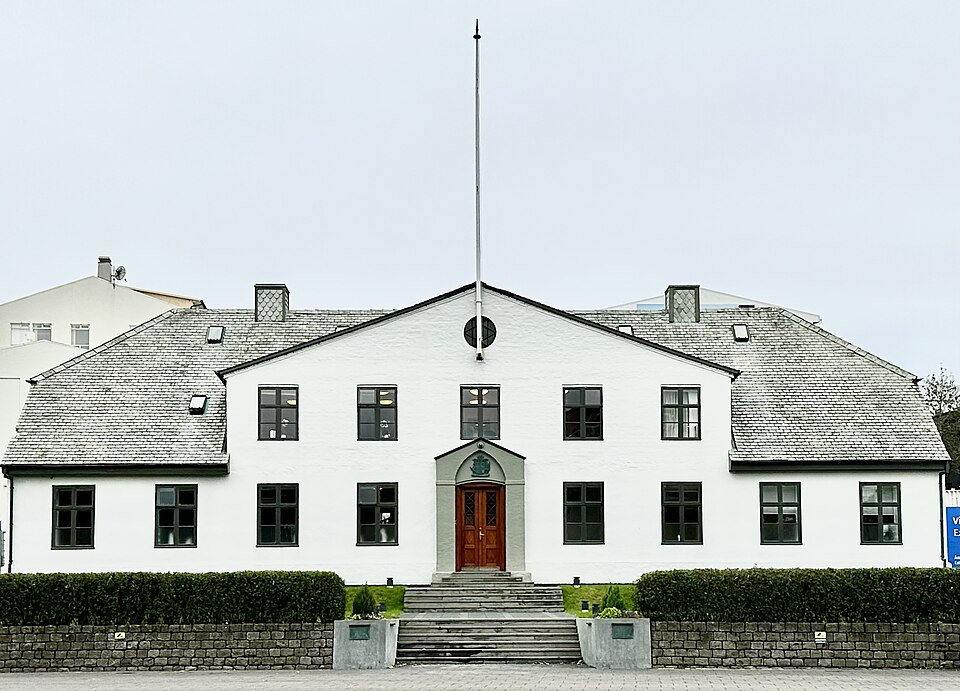
1771
A plain stately home on Lækjargata whose modest domestic appearance gives no outward sign of its past as a penitentiary or its present role as the seat of executive government.
Stjórnarráðshúsið is a stately home on Lækjargata in Reykjavík, built in 1771 as Iceland's first penitentiary. Its purpose changed entirely over time: from a place of confinement it became a seat of public administration, and today it houses the Prime Minister's Office. The building predates Reykjavik's formal charter as a trading town in 1786 by fifteen years, making it one of the oldest surviving structures from before the town's official founding.
Photo: APK (CC BY-SA 4.0)
Harpa
A concert hall and conference centre that held its opening concert on 4 May 2011. Its distinctive colored glass façade takes its design from Iceland's basalt landscape.
The Sun Voyager
A sculpture by Jón Gunnar Árnason beside the Sæbraut road, described as a dreamboat, or an ode to the sun. The artist meant it to convey the promise of undiscovered territory and a dream of hope, progress and freedom.
Perlan
A natural history museum atop Öskjuhlíð hill, opened to the public in June 1991 as a glass dome resting on six heating tanks. It houses a planetarium, a 100-metre ice cave built from around 400 tons of ice and snow, and a 360° observation deck.
Statue of Leif Erikson
A statue of Norse explorer Leif Erikson by American sculptor Alexander Stirling Calder, given by the United States to mark the Althing's 1,000th anniversary in 1930. It was unveiled on 17 July 1932 atop a hill overlooking the city.
Safnahúsið
An exhibition space built at Hverfisgata 15 to house the National Library, and once home to several other museums. Since 2013 it has been part of the National Museum of Iceland, displaying the Points of View exhibition drawn from national collections.
Imagine Peace Tower
A memorial to John Lennon from his widow Yoko Ono, installed in 2007 on Viðey Island in Kollafjörður Bay. It projects a tower of light from a white stone monument carved with the words "Imagine Peace" in 24 languages, referencing Lennon's 1971 song.
Höfði
A house built in 1909, best known as the site of the 1986 Reykjavík Summit between Ronald Reagan and Mikhail Gorbachev. Though the meeting technically failed, it was an important step toward ending the Cold War, and the two nations' flags are cross-hung inside.
Sundhöll Reykjavíkur
The oldest purpose-built indoor swimming pool in the city, designed by architect Guðjón Samúelsson and opened in 1937 after construction stalled during the Great Depression. Its minimalist, almost Art Deco exterior was among the first in the city to use geothermal water, piped from Laugardalur.
Christ the King Cathedral
A Catholic basilica in western Reykjavík and the cathedral of the Diocese of Reykjavík, the only Catholic cathedral in Iceland. Services are held in Icelandic, Polish and English.
National Museum of Iceland
A museum established on 24 February 1863, with Jón Árnason as first curator of the Icelandic collection. The collection had previously been kept in museums in Denmark.
Sky Lagoon
A geothermal spa at Kársnes Harbour in Kópavogur, southwestern Iceland.
Austurvöllur
A public square near the Parliament of Iceland, a popular gathering place and long a focal point for protests. It holds a statue of independence leader Jón Sigurðsson and is ringed by the Parliament House, Dómkirkjan, the city's oldest church, and the Hotel Borg.
Bessastaðir
The official residence of the president of Iceland, in Álftanes, about 15 kilometres from Reykjavík.
Fríkirkjan í Reykjavík
A Lutheran church independent of the established Church of Iceland, standing beside the lake Tjörnin in the city centre. Its congregation was founded in autumn 1899 with an initial 600 members, out of objections to the national church's organisation rather than doctrinal dispute.
Nordic House
A cultural institution opened in 1968, run by the Nordic Council of Ministers to foster ties between Iceland and the other Nordic countries. Its library, designed by Alvar Aalto, holds more than 30,000 items in seven Nordic languages, and hosts events including Iceland Airwaves.
Menntaskólinn í Reykjavík
A secondary school tracing its origins to a school founded in Skálholt in 1056, whose 1846 building in Reykjavík was once the country's largest. Pictured on the 500-krona bill, it is where independence leader Jón Sigurðsson led the cry "Vér mótmælum allir."
Laugardalshöll
A multi-purpose sports and exhibition venue in the Laugardalur district, opened on 4 December 1965 with a sports hall and an indoor athletics arena. It hosts handball, basketball, volleyball and athletics, seating up to 2,300 for sports and around 5,500 with standing room for concerts.
ICGV Óðinn
A decommissioned Icelandic Coast Guard patrol vessel and the oldest ship in the fleet, its Burmeister & Wain engines believed to be the last still serviceable worldwide. Since retiring from active duty, it has served as a museum ship at Reykjavík Harbour.
Árbæjarsafn
The historical museum of the city of Reykjavík, also serving as an open-air and regional museum. Its purpose is to show the public how Reykjavík's people once lived, worked and spent their leisure time.
National Gallery of Iceland
An art museum in Reykjavík holding a collection of Icelandic art. Its collection features work by well-known Icelandic artists and reflects the country's traditional culture.
Kópavogur Church
A modernist church on Borgarholt hill in Kópavogur, built from 1958 and opened on 16 December 1963, designed by Hörður Bjarnason and Ragnar Emilsson. Its unusual profile, a cross-section of two wide arches with smaller arches beneath, appears on the town seal.
Kolaportið
Iceland's only flea market, held since 1994 in the old Customs House near the harbour, having opened in a parking garage in 1989. In 2024 the city moved the University of the Arts into that building, extending the market's stay to at least March 2025.
Botanic Garden
A botanical garden in the Laugardalur district, established on 18 August 1961 to mark the city's 175th anniversary. It conserves more than 5,000 plant species across eight collections and offers guided tours and education programs for schools.
History
According to Landnámabók, Ingólfur Arnarson settled here in 874, but no town grew from that landing for nine hundred years: Reykjavik was chartered only in 1786 as a trading post. Its oldest surviving landmark predates even that charter — the building later known as Government House went up in 1771 as Iceland's first penitentiary, before being converted to house executive administration. Reykjavík Cathedral followed in 1796, serving the young town's parish and later, after the Alþingi was revived in 1845, opening each session of parliament with a Mass. The parliament itself did not get a permanent home until 1880–1881, when hewn dolerite formed the classical Alþingishúsið beside the cathedral. Over a century later, Hallgrímskirkja added an entirely different kind of landmark: a soaring church spire, finished in 1986, that has since stood as a symbol of national identity.