Landmarks in Dublin
A river-split capital where a Norman castle and Georgian civic stone shape the skyline.
Dublin's landmarks cluster close to the River Liffey, which splits the city and shaped most of its early growth. A medieval castle occupies the high ground where a tributary once met the river in a dark tidal pool, giving the city its name, and a Gothic cathedral from the same century stands nearby. Almost everything else belongs to the Georgian era, when the city expanded fast and briefly ranked among Europe's largest: stone civic buildings in the neoclassical and Greek Revival styles, raised as a customs house and a post office, line the quays and main thoroughfare. One cast-iron footbridge, its ironwork shipped over from an English foundry, stands out among all that stone.
Dublin Castle
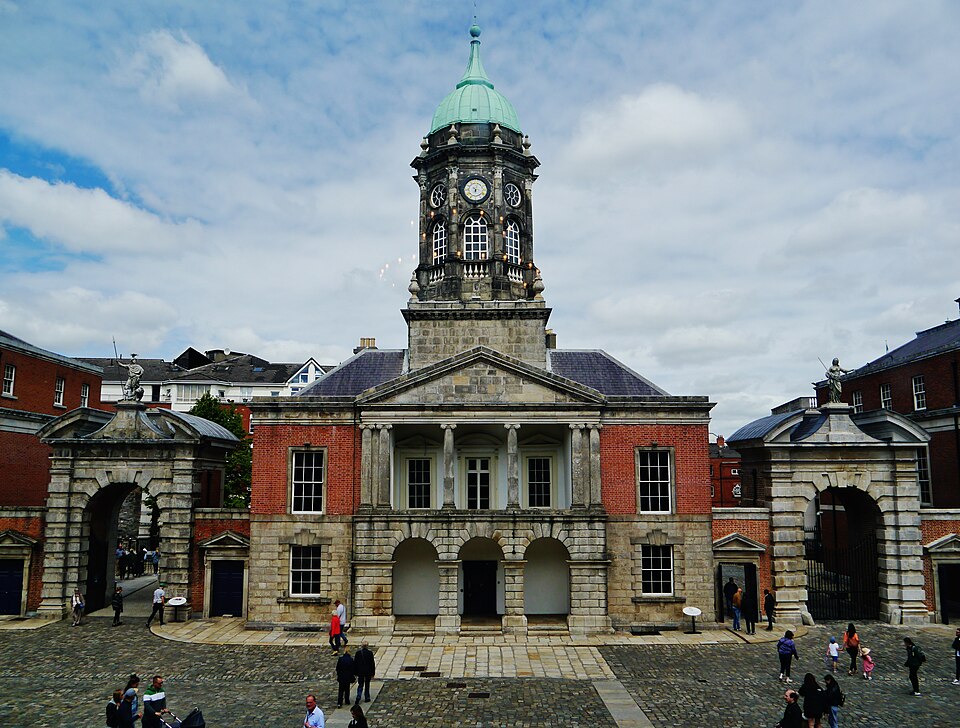
1204–18th century
Pale-stone Georgian courtyard buildings occupy the raised ground where a tributary once met the main river; almost no medieval fabric shows above ground, since the visible structure is nearly all 18th-century remodelling over the original fortress.
Originally a motte-and-bailey fortress on the highest ground in the city, this castle was largely rebuilt from the late 17th century into a Georgian palace, though a stronghold has stood on the site since the days of King John. For more than seven centuries it served as the seat of English, then British, government in Ireland. After the Anglo-Irish Treaty of December 1921, it was ceremonially handed to the incoming Provisional Government led by Michael Collins. It now hosts presidential inaugurations and state receptions, and gave Dublin its name, from the dark pool once beside it.
- The city of Dublin takes its name from the dark pool, Dubh Linn, that once lay beside the castle where the River Poddle met the Liffey.
- Its ceremonial handover to the Provisional Government in 1921 followed the Anglo-Irish Treaty, ending its role as the seat of British administration.
- It still hosts the inauguration of every president, centuries after it stopped being an administrative headquarters.
Photo: Zairon (CC BY 4.0)
Ha'penny Bridge
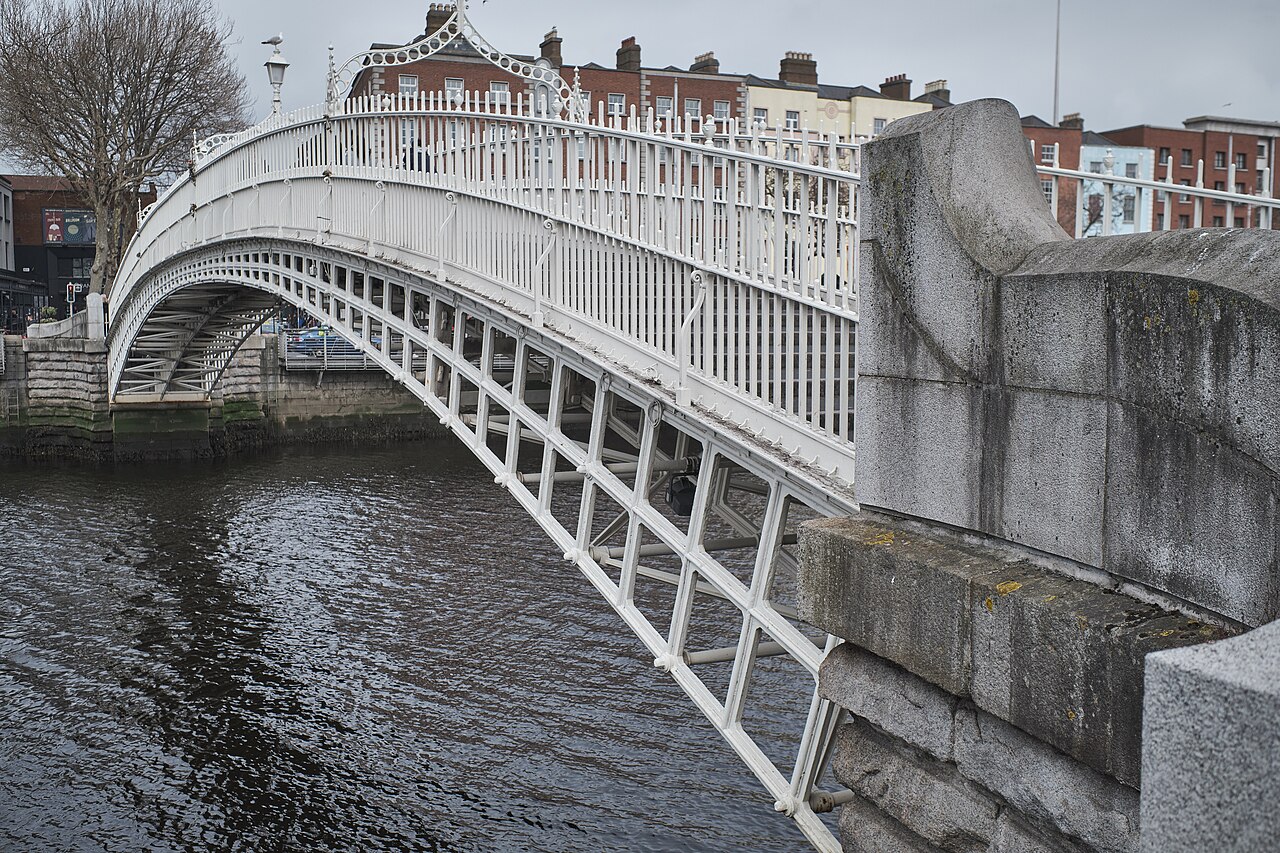
May 1816
A slender footbridge built entirely of cast iron rather than the stone used nearby, its components forged in an English foundry and shipped across for assembly on site — one of the few structures of its date and place made of imported ironwork.
Officially the Liffey Bridge, this is a cast-iron pedestrian crossing built in May 1816 over the river that divides the city. Its ironwork was cast in Shropshire, England, then shipped across for assembly on site, an unusual origin for a structure of its date. It became known as the Ha'penny Bridge, and for a time by the fuller Penny Ha'penny Bridge; both nicknames persisted alongside the official name, and it still carries foot traffic only.
- Its ironwork was cast whole in Shropshire, England, then shipped across the sea for assembly on site.
- It was known for a time by the fuller name Penny Ha'penny Bridge before the shorter nickname took over.
- Its official name, the Liffey Bridge, is rarely used despite being the one on record.
Photo: Luca Sartoni from Vienna, Austria (CC BY-SA 2.0)
The Custom House
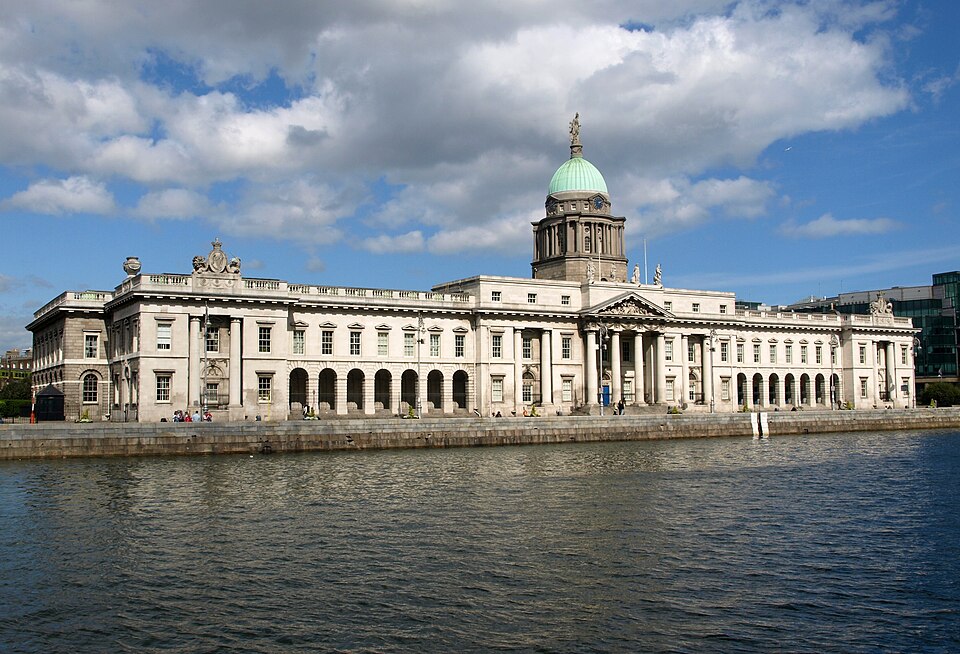
1791 · James Gandon
A long Palladian stone facade runs directly along the river's north quay between two bridges, its proportion and symmetry characteristic of the style its architect, James Gandon, worked in.
Completed in 1791 to a design by James Gandon, this is an 18th-century neoclassical building in the Palladian style, standing on the river's north bank between Butt Bridge and Talbot Memorial Bridge. It now houses the government department responsible for housing, local government and heritage, a function unrelated to the customs duties it was raised to administer. Gandon, its architect, lived until 1823, more than three decades after the building's completion.
- It now houses the government department responsible for heritage, a reversal of its original purpose of administering customs duties.
Photo: Elemaki (CC BY 3.0)
General Post Office
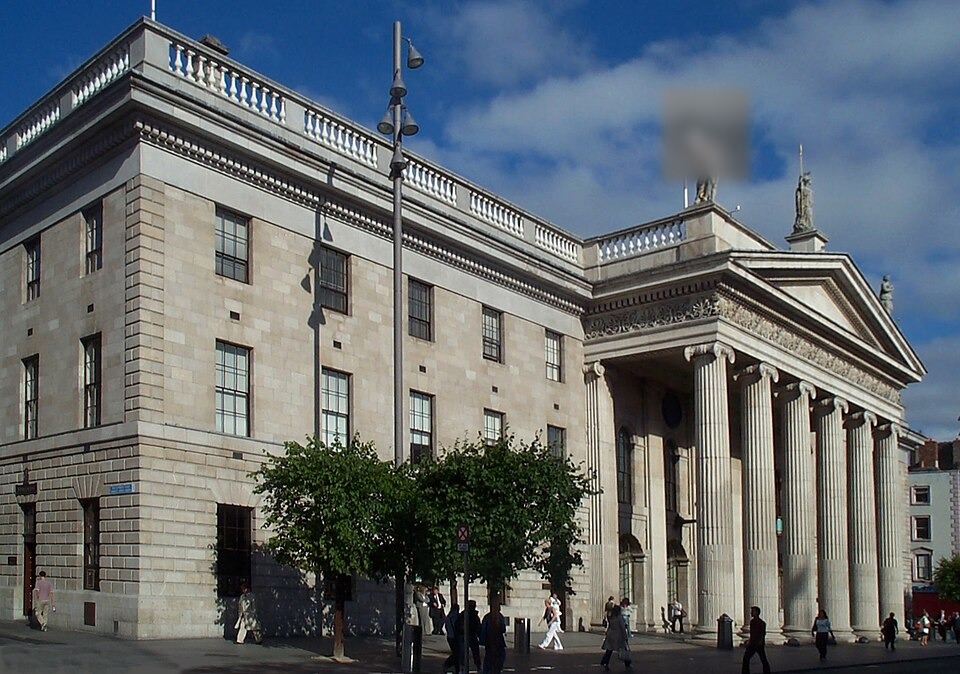
1818 · Francis Johnston
A Greek Revival stone facade sits at the centre of the city's main thoroughfare, the last large Georgian-era public building added to that streetscape before the style fell out of use.
Completed in 1818 to a design by Francis Johnston, this building remains the registered office and principal post office of An Post, the Irish postal service, standing at the centre of O'Connell Street, the city's main thoroughfare. It was the last great Georgian public building erected in the capital, built in the Greek Revival and Georgian styles. Its wider fame rests less on its postal function than on its role as the headquarters of the leaders of the Easter Rising against British rule in 1916.
- It was the last great Georgian public building erected in the capital.
- It served as the headquarters of the leaders of the Easter Rising in 1916, the event it is now best known for.
Photo: Copyright © 2006 Kaihsu Tai (CC BY-SA 3.0)
St. Patrick's Cathedral
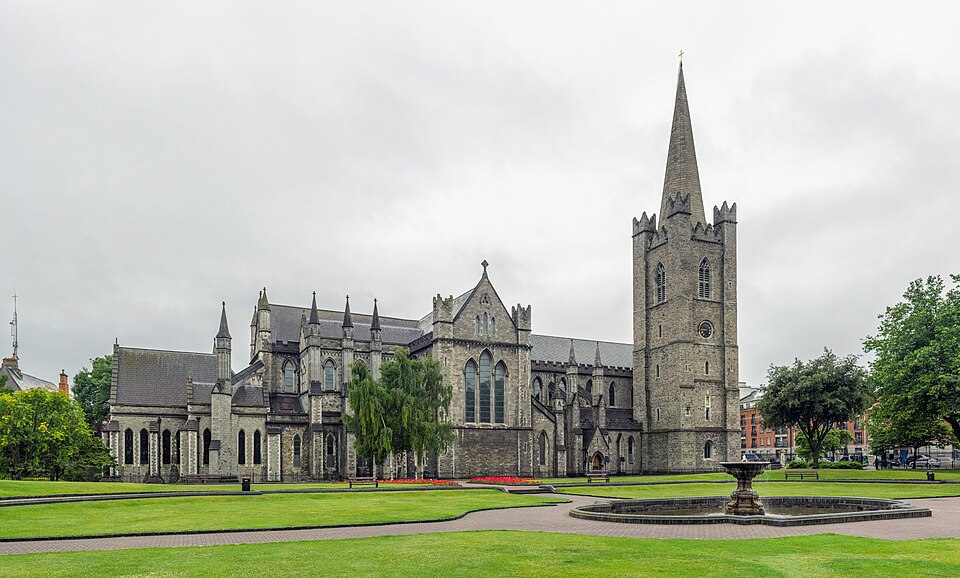
1191
A Gothic stone cathedral built in the pointed-arch style of its period, distinguished chiefly by the unusual arrangement it shares with Christ Church Cathedral nearby: one holds national status, the other the local diocesan one.
Built in 1191 and today the national cathedral of the Church of Ireland, this building shares its city with Christ Church Cathedral, which serves instead as the local cathedral of the Diocese of Dublin and Glendalough, an unusual arrangement of two cathedrals from the same denomination within one city. Its Gothic architecture dates it to the century in which the city's Anglo-Norman-era growth began. No architect is recorded for the medieval structure.
- Dublin has two cathedrals of the same denomination: this one holds national status while Christ Church Cathedral serves as the local, diocesan one.
Photo: Diliff (CC BY-SA 3.0)
Christ Church Cathedral
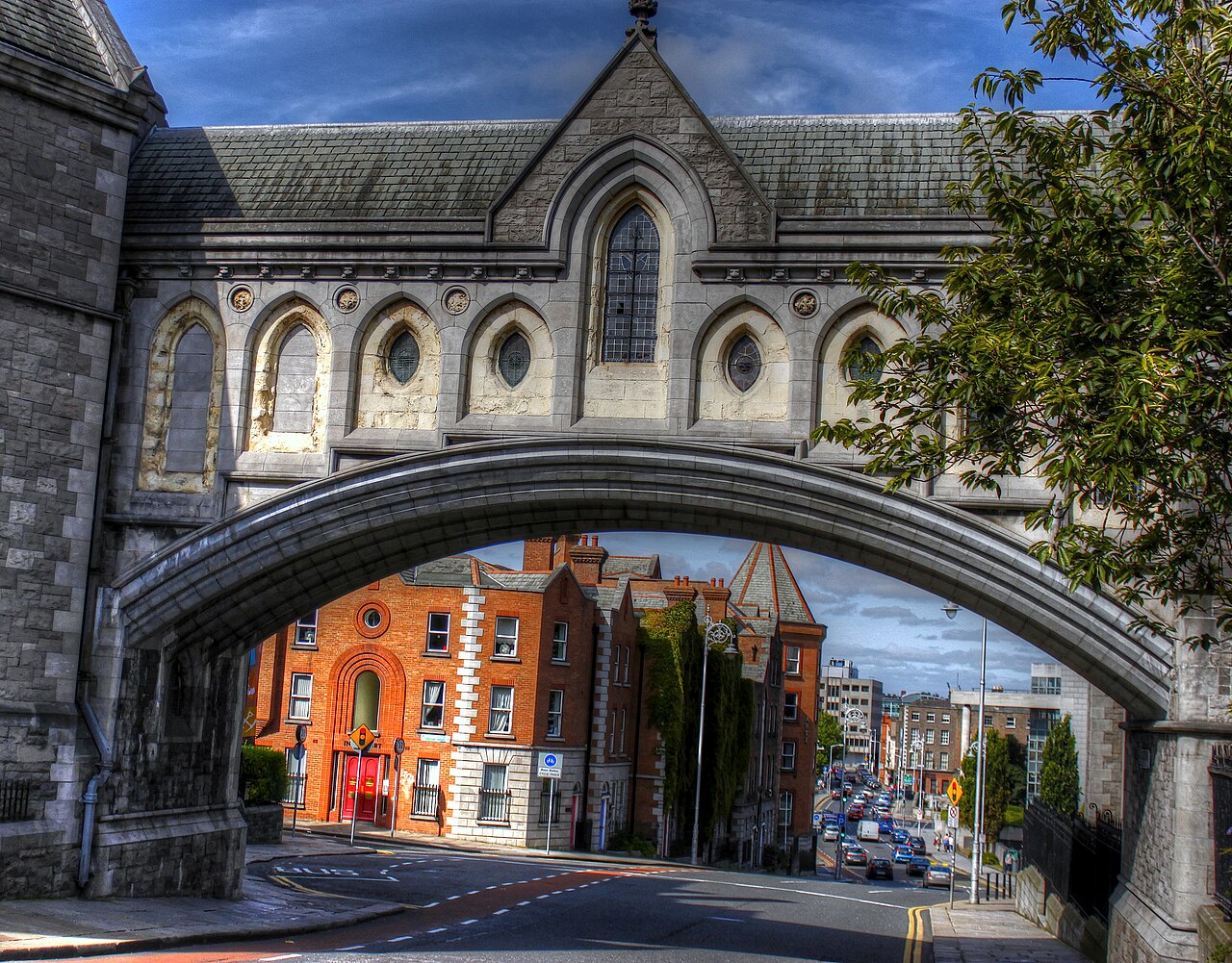
1031–19th century
A Gothic stone cathedral with a squared tower and flying buttresses, joined to a neighbouring building by a distinctive covered footbridge; it stands isolated behind modern civic offices along a riverside quay, cut off from the older street pattern that once surrounded it.
Founded in the early 11th century under the Viking king Sitric Silkenbeard, this cathedral was rebuilt in stone during the 1180s with funding from the Norman lord Strongbow, who financed a new choir, transepts and crypt. Building continued into the 13th century using stone brought from Somerset, and much of the nave dates from the 1230s. A partial collapse in the 16th century left it in poor condition, and extensive rebuilding in the late 19th century gave the cathedral the tower, flying buttresses and covered footbridge it has today.
- Henry II attended a Christmas service here in 1171, reportedly his first Holy Communion since his knights murdered Thomas Becket the previous year.
- In 1487 it was the site of the purported coronation of Lambert Simnel, a boy pretender crowned here as "King Edward VI" in a failed bid to depose Henry VII.
- Road-building and the demolition of the old residential quarter at Wood Quay left the cathedral standing in isolation, detached from the medieval streets that once surrounded it.
Photo: psyberartist (CC BY 2.0)
Parliament House
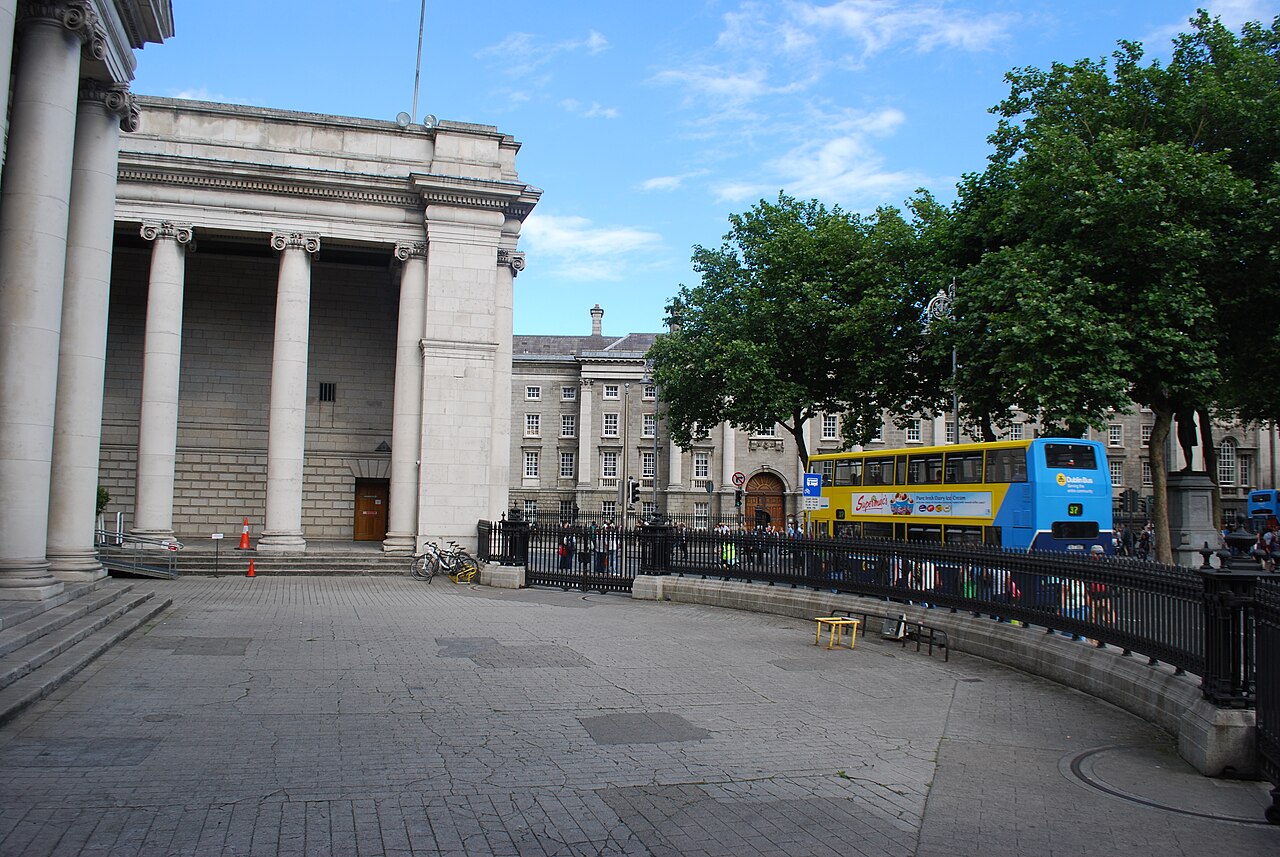
1729–1739 · Edward Lovett Pearce
A curved, colonnaded stone facade of Ionic columns wraps around an entrance plaza in a shape close to the letter E; three statues stand above the portico, and granite has been carved into fine decorative detail despite being an unusually hard stone to work. A second entrance with Corinthian columns was added later on the building's east side.
Built on the site of Chichester House, a mansion used as a temporary home for Parliament in the 1670s, this replaced it as a purpose-built seat for the two-chamber Parliament of the Kingdom of Ireland. Designed by Edward Lovett Pearce, its foundation stone was laid in 1729; Pearce died before completion in 1733, and Arthur Dobbs oversaw the finished building. It served both Houses until Parliament was abolished in 1800. Bank of Ireland has owned it since 1803, using it as its head office until the 1970s; James Gandon later added a columned entrance for the House of Lords.
- It was the world's first purpose-built bicameral parliament building, designed from the outset to hold two separate legislative chambers.
- Its decorative carving was cut from granite, a stone noted as unusually difficult to carve so finely.
- The dome over the House of Commons chamber collapsed after a fire in 1792.
Photo: Jean Housen (CC BY-SA 3.0)
The Spire
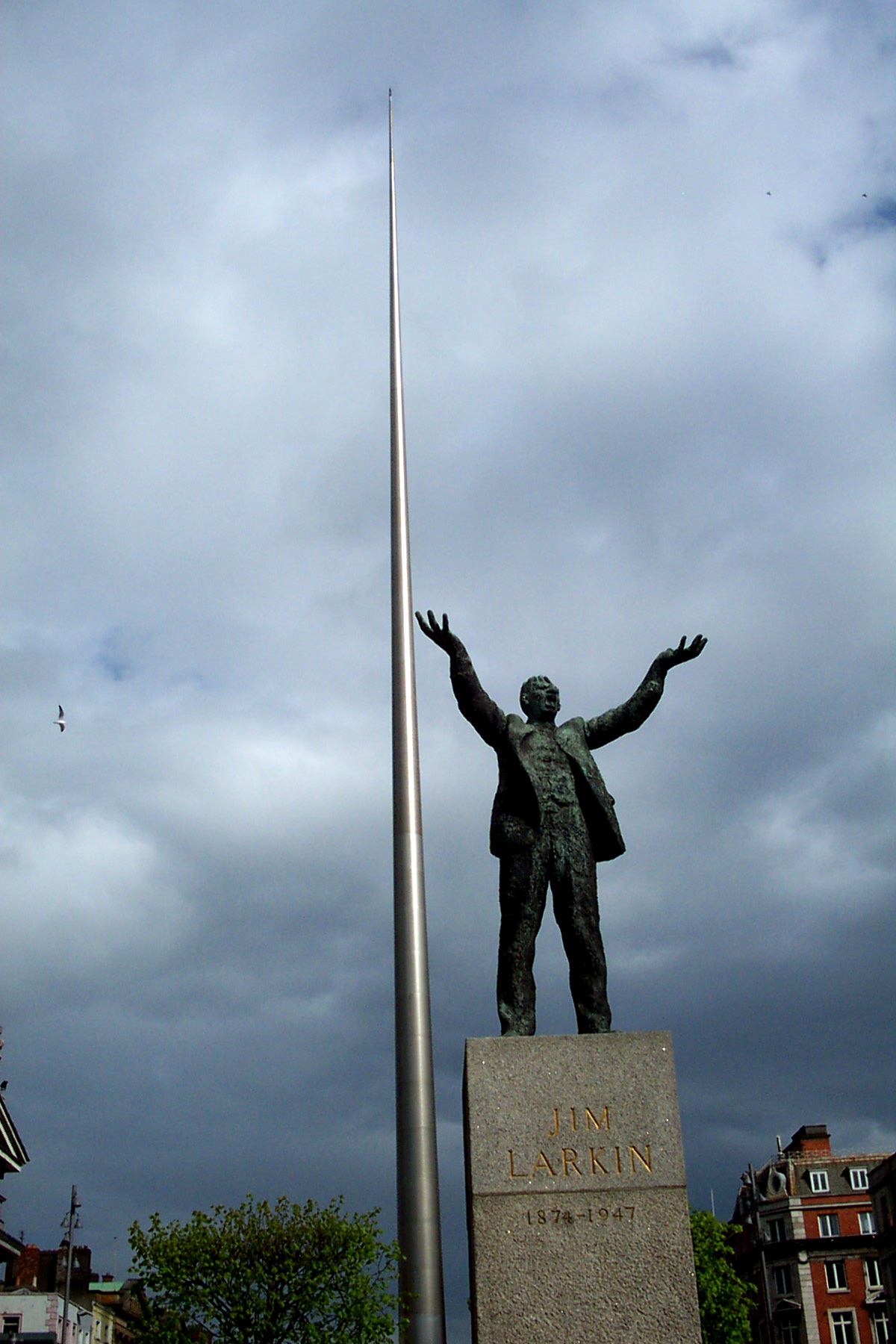
2002–2003 · Ian Ritchie
An elongated, tapering steel cone rises from a three-metre base to a point only fifteen centimetres wide, its lower section bead-blasted in a pattern combining a rock-core sample with a DNA double helix; after dark, light shines outward through thousands of small holes near its base.
Standing 120 metres tall on the site of Nelson's Pillar, destroyed by a bomb in 1966, this stainless-steel monument was designed by Ian Ritchie following an international competition launched in 1998 as part of a wider redevelopment of the street around it. Legal challenges delayed construction past the millennium it was meant to mark; the first of its eight hollow steel sections was installed in December 2002 and the last in January 2003. Weighing over 133 tonnes, it tapers from three metres wide at its base to fifteen centimetres at its tip, and carries two internal dampers to counter sway.
- In September 2025 a Palestinian flag appeared attached near its top, apparently dropped by a drone; with nobody claiming responsibility, it remained in place through mid-2026 because of the cost and difficulty of removing it.
- In 2015 a giant lightsaber hilt was fitted to its base for the Irish premiere of a Star Wars film, lighting the monument blue at night.
- In 2024 a live video link called The Portal connected it to a broadcast point at the Flatiron Building in New York City.
Photo: CGP Grey (CC BY 2.0)
Four Courts
Ireland's most prominent courts building, on Inns Quay, seat of the Supreme Court, Court of Appeal, High Court and Dublin Circuit Court. Until 2010 it also housed the Central Criminal Court, which has since moved to the Criminal Courts of Justice building.
St Stephen's Green
A garden square and public park in the city centre, landscaped by William Sheppard and reopened to the public on 27 July 1880. At 22 acres, it is the largest of Dublin's Georgian garden squares, along with nearby Merrion Square and Fitzwilliam Square.
College Green
A three-sided plaza flanked by the Bank of Ireland building, formerly Ireland's Parliament House, and by Trinity College Dublin to the east. It has hosted major political rallies, including addresses by U.S. Presidents Bill Clinton in the 1990s and Barack Obama in 2011.
Merrion Square
A Georgian garden square on the southside of the city centre.
Leinster House
The seat of the Oireachtas, the parliament of Ireland, originally built as the ducal palace of the Dukes of Leinster. Since 1922 it has grown into a complex of buildings, though the former ducal palace at its core remains the most recognisable, public-facing part.
City Hall
Originally the Royal Exchange, a civic building built between 1769 and 1779 to designs by architect Thomas Cooley. Once used by the city's merchants, it is today the formal seat of Dublin City Council and a notable example of 18th-century architecture.
National Museum of Ireland – Archaeology
A branch of the National Museum of Ireland on Kildare Street, specialising in antiquities from the Stone Age to the Middle Ages. Established under an 1877 act and built by father-and-son architects Thomas Newenham and Thomas Manly Deane, its rotunda mirrors the neighboring National Library's.
National Gallery of Ireland
The national collection of Irish and European art, in the city centre with entrances on Merrion Square and Clare Street. Founded in 1854 and opened a decade later, it is known for its Irish paintings as well as its Italian Baroque and Dutch masters.
Shelbourne Hotel
A historic hotel on the north side of St Stephen's Green. It is owned by Archer Hotel Capital and operated by Marriott International under its Autograph Collection brand.
O'Connell Monument
A 40-foot granite and bronze monument on O'Connell Street honouring Daniel O'Connell, unveiled on 15 August 1882. Four winged victories sit at its base under a bronze frieze of over 30 figures, topped by a cloaked O'Connell about 2.5 times life-size.
St Mary's Cathedral
Formerly known as St Mary's Pro-Cathedral, it is the episcopal seat of the Catholic Archbishop of Dublin and Primate of Ireland.
Trinity College Library
The main library of Trinity College, with legal-deposit rights entitling it to a free copy of every book published in the country. Its 18th-century Old Library and Long Room hold the 8th-century Book of Kells, arrived 1661, and the Brian Boru harp, a national symbol.
Hugh Lane Gallery
An art museum operated by Dublin City Council, housed in Charlemont House on Parnell Square, built in 1763. Originally the Municipal Gallery of Modern Art, it offers free admission and closed in September 2025 for major refurbishment.
Marsh's Library
A well-preserved library of the late Renaissance and early Enlightenment, next to St Patrick's Cathedral, built to the order of Archbishop Narcissus Marsh. It opened to the public in 1707, Ireland's first public library, and holds over 25,000 books and 300 manuscripts.
Abbey Theatre
Ireland's National Theatre, opened on 27 December 1904 and rebuilt after a 1951 fire destroyed its original building. The first state-subsidised theatre in the English-speaking world from 1925, it has stood on Lower Abbey Street since July 1966.
Gaiety Theatre
A theatre on South King Street, off Grafton Street and close to St Stephen's Green. It specialises in operatic and musical productions, with occasional dramatic shows.
Olympia Theatre
A concert hall and theatre venue on Dame Street, branded since 2021 as the 3Olympia Theatre under a naming-sponsorship deal. It has hosted international acts including Charlie Chaplin, Laurel and Hardy, David Bowie and Radiohead, and a branch of the River Poddle flows beneath it.
St. Michan's Church
A Church of Ireland church whose first chapel on the site dated from 1095; the current building dates from 1686. Known for vaults with mummified remains, it lost five mummies, including the 800-year-old 'Crusader,' to a fire set in the crypt in 2024.
Tailors' Hall
The oldest of two surviving guildhalls in the city, on Back Lane in the Liberties, once used as a court-house, barracks and school. It hosted the United Irishmen and the Back Lane Parliament, and now houses heritage charity An Taisce after a 1966–1971 restoration.
Liberty Hall
Headquarters of the Services, Industrial, Professional and Technical Union, designed by Desmond Rea O'Kelly, completed in 1965. At 59.4 metres it was Ireland's tallest building, and had earlier served as headquarters of the Irish Transport and General Workers' Union and the Irish Citizen Army.
The Brazen Head
A pub in Merchant's Quay built as a coaching inn in 1754, on a site with a merchant's dwelling dating back to at least 1613. It received a licence to sell ale in 1661, and was first mentioned as an inn in 1668.
History
A settlement here predates the 7th century, founded by Gaels and then taken over by Vikings, who built the trading town that became Ireland's principal settlement by the 12th century, after the Anglo-Norman invasion. A castle raised in 1204 at the meeting of two rivers became the seat of English, then British, administration for more than seven centuries, rebuilt as a Georgian palace from the late 1600s onward. St Patrick's Cathedral had already stood since 1191. The city grew fast from the 17th century, briefly the second-largest in the British Empire after the Acts of Union in 1800, and its grandest Georgian public buildings, a customs house and a post office, were raised either side of that date. The post office became the headquarters of an armed uprising against British rule in 1916, six years before independence in 1922.