Landmarks in Riga
A Hanseatic port whose old town pairs Brick Gothic churches with Art Nouveau architecture.
Riga's marked buildings sit close to where the Daugava reaches the Gulf of Riga, on the flat, sandy site the city has occupied since its founding in 1201 as a Hanseatic League port. The oldest survivors are Brick Gothic churches begun in the following century. A riverside castle nearby shows a different pattern: founded in 1330 but almost entirely rebuilt by 1515, extended with Swedish annexes in 1641, and reconstructed again through the 19th century, so it now reads as layers rather than one design. Two later additions mark separate periods: a granite, travertine and copper column raised in 1935 to mark independence, and a Neo-Byzantine cathedral built in the 1870s and 1880s under Russian imperial rule.
Riga Cathedral
1211
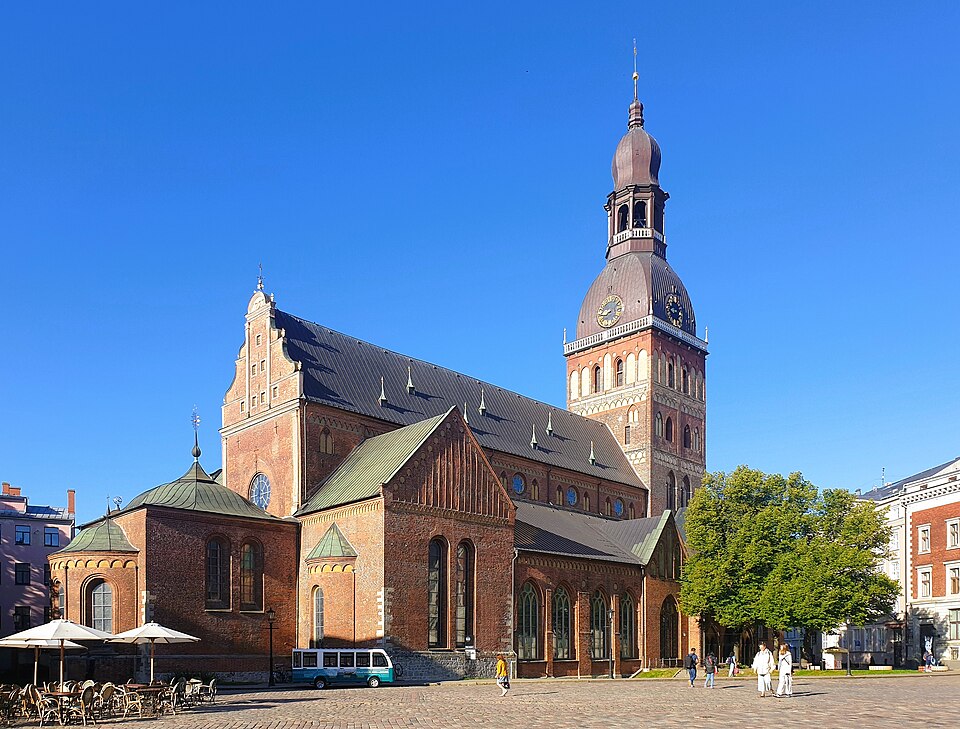
Built in Brick Gothic style, the cathedral carries a weathercock at its top, a feature it shares with the city's other old churches. It is closely tied to the city's image through repeated appearances in paintings, photographs and television footage rather than through any single unusual feature.
Riga Cathedral, formally the Cathedral Church of Saint Mary, is the Evangelical Lutheran cathedral of Riga and the seat of the Archbishop of Riga. Built from 1211 in Brick Gothic style, it is commonly called the Dome Cathedral, a pleonasm since the German word Dom already means cathedral. It ranks among the most recognisable religious buildings in Latvia, appearing repeatedly in paintings, photographs and television travelogues of the city.
- Its everyday nickname, Dome Cathedral, repeats itself: the German word Dom already means cathedral.
Photo: Chris06 (CC BY-SA 4.0)
St. Peter's Church
1209
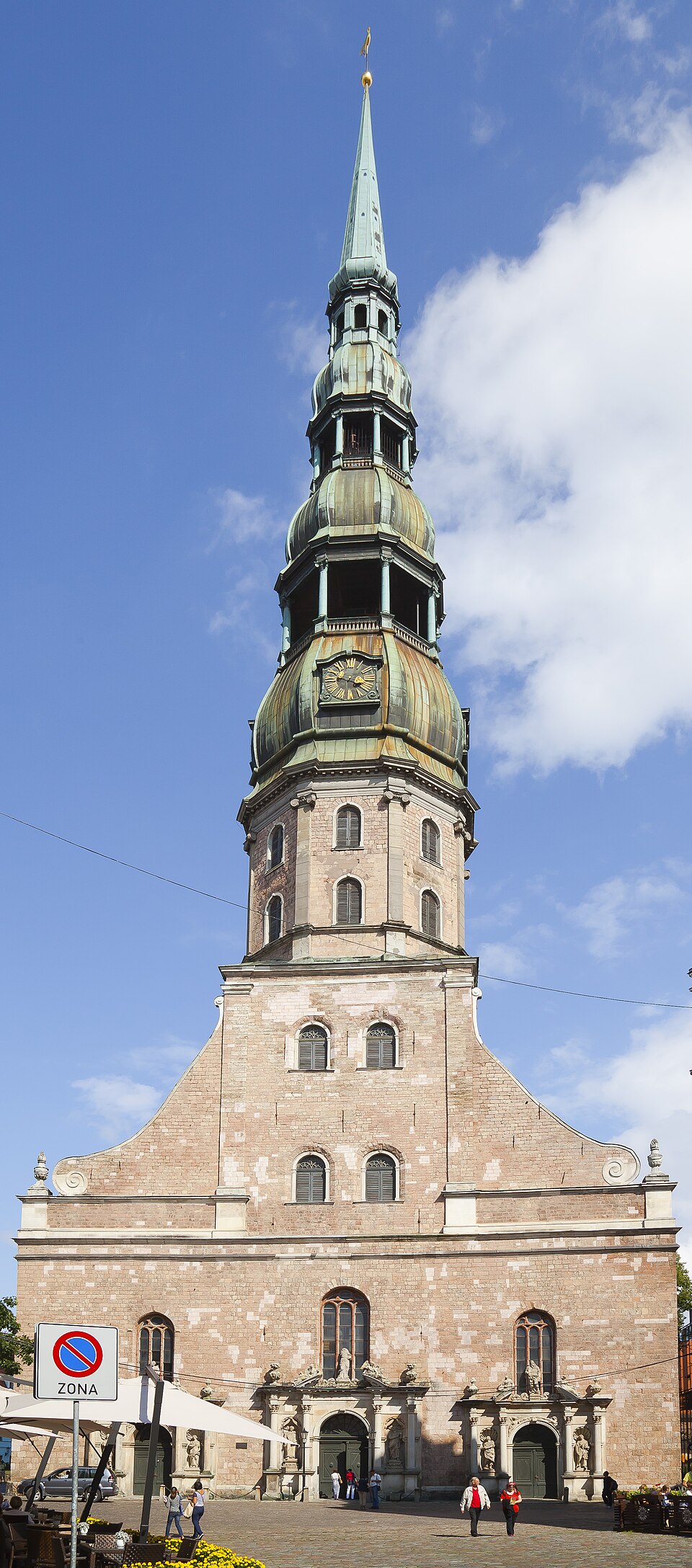
The fabric shows an original Brick Gothic and Gothic build with Baroque elements added in a later phase, a layering of period styles rather than a single defining shape, reflected in its listing as a national architectural monument of Latvia.
St. Peter's Church is a Lutheran parish church dedicated to the apostle Peter, serving the Evangelical Lutheran Church of Latvia. Its construction combines Brick Gothic and Gothic work with later Baroque additions, evidence of building across more than one period. The church holds status as a national architectural monument of Latvia.
Photo: Diego Delso (CC BY-SA 3.0)
Riga Castle
1330–1515
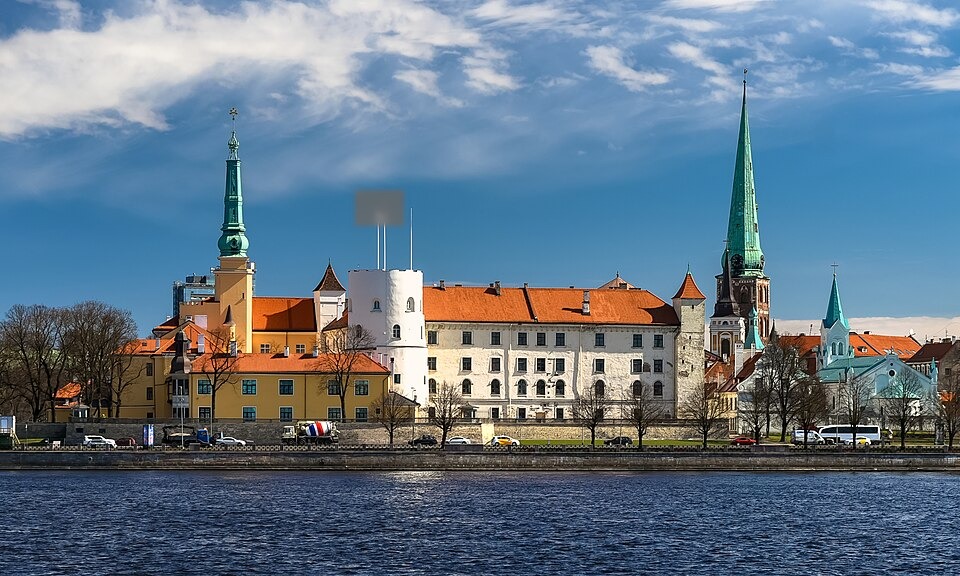
Its riverbank walls carry visible layers from centuries of rebuilding: Swedish annexes added in 1641 sit alongside 17th- to 19th-century reconstruction and a 1930s renovation, so the fortress reads as a patchwork of periods rather than one design.
Riga Castle stands on the bank of the River Daugava, founded in 1330 and thoroughly rebuilt between 1497 and 1515. After seizing it, Swedish forces added spacious annexes in 1641, and the fortress was reconstructed repeatedly through the 17th to 19th centuries. Architect Eižens Laube carried out further renovation in the 1930s, after which the Latvian government declared it its official residence in 1938. It now houses the presidency alongside several museums.
- It became Latvia's presidential residence only in 1938, roughly six centuries after it was founded.
Photo: Jorge Franganillo (CC BY 2.0)
Freedom Monument
1935 · Ernests Štālbergs
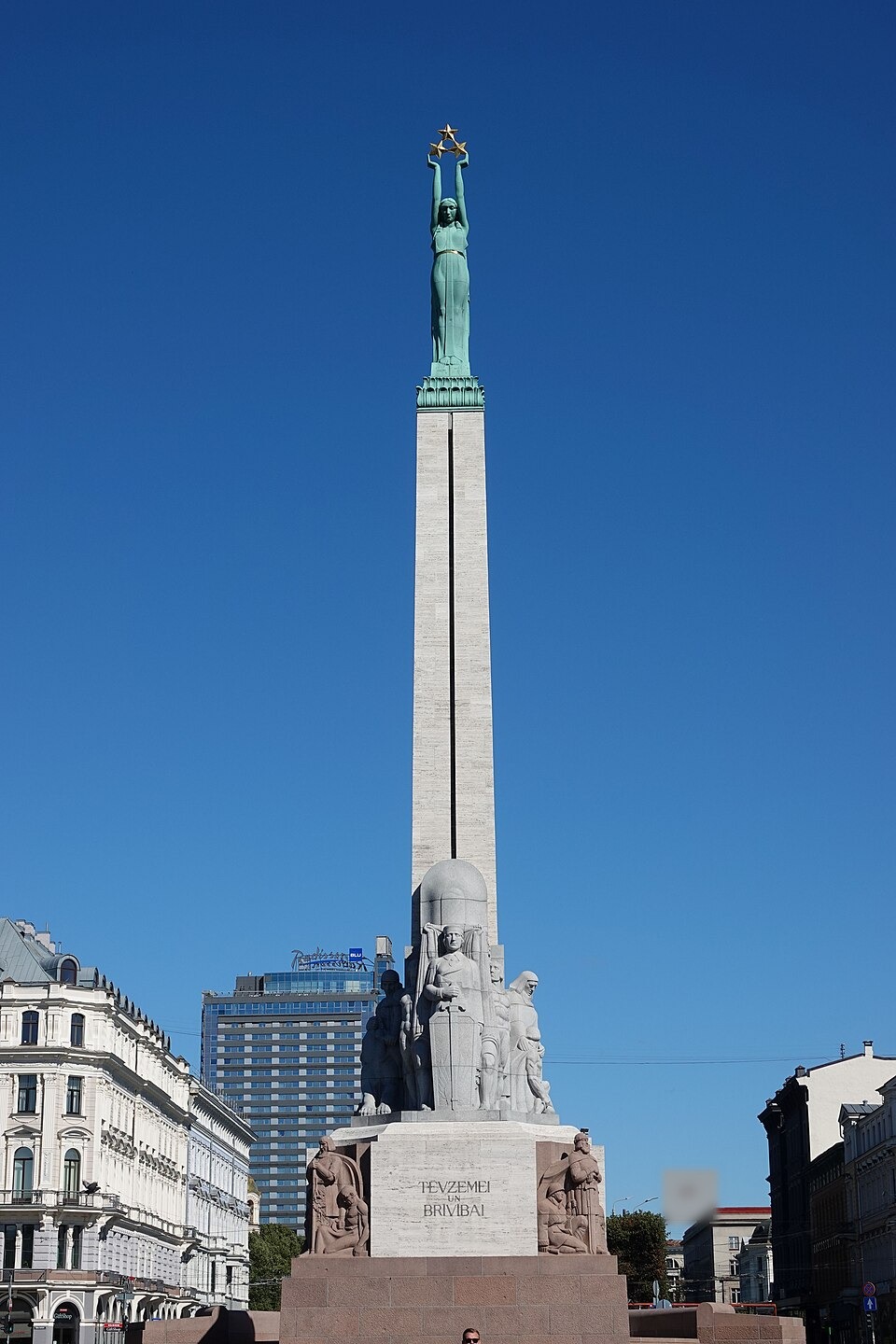
The monument rises 42 metres in tiers of granite blocks that shrink toward the top, carried on a 19-metre travertine column and finished with a copper figure lifting three gilded stars; thirteen groups of sculpture and relief line its base.
The Freedom Monument commemorates soldiers killed in the Latvian War of Independence of 1918–1920 and stands as a symbol of the country's sovereignty. Architect Ernests Štālbergs designed the structure, built to the winning competition scheme, "Shine like a star!", submitted by sculptor Kārlis Zāle, whose work fills its thirteen sculpture groups. Financed by private donations and unveiled in 1935, it remains a site for public gatherings and official ceremonies.
- The design competition was won under the motto "Shine like a star!", submitted by sculptor Kārlis Zāle.
- After Latvia's Soviet occupation in 1940, the new authorities considered demolishing the monument.
Photo: Nenea hartia (CC BY-SA 4.0)
Nativity of Christ Cathedral
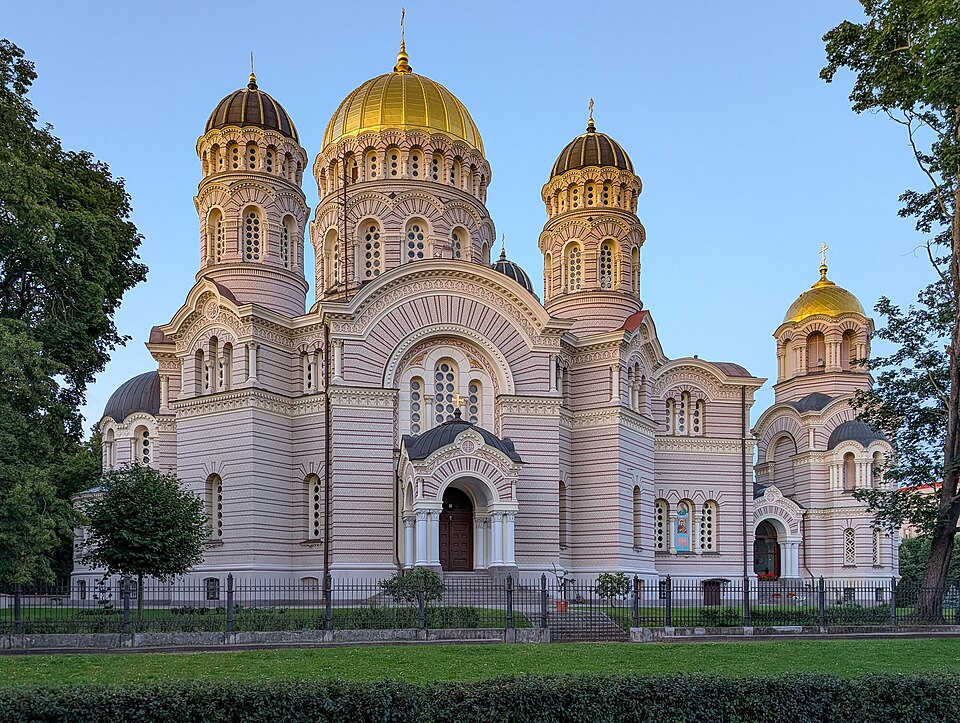
1876–1883 · Nikolai Chagin
Built in Neo-Byzantine style, it is the largest Orthodox cathedral in the Baltic provinces, its interior known for icons, some painted by Vasili Vereshchagin, and for bells recast in 2002 after the originals were lost.
Designed jointly by Nikolai Chagin and Robert Pflug in Neo-Byzantine style, the cathedral was built between 1876 and 1883 under Russian imperial rule, becoming the largest Orthodox cathedral in the Baltic provinces. German occupying forces converted it into a Lutheran church during the First World War, and it returned to Orthodox use in 1921. Soviet authorities closed it in the early 1960s and ran it as a planetarium until restoration followed Latvia's independence in 1991.
- Some of its icons were painted by the artist Vasili Vereshchagin.
- New bells were cast for the cathedral in 2002.
Photo: Granada (CC BY-SA 4.0)
Central Market
Europe's largest market, built between 1924 and 1930 from five pavilions made by reusing old German Zeppelin hangars in Neoclassical and Art Deco styles. Covering 72,300 square metres with more than 3,000 trade stands, it was added to the UNESCO World Heritage list in 1998.
National Library of Latvia
The national library, formed in 1919 after Latvia's independence, known by the nickname Castle of Light for its current building. Designed in 1989 by Latvian-American architect Gunnar Birkerts, the building was constructed in the early 21st century and opened in 2014.
House of the Blackheads
A building originally erected in 1334 as a merchant meeting and warehouse hall, later home to the Brotherhood of Blackheads guild. It is also the site of the first decorated Christmas tree, put up in 1510, and was bombed to ruins in 1941.
Three Brothers
A complex of three houses forming the oldest group of dwelling houses in the city. Each house represents a different period in the development of Riga's residential architecture.
Mežaparks
A 424-hectare urban park covered with coastal dunes and boreal forest, home to the Riga Zoo and the open-air Great Bandstand. It became in 1901 the Russian Empire's first garden-city project, later expanded by the Soviet government in 1949.
Riga Radio and TV Tower
The tallest tower in the European Union, built between 1979 and 1989 with funding from the Soviet central government. Reaching 368.5 metres, it ranks as the third-tallest tower in Europe, after the Ostankino Tower and the Kyiv TV Tower.
Art Museum Riga Bourse
A museum established in 1920, holding the most extensive collection of world art in Latvia. Its permanent exhibits range from Ancient Egyptian art to Asian works from as recently as the 21st century.
Large Guild
A guild building near Livonian Square, built between 1854 and 1859 in English Gothic style and among the oldest public buildings in the Baltic states. It serves as the main concert hall of the Latvian National Symphony Orchestra, under renovation until late 2026.
Peitav Synagogue
An Orthodox synagogue designed by Wilhelm Neumann in Art Nouveau and Egyptian Revival styles, completed in 1905. Partially destroyed by the Nazis in 1941 and later damaged by bombings in 1995 and 1998, it was restored and reopened in 2009.
The Ethnographic Open-Air Museum of Latvia
An open-air museum on the lightly wooded shores of Jugla Lake, just outside the city.
Bastejkalns Park
A spacious park on the northern edge of the old town.
Latvian National Museum of Art
An art museum holding the largest collection of national art in Latvia, with more than 65,000 works. It traces the development of professional art in the Baltic region from the mid-18th century to the present, at Janis Rozentāls Square.
St. James's Cathedral
The Roman Catholic cathedral, dedicated to Saint James the Greater and part of the Old Riga UNESCO World Heritage Site. It stands directly opposite the House of the Livonian Noble Corporation, meeting place of Latvia's parliament, the Saeima.
Powder Tower
Originally part of the town's defensive fortifications, the current tower was built in 1650. It was renovated between 1937 and 1940 and incorporated into the Latvian War Museum.
Cat House
A building at 10 Meistaru iela, built in 1909 to a design by architect Friedrich Scheffel mixing medieval style with Art Nouveau elements. It is known for two arch-backed cat sculptures on its roof, originally turned away from the Great Guild out of a grudge.
St. George's Church
The oldest stone building in the city and its first church, now home to the Latvian Museum of Decorative Arts and Design. It stands at 10/12 Skārņu Street, having originally served as a Catholic church.
Brothers' Cemetery
A military cemetery and national monument, burial ground for thousands of Latvian soldiers killed between 1915 and 1920 in World War I and the War of Independence. The memorial was built between 1924 and 1936 to designs by sculptor Kārlis Zāle.
St. Albert's Church
A Roman Catholic church in the Āgenskalns district, built to mark the city's 700th anniversary and named in honor of Albertus Magnus (1193–1280). It is the largest Catholic church in Latvia, with room for about 2,500 people.
Ministry of Agriculture Building
A high-rise office building traditionally nicknamed the Silage Tower, built between 1968 and 1976 and opened in 1978. Standing 92 metres tall with 26 floors, it is currently the seventh-tallest building in Latvia and serves as headquarters of the Ministry of Agriculture.
Xiaomi Arena
An indoor arena holding up to 14,500 people, opened on 15 February 2006 as a venue for that year's IIHF World Championship. Formerly known as Arena Riga, it was renamed Xiaomi Arena in 2025 under a naming rights deal with the Chinese electronics company.
Museum of the Occupation of Latvia
A history museum established in 1993 to document the 51-year period when Latvia was occupied successively by the USSR, Nazi Germany, and the USSR again. After a decade of reconstruction, a new permanent exhibition opened on 1 June 2022.
Riga Circus
A circus venue that opened on 4 Merķeļa Street on 29 December 1888 as Salamonsky's Circus, designed by architect Jānis Frīdrihs Baumanis. Considered the only permanent circus building in the Baltic states, it closed in 2016 over safety concerns before reopening after reconstruction in 2022.
Radisson Blu Hotel Latvija
A high-rise hotel in the Vidzeme Suburb, built between 1967 and 1979 and renovated in 2001. Standing 95 metres tall with 27 floors, it is currently the sixth-tallest building in Latvia.
Mežaparks Great Bandstand
A large open-air bandstand, originally erected in 1954–1955 by architect Vladimirs Šņitņikovs, that has hosted the Latvian Song and Dance Festival since 1955. Surrounded by long wing-shaped benches seating 30,000 spectators, it was fully rebuilt between 2018 and 2021.
Triangular Bastion
Part of the 18th-century fortifications, its foundations remain visible beneath a modern office building today.
History
Riga was founded in 1201 as a Hanseatic League port at the mouth of the Daugava, and its oldest churches, built in Brick Gothic, date from the following century. The riverside castle followed in 1330, was rebuilt almost entirely between 1497 and 1515, and gained new annexes in 1641 after Swedish forces seized it; further reconstruction ran through the 17th to 19th centuries and again in the 1930s, when it became the Latvian government's official residence in 1938. Russian imperial rule, which lasted into the First World War, added a Neo-Byzantine cathedral in the 1870s and 1880s alongside the older Lutheran churches. After the Latvian War of Independence of 1918–1920, a granite, travertine and copper monument went up in 1935, financed by private donations rather than by the state.