Landmarks in Sarajevo
Ottoman mosques and fountains sit beside Austro-Hungarian civic grandeur on the Miljacka.
Sarajevo's landmarks trace two layers pressed onto the same narrow valley. The Gazi Husrev-beg Mosque and the wooden Sebilj fountain sit around Baščaršija, the historic marketplace at the city's core, both begun in the centuries after Sarajevo grew into an Ottoman stronghold; the mosque in cut stone, the fountain in timber and rebuilt once already after a fire. The Latin Bridge, a stone arch raised in 1798, carries that same Ottoman engineering over the Miljacka River. Sarajevo City Hall stands apart: a large civic building raised in the 1890s under Austro-Hungarian administration, built to outdo anything the Ottoman city had produced, and now serving again as the seat of the mayor and city council.
Sebilj
1891 · Alexander Wittek
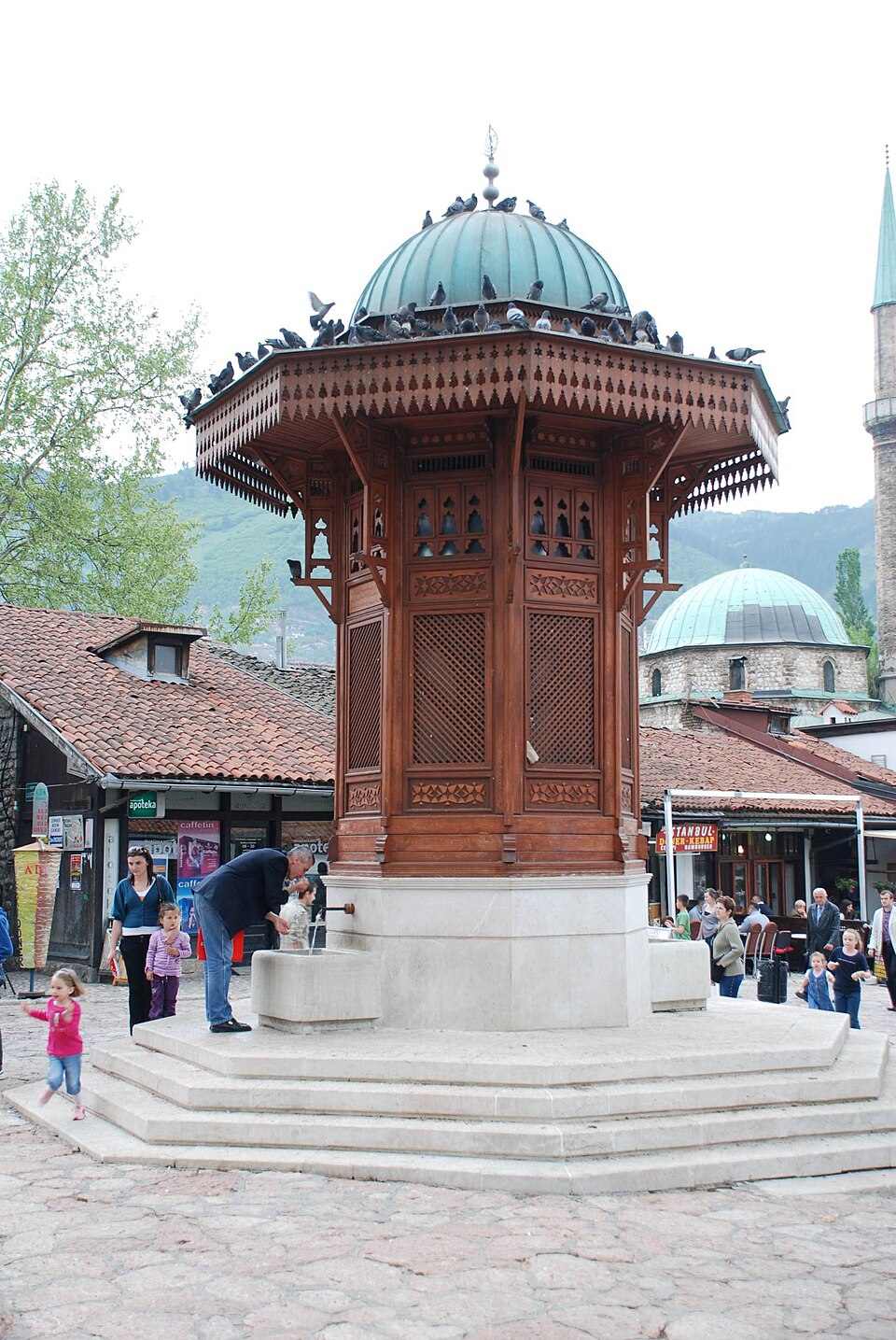
A small, free-standing wooden fountain pavilion in Ottoman style marks the centre of Baščaršija Square, the marketplace it has anchored — through a fire and a rebuild — since the eighteenth century.
The Sebilj is a wooden Ottoman-style drinking fountain at the centre of Baščaršija, Sarajevo's old market square. The Ottoman governor Mehmed Pasha Kukavica had the first one built in 1753; it burned down in an 1852 fire. The Austrian architect Alexander Wittek designed its replacement in 1891, moving it a few metres from where the original had stood. Local tradition holds that drinking from its taps promises a return to the city. It remains a gathering point in the old town today.
- Local legend claims that drinking from the fountain guarantees a return to the city.
- The fountain standing today is an 1891 replacement; a fire destroyed the 1753 original in 1852.
Photo: xiquinhosilva (CC BY 2.0)
Sarajevo City Hall
1896 · Karel Pařík
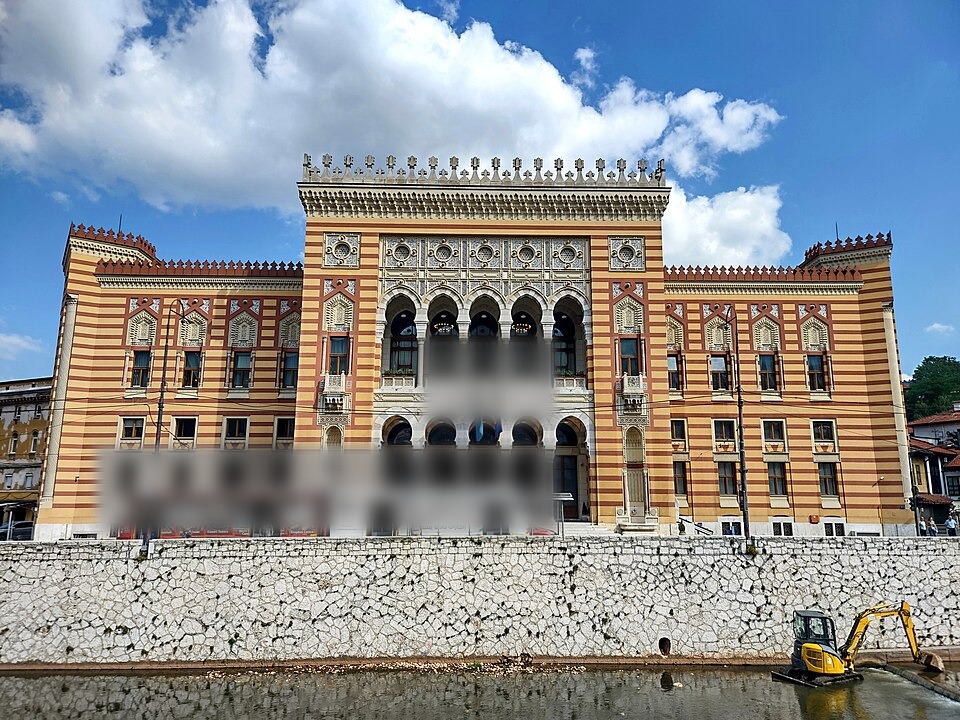
A large formal public building that served as the largest and most representative structure of the Austro-Hungarian administration, combining a city hall and a library before reopening as a civic seat in 2014.
Sarajevo City Hall, known as Vijećnica, was designed in 1891 by the Czech architect Karel Pařík as the largest and most representative building of the Austro-Hungarian administration in the city. Criticism from the minister Baron Béni Kállay led Pařík to abandon the project partway through, and construction was not completed until 1896. It combined the roles of city hall and library. After renovation, the building reopened on 17 July 2014 and now serves as the seat of the mayor of Sarajevo and the city council.
- The architect, Karel Pařík, abandoned the project partway through after criticism from a government minister.
- It served as a library as well as a city hall.
Photo: Ladislav Boháč (CC0)
Gazi Husrev-beg Mosque
1531 · Mimar Sinan
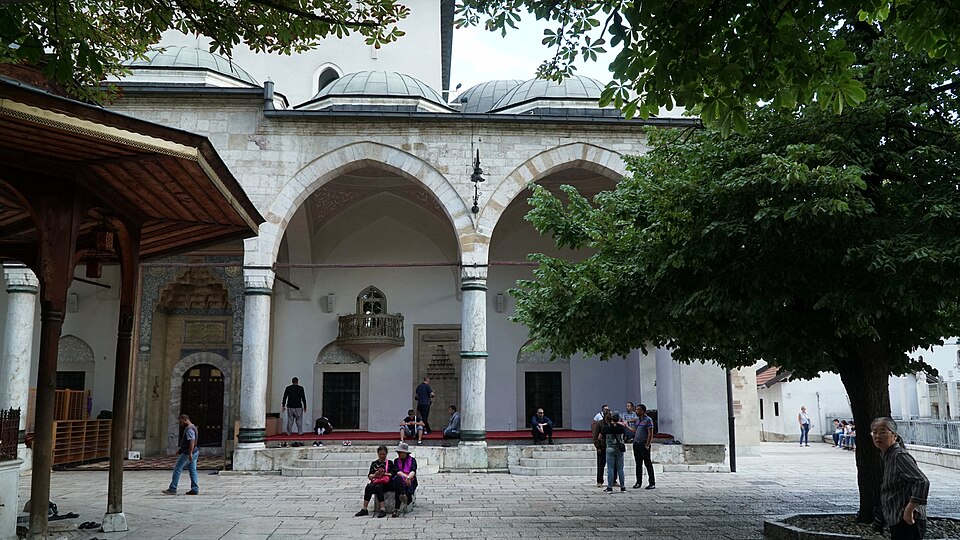
Built as part of a larger religious complex, or külliye, this is the largest historical mosque in Bosnia and Herzegovina, standing beside the mausoleum of the patron who founded it.
The Gazi Husrev-beg Mosque, completed in 1531, is the largest historical mosque in Bosnia and Herzegovina and one of the most representative Ottoman religious buildings in the Balkans. It has served as Sarajevo's central mosque since construction and remains the main congregational mosque for the country's Muslims. Standing in the Baščaršija neighbourhood of the Stari Grad municipality, it forms part of a wider religious complex, a külliye, and takes its name from its founder, Gazi Husrev-beg, who is buried in an adjoining mausoleum.
- It is the largest historical mosque in Bosnia and Herzegovina.
- Its founder, Gazi Husrev-beg, is buried in a mausoleum next to it.
Photo: Adam Harangozó (CC BY-SA 4.0)
Latin Bridge
1798
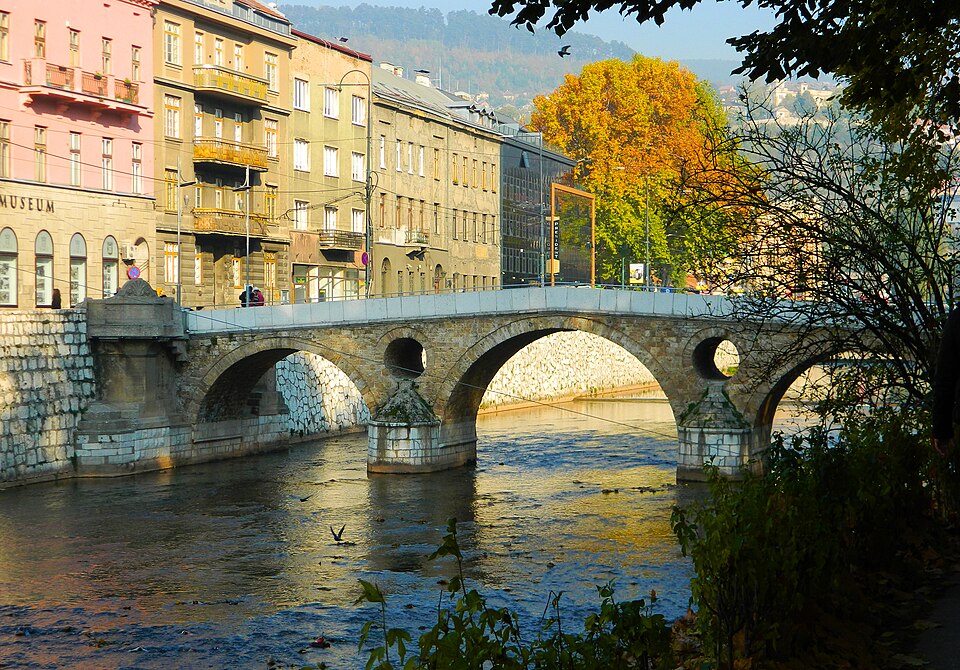
A stone arch bridge crossing the Miljacka River, its northern end marking the site of the 1914 assassination of Archduke Franz Ferdinand — the event that triggered the July Crisis and the outbreak of the First World War.
The Latin Bridge is an Ottoman-era stone arch bridge across the Miljacka River in Sarajevo, built in 1798. During the Yugoslav era it was renamed Princip's Bridge after Gavrilo Princip, who assassinated Archduke Franz Ferdinand of Austria at its northern end in 1914. That killing set off the July Crisis, the sequence of diplomatic failures that led, within weeks, to the outbreak of the First World War.
- During the Yugoslav era it was renamed Princip's Bridge.
- The assassination at its northern end in 1914 set off the July Crisis that led to the First World War within weeks.
Photo: sundeviljeff (CC BY 2.0)
Sacred Heart Cathedral
The largest cathedral in Bosnia and Herzegovina, standing in Sarajevo's Old Town district. It is the seat of the Archbishop of Vrhbosna and the centre of Catholic worship in the city.
Sarajevo Clock Tower
A 30-metre clock tower beside the Gazi Husrev-beg Mosque, the tallest of 21 such towers in the country and a National Monument since 2006. It shows lunar time, its hands reaching twelve at sunset, and is reset weekly by hand.
National Museum of Bosnia and Herzegovina
Established in 1888 and expanded in 1913 by Czech architect Karel Pařík with four symmetric pavilions. It holds the Sarajevo Haggadah, an illuminated manuscript from around 1350 considered the oldest Sephardic Jewish document in the world.
Koševo City Stadium
The largest stadium in Bosnia and Herzegovina, located in the Koševo neighbourhood of Sarajevo. It hosted the opening ceremony of the 1984 Winter Olympics.
Sarajevo National Theatre
The largest theatre in Bosnia and Herzegovina. It is considered one of the most important cultural institutions in Southeastern Europe.
Tunnel of Hope
A tunnel built between March and June 1993 during the Siege of Sarajevo, linking the besieged city to territory beyond the airport held by Bosnian government forces. Running between the Dobrinja and Butmir neighbourhoods, it carried food, weapons, and people in and out of the city.
Morića Han
The only surviving han in Sarajevo, originally built in 1551 and reconstructed after a fire in 1697. Financed by Gazi Husrev-Beg's endowment, it once accommodated about 300 travellers and 70 horses in the Baščaršija quarter.
Sarajevo Synagogue
An Orthodox synagogue on the south bank of the Miljacka river, built in 1902. It is the only functioning synagogue in Sarajevo today, with a congregation that worships in the Ashkenazi rite.
Bijela Tabija
A stone fort standing 667 metres above sea level, overlooking Sarajevo's historic core as part of the old Vratnik City walls. Once housing a gun-crew and ammunition store, its thick walls still bear openings built for cannons.
Emperor's Mosque
The first mosque built after the Ottoman conquest of Bosnia, completed in 1457 and dedicated to Sultan Mehmed the Conqueror. Built in classical Ottoman style, it is the largest single-subdome mosque in the country, noted for its finely decorated mihrab.
Gazi Husrev-begov bezistan
A covered Ottoman-era market built in 1555 in the Baščaršija quarter. It remains one of Sarajevo's preserved bezistans and still serves its original purpose as a trading hall.
Cathedral of the Nativity of the Theotokos
Sarajevo's Eastern Orthodox cathedral, seat of the Metropolitanate of Dabar and Bosnia within the Serbian Orthodox Church. It was designated a National Monument of Bosnia and Herzegovina in 2006.
Olympic Bobsleigh and Luge Track
A derelict bobsleigh and luge track on Trebević mountain, overlooking Sarajevo. It was built for the 1984 Winter Olympics.
Juan Antonio Samaranch Olympic Hall
An indoor multi-purpose arena also known as Zetra, used for events at the 1984 Winter Olympics and renamed in 2010 to honour Juan Antonio Samaranch. It served as the main venue of the 2019 European Youth Olympic Winter Festival.
Stadion Grbavica
An association football stadium in Grbavica, seating 13,057 spectators. Home to FK Željezničar and occasionally used by the Bosnia and Herzegovina national team, it is also known as Dolina ćupova, the Valley of Jars.
Vilayet Printing House
The official printing house of the Ottoman Vilayet of Bosnia from 1866 until the Austro-Hungarian occupation in 1878, founded by publisher Ignjat Sopron. It was only the second printing house in present-day Bosnia and Herzegovina, set up to issue the vilayet's official gazette and school textbooks.
Hotel Europe
A historic hotel in central Sarajevo, opened in 1882 as the city's first modern hospitality venue during the Austro-Hungarian era. Run for sixty years by the Jeftanović family, it was later nationalized under communist Yugoslavia and re-privatized after the Bosnian War.
Historical Museum of Bosnia and Herzegovina
A museum founded in 1945, dedicated to the history of Bosnia and Herzegovina and of Sarajevo from the Middle Ages to the present day.
UNITIC Towers
A pair of 111-metre twin skyscrapers owned by the United Investment and Trading Company, a joint venture between UNIS Holding and a Kuwaiti investment firm formed in 1998. The company has since invested 45 million convertible marks renovating the complex.
Avaz Twist Tower
A 40-storey, 172-metre skyscraper built between 2006 and 2008 as headquarters for the newspaper Dnevni avaz, notable for its twisted facade. It remains the tallest building in the former Yugoslavia, and was named one of the world's ten most beautiful buildings by Schuco in 2009.
Hum Tower
A 78.5-metre telecommunications tower on Mount Hum, on the outskirts of Sarajevo, originally completed in the 1960s and rebuilt in the 1980s. It was partly destroyed on 2 May 1992 during the Bosnian War.
ICAR Canned Beef Monument
A public outdoor sculpture in Sarajevo.
History
The city grew from the fifteenth century as an Ottoman stronghold, and its oldest standing landmarks date from the two centuries that followed: the Gazi Husrev-beg Mosque, completed in 1531 as the city's central mosque, and the Latin Bridge, a stone arch raised over the Miljacka in 1798. Baščaršija's wooden Sebilj fountain also began in this period, in 1753, though a fire destroyed it in 1852, and the version standing today was rebuilt by the Austrian architect Alexander Wittek in 1891, on a site a few metres from the original. That reconstruction fell within Austro-Hungarian rule, which also produced Sarajevo City Hall, designed in 1891 and completed in 1896 as the administration's largest and most representative building. It later became the seat of the mayor and city council, reopening in 2014.