Landmarks in Vancouver
An Art Deco tower and a sail-roofed harbour terminal frame Canada's densest downtown.
Vancouver's built landmarks cluster in a small, intensely dense downtown on the Burrard Inlet waterfront, reflecting the city's status as the most densely populated in Canada. The oldest survivor, a 1906 provincial courthouse near Robson Square, was repurposed as an art museum after the provincial government moved out, and now houses one of the largest art museum buildings in western Canada. A few blocks away, the 1930 Marine Building rises in Art Deco style, its facade covered in carved marine ornament, and stood as the city's tallest structure when finished. Down on the harbour itself, the sail-roofed Canada Place complex, completed in the mid-1980s, combines a convention centre, hotel, and cruise terminal at the water's edge.
Canada Place
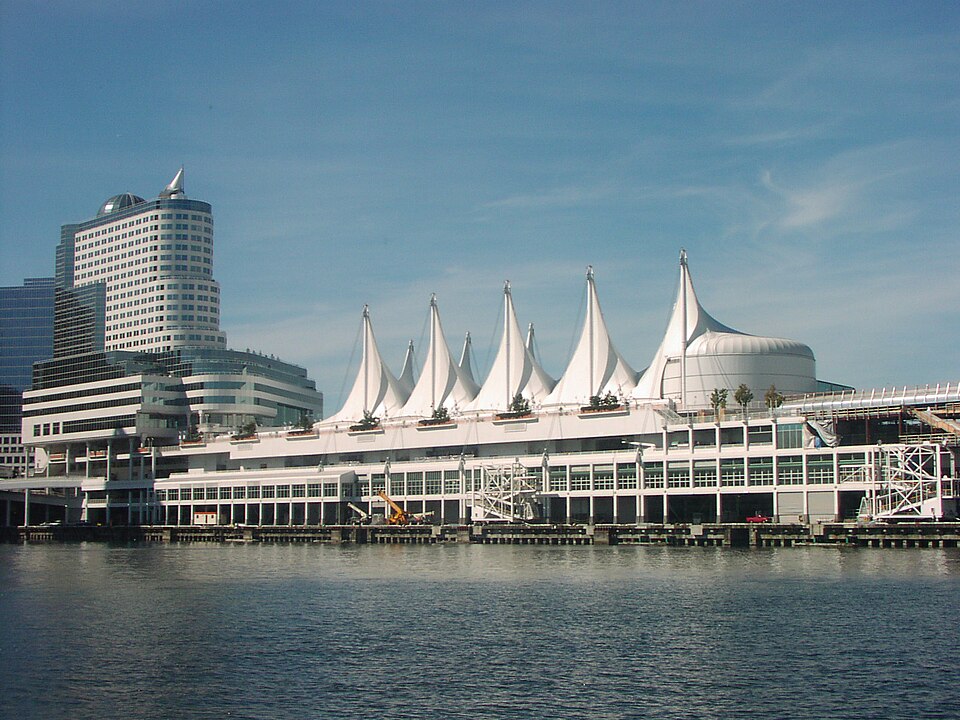
1986 · Eberhard Zeidler
Rows of white, sail-shaped fabric roofs run the length of this harbourside building, a silhouette often echoed by the masts of cruise ships moored beside it; a hotel, a convention centre, and a trade centre sit under the same roofline.
Canada Place combines a cruise-ship terminal with the Vancouver Convention Centre East Building, the Pan Pacific Vancouver Hotel, the Vancouver World Trade Centre, and the virtual-flight attraction Flyover Vancouver. Designed by Zeidler Roberts Partnership working with Musson Cattell Mackey Partnership and DA Architects + Planners, it sits beside Waterfront Station, the transit hub for SkyTrain, SeaBus, and the West Coast Express. A 2001 extension added a second berth for cruise ships, most of which depart from here for Alaska. In 2010 the building served as the Main Press Centre for the Winter Olympics.
- A 2001 extension added a second cruise-ship berth.
- It served as the Main Press Centre during the 2010 Winter Olympics.
Photo: Nicolas Untz (CC BY-SA 2.0)
Vancouver Art Gallery
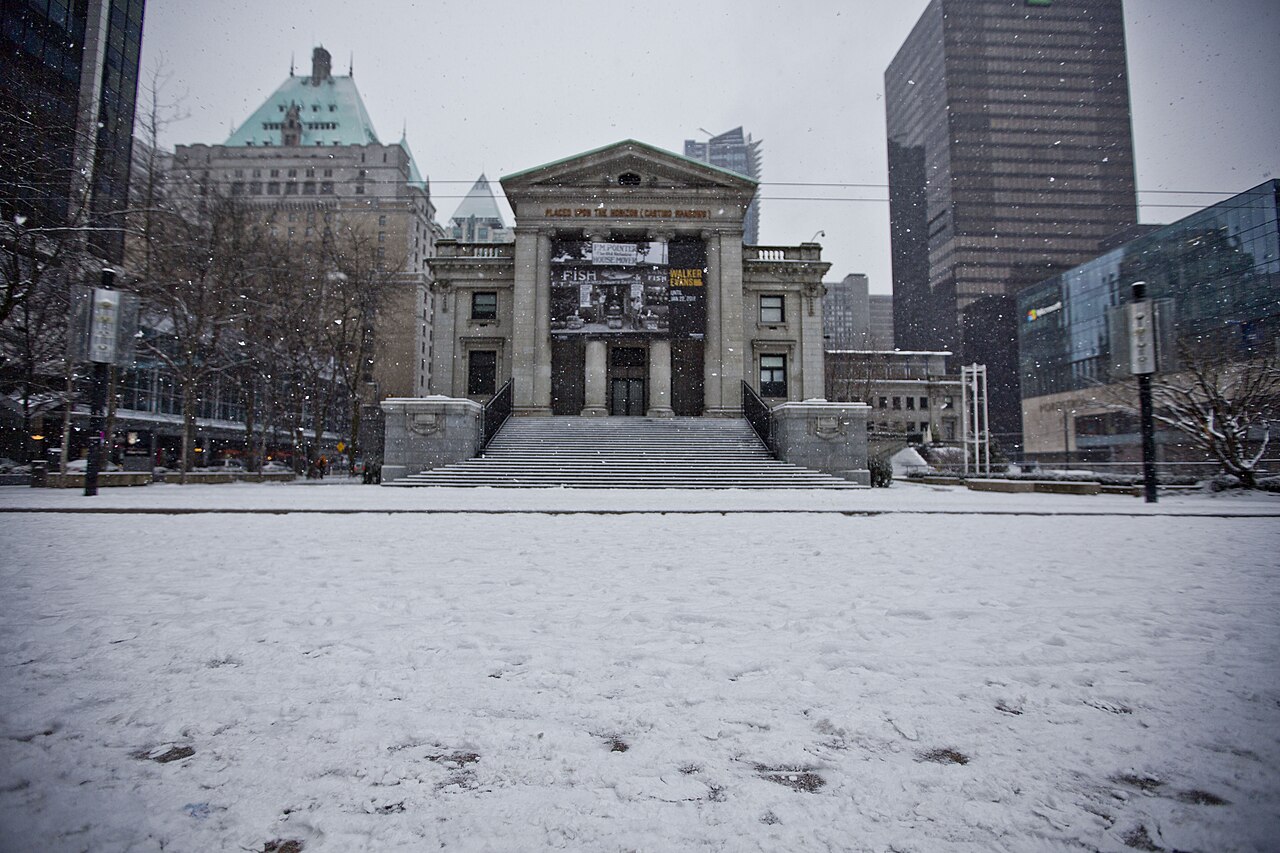
1906 · Francis Rattenbury
Recognisable more by setting than ornament, the museum fills a former courthouse building beside a large public square and is, by floor area, the largest art-museum building in western Canada.
The gallery occupies a building designed by Francis Rattenbury and opened in 1906 as a provincial courthouse, adjoining what is now Robson Square. The courthouse was designated the Former Vancouver Law Courts National Historic Site of Canada in 1980 and handed over for museum use, with the Vancouver Art Gallery completing its move in 1983. The gallery itself had been founded in 1931 in a separate building by Sharp and Johnston, expanded in 1950, before this later relocation. Its permanent collection holds around 12,000 works by artists from Canada and elsewhere, shown alongside travelling exhibitions.
- It is the largest art museum building in western Canada by floor area.
- The building served as a provincial courthouse until the early 1980s, decades after the gallery itself was founded elsewhere in 1931.
Photo: GoToVan from Vancouver, Canada (CC BY 2.0)
Marine Building
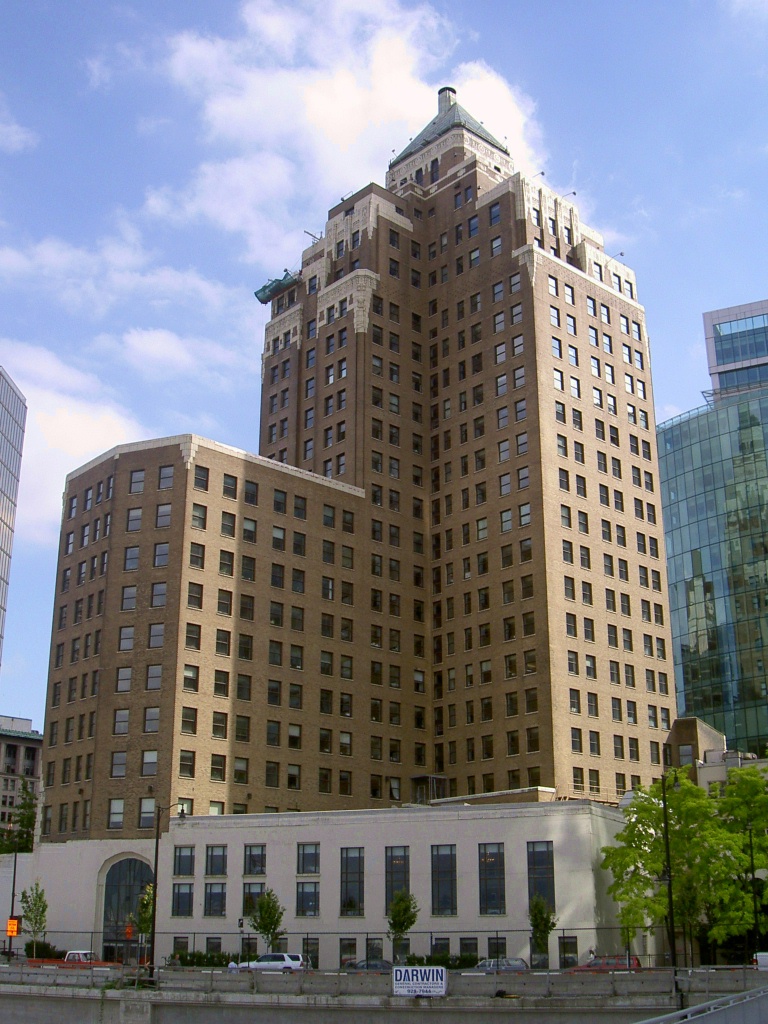
1930
Sea creatures, ships, and other marine motifs are carved across the exterior and lobby of this Art Deco tower, ornament that gave the building its name.
Completed in 1930 at 355 Burrard Street near the financial district, the Marine Building opened as the tallest skyscraper in the city, a title it briefly held before taller towers followed. It is ranked among the best Art Deco buildings in the world, owing its name to the extensive marine-themed ornament covering its exterior and interior. The building carries a heritage designation. Its architecture and decoration have made it a repeated setting for film and television productions.
- It briefly held the title of the city's tallest building after opening.
- Its Art Deco interiors have made it a recurring film and television filming location.
Photo: Zhatt (Public domain)
Stanley Park
A 405-hectare public park covering the northwestern half of the downtown peninsula, connected to the North Shore by the Lions Gate Bridge. Larger than New York's Central Park, it was used by Indigenous peoples for thousands of years before the 1858 Fraser Canyon Gold Rush.
Lions Gate Bridge
A suspension bridge opened in 1938, officially the First Narrows Bridge, connecting the city to the North Shore across Burrard Inlet. Its name refers to the Lions mountain peaks, and cast concrete lions by sculptor Charles Marega were added at its south end in 1939.
Science World
A science centre at the eastern end of False Creek, built as the Expo Centre for the 1986 world's fair and reopened as Science World in 1989. It was branded Science World at Telus World of Science from 2005 to 2020.
Hotel Vancouver
A Châteauesque-style hotel on West Georgia Street, designed by architects John Smith Archibald and John Schofield and opened in May 1939. Standing 112.47 metres tall with 17 floors, it was considered one of Canada's grand railway hotels and the tallest building in Vancouver until 1972.
Capilano Suspension Bridge
A suspension bridge crossing the Capilano River in North Vancouver, currently 140 metres long and suspended 70 metres above the river. Part of a private facility charging admission, it draws more than 1.2 million visitors a year.
BC Place
A multi-purpose stadium on False Creek, opened on 19 June 1983 with an air-supported roof that was then the world's largest. After the 2010 Winter Olympics it closed for 16 months to replace that roof with a retractable one, again the largest of its type.
Holy Rosary Cathedral
A French Gothic Revival church whose construction began in 1899, opening in December 1900 and elevated to cathedral status in 1916. Its style has been compared to the medieval Chartres Cathedral in France, and it was consecrated in 1953.
Rogers Arena
A multi-purpose arena opened in 1995 as General Motors Place, renamed Rogers Arena in 2010 when Rogers Communications took over the naming rights. Home to the Vancouver Canucks and Vancouver Warriors, it also hosted ice hockey events at the 2010 Winter Olympics.
Burrard Bridge
A four-lane Art Deco steel truss bridge built between 1930 and 1932, spanning False Creek to connect downtown with Kitsilano. Designed by architect George Lister Thornton Sharp and engineer John R. Grant, it is one of three bridges crossing False Creek.
Sam Kee Building
A two-storey commercial building near the entrance to Chinatown, its ground floor just 4 feet 11 inches wide and its upper floor 6 feet due to overhanging bay windows. Guinness World Records recognizes it as the narrowest commercial building in the world.
Public Library
The public library system for the city, serving more than 236,000 active members across 21 locations and online, the largest such system in British Columbia. In 2023 it recorded over 4.6 million visits and nearly 10.4 million items borrowed.
Olympic Cauldron
A cauldron erected for the 2010 Winter Olympics, with a ceremonial version lit at BC Place's opening ceremony. A permanent public version stands in Jack Poole Plaza, in keeping with Olympic protocol that the flame be visible outdoors.
Robson Square
A civic centre and public plaza in downtown Vancouver, home to the Provincial Law Courts, UBC Robson Square, and government offices. It forms a public space connecting newer development to the Vancouver Art Gallery.
Convention Centre
One of Canada's largest convention centres, expanded with the opening of the West Building in 2009 to 43,340 square metres of meeting space. It served as the main press and international broadcast centre for the 2010 Winter Olympics.
Christ Church Cathedral
The cathedral church of the Anglican Diocese of New Westminster, and the second church to hold that role. It stands at 690 Burrard Street, directly across from the Fairmont Hotel Vancouver in downtown.
Seawall
A stone wall built around Stanley Park to prevent shoreline erosion, now the world's longest uninterrupted waterfront path. Its pedestrian and cycling pathway extends about 30 kilometres from CRAB Park, around Stanley Park and False Creek, to Spanish Banks.
Brockton Point
A headland at the easternmost point of Stanley Park, named for Francis Brockton and home to a 100-year-old lighthouse and several hand-carved totem poles. Its main sports field, Brockton Oval, has hosted cricketers including Donald Bradman, and cricket and rugby are still played there.
Aquarium
A public aquarium in Stanley Park and a center for marine research, ocean literacy, and conservation. It was the first facility to employ educational naturalists on a full-time basis to interpret animal behaviour for visitors.
Playland
An amusement park at Hastings Park, operated by the Pacific National Exhibition, opened at its current location in 1958. Its predecessor, Happyland, ran there from 1929 to 1957, and as of 2024 the park had 40 attractions, including four roller coasters.
St. Andrew's-Wesley United Church
An affirming church in the downtown core, part of the United Church of Canada, which welcomed its first congregation in 1933. Renowned for its architecture and art, it underwent a major restoration beginning in 2019 and holds three weekly services, including long-standing jazz vespers.
Museum of Vancouver
A civic history museum in Vanier Park, founded in 1894 and rebranded as the Museum of Vancouver in 2009. It is the oldest museum in the city and the largest urban museum in Canada, sharing its foyer with the H. R. MacMillan Space Centre.
Bloedel Conservatory
A domed conservatory and aviary atop Queen Elizabeth Park, opened in 1969 with funding from the Bloedel Foundation. Its triodetic dome houses around 500 plant species and more than 200 birds, and it was saved from closure in 2010 through community advocacy.
Woodward's Building
A historic building whose original portion was built in 1903 for Woodward's Department Store, once the premier shopping destination on Cordova Street. Famous for its Christmas displays and rooftop 'W' sign, it stood vacant after the store's 1993 bankruptcy until a 2002 occupation spurred redevelopment.
Ironworkers Memorial Second Narrows Crossing
A steel truss cantilever bridge across the Second Narrows of Burrard Inlet, designed by Swan Wooster Engineering. Built between 1956 and 1960, its construction was marred by a multi-death collapse on 17 June 1958, 8 kilometres east of the Lions Gate Bridge.
Orpheum
A theatre and music venue on Granville Street, part of the Vancouver Civic Theatres group and the permanent home of the Vancouver Symphony Orchestra. Its interior appeared in the 2004 reboot of Battlestar Galactica, dressed as a heavenly opera house.
History
Indigenous settlement here predates the city by more than 10,000 years, with the Squamish, Musqueam, and Tsleil-Waututh among the peoples established along these shores before colonial development began. The buildings that now define downtown Vancouver arrived in distinct waves. In 1906, the provincial government raised a courthouse designed by Francis Rattenbury; it stood for decades before being designated a National Historic Site in 1980 and handed to the Vancouver Art Gallery, which completed its move in 1983, having been founded elsewhere in 1931. In 1930, the Marine Building added an Art Deco skyscraper to the financial district, briefly the tallest in the city. Decades later, in the mid-1980s, Canada Place extended downtown onto the harbour itself with a sail-roofed convention and cruise terminal, later expanded in 2001 and pressed into service as a press centre for the 2010 Winter Olympics.