Landmarks in Los Angeles
Downtown pairs a 1928 Art Deco city hall with Frank Gehry's deconstructivist concert hall.
The city's landmarks cluster in two distinct places: downtown's Civic Center, once the heart of the 1880s and 1890s business district, and a hillside park above Hollywood. Los Angeles City Hall, an Art Deco tower completed in 1928, held the title of tallest building in the city for nearly forty years and remains the tallest base-isolated structure in the world, engineered to shift during earthquakes. Griffith Observatory, from the same architectural period, sits on the south-facing slope of Mount Hollywood in Griffith Park, commanding views of the Los Angeles Basin and free to enter under the terms of its founder's will. Contemporary architecture arrived downtown in 2003 with the deconstructivist Walt Disney Concert Hall, the fourth home of the city's philharmonic and choir, funded initially by a Disney family gift.
Griffith Observatory
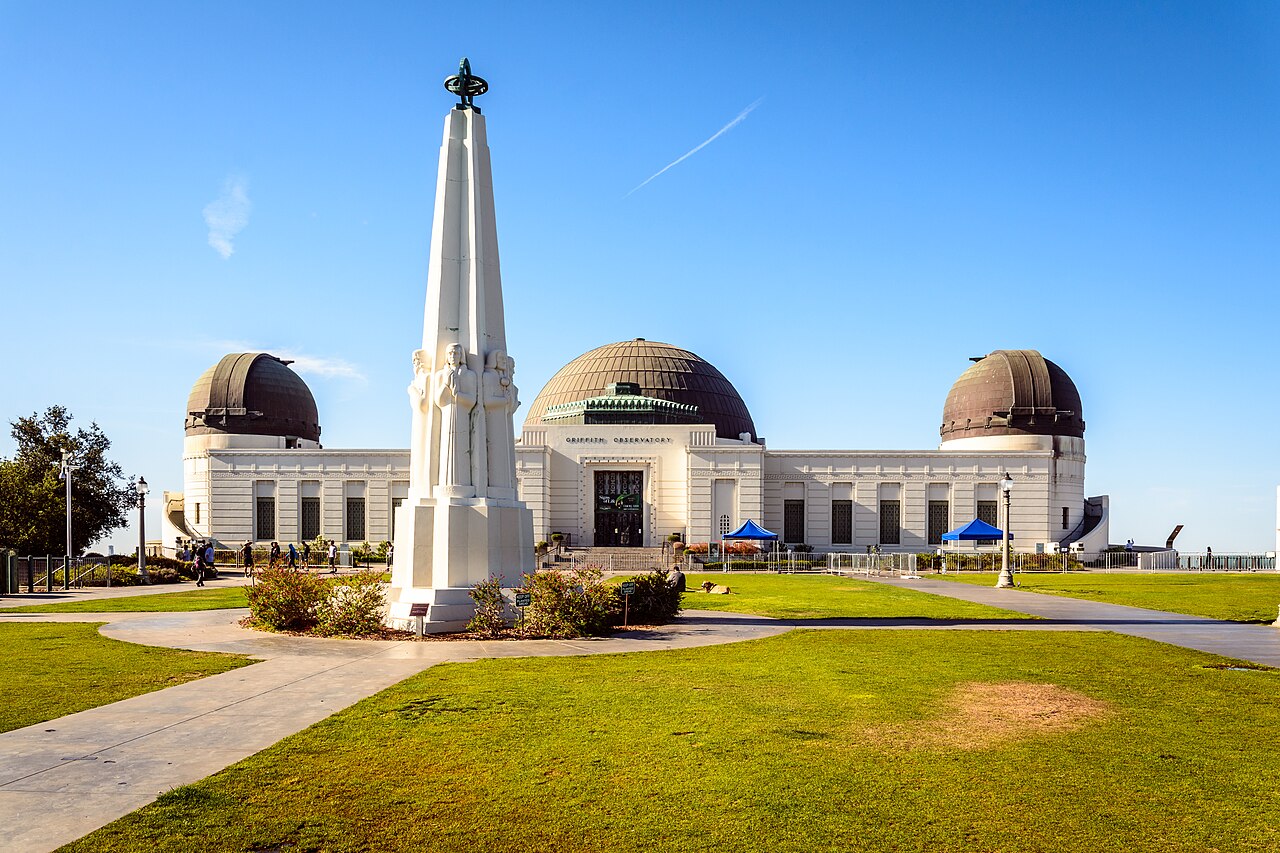
1935 · John C. Austin
An Art Deco observatory on a hillside within a city park, offering a close view of the Hollywood Sign on the ridge above and free admission under the terms of its founder's will.
Griffith Observatory opened in 1935 on the south-facing slope of Mount Hollywood in Griffith Park, designed by John C. Austin in the Art Deco style. Named for its benefactor, Griffith J. Griffith, it has offered free admission since opening, a condition set by his will. The building looks out over the Los Angeles Basin, downtown, Hollywood, and the Pacific Ocean, and gives visitors a close view of the Hollywood Sign. Its 12-inch Zeiss refracting telescope has been used by more than nine million people, making it the most viewed telescope in the world. It is a Los Angeles Historic-Cultural Monument.
- Its 12-inch Zeiss refracting telescope has been used by more than nine million visitors, making it the most viewed telescope on Earth.
- Admission has been free since it opened in 1935, a condition set in the will of its benefactor, Griffith J. Griffith.
Photo: dconvertini (CC BY-SA 2.0)
Los Angeles City Hall
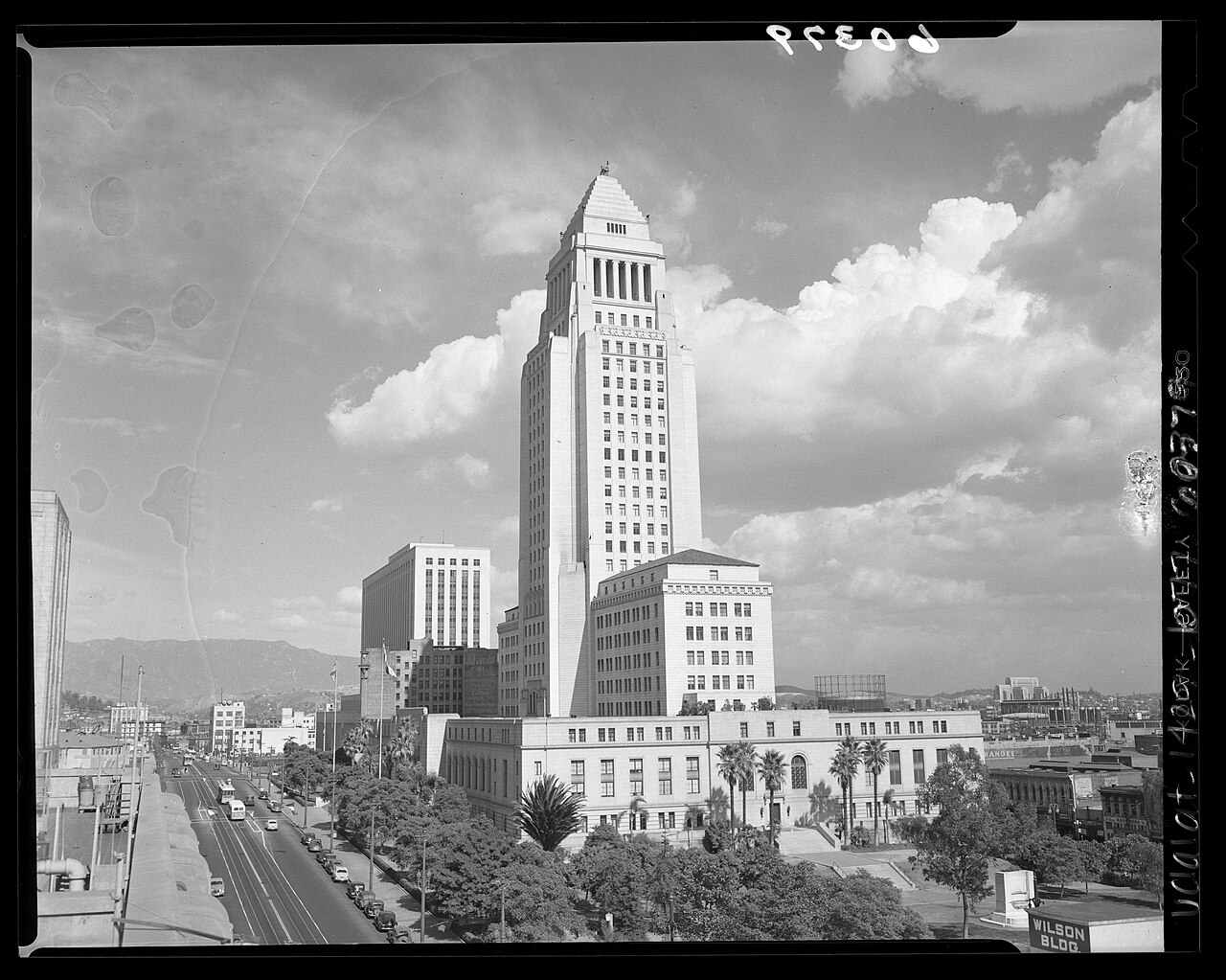
1928 · John C. Austin
An Art Deco tower over a Civic Center, the tallest building in its downtown skyline for the better part of four decades and still the tallest structure anywhere engineered to float on base isolators.
Los Angeles City Hall, designed by John C. Austin and completed in 1928, houses the mayor's office and the meeting chambers of the city council in the Civic Center district of downtown. It stands on the block bounded by Main, Temple, First, and Spring streets, once the heart of the city's central business district in the 1880s and 1890s. Built in the Art Deco style, it was the tallest building in the city from 1928 until 1966 and remains the tallest base-isolated structure in the world, engineered to shift rather than crack during an earthquake.
- It remains the tallest base-isolated structure in the world, engineered to shift rather than crack during an earthquake.
- The block it stands on was the heart of the city's central business district back in the 1880s and 1890s.
Photo: Los Angeles Times (CC BY 4.0)
Walt Disney Concert Hall
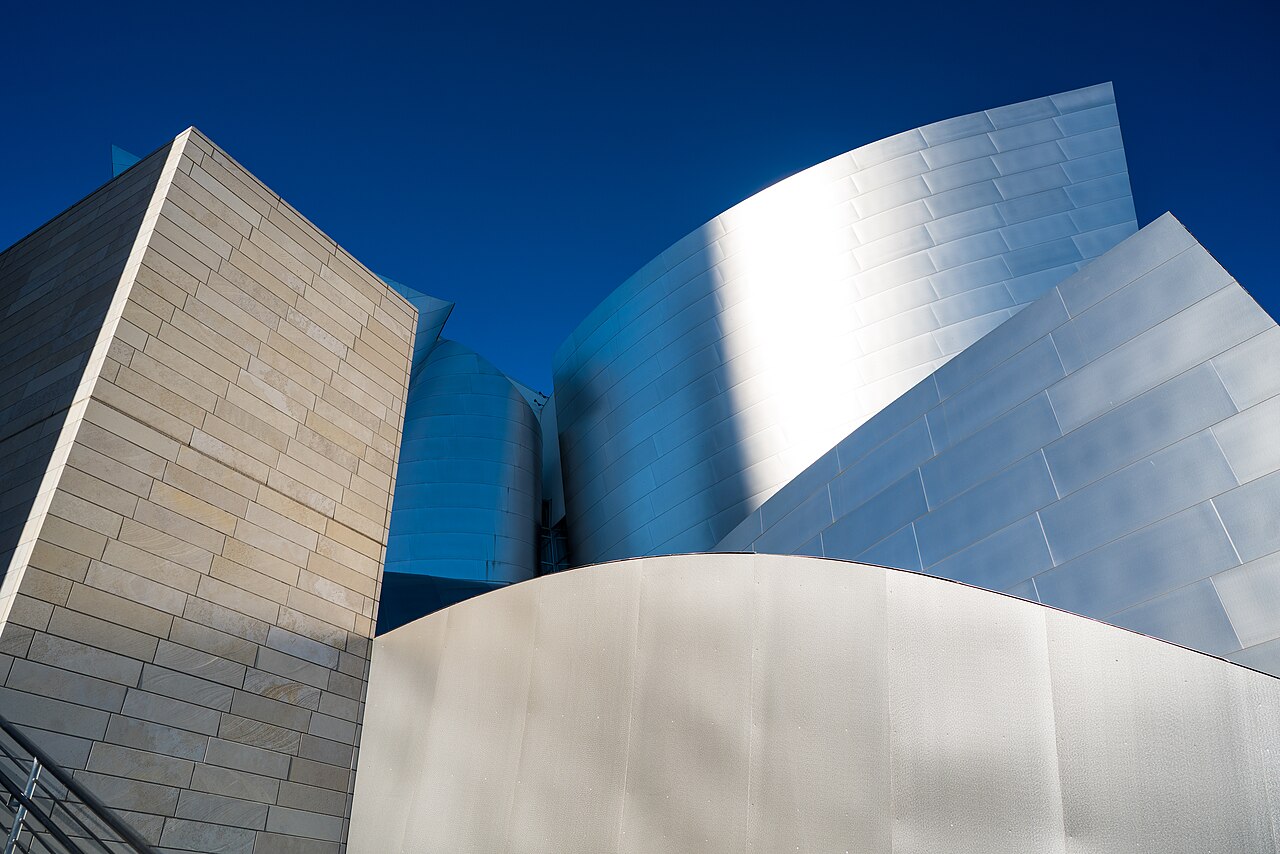
2003 · Frank Gehry
A deconstructivist, expressionist concert hall downtown whose interior seating wraps around the stage in a vineyard layout rather than facing it head-on, blending that scheme with elements of a classical shoebox hall.
The Walt Disney Concert Hall, the fourth hall of the city's Music Center, was designed by Frank Gehry and opened in 2003. An initial $50 million gift from Lillian Disney in 1987 funded it as a tribute to her husband's devotion to the arts. Seating 2,265, it is home to the Los Angeles Philharmonic and Master Chorale, its plan a compromise between vineyard-style seating and the classical shoebox layout of halls such as the Vienna Musikverein. Its acoustics, designed by Minoru Nagata and completed by Yasuhisa Toyota, have been praised alongside the architecture, unlike its predecessor, the Dorothy Chandler Pavilion.
- Lillian Disney's initial $50 million gift in 1987 was conceived as a tribute to her husband's devotion to the arts.
- Acoustics design passed from Minoru Nagata to his protégé Yasuhisa Toyota, who supervised the hall's completion.
- Its seating design is a compromise between the vineyard-style Berliner Philharmonie and the classical shoebox layout of the Vienna Musikverein and Boston Symphony Hall.
Photo: Nan Palmero from San Antonio, TX, USA (CC BY 2.0)
Union Station
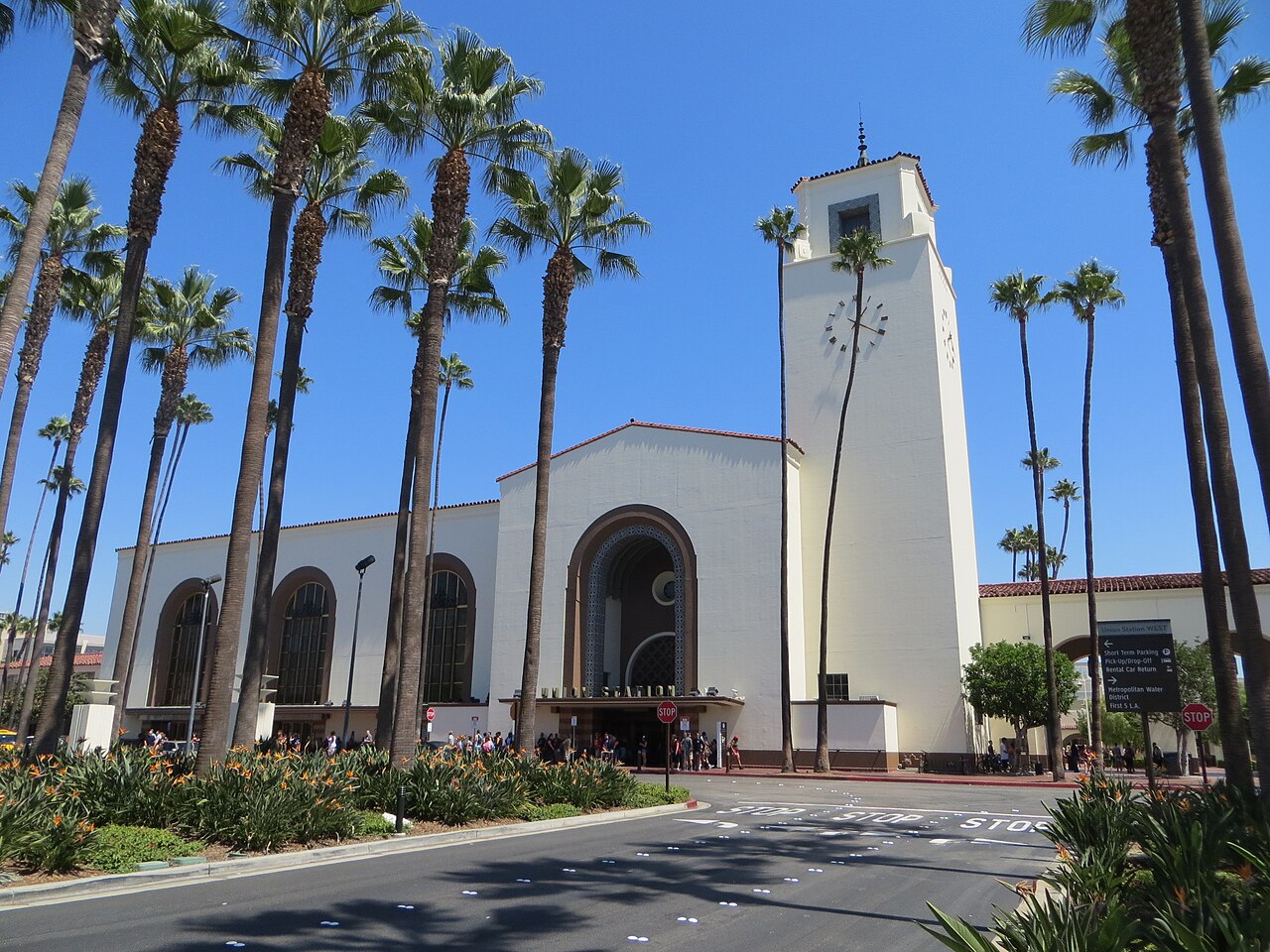
1939
A single large terminal building combining Art Deco, Mission Revival and Streamline Moderne detailing in one structure, unlike the single-style stations built elsewhere in the country during the same period.
Los Angeles Union Station opened in May 1939 as the city's main railroad terminal, replacing three separate stations after a contested 1926 ballot measure approved its construction. It consolidated services from the Santa Fe, Southern Pacific and Union Pacific railroads, combining Art Deco, Mission Revival and Streamline Moderne styles in a building later called the last of the great American railway stations. It was built on land cleared through the demolition of Chinatown, where construction later uncovered remains of the Tongva village of Yaanga. The station has been listed on the National Register of Historic Places since 1980.
- Construction uncovered archaeological remains of the Tongva village of Yaanga, since the station sits on fill placed over the original Chinatown, itself built over the earlier Indian settlement.
- In 1948 a Santa Fe Super Chief train lost its brakes coming into the station and punched through a steel bumper and concrete wall, leaving its front end dangling over the street outside; no one was hurt, but the engineer lost his job.
- The chosen site placed the station in the city's original Chinatown, rather than the more fiercely disputed Plaza location proposed in the same 1926 ballot measure, and Chinatown was demolished to make way for it.
Photo: David Wilson from Oak Park, Illinois, USA (CC BY 2.0)
Cathedral of Our Lady of the Angels
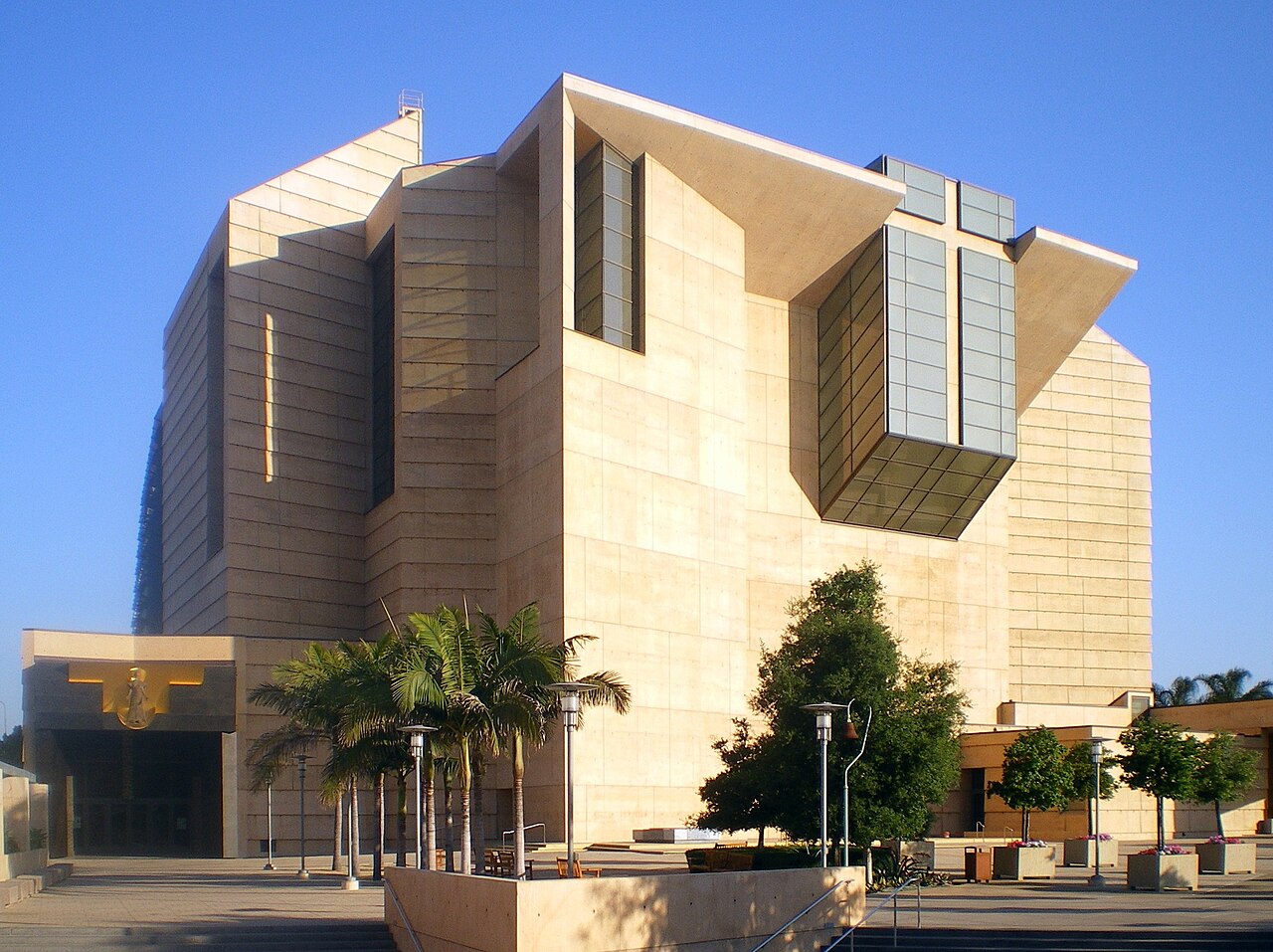
1998–2002 · Rafael Moneo
A large concrete cathedral built almost entirely from acute and obtuse angles rather than right angles, its plaza entrance marked by oversized bronze doors and a bronze statue of the Virgin Mary.
The Cathedral of Our Lady of the Angels is the metropolitan cathedral of the Roman Catholic Church in Los Angeles and the mother church of its archdiocese, serving about five million professed Catholics. Designed by Rafael Moneo and built between 1998 and 2002 under Cardinal Roger Mahony, it replaced the nineteenth-century Cathedral of Saint Vibiana, severely damaged in the 1994 Northridge earthquake. Its deconstructivist design, chosen from 38 international submissions, drew controversy over its modern style, cost and an underground crypt. The building holds relics of Saint Vibiana and a fragment of the tilma worn by Juan Diego.
- The cathedral holds relics of Saint Vibiana, whose earlier, earthquake-damaged cathedral it replaced, along with a fragment of the tilma once worn by the sixteenth-century saint Juan Diego.
- Its design, chosen from 38 international submissions by a jury drawn from institutions including Harvard and the American Academy in Rome, deliberately avoids right angles throughout the building.
- Solar panels on the complex generate about 15 percent of its electricity.
Photo: Los Angeles (CC BY-SA 4.0)
Westin Bonaventure Hotel
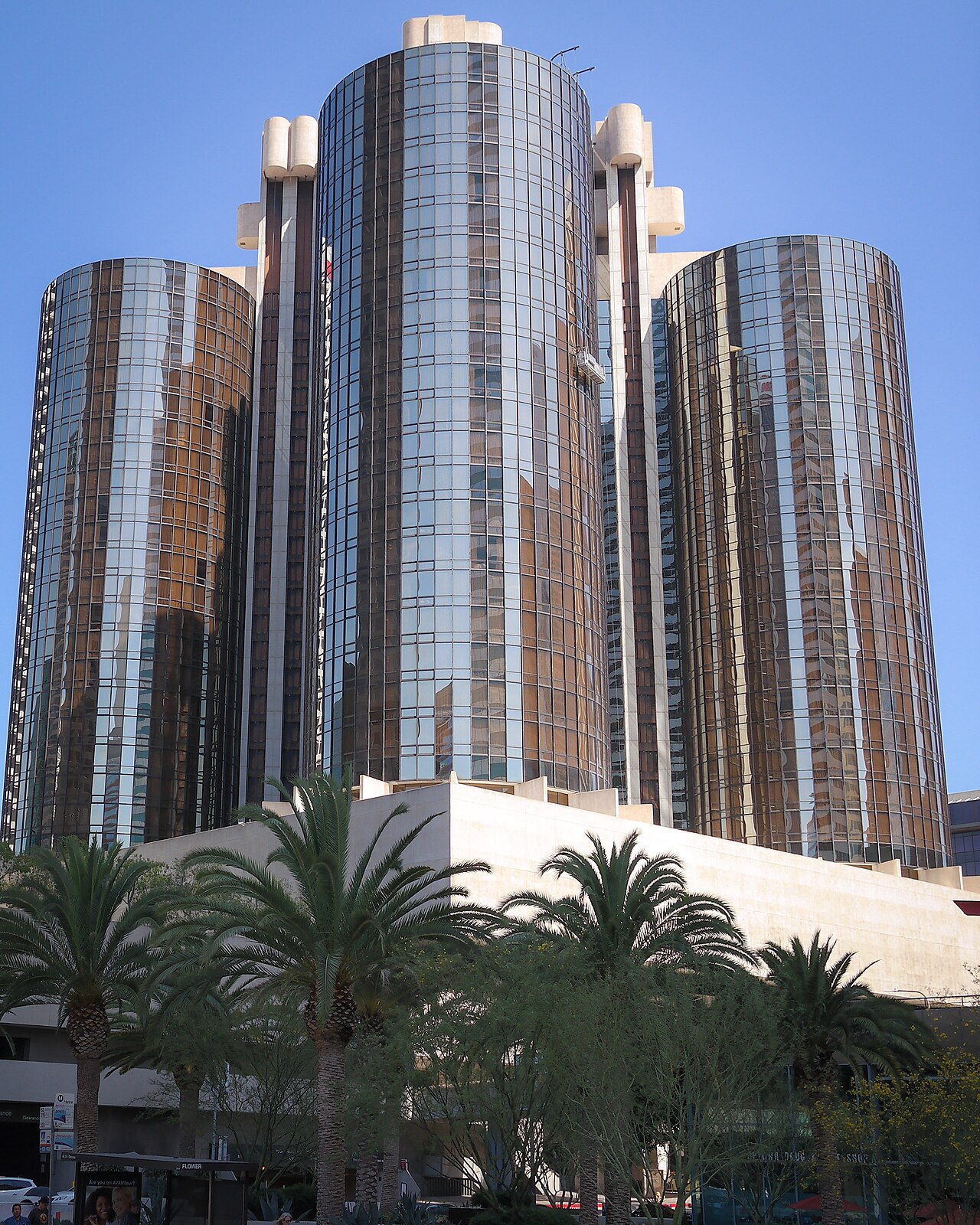
1974–1977 · John C. Portman Jr.
Four towers rise together to a shared top floor holding a revolving restaurant and bar; internally, four elevator banks distinguished by colour and symbol rather than by number connect the towers, one bank alone continuing to the very top.
Built between 1974 and 1977 to a design by John C. Portman Jr., this 367-foot, 33-storey hotel rises as four towers sharing a revolving restaurant and bar on the top floor, numbered 35 because no floor carries the number seven or thirteen. Four colour-and-symbol-coded elevator banks, only one of which reaches the top floor, were introduced after visitors found the building's internal layout too confusing to navigate unaided. Marxist critic Fredric Jameson used the hotel as a central example in his 1984 essay on postmodernism, and geographer Edward Soja later described it in similar terms.
- The colour-coded elevator system was a later addition, introduced only after visitors found the original layout too confusing to navigate on their own.
- Bronze plaques inside commemorate elevator scenes filmed for three different films within a span of fourteen months in 1993 and 1994.
- While still under construction, the building appeared in a 1975 film released a year before the hotel itself opened.
Photo: Visitor7 (CC BY-SA 3.0)
Dodger Stadium
A ballpark in Elysian Park, home of the Los Angeles Dodgers since it opened in 1962. It is the largest baseball stadium in the world by seating capacity and the third-oldest in Major League Baseball, after Fenway Park and Wrigley Field.
Angels Flight
A narrow-gauge funicular in Bunker Hill, its two cars, Olivet and Sinai, sharing a single cable. It ran at its original site from 1901 to 1969, reopened nearby in 1996, closed after a fatal accident in 2001, and reopened again in 2010.
Wilshire Grand Center
A 1,100-foot skyscraper occupying an entire block of downtown Los Angeles's financial district, completed in 2017. Including its spire, it is the tallest building in the United States west of Chicago, ranked 15th-tallest in the country and 95th-tallest in the world.
U.S. Bank Tower
A 1,018-foot skyscraper in the Financial District, known locally as the Library Tower, built between 1987 and 1989 to a design by Henry N. Cobb. It often appears in film and television establishing shots, and is the city's second-tallest building.
Central Library
The main branch of the Los Angeles Public Library, named after Mayor Richard Riordan. It comprises the Goodhue Building of 1926, listed on the National Register of Historic Places in 1970, and the Tom Bradley addition of 1993.
The Broad
A contemporary art museum on Grand Avenue, opened on 20 September 2015. Named for philanthropists Eli and Edythe Broad, who financed the $140 million building, it offers free general admission to its permanent collection galleries.
MacArthur Park
A park dating to the late 19th century, originally called Westlake Park, renamed in the early 1940s after General Douglas MacArthur. Its lake is fed by natural springs, though an artificial bottom was added during construction of the Red Line, which opened in 1993.
Echo Park Lake
A lake and urban park in Echo Park, originally built in the 1860s as a drinking-water reservoir. Now functioning mainly as a storm-drain detention basin, it hosts community events such as the annual Lotus Festival, and underwent a major renovation completed in 2013.
Bullocks Wilshire
A 230,000-square-foot Art Deco building on Wilshire Boulevard, opened in 1929 as a luxury department store and flagship of the seven-store Bullocks Wilshire chain. Rebranded as I. Magnin by Macy's in 1989 and closed in 1994, it is now owned by Southwestern Law School.
El Pueblo de Los Ángeles Historical Monument
A historic district taking in the oldest section of Los Angeles, its old plaza the city's centre under Spanish, Mexican and American rule. The 44-acre park was designated a state historic monument in 1953 and listed on the National Register of Historic Places in 1972.
Million Dollar Theatre
One of the first movie palaces built in the United States, opened in 1917 with the premiere of The Silent Man. The northernmost of Broadway's historic theatres, it stands across from the Bradbury Building and is listed on the National Register of Historic Places.
Dorothy Chandler Pavilion
One of the halls of the Los Angeles Music Center, alongside the Mark Taper Forum, Ahmanson Theatre and Walt Disney Concert Hall. It hosted the Academy Awards through most years from 1969 to 1999, before becoming home to the Los Angeles Opera.
Homer Laughlin Building
A landmark building at 317 South Broadway, best known for its ground-floor tenant. It houses the Grand Central Market, the city's largest and oldest public market.
The Biltmore
A historic hotel opened in 1923, opposite Pershing Square in Downtown Los Angeles. It has 70,000 square feet of meeting and banquet space, and now has 683 guestrooms, down from the original 1,500.
Clifton's Cafeteria
A cafeteria founded in 1931 by Clifford Clinton, whose name combined 'Clifford' and 'Clinton'. Its kitschy, theatrical decor grew to include fake redwood trees and stuffed lions, and it was the largest public cafeteria in the world when it closed in 2018.
Bradbury Building
A five-story office building built in 1893, commissioned by gold-mining millionaire Lewis L. Bradbury and known for its skylit atrium of ironwork walkways, stairs and elevators. Designated a National Historic Landmark in 1977, it is the city's oldest landmarked building.
Triforium
A 60-foot concrete public art sculpture at Fletcher Bowron Square in the Civic Center district, mounted with 1,494 Venetian glass prisms and light bulbs. It also contains an internal 79-bell carillon.
Grand Park
A 12-acre park in the civic centre, first developed in 1966 as the Civic Center Mall before reopening as Grand Park in 2012. Designed by Rios Clementi Hale Studios, it stretches between Los Angeles City Hall and the Music Center, connecting Bunker Hill to downtown.
Pershing Square
A one-block public park in Downtown Los Angeles, originally dedicated in 1866 by Mayor Cristóbal Aguilar as La Plaza Abaja. After several name changes, it was finally dedicated in honour of General John J. Pershing in 1918.
Cathedral of Saint Vibiana
The former Catholic cathedral for the Archdiocese of Los Angeles, opened in 1876. Serving as the official cathedral for over a century, it was heavily damaged in the 1994 Northridge earthquake and later became a secular events venue.
Museum of Contemporary Art
A contemporary art museum with two Los Angeles locations: the main museum on Grand Avenue, and the Geffen Contemporary in Little Tokyo, originally meant as temporary space. Its collection, focused on American and European art made after 1940, includes nearly 8,000 objects as of 2026.
L.A. Live
An entertainment complex in the South Park District, adjacent to the Crypto.com Arena, developed by Anschutz Entertainment Group at a cost of about $2.5 billion. It is part of the 'Downtown Sports Park' cluster, alongside the arena and Convention Center, for the 2028 Summer Olympics.
History
The area was originally home to the indigenous Tongva people before growing into the seat of a basin city bordered by the Santa Monica Mountains and the San Fernando Valley. Downtown's Civic Center, the heart of the central business district in the 1880s and 1890s, later filled with the city's defining civic architecture: Los Angeles City Hall, an Art Deco tower completed in 1928 that stood as the tallest building in the city until 1966 and remains the tallest base-isolated structure anywhere. Griffith Observatory, also Art Deco, opened in 1935 on a hillside in Griffith Park, free to the public under the terms of its founder's will. Downtown architecture turned sharply in 2003, when Frank Gehry's deconstructivist Walt Disney Concert Hall, funded by a Disney family gift, opened as the fourth hall of the city's music center.