Landmarks in Warsaw
Rebuilt almost from rubble after 1944, its old town sits beside a Soviet-era skyline.
Warsaw's landmarks sit close together around the Vistula's western bank, in a core rebuilt almost entirely after 1944 and layered with later additions. Brick and stucco Old Town buildings, reconstructed to their historic appearance, stand within walking distance of a single Soviet-era high-rise that still dominates the skyline it was built to crown. Baroque palaces from the Commonwealth era sit further out, in garden districts once separate from the city proper. Gothic origins survive mostly as later shells: a medieval church core carries Baroque and neoclassical rebuilding, and a fortified gatehouse is one of the few fragments left from walls torn down as the city outgrew them. The result is a centre where reconstruction, not survival, explains most of what stands.
Royal Castle
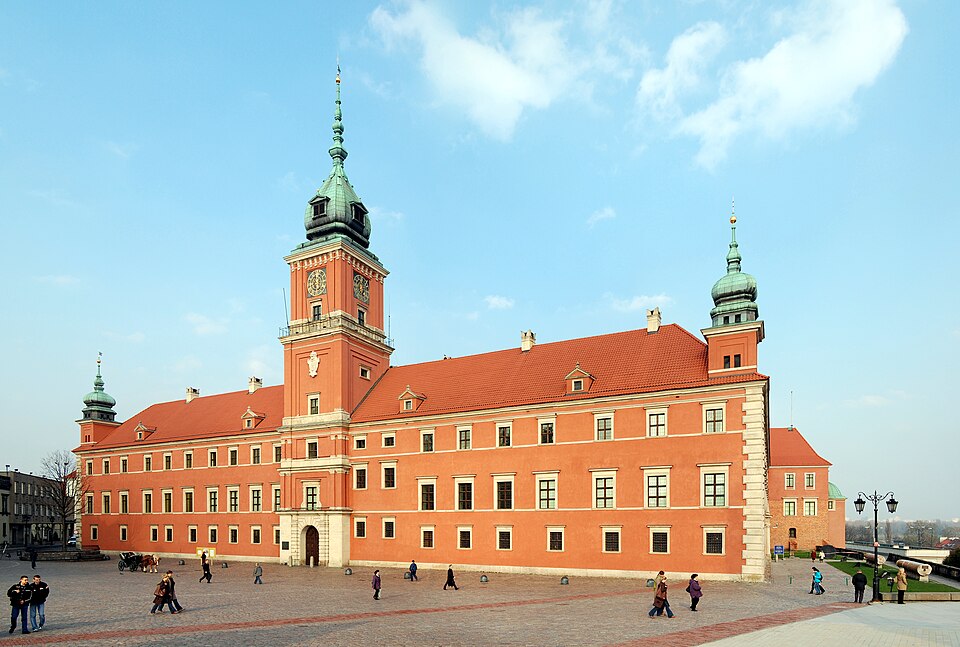
1619–1984 · Giovanni Battista Trevano
A rebuilt palace fronting the wide Castle Square where the Old Town begins, incorporating the Kubicki Arcades below and the adjoining Copper-Roof Palace, its exterior remade in neoclassical style after Poland's eighteenth-century partitions replaced an earlier form.
Built from 1619 as the official residence of Poland's monarchs, the castle housed the king's personal offices and the royal court's administration until the final partition of Poland in 1795. The Constitution of 3 May 1791 was drafted here. Redesigned in neoclassical style after the partitions, it later served as the seat of the interwar Polish presidency. German forces destroyed it after the 1944 Warsaw Uprising; only wall fragments survived, registered as monuments in 1965 and used to guide a full reconstruction completed in 1984.
- The Constitution of 3 May 1791, Europe's first and the world's second-oldest codified national constitution, was drafted inside the castle.
- It served as the seat of the Polish head of state and president during the Second Polish Republic, between 1918 and 1939.
Photo: Marcin Białek (CC BY-SA 3.0)
Palace of Culture and Science
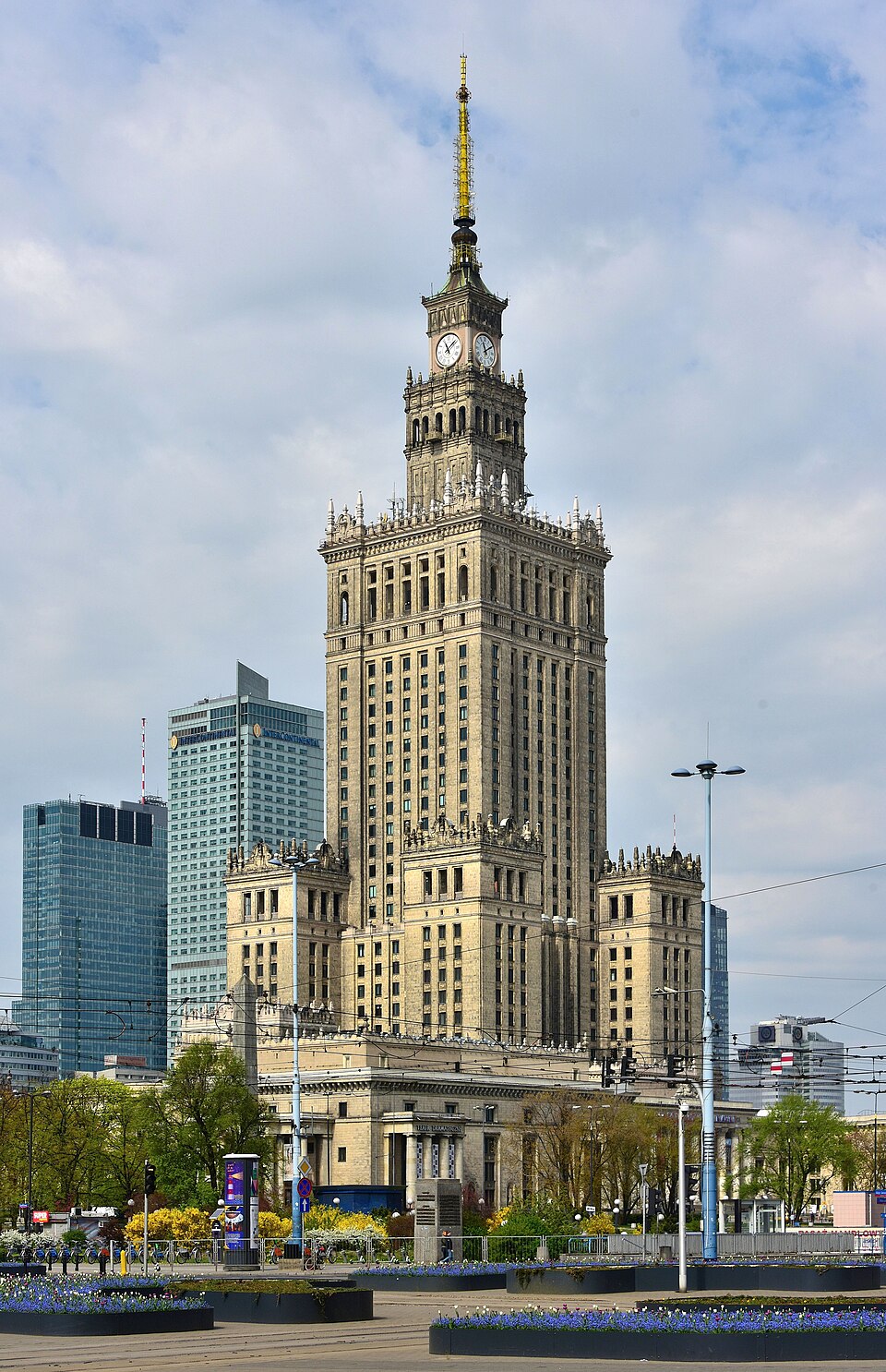
1955 · Lev Rudnev
A 237-metre stepped tower in the 'Seven Sisters' style, its tiers narrowing toward a spire and clock, with sculptures of the astronomer Copernicus and the poet Adam Mickiewicz flanking its main entrance.
Designed by Soviet architect Lev Rudnev and completed in 1955, the high-rise draws on Polish historical architecture and American art deco towers of the 1920s and 1930s. At 237 metres it was briefly the world's eighth-tallest building and remains the second-tallest in the city. It houses theatres, museums, a university, a cinema, a concert hall, a swimming pool and the Polish Academy of Sciences, and has been listed on Poland's heritage register since 2007.
- From 2000 to 2002 it held the world record for tallest clock tower, until a clock mechanism was installed on Tokyo's NTT Docomo Yoyogi Building.
- At its 1955 completion it ranked as the eighth-tallest building on Earth, a position it kept until 1961.
Photo: Adrian Grycuk (CC BY-SA 3.0 pl)
Wilanów Palace
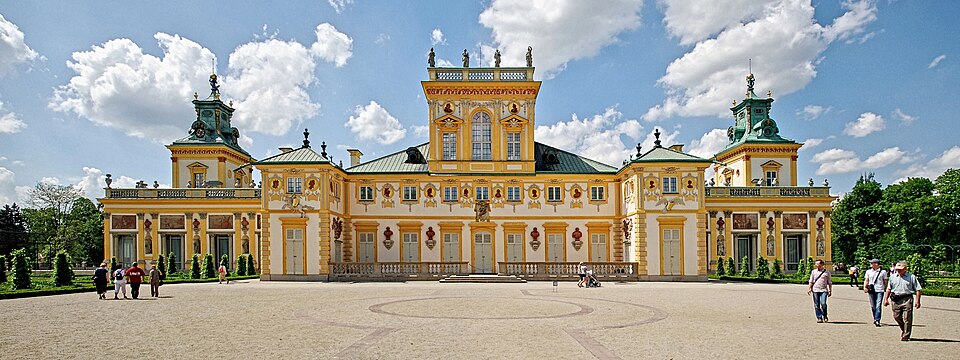
1677–1696 · Augustyn Wincenty Locci
A baroque palace opening onto formal gardens that include a Rose Garden used for summer concerts, its museum, established in 1805, housing Poland's royal and artistic collections and drawing about three million visitors a year.
Built between 1677 and 1696 to a design by Augustyn Wincenty Locci for King John III Sobieski, the palace is among the country's most complete examples of baroque architecture. Its museum opened in 1805 and now holds one of Poland's principal collections of royal and artistic heritage. The palace and its park, including the Rose Garden, host concerts and an early-music academy each summer. Designated a national Historic Monument in 1994, it has belonged to the international Association of the Royal Residences of Europe since 2006.
- It survived both World Wars intact, unlike many of the city's other historic buildings.
- Its museum draws around three million visitors a year, making it one of the most visited palace museums anywhere.
Photo: This photo was taken by Przemysław Jahr Autorem zdjęcia jest Przemysław Jahr Wykorzystując zdjęcie proszę podać jako autora: Przemysław Jahr / Wikimedia Commons (Public domain)
St. Anne's Church
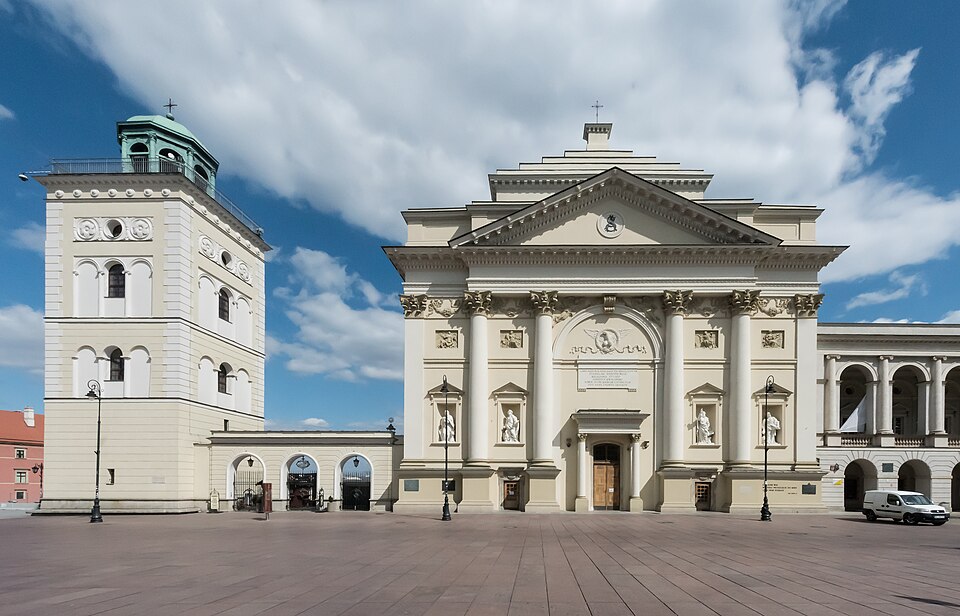
1788
A church with a neoclassical facade unchanged since 1788 despite Gothic origins and Baroque-era rebuilding, standing on Krakowskie Przedmieście beside the Castle Square entrance to the Old Town.
Among the oldest buildings in central Warsaw, the church has been rebuilt repeatedly since its medieval founding, acquiring Baroque additions and, by 1788, the neoclassical facade that still defines it. Architects credited with work on the building over the centuries include Giovanni Battista Gisleni, Tylman van Gameren and Chrystian Piotr Aigner, though the brief does not specify which phase each carried out. The church now serves as the main parish for Warsaw's academic community, at Krakowskie Przedmieście 68, next to the Castle Square.
Photo: Adrian Grycuk (CC BY-SA 3.0 pl)
Warsaw Barbican
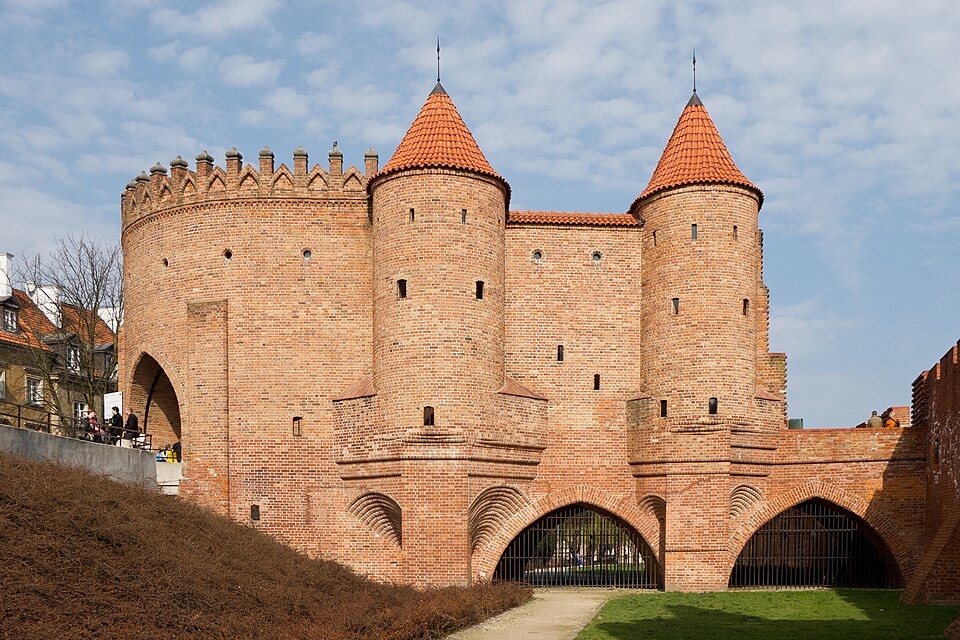
1548 · Jan Baptysta Wenecjanin
A semicircular fortified outpost in Renaissance style, one of the last surviving fragments of the old defensive walls, spanning the passage between the Old and New Towns.
Designed by Jan Baptysta Wenecjanin and completed in 1548, the barbican was a semicircular fortified outpost defending the passage between Warsaw's Old and New Towns. It survives as one of only a few relics of the network of fortifications that once encircled the city entirely. Stripped of its military purpose long ago, it is now a major tourist attraction on the route between the two districts.
Photo: Carlos Delgado (CC BY-SA 3.0 pl)
Stadion Narodowy
A retractable-roof football stadium with a seating capacity of 58,580, the largest in Poland, built between 2008 and November 2011 on the site of the former 10th-Anniversary Stadium. Known as PGE Narodowy since 2015, its PVC roof unfolds from a suspended spire inspired by Commerzbank-Arena.
Łazienki Park
The largest park in Warsaw at 76 hectares, part of the Royal Route linking the Royal Castle to Wilanów Palace. Most of its buildings, including an ornate bathing pavilion, were designed in the 17th century by Tylman van Gameren for commander Stanisław Herakliusz Lubomirski.
Sigismund's Column
Erected in 1644 at Castle Square, considered the first secular column monument in modern history. It commemorates King Sigismund III Vasa, who moved Poland's capital from Kraków to Warsaw in 1596, and is part of the UNESCO-listed Historic Centre of Warsaw.
Palace on the Isle
A classicist palace in the Royal Baths Park, commissioned as a Baroque bath-house from 1674 by Prince Stanisław Herakliusz Lubomirski. In 1766 King Stanisław August Poniatowski bought the estate and converted it into a classicist summer residence with an English garden.
Castle Square
A historic, roughly triangular square in front of the Royal Castle, the former official residence of Polish monarchs. Surrounded by historic townhouses and marked by Sigismund's Column, it is a popular meeting place and the starting point of the Royal Route.
Mermaid Monument
A zinc sculpture in the Old Town Market Place, a 2008 replica of the original by Konstanty Hegel, unveiled in 1855 and now held in the Museum of Warsaw. It depicts the Mermaid of Warsaw, the city's symbol, as a melusine with a raised sword.
Tomb of the Unknown Soldier
A monument at Piłsudski Square, the only surviving part of the Saxon Palace that stood there until World War II. Since 2 November 1925 it has housed the body of an unidentified soldier who fell in the Defence of Lwów, lit by an eternal flame.
University Library
Established in 1816 with the founding of the Royal Warsaw University, its first director was linguist Samuel Linde. By 1831 it held more than 134,000 volumes, though the November Uprising that year triggered a temporary closure and confiscation of books by Russian authorities.
Saxon Garden
A 15.5-hectare public garden facing Piłsudski Square, the oldest public park in the city. Founded in the late 17th century, it opened to the public in 1727 as one of the first publicly accessible parks in the world.
Hotel Bristol
A five-star Neo-Renaissance hotel opened in 1901 on Krakowskie Przedmieście, next to the Presidential Palace. One of the few Warsaw landmarks to survive World War II relatively unscathed, it is considered one of the city's oldest and the country's most luxurious hotels.
Piłsudski Square
The largest city square in Poland's capital, named for Marshal Józef Piłsudski, who played a key role in restoring Polish statehood after World War I.
Varso
A neomodern office complex designed by Foster + Partners, whose main building, Varso Tower, is the tallest in Poland and the European Union at 310 metres. Topped out in February 2021 and completed in September 2022, it opened an observation deck in September 2025.
Sejm and Senate Complex
A complex of buildings in central Warsaw housing the bicameral Polish parliament, its construction begun after Poland regained independence in 1918. Expansion has continued ever since, with a new building under construction since 2014, and all structures are managed by the Chancellery of the Sejm.
Presidential Palace
The official residence of Poland's president, originally built in 1643 as an aristocratic mansion and rebuilt into its current neoclassical form by 1818. In 1791 it hosted the authors of the Constitution of 3 May 1791, the first modern European constitution.
Holy Cross Church
A Roman Catholic church on Krakowskie Przedmieście, opposite the main Warsaw University campus, considered one of the most notable Baroque churches in the capital. Its interior holds the embalmed heart of composer Frédéric Chopin.
St. John's Archcathedral
A Brick Gothic cathedral on Świętojańska Street in the Old Town, the mother church of the Archdiocese of Warsaw and one of Poland's national pantheons. The only archcathedral among the city's three major cathedrals, it is a UNESCO World Heritage Site.
Grand Theatre
A theatre and opera complex on Theatre Square, home to the Polish National Ballet. Inaugurated in 1833 with Rossini's The Barber of Seville, it was destroyed in World War II and reopened, after two decades closed, on 19 November 1965.
Nicolaus Copernicus Monument
A monument standing before the Staszic Palace, seat of the Polish Academy of Sciences, on Krakowskie Przedmieście. Designed by Bertel Thorvaldsen in 1822 and completed in 1830, his original plaster model is held today by the Thorvaldsen Museum in Copenhagen.
Nożyk Synagogue
An Orthodox synagogue at 6 Twarda Street, designed by Karol Kozłowski in Romanesque Revival style and completed in 1902. The only surviving prewar synagogue in Warsaw, it was desecrated by the Nazis, restored after the war, and remains operational, also housing the Warsaw Jewish Commune.
National Museum
A national art museum established in 1862 as the Museum of Fine Arts, Warsaw, and renamed in 1916. Its collections include roughly 11,000 pieces of ancient art and Poland's largest collection of Chinese art, drawing more than 1.5 million visitors in 2025.
Zachęta – National Gallery of Art
A contemporary art museum whose name means 'encouragement,' taken from the Society for the Encouragement of the Fine Arts, founded in Warsaw in 1860. It presents and supports Polish contemporary art, and has built an international reputation through exhibitions of well-known foreign artists.
Ujazdów Castle
A castle in the historic Ujazdów district dating to the 13th century and rebuilt several times since. Badly damaged in the 1944 Warsaw Uprising, it was reconstructed in 1974 and now houses Warsaw's Center for Contemporary Art.
Złota 44
A 192-metre, 52-storey residential skyscraper designed by Polish-American architect Daniel Libeskind, who drew inspiration from the shape of an eagle's wing to symbolize a changing Poland and freedom. It is sometimes nicknamed Żagiel, meaning 'sail.'
Copernicus Science Centre
A science museum on the bank of the Vistula River, with more than 450 interactive exhibits letting visitors carry out experiments themselves. The largest institution of its kind in Poland, it had drawn over 8 million visitors by 2018.
St. Florian's Cathedral
A Roman Catholic minor basilica dedicated to St. Florian, more formally the Cathedral of St. Michael the Archangel and St. Florian the Martyr. It stands at 3 Floriańska Street in the Praga-Północ district.
History
Warsaw began as a fishing settlement that became the seat of the Duchy of Masovia in 1413. It gained lasting importance in 1596, when Sigismund III moved the royal court from Kraków, and by the 18th century it had overtaken Gdańsk as Poland's largest city. As capital of the Polish-Lithuanian Commonwealth until 1795, and then of Napoleon's Duchy of Warsaw, it acquired the palaces and churches that still anchor its old quarters. Nineteenth-century industrial growth added boulevards and packed the city with new residents. The Second World War brought near-total destruction of the historic centre, including the deliberate demolition of the royal residence after the 1944 uprising. Postwar reconstruction rebuilt the Old Town from surviving fragments and added the socialist-era high-rise that has defined the skyline since 1955.