Landmarks in Krakow
A royal capital whose Gothic and Renaissance core has stood largely unchanged since 1596.
Kraków's landmarks cluster around two points that have anchored the city since the Middle Ages: Wawel Hill, where a limestone outcrop above the river carries a royal castle and cathedral built up in stages of Romanesque, Gothic, Renaissance and Baroque work, and the Main Market Square, ringed by the brick Gothic towers of St. Mary's Basilica and crossed by the Renaissance-arcaded Cloth Hall. A stretch of the medieval defences survives at St. Florian's Gate, a rough-stone tower raised as part of the walls that once enclosed the whole Old Town. The mix of styles reflects Kraków's long run as a royal seat and Commonwealth capital until 1596, after which the court's move to Warsaw left the centre largely as it already was.
Wawel Castle
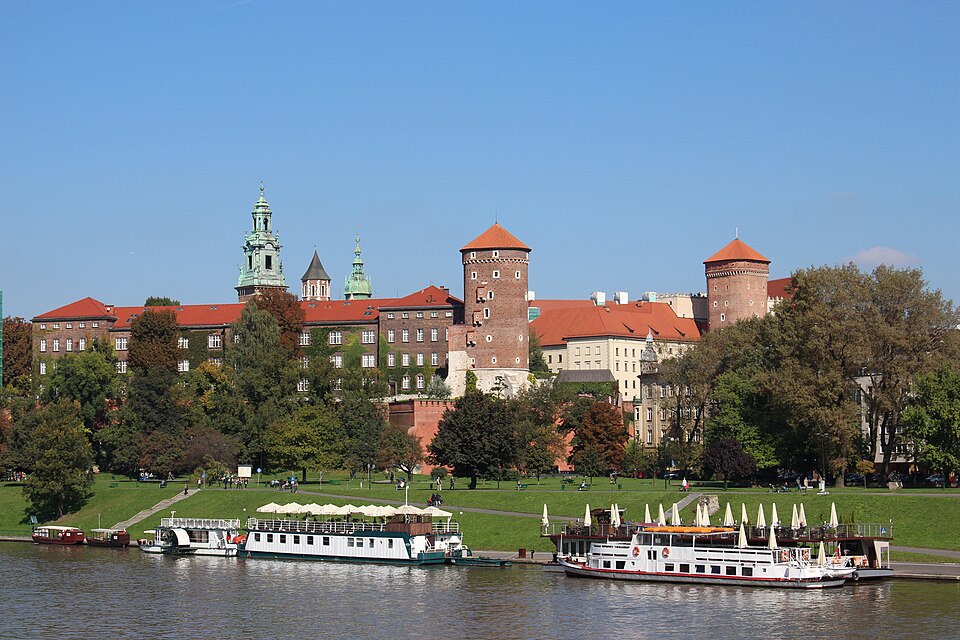
1504 · Francesco Fiorentino
A pale stone hilltop complex where Gothic towers meet a three-storey Renaissance courtyard lined with open arcaded galleries on all four sides, overlooking a curve of the river below.
Wawel Castle began as a fortified royal residence on a limestone outcrop above the Vistula, established by order of Casimir III the Great; some of its stone foundations trace back to around 970 CE. The present castle, raised in the fourteenth century, was expanded over the following centuries, with a major Renaissance rebuilding from 1504 credited to Francesco Fiorentino and continued by Bartolommeo Berrecci, Mikołaj Castiglione, Giovanni Battista Trevano, Kacper Bażanka and Domenico Merlini. Home to Polish monarchs until 1596, it now operates as a history museum.
- It drew over 3.47 million visitors in 2025, making it the most-visited art museum in Poland and the 14th most-visited art museum in the world.
- Some of its stone foundations date to around 970 CE, among the oldest masonry in Poland.
- It was declared the first World Heritage Site as part of the Historic Centre of Kraków in 1978.
Photo: Stanislau 93 (CC BY-SA 3.0 pl)
St. Mary's Basilica
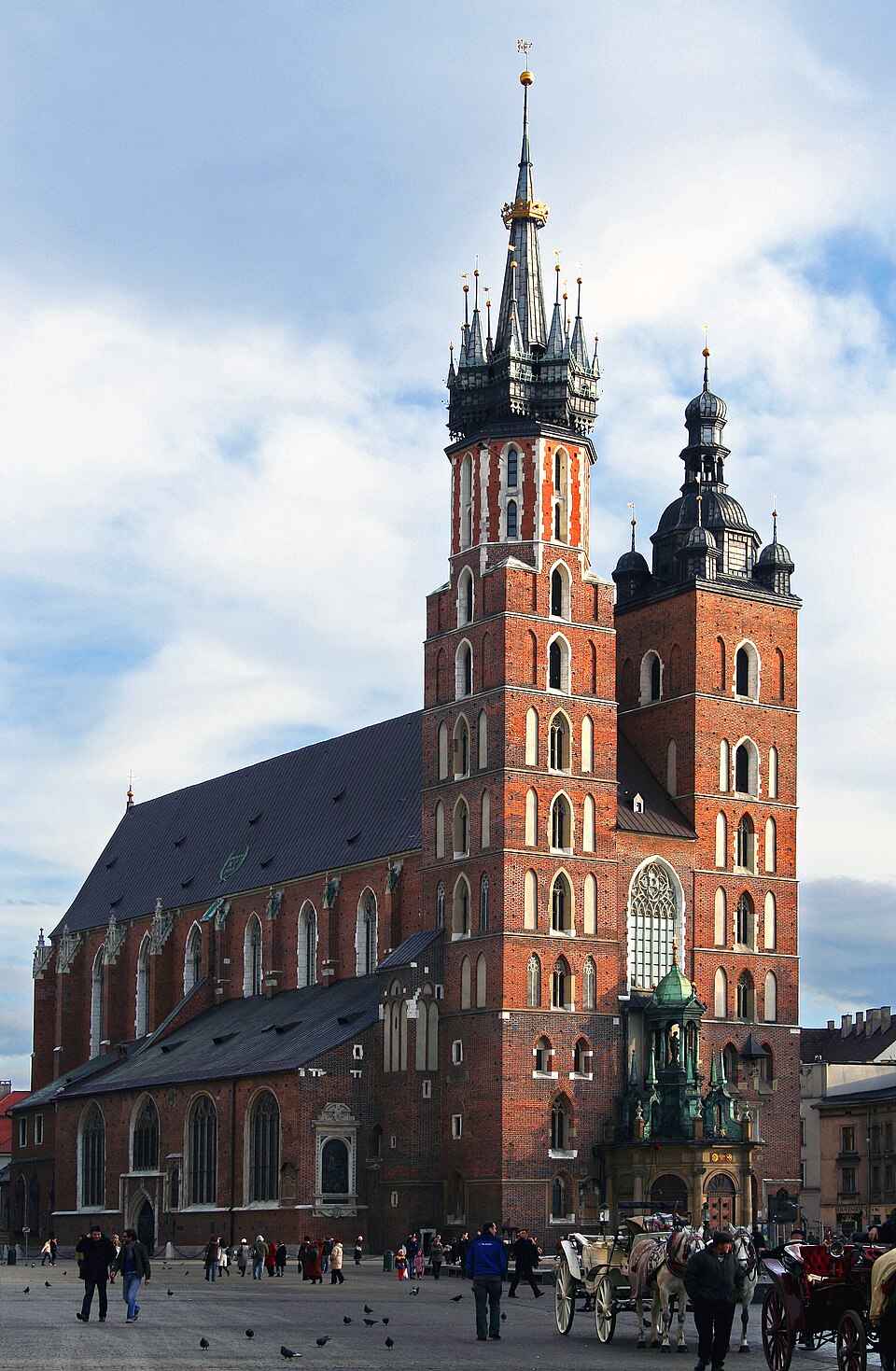
1347
Two unequal Gothic brick towers rise over a market square, the taller crowned with a spired gilded helmet from which a trumpet sounds every hour; inside, a tall carved and painted wooden altarpiece dominates the nave.
St. Mary's Basilica is a Roman Catholic parish church on the Main Market Square, built in Brick Gothic style in the fourteenth century over foundations laid in the early thirteenth. It is known for a monumental wooden altarpiece carved by Veit Stoss and for later polychrome murals designed by Jan Matejko. Every hour, a trumpet signal is sounded from its taller tower and breaks off mid-note; the basilica was included in Kraków's Old Town UNESCO listing in 1978.
- The hourly trumpet call breaks off abruptly at the same point each time, a tradition linked to a legend of a trumpeter shot in the throat, though the earliest known written version of that story appears in a 1928 American novel.
- The taller of its two towers stands 80 metres high.
- Its wooden altarpiece was carved by Veit Stoss.
Photo: Pgkos (CC BY-SA 4.0)
Krakow Cloth Hall
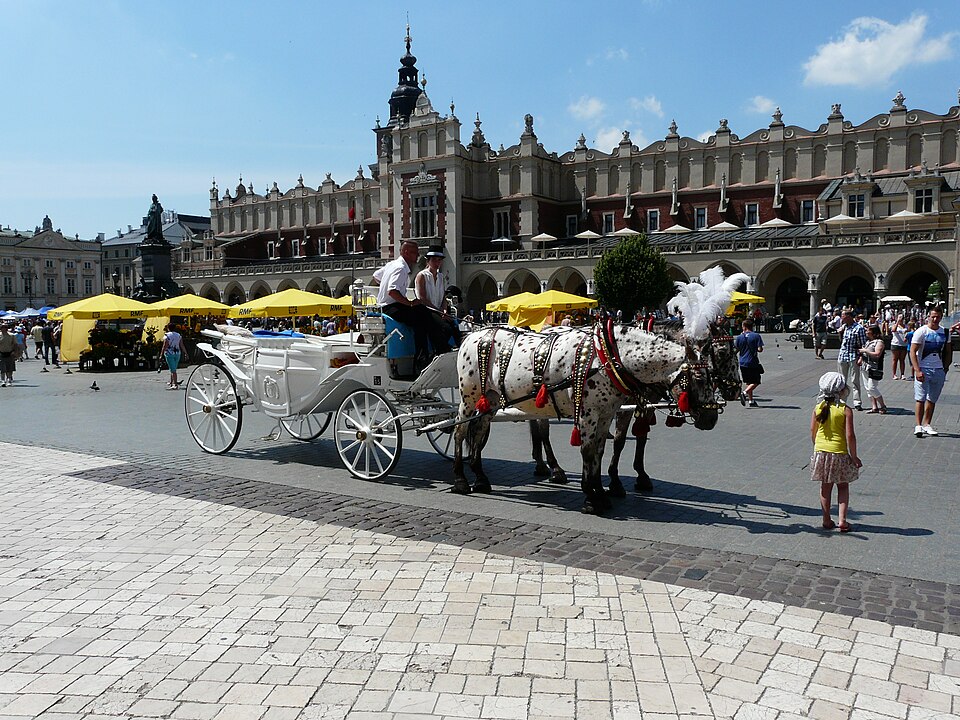
1555 · Giammaria Mosca
A long, low Renaissance hall with an arcaded ground floor and a decorative stone parapet of masks and finials along its roofline, standing down the middle of the market square between two Gothic towers.
The Cloth Hall stands at the centre of the Main Market Square in Kraków's Old Town and takes its present Renaissance form from 1555, work credited to the sculptor and architect Giammaria Mosca. Built to house the wholesale cloth trade that gives it its name, it is one of the square's most recognisable structures and now contains a museum. Since 1978 it has formed part of the Old Town's UNESCO World Heritage listing.
Photo: User:Piotrus (CC BY-SA 3.0)
Wawel Cathedral
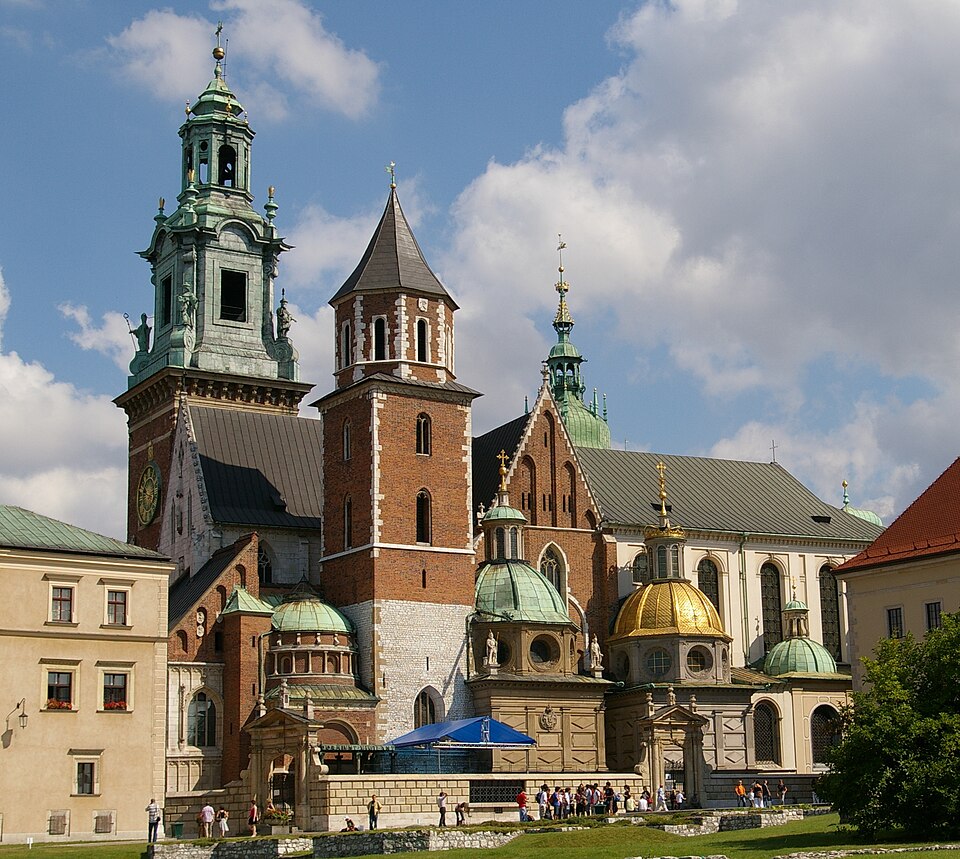
1364
A patchwork of Romanesque, Gothic, Renaissance and Baroque work topped by a gilded, onion-domed royal chapel that stands out in gold against the cathedral's grey stone.
Wawel Cathedral is the third church built on this site: the first, from the eleventh century, and the second, from the twelfth, were both destroyed, the latter by a fire in 1305. Construction of the present Gothic cathedral began in the fourteenth century on the orders of Bishop Nanker and was expanded over the following centuries with Renaissance, Baroque, Neoclassical and Neogothic additions, including later work attributed to Giovanni Battista Trevano and Giovanni Battista Gisleni. It served as the coronation and burial site of Polish monarchs.
- The present cathedral is the third church built on the site; its two predecessors, raised in the eleventh and twelfth centuries, were both destroyed, the second by a fire in 1305.
- Its most striking side chapel is capped with a gilded dome.
Photo: Jakub Hałun (CC BY-SA 3.0)
St. Florian's Gate
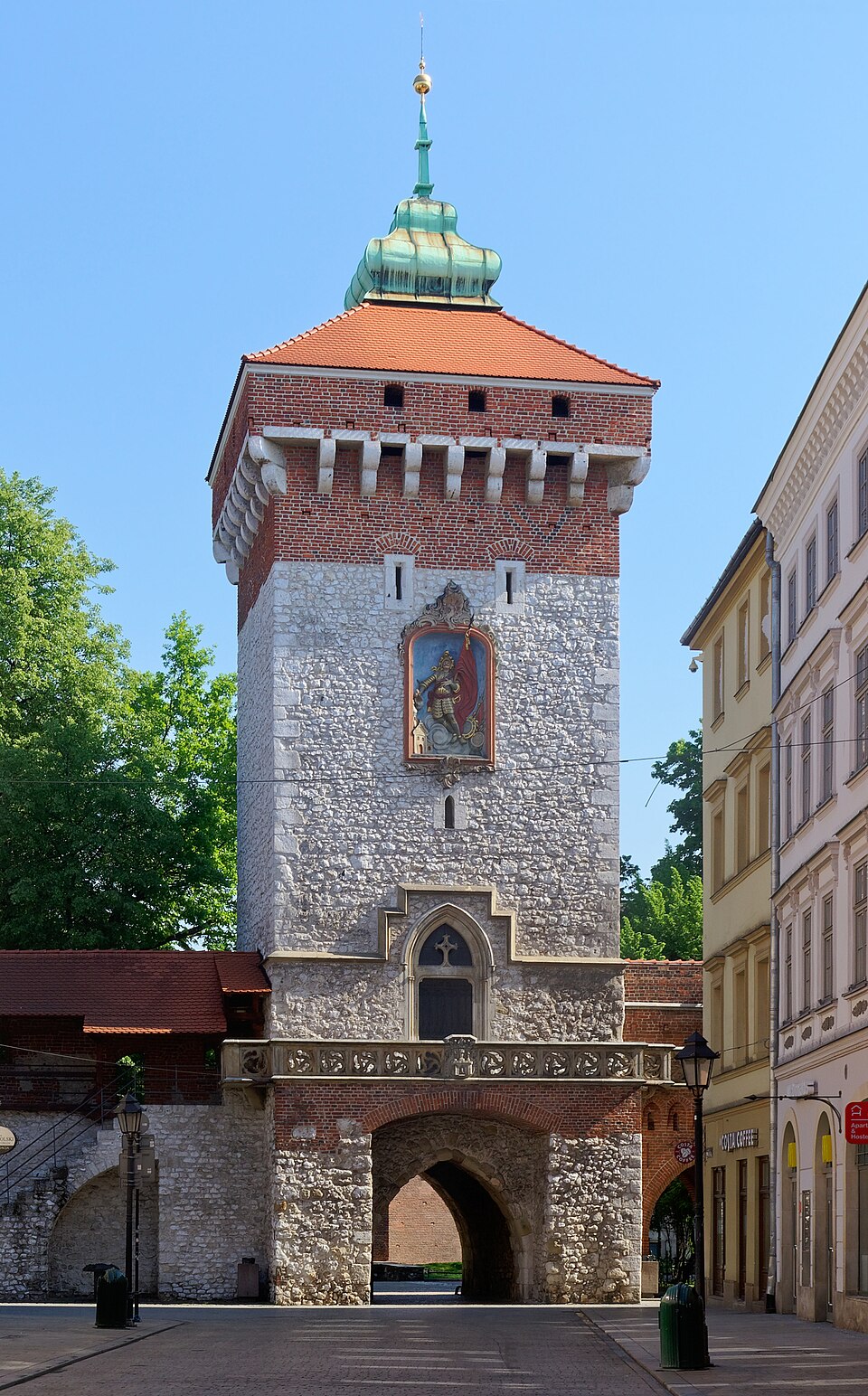
1307
A squat, rough-stone Gothic tower with a pointed roof, pierced by a single arched passage and set into a surviving stretch of medieval town wall.
St. Florian's Gate is a rectangular Gothic tower built of rough, unworked stone, raised about the fourteenth century as part of Kraków's town fortifications against the threat of Mongol attack. It is counted among the best-known Gothic towers in Poland and today forms a focal point of the Old Town, standing as one of the surviving gateways into the historic market district it once helped defend.
Photo: Jakub Hałun (CC BY-SA 4.0)
Town Hall Tower
The only surviving part of Kraków's old town hall, demolished in 1820 to open up the Main Market Square. Its cellars once held a city prison and torture chamber, and since 1967 the tower has been managed by the Historical Museum of Kraków.
Adam Mickiewicz Monument
A bronze monument standing in the Main Market Square of the Old Town.
Church of Saints Apostles Peter and Paul
A Baroque church on Grodzka Street, built between 1597 and 1619 by Giovanni Maria Bernardoni after an original design by Józef Britius. The largest of Kraków's historic churches by seating capacity, it has served the Catholic All Saints parish since 1842.
Old Synagogue
A former Orthodox fortress synagogue in Kazimierz, designed by Mateo Gucci the Younger in Gothic and Mannerist styles, completed sometime between 1407 and 1570. The oldest surviving synagogue in Poland, it was desecrated by Nazis in 1939 and now houses a Historical Museum branch.
Basilica of St. Francis of Assisi
A Roman Catholic church and friary dating to the 13th century, on All Saints Square opposite the Bishop's Palace where Pope John Paul II stayed during visits. Saint Maximilian Kolbe served as a friar here in 1919, leading his first service after Poland regained sovereignty.
Mogiła Abbey
A Cistercian monastery in Nowa Huta, founded in 1222 by the Bishop of Kraków, Iwo Odrowąż, and once the largest church in medieval Poland after Wawel Cathedral. Its complex includes a Gothic church, a Renaissance abbot's palace from around 1569, and a red-brick monastery.
Juliusz Słowacki Theatre
A 19th-century Eclectic-style theatre and opera house, erected in 1893 and modeled on European houses such as the Palais Garnier in Paris. Named after the poet Juliusz Słowacki in 1909, it was inscribed as a UNESCO World Heritage Site alongside Kraków's historic center in 1978.
Izaak Synagogue
A Baroque synagogue on Kupa Street in the Kazimierz district, designed by Francesco Olivierri and completed in 1644. It is named for its donor, the banker Izaak Jakubowicz, known as Isaac the Rich, who served King Ladislaus IV of Poland.
Church of St. Adalbert
One of Poland's oldest stone churches, standing at the corner of the Main Market Square and Grodzka Street, with roots almost 1,000 years old in early Polish Romanesque architecture. It was long a meeting place for merchants, citizens and nobility passing through the city.
Wawel Dragon
A statue at the foot of Wawel Hill, in front of the Dragon's Den, installed in 1972 to honor the mythical Wawel Dragon. It can breathe fire on command, and typically does so roughly every 15 minutes.
Kościuszko's Mound
An artificial mound raised by Cracovians to honor national leader Tadeusz Kościuszko, modeled after the city's prehistoric Krak and Wanda mounds. A serpentine path climbs to its summit, about 326 meters above sea level, for a panoramic view of the Vistula and the city.
Divine Mercy Sanctuary
A Roman Catholic basilica in the Łagiewniki district, built between 1999 and 2002 and dedicated to the devotion of Divine Mercy. It is the resting place of Saint Faustina Kowalska, visited by three popes and millions of pilgrims each year.
Church of St. Anne
A Roman Catholic parish and university church on św. Anny Street, one of the leading examples of Polish Baroque architecture, designed by Tylman van Gameren. Its history on the site traces back to the 14th century.
Tadeusz Kościuszko Monument
An equestrian bronze statue of Tadeusz Kościuszko, hero of the Polish and American wars of independence, standing at the west entrance to Wawel Castle. It is the work of sculptor Leonard Marconi and his son-in-law, Antoni Popiel, and ranks among Poland's best-known monuments.
Kraków Fortress
A network of fortifications encompassing the 19th-century Austro-Hungarian defenses in the narrow sense, and more broadly the 18th-century Kościuszko Insurrection works alongside the medieval Wawel Castle and city walls. It represents centuries of overlapping military construction around the city.
Jan Matejko House
A museum dedicated to the Polish painter Jan Matejko, established in 1895 and a branch of the National Museum in Kraków since 1904. The building has been a registered cultural property since 1931.
Ethnographic Museum of Kraków
The Seweryn Udziela Ethnographic Museum, established in 1902 in the Kazimierz district of Kraków.
Piłsudski's Mound
A mound built by the Polish people between 1934 and 1937 to honor Józef Piłsudski, in western Kraków's Sowiniec Heights. It is the newest and largest of the city's four mounds.
Błonia
A 48-hectare meadow park just west of the Old Town, its history dating to 1162 when a nobleman donated the land to Norbertine Nuns. Long used for grazing cattle and prone to flooding from the Rudawa river, it was later drained and improved.
Camaldolese Priory
A Camaldolese priory in the Bielany district, on the 326-meter Silver Mount, made up of hermitages and the Assumption of Mary Church.
Smocza Jama
A limestone cave in Wawel Hill, known in Poland for its location in the heart of the former capital and its connection to the legendary Wawel Dragon. Its name translates from Polish as dragon's den.
Wielopolski Palace
The seat of Kraków's City Council and the office of the city's president, located between All Saints Square and Deputies Street. The palace and its courtyard buildings serve as the official address of City Hall.
Sigismund's Chapel
A royal funerary chapel at Wawel Cathedral, built 1519-33 for the last Jagiellonian rulers, financed by King Sigismund I and designed by Italian architect Bartolomeo Berrecci. Topped by a golden dome, it houses the tombs of King Sigismund, Sigismund II Augustus, and Anna Jagiellon.
Polish Aviation Museum
A museum of historic aircraft and engines on the site of the former Kraków-Rakowice-Czyżyny Airport, one of the world's oldest, established in 1912. It opened in 1964 after the airfield closed, and gained a new main building in 2010 after decades using the original hangars.
Oskar Schindler's Enamel Factory
A former metal-goods factory in the Zabłocie district, once home to Oskar Schindler's Deutsche Emailwarenfabrik, as depicted in the film Schindler's List. It now houses the Museum of Contemporary Art in Kraków and a branch of the city's Historical Museum.
History
Kraków began as a fortified settlement on Wawel Hill around the eighth century and became the seat of Polish monarchs of the Piast dynasty in 1038. Under the Jagiellonian kings it served as the administrative centre of the Polish–Lithuanian Commonwealth and remained the kingdom's capital until 1596, when Sigismund III moved the royal court to Warsaw; it stayed one of Poland's leading centres of academic, cultural and artistic life regardless. With the founding of the Second Polish Republic in 1918, the city again became a focal point of national identity. During the Second World War, German occupation made it the seat of the Distrikt Krakau within the General Government, and its Jewish population was confined to the Kraków Ghetto before being sent to nearby camps including Auschwitz and Płaszów. In 1978 the Old Town was named a UNESCO World Heritage Site, among the first anywhere to receive the designation.