Landmarks in Agra
A walled red-sandstone fort and two white-marble mausoleums line a short Yamuna stretch.
Agra's protected monuments sit within a few kilometres of each other along the Yamuna, and together trace a single architectural shift. Agra Fort, begun in red sandstone under Akbar from 1565 and finished as a walled residence by 1573, still reads as a fortified city rather than a single building. A few kilometres downriver, the Tomb of I'timad-ud-Daulah, raised between 1622 and 1628, replaces sandstone with white marble and dense stone inlay, a transition treated as a rehearsal for what followed. The Taj Mahal, on the opposite riverbank, carries that marble and inlay technique into a much larger mausoleum set inside formal walled gardens, with red sandstone kept only for its subordinate mosque and guest house.
Taj Mahal
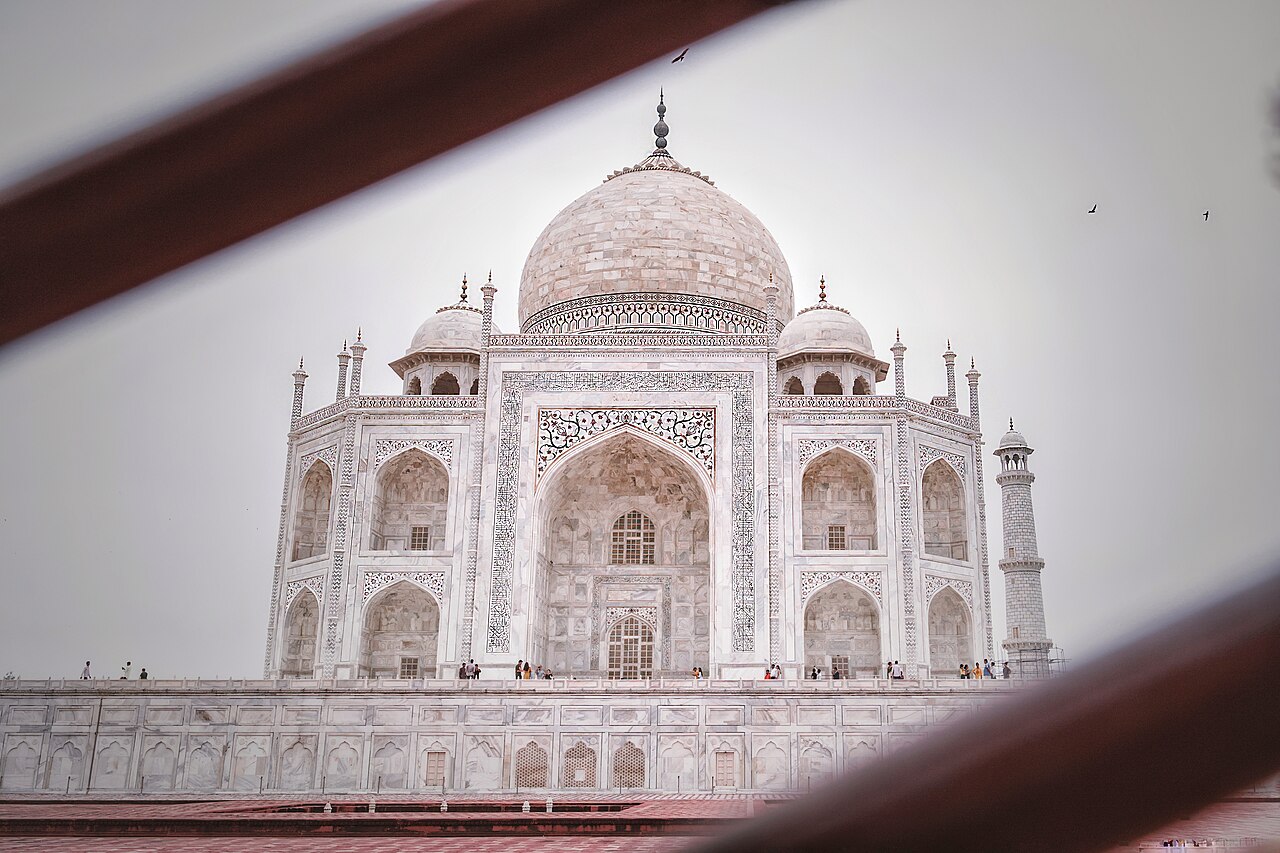
1631–1648 · Ahmad Lahori
The mausoleum's ivory-white marble body, inlaid with semi-precious stone in a rigorously symmetrical facade, stands apart from the red sandstone mosque and guest house that flank it inside a walled riverside garden.
Commissioned in 1631 by the Mughal emperor Shah Jahan as a tomb for his wife Mumtaz Mahal, the mausoleum was structurally complete by 1648, though work on its surrounding mosque, guest house and gardens continued for another five years. The 17-hectare complex sits on the Yamuna's right bank behind a crenellated wall. Shah Jahan himself was later buried beside his wife inside it. The site draws on Indo-Islamic and Mughal design traditions and is inscribed as a UNESCO World Heritage Site.
- Shah Jahan is buried inside it too, although the mausoleum was commissioned for his wife alone.
- The complex is estimated to have cost around ₹32 million at the time, near US$827 million in 2015 terms.
- Its first formal ceremony, held in 1643, marked the twelfth anniversary of Mumtaz Mahal's death, five years before construction was finished.
Photo: Biswarup Ganguly (CC BY 3.0)
Agra Fort
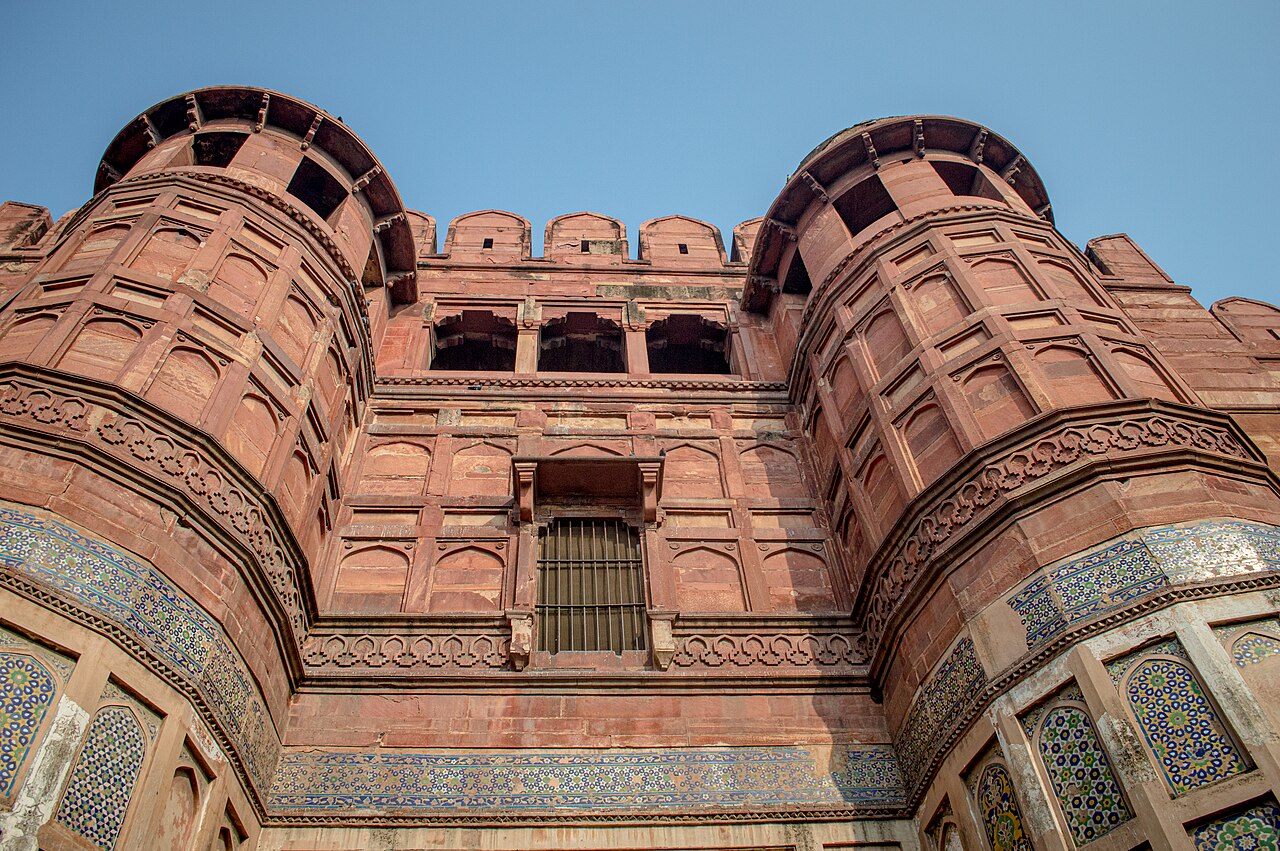
1565–1573
Known locally as the Red Fort for its massed red sandstone ramparts, the complex reads less like a single building than a walled city, its scale and crenellated perimeter distinguishing it from the white marble monuments nearby.
Mughal emperor Humayun was crowned inside an earlier fort on this site in 1530. Akbar rebuilt it in red sandstone from 1565, completing the present structure in 1573, and it served as the Mughal capital's main residence until the seat moved to Delhi in 1638. Later occupied by the Marathas and then the East India Company, it is also known as Lal-Qila or Qila-i-Akbari. Its scale means it is more accurately described as a walled city than a single fort. UNESCO listed it as a World Heritage Site in 1983.
- It was also called Qila-i-Akbari, and its scale means it is better described as a walled city than a single fort.
- A Mughal emperor was crowned inside it in 1530, decades before Akbar's rebuilding gave the fort its present form.
Photo: Philip Nalangan (CC BY 4.0)
Tomb of I'timad-ud-Daulah
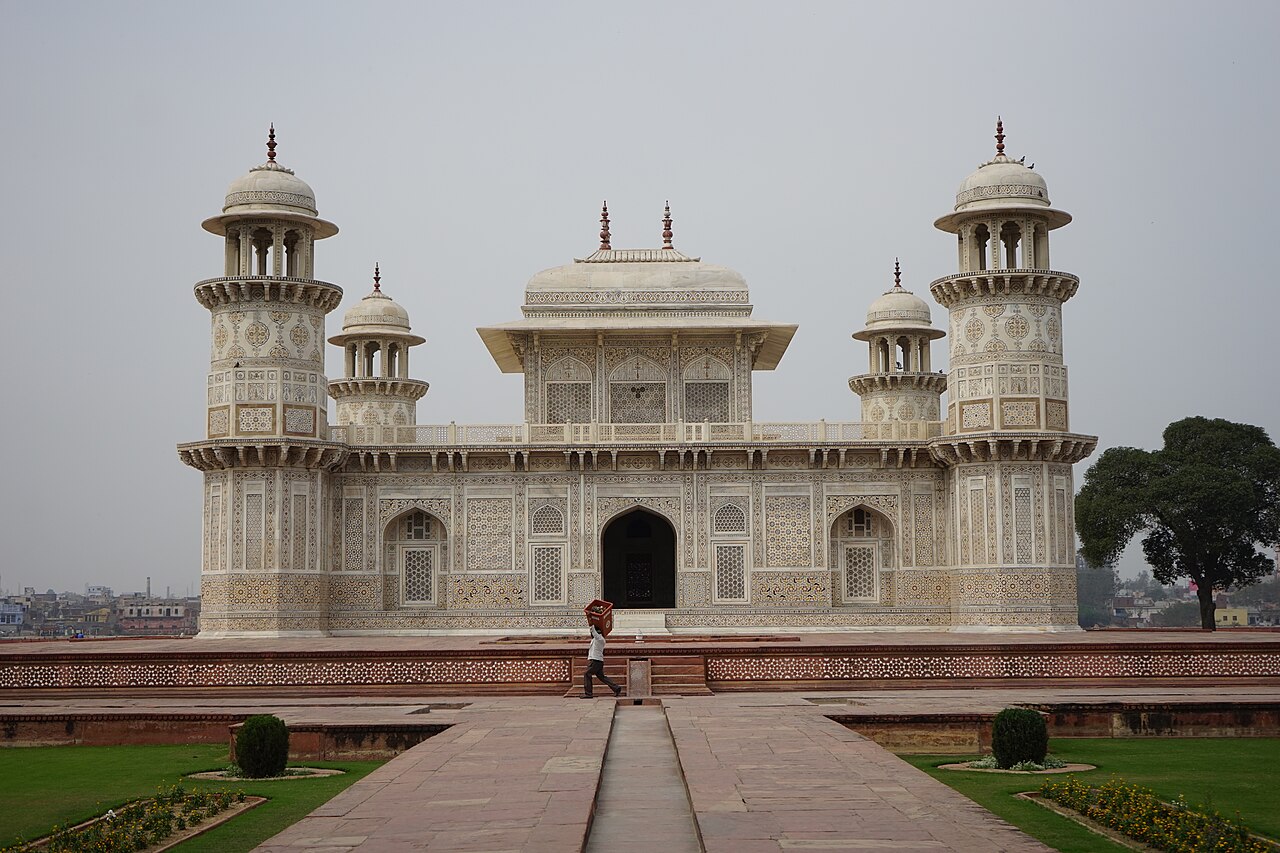
1622–1628
Small enough to be nicknamed a jewel box, the tomb is covered almost entirely in pietra-dura inlay and marble latticework rather than left with bare stone, marking the shift from Agra's earlier red sandstone monuments toward the all-marble style the Taj Mahal later used.
Nur Jahan, wife of the emperor Jahangir, commissioned this mausoleum for her father, Mirza Ghiyas Beg, a Persian nobleman given the title I'timad-ud-Daulah. Built between 1622 and 1628, it consists of a main tomb with outbuildings and gardens, and is often described as a jewel box or the Baby Taj. Its combination of red sandstone traditions with marble and inlay work is regarded as a transitional step toward the fully marble style of the Taj Mahal. Mirza Ghiyas Beg was also the grandfather of Mumtaz Mahal.
- The man it honours, Mirza Ghiyas Beg, was the grandfather of Mumtaz Mahal, for whom the Taj Mahal was later built.
- Its 'jewel box' nickname comes from an all-over inlay decoration that leaves almost no stone surface bare.
Photo: Jan Bockaert (CC BY-SA 2.0)
Akbar's tomb
The mausoleum of the Mughal emperor Akbar, built in 1605–1613 by his son Jahangir on 119 acres at Sikandra. Built mainly of deep red sandstone enriched with white marble, it was plundered and largely desecrated by Hindu Jat forces in 1688.
Tomb of Mariam-uz-Zamani
The mausoleum of Mariam-uz-Zamani, the favorite wife of Mughal Emperor Akbar, built by her son Jahangir between 1623 and 1627. It stands in Agra's Sikandra suburb next to Akbar's tomb; she is the only one of his wives buried beside him.
Mehtab Bagh
A charbagh, or walled quadrangle garden, on the Yamuna's flood plain directly opposite the Taj Mahal. Square in plan and about 300 by 300 metres, it is aligned precisely with the Taj Mahal on the opposite bank and floods partly in the rainy season.
Jama Mosque, Agra
A 17th-century congregational mosque in the historic core of the old city, built during the reign of Mughal Emperor Shah Jahan. It was commissioned by Jahanara Begum, Shah Jahan's eldest daughter, and remains the city's principal mosque, standing close to Agra Fort.
Moti Masjid (Agra Fort)
A Sunni Friday mosque inside Agra Fort, a UNESCO World Heritage Site, built in the 17th century by Mughal Emperor Shah Jahan. Known as the Pearl Mosque, it is built entirely of white marble and is administered today as a Monument of National Importance.
Musamman Burj (Agra Fort)
An octagonal tower within Agra Fort, also known as the Saman Burj or Shah Burj. It stands close to Diwan-e-Khas, Shah Jahan's private hall of audience.
Akbar's Church
A Roman Catholic church in Agra, built in 1600 by Jesuit Fathers. It is also known as the Church of Akbar.
Aram Bagh, Agra
The oldest Mughal garden in India, originally laid out by Emperor Babur, the first Mughal emperor, in 1526. It lies about five kilometres northeast of the Taj Mahal, and Babur was buried there temporarily before his remains were moved to Kabul.
Chini Ka Rauza
A funerary monument, or rauza, built in 1635 for Afzal Khan Shirazi, a scholar-poet who served as Grand Vizier to Shah Jahan. Its outer walls are decorated with glazed tile, the source of its name — chini, from China, and rauza, Persian for tomb.
Nagina Masjid
A Sunni mosque within Agra Fort, built by Shah Jahan for personal and royal-women's use between 1631 and 1640. Also called the Gem or Jewel Mosque, it was among the last structures built there before the capital moved to Old Delhi in 1648.
Chauburji
A Mughal-era building of debated date and purpose, set in a garden on the Yamuna's bank with a small mosque to its west. Square in plan with towers at each corner and nine interconnected chambers inside, listed as a monument of national importance.
Humayun Mosque
A former mosque, now partly ruined, in the village of Kachhpura on the left bank of the Yamuna River. Also known as the Kachpura Masjid, it is a Monument of National Importance administered by the Archaeological Survey of India.
Mina Mosque
A Sunni mosque near Diwan-i-Khas inside Agra Fort, built entirely of white marble by Shah Jahan around 1631–1640 for his personal use. Also called the Heavenly Mosque, it is a Monument of National Importance and is currently closed to the public.
Battis Khamba
A tower whose name translates as "tower of thirty-two pillars."
Sadar Bazaar
A popular shopping destination for tourists, located close to Agra Cantonment railway station. It is in close proximity to both the Taj Mahal and Agra Fort.
Gyarah Sidhi
The remains of an astronomical observatory built by the Mughal Emperor Humayun, its name meaning "eleven steps." The ruins sit in a field on the Yamuna's bank, close to Babur's Mehtab Bagh.
History
Agra's rise began under Sikandar Khan Lodi, who moved his capital there from Delhi in the late fifteenth century and raised the first buildings inside what became Agra Fort. Mughal rule followed after the 1526 Battle of Panipat; Humayun was crowned inside the fort in 1530, and Akbar rebuilt it in red sandstone between 1565 and 1573 as the dynasty's seat until the capital moved to Delhi in 1638. Jahangir's wife, Nur Jahan, then commissioned the marble Tomb of I'timad-ud-Daulah for her father between 1622 and 1628, introducing the white-marble, stone-inlaid style that Shah Jahan carried further in the Taj Mahal, built between 1631 and 1648 for his wife Mumtaz Mahal. Mughal decline in the late eighteenth century brought Maratha and then East India Company control, before Agra turned, after independence, into an industrial and tourism centre.