Landmarks in Jaipur
A planned 1727 grid city whose old core is faced almost entirely in pink sandstone.
Jaipur's landmarks cluster around the walled old city that Sawai Jai Singh II laid out on a grid in 1727, one of the first planned cities in modern India. The City Palace sits at the centre of that grid, a complex of courtyards and buildings combining Mughal and Rajput architectural elements, completed in 1732 as the seat of the Jaipur rulers. Hawa Mahal rises from its edge, a red-and-pink sandstone screen wall added in 1799 to let the palace's women watch the street below unseen. Outside the walls, Jal Mahal stands apart entirely, a palace built into Man Sagar Lake in the same period. The consistent pink colour scheme that gives the old city its nickname covers buildings of otherwise varied purpose and date.
Hawa Mahal
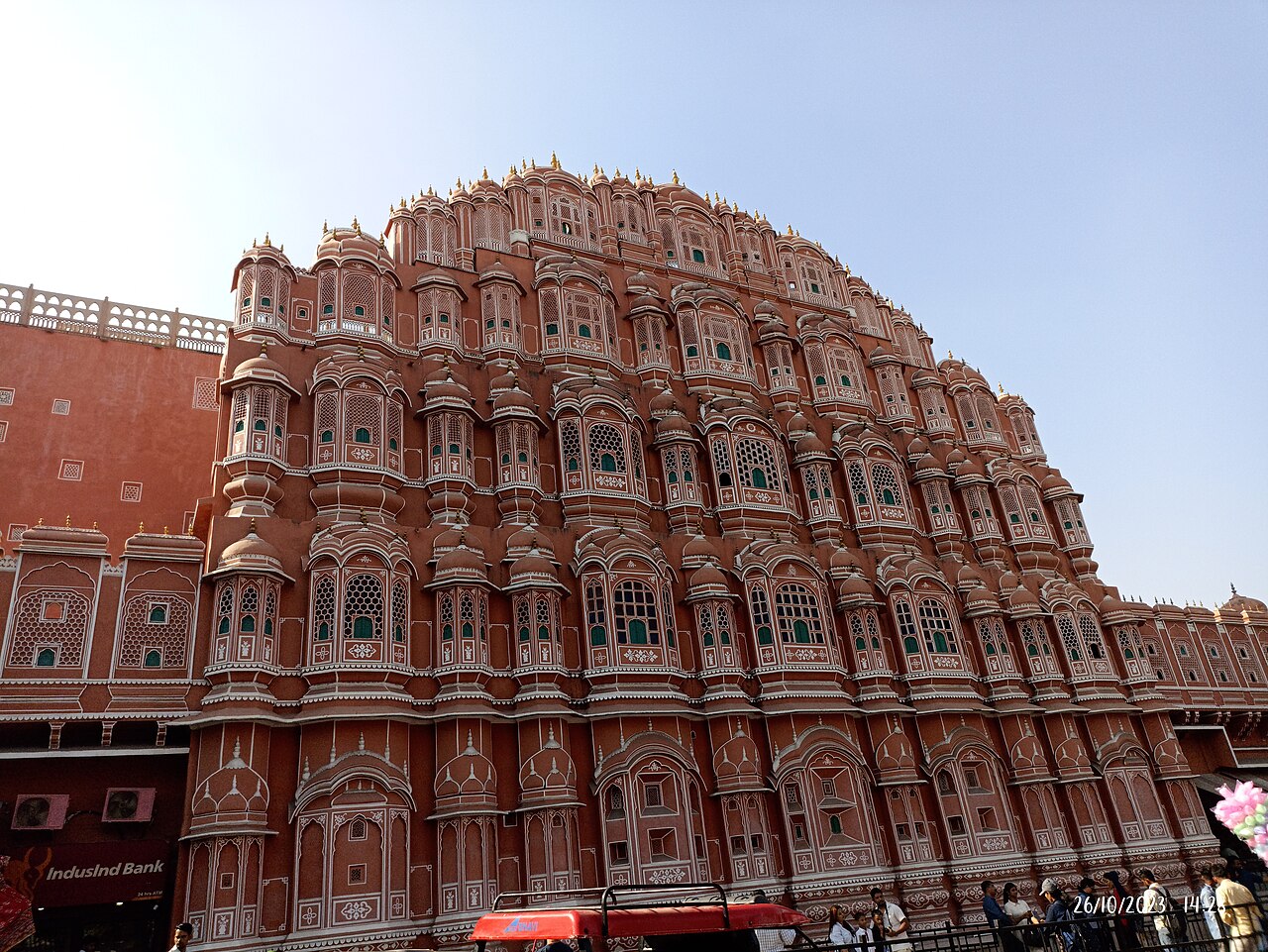
1799 · Lal Chand Ustad
A street-facing wall of red and pink sandstone, five storeys tall, its surface entirely honeycombed with 953 small arched jharokha windows set edge to edge in tight rows.
Hawa Mahal is a screen wall of red and pink sandstone built onto the edge of the City Palace complex in 1799, under Maharaja Sawai Pratap Singh and designed by Lal Chand Ustad. Its five-storey façade is pierced by 953 small windows, called jharokhas, arranged in a honeycomb pattern that let royal women watch street life and festivals below without being seen themselves. The lattice openings also drew air through by the Venturi effect, cooling the palace's interior during Jaipur's hot summers. It extends toward the Zenana, the women's chambers.
- Despite its palace-like façade, Hawa Mahal is essentially a single screen wall attached to the City Palace's women's quarters, not a freestanding building.
- Its 953 small lattice windows were built to draw air through by the Venturi effect, cooling the interior in Jaipur's summer heat.
- The ruler who commissioned it was reportedly inspired by another palace, the Khetri Mahal, whose design he admired.
Photo: Jupiterthescholar (CC BY-SA 4.0)
City Palace
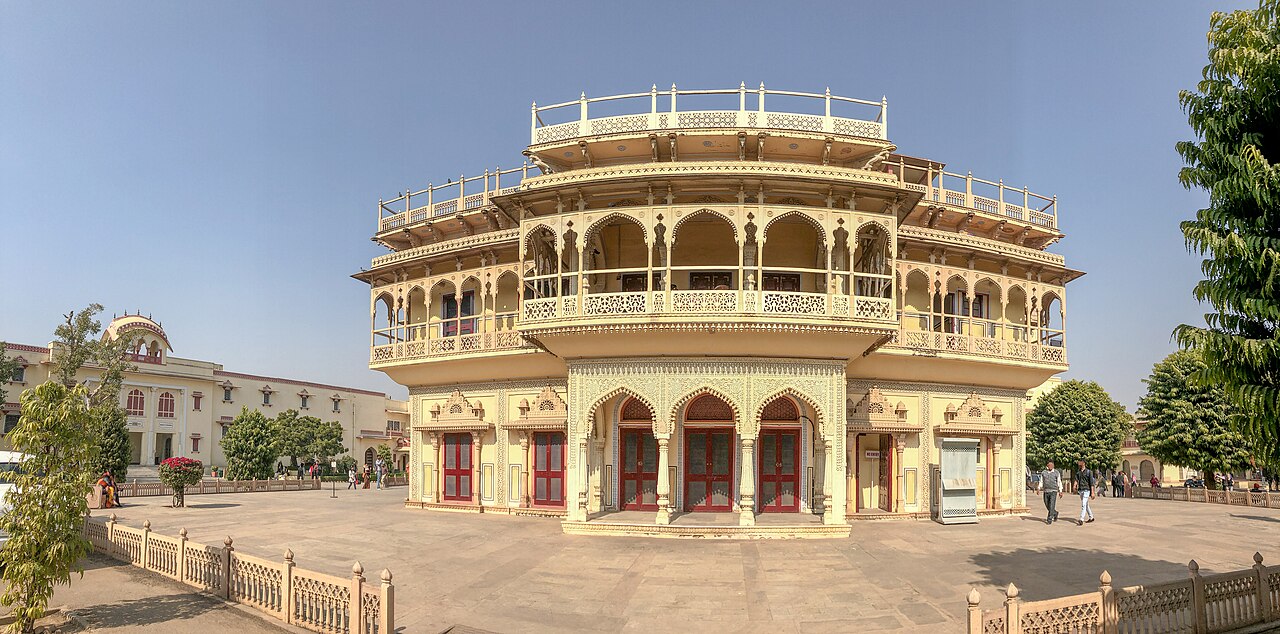
1732 · Vidyadhar Bhattacharya
A complex of multiple courtyards, gateways and buildings rather than a single structure, combining Mughal and Rajput architectural elements, with part of it now open as a museum of the former rulers' collections.
The City Palace was the residence and administrative seat of Jaipur State's rulers, built soon after the city's founding. Construction began in 1727, when Maharaja Sawai Jai Singh II moved his court here from Amer, and finished in 1732 under Vidyadhar Bhattacharya. Built to the rules of vastushastra, it combines Mughal and Rajput elements across a complex of courtyards, galleries and administrative buildings. It remained the kingdom's ceremonial and governing centre until 1949, when Jaipur State merged into Rajasthan. Part of it now houses the Maharaja Sawai Man Singh II Museum, and the royal family still lives within it.
- The royal family, who still occupy part of the palace, is served by around 500 personal staff, according to the palace's own account.
- The palace's museum trust is run by Princess Diya Kumari, who also oversees two schools in the city that carry the family's name.
Photo: FLASHPACKER TRAVELGUIDE (CC BY-SA 2.0)
Jal Mahal
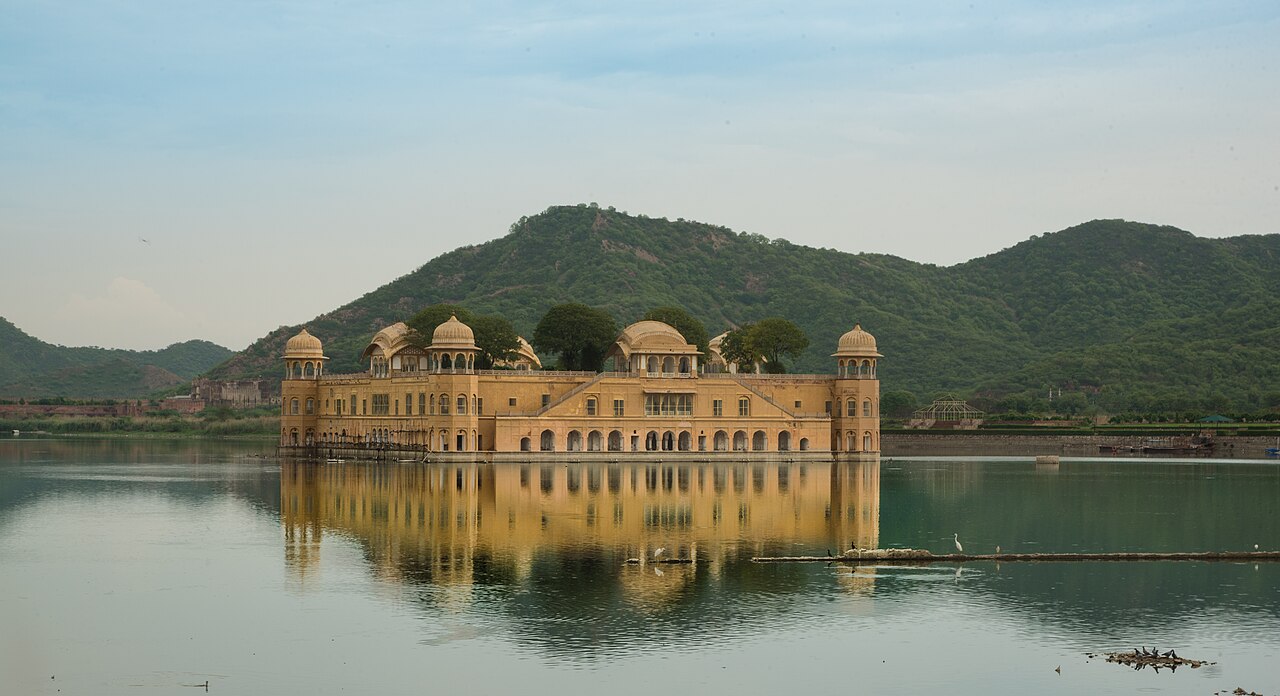
1799
A palace standing alone in the middle of a lake, apparently rising directly out of the water because it is built on its own artificial island rather than the shoreline.
Jal Mahal is a palace built in 1799 in the middle of Man Sagar Lake, standing on what is effectively its own artificial island rather than the shoreline. Unlike Jaipur's other surviving palaces, no architect, patron or later history for it appears in the record: what is documented is simply its date, its type, and its setting in the water. It remains known chiefly for that setting, a palace reachable only by crossing the lake itself.
Photo: Piyushsh9 (CC BY-SA 4.0)
Amber Fort
A hilltop fort in the town of Amer, 11 kilometers from Jaipur, overlooking Maota Lake through a series of ramparts and gates. Its Amer Palace, built of red sandstone and marble in Rajput style with Mughal influences, is laid out across four courtyarded levels.
Jantar Mantar
A collection of 19 astronomical instruments built by Rajput king Sawai Jai Singh, founder of Jaipur, and completed in 1734. A UNESCO World Heritage Site near the City Palace and Hawa Mahal, it houses the world's largest stone sundial.
Jaigarh Fort
A rugged hilltop fort on the Cheel ka Teela ridge above Amer Fort, begun by Raja Kakil Dev in the eleventh century and expanded by later rulers. Also called Victory Fort, it houses the Jaivana Cannon, once the world's largest cannon on wheels.
Nahargarh Fort
A fort on the edge of the Aravalli Hills overlooking the city, originally named Sudershangarh, that once formed a defensive ring with Amber and Jaigarh Forts. It was renamed Nahargarh, meaning abode of tigers, after a temple pacified the spirit of Nahar Singh Bhomia.
Rambagh Palace
A former royal residence outside the old city walls, built in 1835 as a garden retreat before becoming the principal home of Maharaja Sawai Man Singh II. Converted into India's first luxury palace hotel after independence, it has been run by Taj Hotels since 1972.
Albert Hall Museum
The oldest museum in Rajasthan, standing in Ram Niwas Garden opposite New Gate as a fine example of Indo-Saracenic architecture. Also known as the Government Central Museum, it was renovated in 2008 and reopened as one of India's most advanced museums.
Jawahar Kala Kendra
A multi-arts center built by the Rajasthan government to preserve the state's arts and crafts. Its eight blocks hold museums, an amphitheater, an auditorium, a library and two permanent art galleries, and it hosts an annual theatre festival.
Govind Dev Ji Temple
A Hindu temple dedicated to Radha and Krishna within the City Palace complex, established in the 18th century by Maharaja Jai Singh II, Jaipur's founder. Its deities were brought from Vrindavan when the temple was built.
Raj Mandir Cinema
A meringue-shaped cinema on Bhagwan Das Road, opened in 1976 and known for hosting many Hindi film premieres. Equipped with Dolby Atmos and SLS sound, the first such systems in Rajasthan, it holds the status of the largest single-screen theater in Asia.
Birla Mandir
A Hindu temple built entirely of white marble by the B.M. Birla Foundation in 1988, one of several temples in the Birla mandir series. Dedicated to the goddess Lakshmi and the god Vishnu, it stands in the Tilak Nagar neighborhood near Moti Dungari hill.
Jagat Shiromani Temple
A 17th-century Hindu temple in the town of Amer, unusual for being dedicated jointly to Krishna, Meera Bai and Vishnu. It is one of the few temples in India enshrining the poet-saint Meera Bai alongside Krishna.
Moti Dungri
A Hindu temple complex dedicated to Lord Ganesha, built in 1761 under Seth Jai Ram Paliwal. Located next to the Birla Temple, it is a popular attraction for visitors to the city.
Tarkeshwar Nath Temple
An ancient Shiva temple in the Choura Rasta area, believed to date to Jaipur's founding around 1727 or possibly earlier, with a self-manifested Shivalinga at its center. Jaipur is known as Chhoti Kashi for its many old Shiva temples, of which this is one.
Garh Ganesh Temple
A Hindu temple on the Aravalli hills dedicated to Lord Ganesha, notable for an idol depicted without a trunk, an uncommon form for the deity. It draws large numbers of devotees, especially during the Ganesh Chaturthi festival.
The Raj Palace
A palace more than two and a half centuries old, converted into a heritage hotel and named best heritage hotel of India by the government. It has also been voted the world's leading heritage hotel by World Travel Awards for seven consecutive years.
Bissau Palace Hotel
A 19th-century palace turned heritage hotel, built for the royal nobleman Raghubir Singhji. It stands just outside the old city walls, a short distance north of the Chand Pol gate.
Kanak Vrindavan
A garden in a valley of the Aravalli Hills at the foot of Nahargarh hill, commissioned by Maharaja Sawai Jai Singh around 275 years ago. Named for its resemblance to Krishna's Vrindavan, it holds a temple to Krishna consecrated by the maharaja.
Diggi Palace
A royal palace converted into a heritage hotel, though part of it remains occupied and run by the royal family. It has hosted the annual Jaipur Literature Festival since 2006.
Khole Ke Hanuman Ji Temple
A Hindu temple dedicated to Hanuman, about 9 kilometers from the district headquarters. Besides devotees, domestic and foreign tourists visit for its scenic natural surroundings.
World Trade Park
A shopping mall in Malviya Nagar, officially opened in late 2012. Popular with young people, it houses stores including Zara, Cromā and Sephora.
Ram Niwas Garden
A garden in the city, built by Maharaja Sawai Ram Singh of Jaipur in 1868.
History
The city took shape after 1727, when Sawai Jai Singh II, the Kachhwaha Rajput ruler of Amer, moved his court onto a newly planned site and laid it out on a grid designed by Vidyadhar Bhattacharya. Construction of the City Palace, the new capital's administrative and ceremonial centre, began that year and was finished in 1732, following the rules of vastushastra and mixing Mughal and Rajput architectural styles. Later rulers kept building within and beyond that plan: Hawa Mahal was added onto the palace complex in 1799 for the court's secluded women, and Jal Mahal, a separate palace set into Man Sagar Lake, dates from the same year. Jaipur remained the seat of its own princely state through the colonial period, then became capital of Rajasthan in 1949, after Indian independence.