Landmarks in Bogotá
A colonial capital rebuilt in Neoclassical stone around a single central plaza.
Bogotá's oldest surviving landmarks cluster tightly around Plaza de Bolívar and the streets just south of it, in what began as the colonial seat of the Viceroyalty of New Granada. Despite spanning four centuries — from a sixteenth-century mansion to a legislature finished in 1926 — nearly all wear the same Neoclassical dress, imposed onto older colonial fabric as the new republic reached for a shared civic style after independence. The result is a compact core where a colonial-era palace, a cathedral rebuilt in the early nineteenth century and a slow-built capitol face one another across a few short blocks, their outward uniformity masking very different construction histories underneath.
Primatial Cathedral of Bogotá
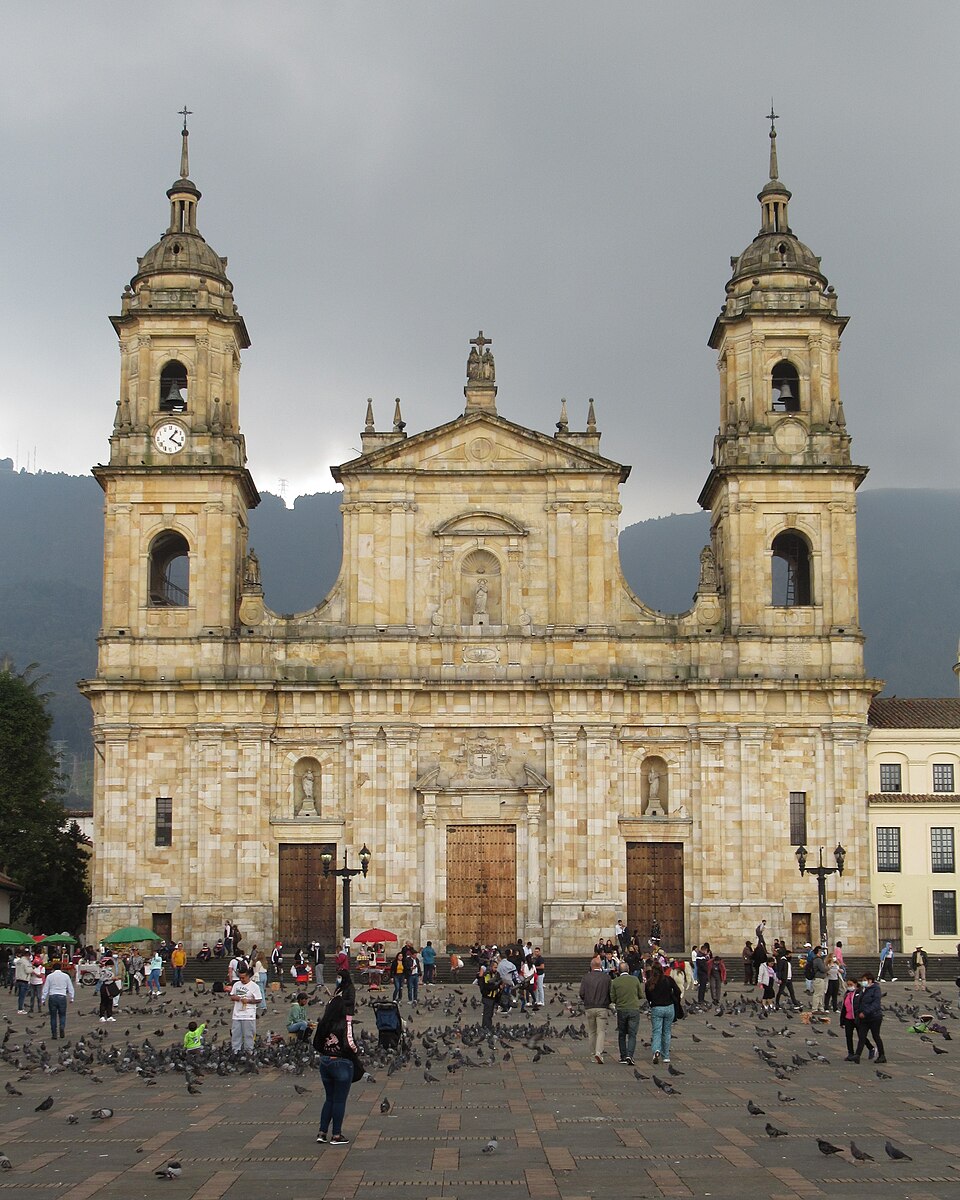
1807–1823 · Domingo de Petrés
Its Neoclassical facade lines one side of Plaza de Bolívar, the same square the National Capitol faces.
Domingo de Petrés designed this Neoclassical cathedral, dedicated to the Immaculate Conception and Saint Peter, on Plaza de Bolívar. Built between 1807 and 1823, it replaced a line of earlier churches on the same ground and now serves as the seat of the Metropolitan Archbishop of Bogotá, whose see holds the honorary title Primate of Colombia, granted by Pope Leo XIII in 1902. It is also the seat of the cathedral's Cabildo metropolitano.
- It is the fourth church built on this exact site, following three earlier ones.
- A 1975 government decree declared the building a national monument.
Photo: Felipe Restrpo Acosta (CC BY-SA 4.0)
National Capitol of Colombia
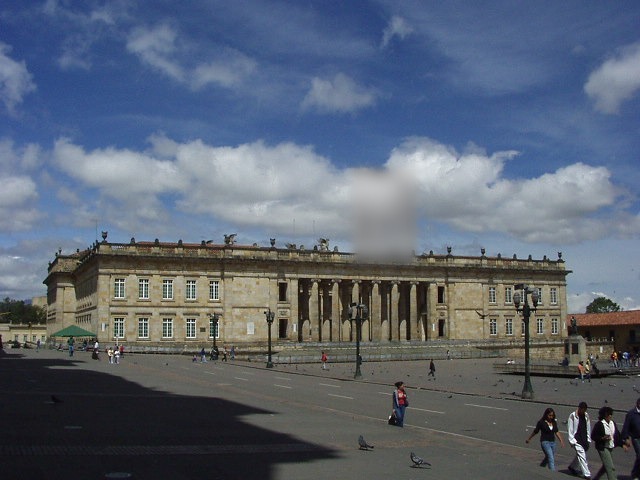
1848–1926 · Thomas Reed
Its long Neoclassical mass anchors one side of Plaza de Bolívar, opposite the cathedral, and houses both chambers of the national legislature.
Thomas Reed designed this Neoclassical seat of the Congress of Colombia, often called simply the Capitolio Nacional, on Plaza de Bolívar in central Bogotá. Construction began in 1848 and was not finished until 1926, after decades of interrupted work that outlasted the architect. The completed building houses both houses of Congress and has since been recognised as a national monument.
- Thomas Reed, who designed the building, died in 1878, nearly half a century before it was finished.
Photo: user:Kinori (Public domain)
Palacio de San Carlos
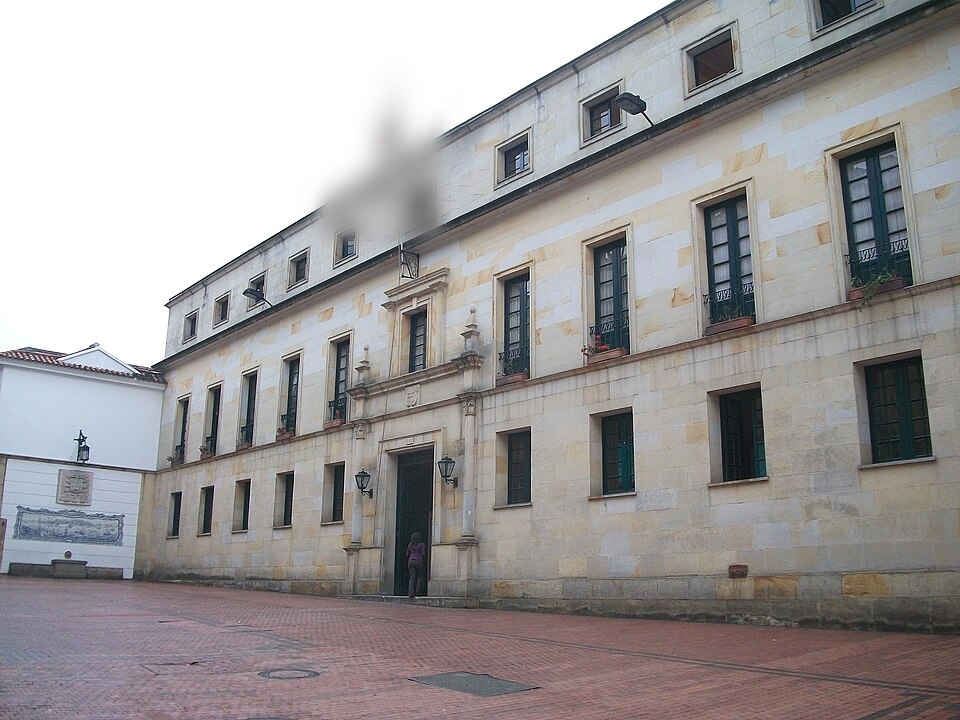
1580
A Neoclassical facade fronts this sixteenth-century mansion at the corner of Calle 10 and Carrera 5.
Originally a sixteenth-century structure that later housed the Colegio Seminario de San Bartolomé, this mansion stands at the corner of Calle 10 and Carrera 5 and carries a Neoclassical style. Over the centuries it has been the site of various political, social and academic events. Since December 1993 it has served as the seat of the Ministry of Foreign Affairs.
Photo: Felipe Restrepo Acosta (CC BY-SA 3.0)
Plaza de Bolívar
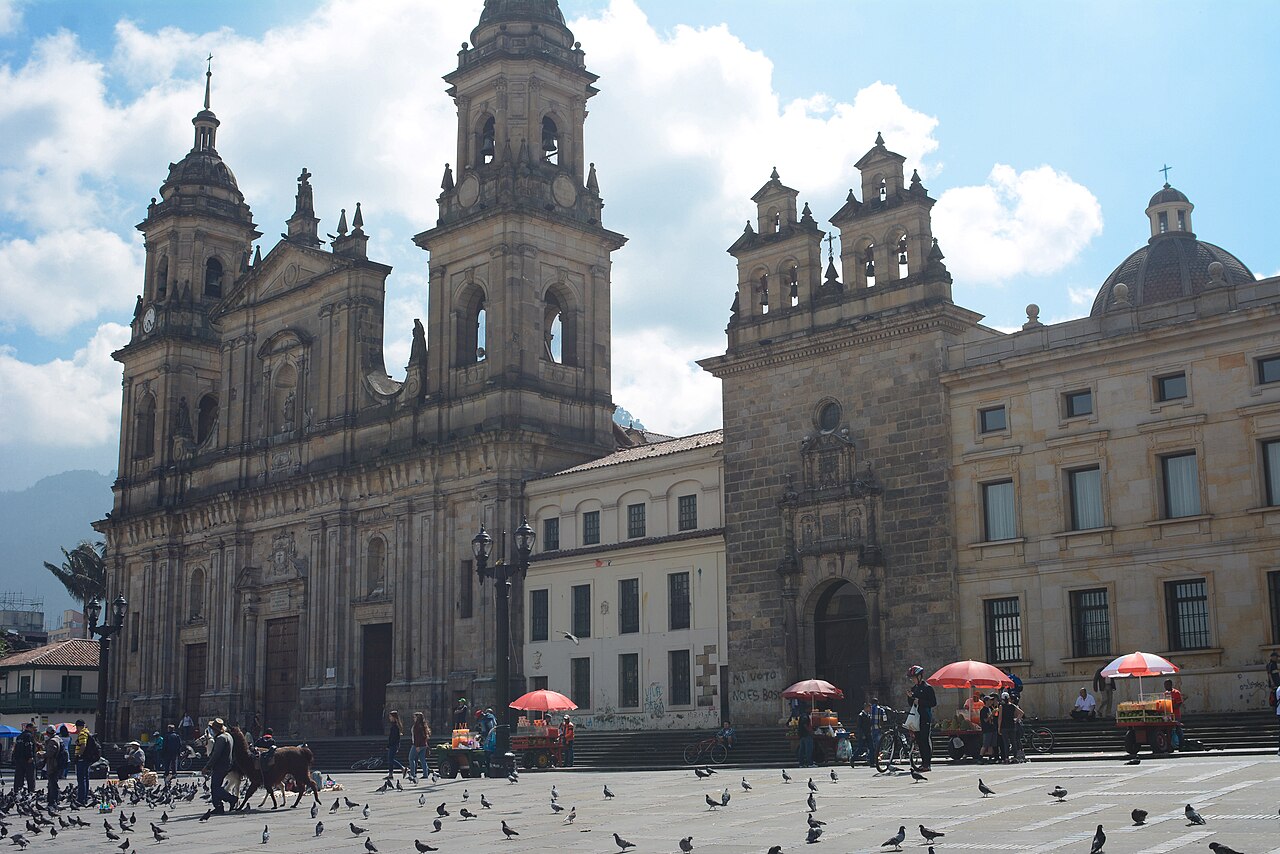
1538
A statue at the centre of the square, sculpted in 1846 by Pietro Tenerani, is ringed by grand nineteenth- and twentieth-century facades on all four sides, including a cathedral, a legislative palace and a courthouse rebuilt after a 1985 siege.
This square has served as the historic centre of the city since its founding in 1538, when it was known as the Plaza Mayor and later the Plaza de la Constitución. A pillory once stood here for public punishments, and colonial-era markets, staged performances and bullfights were held on the ground into the seventeenth century. Its current name was adopted after a statue of Simón Bolívar, sculpted in 1846 by Pietro Tenerani, was installed as the city's first public monument. The square remains bordered by a cathedral, a legislative palace and a courthouse, and still hosts large public gatherings.
- Studies published in 2011 and 2017 traced Muisca solar alignments framed by the square's north-eastern corner, with the sun rising over one nearby hill at the June solstice and another at the December solstice.
- A pillory known as La Picota stood on the square for public punishments until it was replaced by a water fountain in 1583.
- The Palace of Justice on the square's north side has been rebuilt twice, after a 1948 fire and again after a 1985 siege that destroyed the previous building.
Photo: M M from Switzerland (CC BY-SA 2.0)
Teatro de Cristóbal Colón
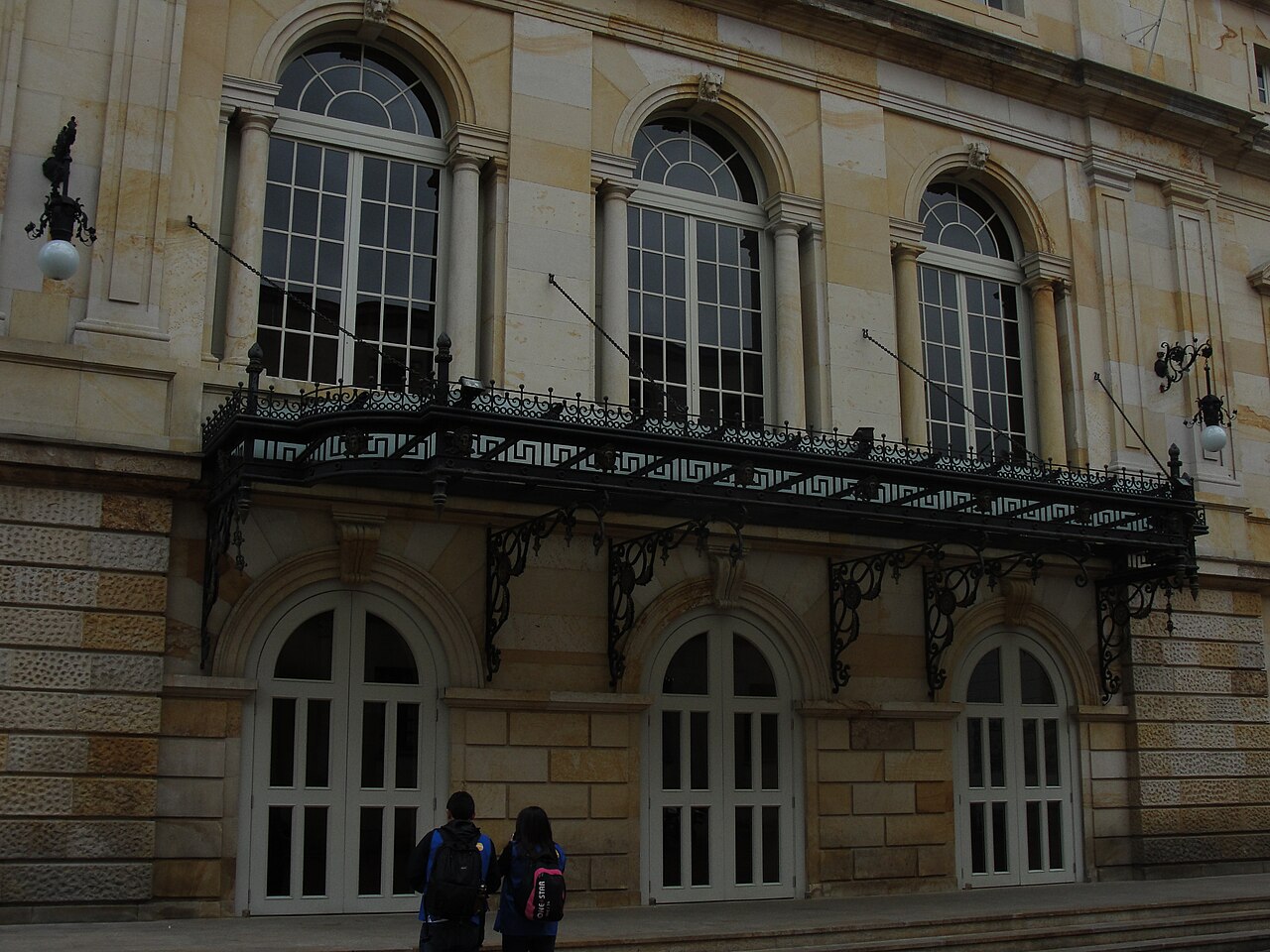
1885–1892 · Pietro Cantini
Cornices divide its stone facade, cut in the Tuscan Doric order, into three horizontal sections; inside, tiered boxes and a gallery wrap a horseshoe-shaped hall laid out on the model of the Palais Garnier in Paris.
Pietro Cantini designed this Neoclassical theatre on the site of two earlier venues, the Coliseo Ramírez and the Teatro Maldonado. Construction began in 1885, and the building opened in 1892 with a performance of Verdi's Ernani; Swiss sculptor Luigi Ramelli handled the ornamentation. The horseshoe-shaped hall seats 785 people across stalls, boxes and a gallery. Declared a national monument in 1975, the building underwent renovations that decade and again between 2009 and 2010, and its main hall hosted the 2016 signing of the peace agreement that ended the Colombian armed conflict.
- Its stage curtain, painted in Florence by Annibale Gatti and hung in 1891, originally depicted farmers alongside opera characters until President Rafael Núñez asked for the farmers to be replaced with more decorative figures.
- A 2016 peace agreement between the Colombian government and the FARC guerrilla group was signed in the building, ending decades of armed conflict.
- A 2007 newspaper poll ranked the building seventh among the seven wonders of Colombia.
Photo: Racso (Oscar Fernando Gómez) (CC BY-SA 3.0)
Casa de Nariño
The official residence and workplace of Colombia's president, dedicated in 1908 on the site of the house where Antonio Nariño was born. It was designed by architects Gastón Lelarge and Julián Lombana, and its garden holds the Observatorio Astronómico de Bogotá, built in 1802–03.
National Museum of Colombia
Colombia's largest and oldest museum, holding a collection of more than 20,000 pieces on the country's history, art and culture. Its permanent exhibitions span archaeology and ethnography from 10,000 BC to twentieth-century indigenous and Afro-Colombian art.
Basilica of the Sacred Heart of Jesus
A minor basilica commonly known as the Basilica of the Voto Nacional, on the western side of Plaza de Los Mártires. Built by the Claretian community, it has ceiling paintings, stained glass and a main retablo created by Ricardo Acevedo Bernal.
Museo Botero
An art museum in La Candelaria holding mostly works by the Colombian artist Fernando Botero, alongside international pieces from his private collection. Managed by the Bank of the Republic's cultural branch, it draws over 500,000 visitors a year, including 2,000 students a month.
Luis Ángel Arango Library
A public library founded in 1958 that has grown to occupy two city blocks and hold about two million works. Considered the most important public library in Latin America, it seats 1,900 readers and drew 6.7 million visitors in 2008.
Gold Museum
An archaeology museum holding the largest collection of gold artifacts in the world, drawing around 500,000 visitors a year. Its exhibits of pre-Columbian gold and metal alloys, including Tumbaga, testify to the beliefs of indigenous societies before the Spanish conquest.
Quinta de Bolívar
A colonial house that served as Simón Bolívar's residence in the capital after the war of independence. It now operates as a museum dedicated to his life and times.
Chorro de Quevedo
A fountain in La Candelaria marking the traditional site where Gonzalo Jiménez de Quesada founded Bogotá in 1538. An Augustinian priest, Father Quevedo, built the original fountain here in 1832, and the nearby Hermitage of San Miguel del Príncipe was rebuilt in 1969.
Torre Colpatria
A 50-story skyscraper in downtown Bogotá, built between 1973 and 1978 and standing 196 meters tall. It held the title of Colombia's tallest building from its 1979 opening until 2016, and houses the headquarters of Colpatria Bank.
Avianca Building
A 161-meter office skyscraper next to Santander Park, built between 1966 and 1969 on the site of the demolished Hotel Regina. Inaugurated in late 1969 as headquarters of the airline Avianca, it became the tallest building in Bogotá and Colombia.
Estadio El Campín
The main stadium of Bogotá, inaugurated on 10 August 1938 with a capacity of 39,512, home to the football clubs Millonarios and Santa Fe. Sitting at 2,553 meters above sea level, it is one of the highest-altitude major football venues in South America.
Teatro Metropol
A theater built in the 1970s that has the greatest capacity of any theater in Bogotá, holding up to 2,500 people standing or 1,100 seated. It opened originally as a movie theater and, since 2016, has been rented to a Christian organization.
Hotel Tequendama
A historic hotel in the San Diego neighborhood, designed by Holabird & Root, John Burgee and Cuéllar Serrano Gómez, built between 1950 and 1951. Expanded to double its size between 1967 and 1970, it was fully renovated in 2025 and split into two properties.
Fragmentos
A site-specific art installation and memorial created in 2018 by artist Doris Salcedo and architect Carlos Granada. Its floor is made of 1,288 tiles cast from firearms surrendered by the FARC guerrilla group after the 2016 peace agreement, forming what Salcedo calls a countermonument.
Palace of Justice
A building on Plaza de Bolívar that serves as the seat and symbol of Colombia's Judiciary.
Simón Bolívar Park
A greenspace and sports complex in the Teusaquillo locality, covering more than 1,000 acres and ranking among the largest urban parks in the world. It includes a lake for paddle boats and an event space that can hold up to 140,000 people for concerts.
Bogotá Botanical Garden
Colombia's largest botanical garden, founded in 1955 and named for the botanist and astronomer José Celestino Mutis. Spanning 19.5 acres with an artificial waterfall, it is the country's only garden specialized in collecting and preserving Andean species of flowers.
Central Cemetery of Bogotá
One of Colombia's most famous cemeteries, opened in 1836 and declared a National Monument in 1984. It holds the graves of national heroes, poets and former presidents, with mausoleums sculpted by Tenerani and Sighinolfi.
Planetarium of Bogotá
A cultural center and planetarium in the International Center of Bogotá, within Independence Park. Its dome holds a 23-meter screen cupola.
History
Gonzalo Jiménez de Quesada founded the city on 6 August 1538, after a campaign into the Andes that conquered the Muisca, and it became capital of the New Kingdom of Granada. Renamed Santafé, it seated the Royal Audiencia from 1550 and, after 1717, governed the entire Viceroyalty of New Granada. Independence came after the Battle of Boyacá on 7 August 1819, and Simón Bolívar renamed the city Bogotá to honour the Muisca. The mansion later called the Palacio de San Carlos already stood from the 1500s; the cathedral was rebuilt in Neoclassical form between 1807 and 1823; and the Capitol, meant to house the new republic's Congress, took from 1848 to 1926 to complete.