Landmarks in Bruges
Gothic brick towers and stepped gables ring an oval medieval core threaded by canals.
Bruges' landmarks sit inside the oval, roughly 430-hectare historic centre that UNESCO lists as a single site, so the belfry, the city hall, the basilica and the beguinage are all within a short walk of one another, threaded by the city's canals. Brick is the constant material: the belfry's leaning bell tower, the Church of Our Lady's tower — the third-tallest brick church tower in the world — and the beguinage's walled houses are all built of it. Civic and religious construction spans the 12th to 15th centuries, with Gothic Revival restoration added across the 19th century, so what stands today layers original medieval fabric with later rebuilding.
Belfry of Bruges
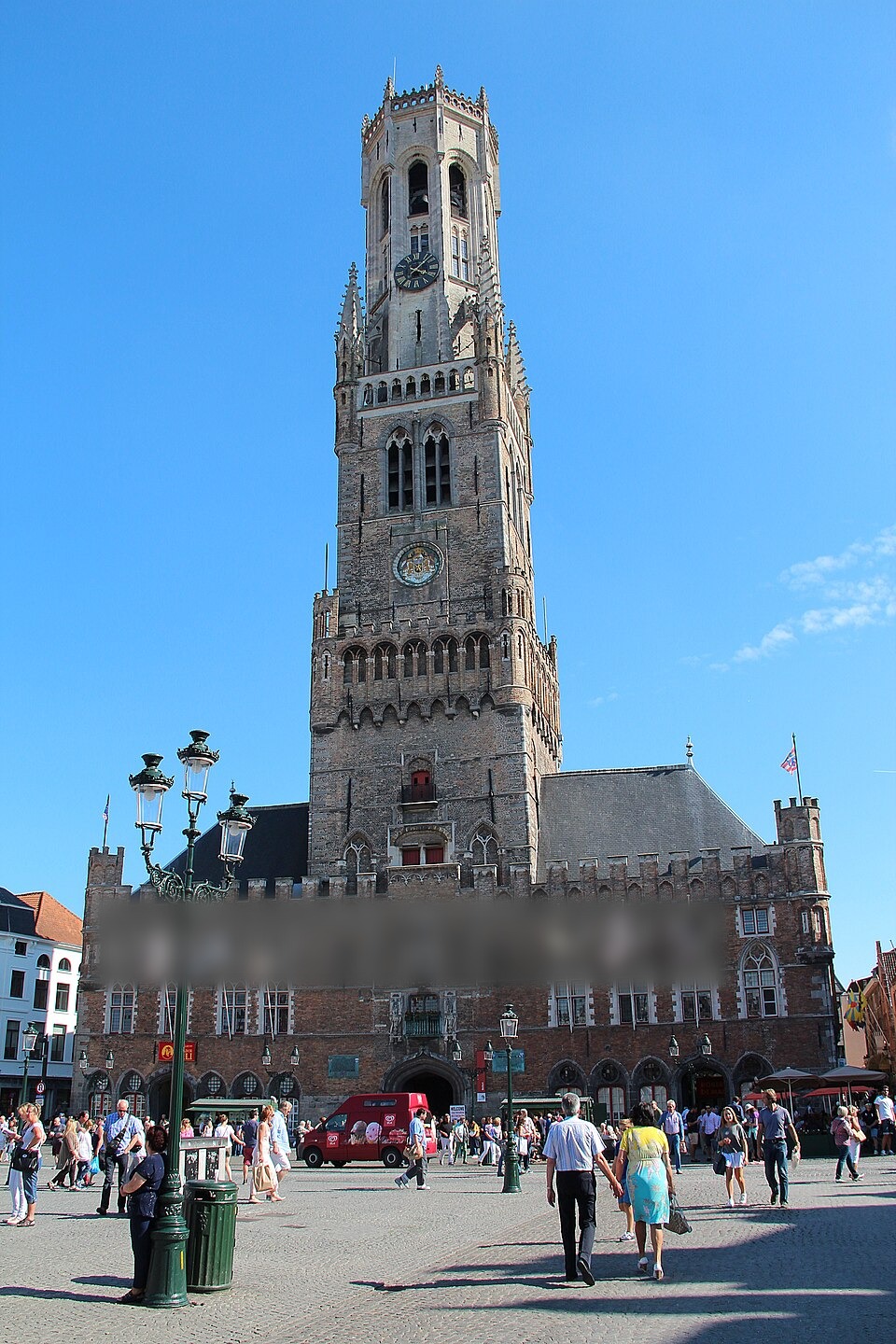
1240
A brick bell tower that tilts noticeably off true vertical, its Gothic outline dominating the skyline of the old centre.
This medieval bell tower dates from 1240 and stands in the centre of Bruges, built in the Brabantine Gothic style. It formerly housed the city's treasury and municipal archives and served as an observation post for spotting fires and other dangers. Officially classified as an inclined tower, it leans slightly off vertical. Today it operates as a museum and, together with the surrounding historic centre, forms part of a UNESCO World Heritage Site.
- It is officially classified as an inclined tower, leaning slightly off vertical.
- It once served as a lookout post for spotting fires and other dangers across the city.
Photo: Jean-Pol GRANDMONT (CC BY-SA 4.0)
Church of Our Lady
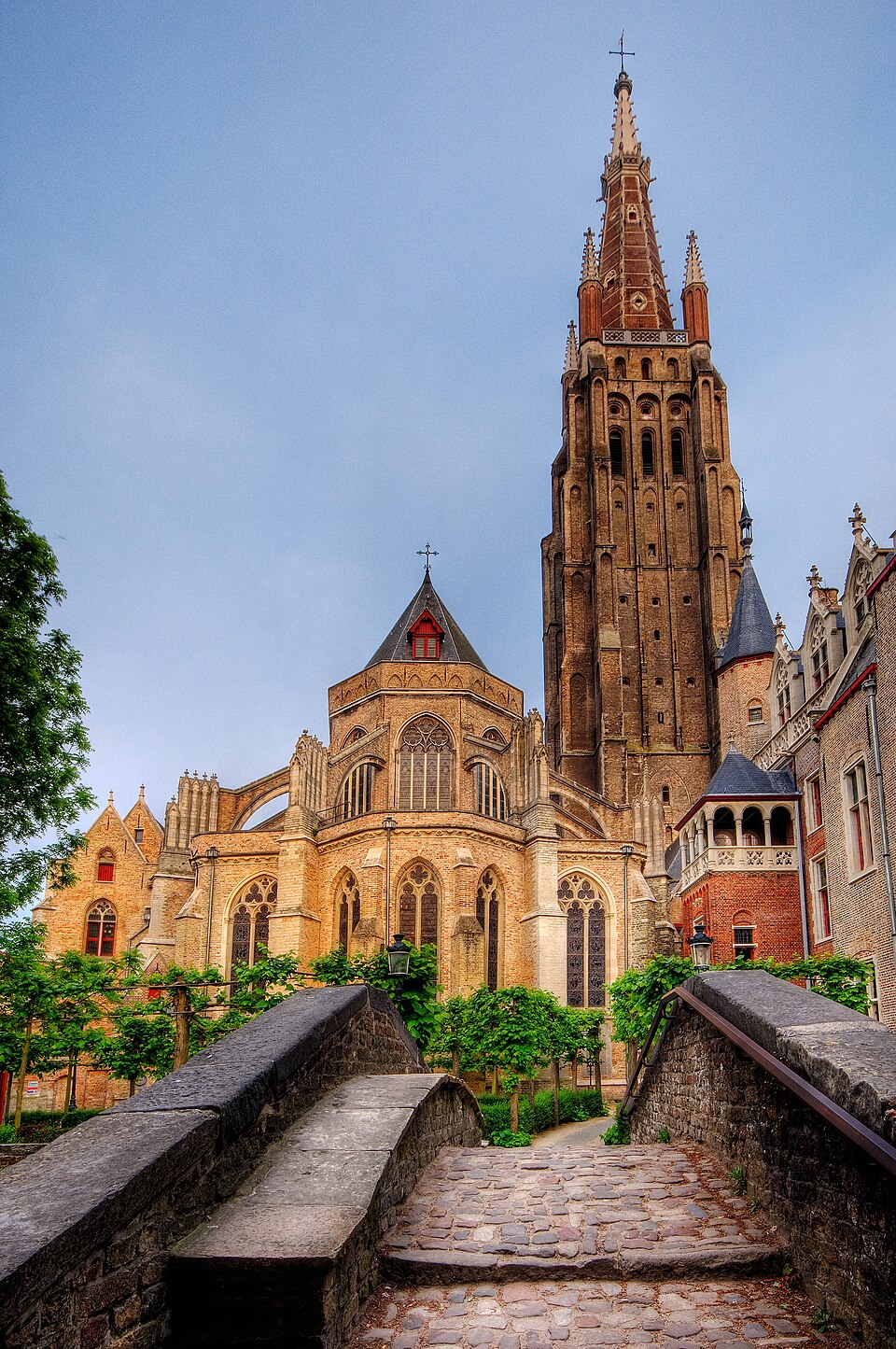
13th–15th century
A soaring brick tower — the tallest structure in the old centre and the third-tallest brick church tower in the world — braced by exterior flying buttresses added in the late 13th century.
This Roman Catholic church dates mainly from the 13th to 15th centuries, its exterior flying buttresses added in the 1270s and 80s. At 115.6 metres, its tower is the tallest structure in the city and the third-tallest brickwork church tower in the world. The nave has cross-vaults and black-and-white tiled flooring, while the side aisles and chancel were later reworked in Baroque style. A chapel built in 1482 served the private worship of a wealthy merchant. Gothic Revival-era restorers, among them Jean-Baptiste Bethune and members of the Viérin family, worked on the building in the 19th and 20th centuries.
- Its tower is the third-tallest brickwork church tower in the world, after two in Germany.
- One chapel was built in 1482 for the private worship of a single wealthy merchant.
Photo: Wolfgang Staudt (CC BY 2.0)
Bruges City Hall
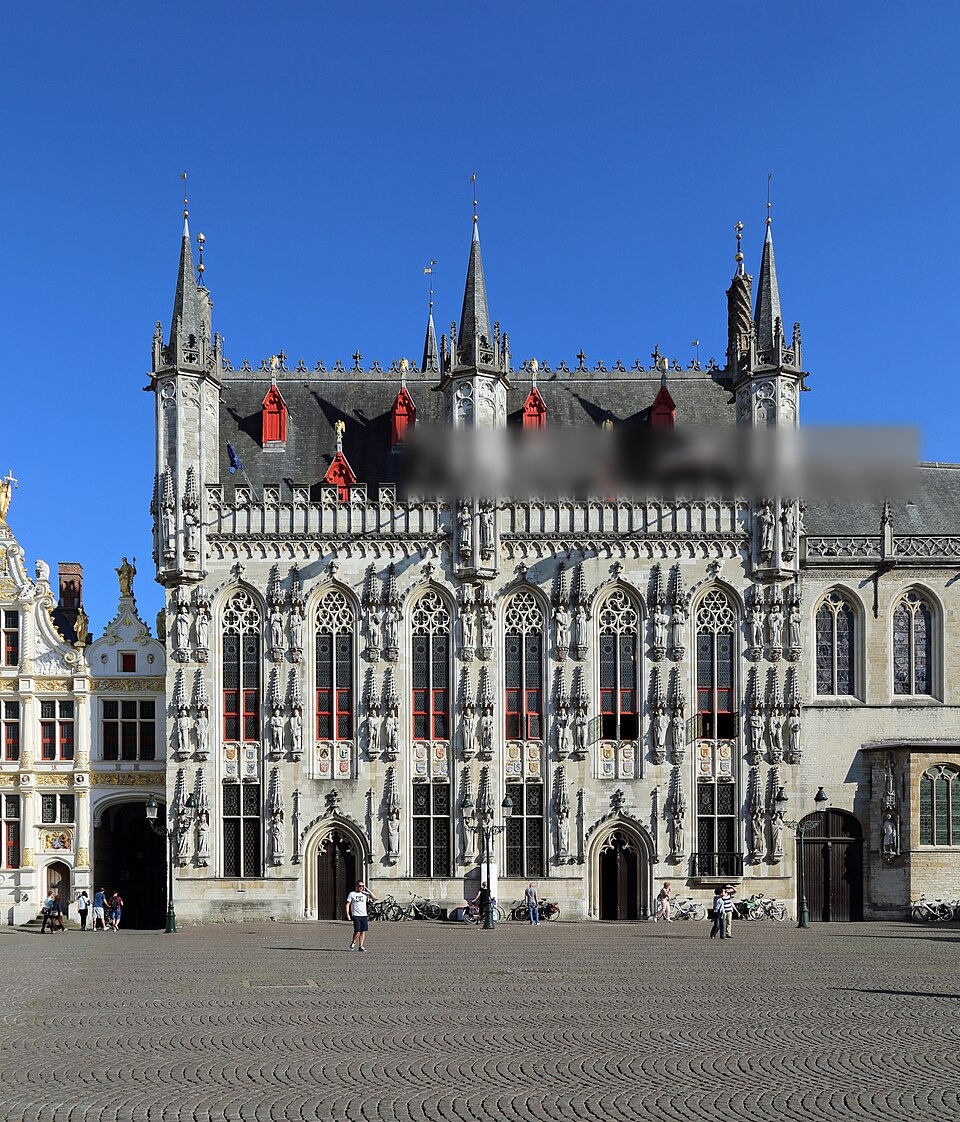
1376–1421
A tall, symmetrical late-Gothic façade of dense window tracery overlooking a small square, among the oldest town halls to survive from the region's Burgundian era.
Built between 1376 and 1421, this town hall is one of the oldest surviving city halls from the former Burgundian Netherlands. It was raised in a monumental late-Gothic style on Burg Square, the site of the city's former fortified castle, and has served as the seat of municipal government ever since. The building now also operates as a museum and, together with the surrounding historic centre, forms part of a UNESCO World Heritage Site.
- It ranks among the oldest surviving city halls in the entire former Burgundian Netherlands.
- It was raised on the site of the city's former fortified castle.
Photo: Marc Ryckaert (CC BY-SA 4.0)
Basilica of the Holy Blood
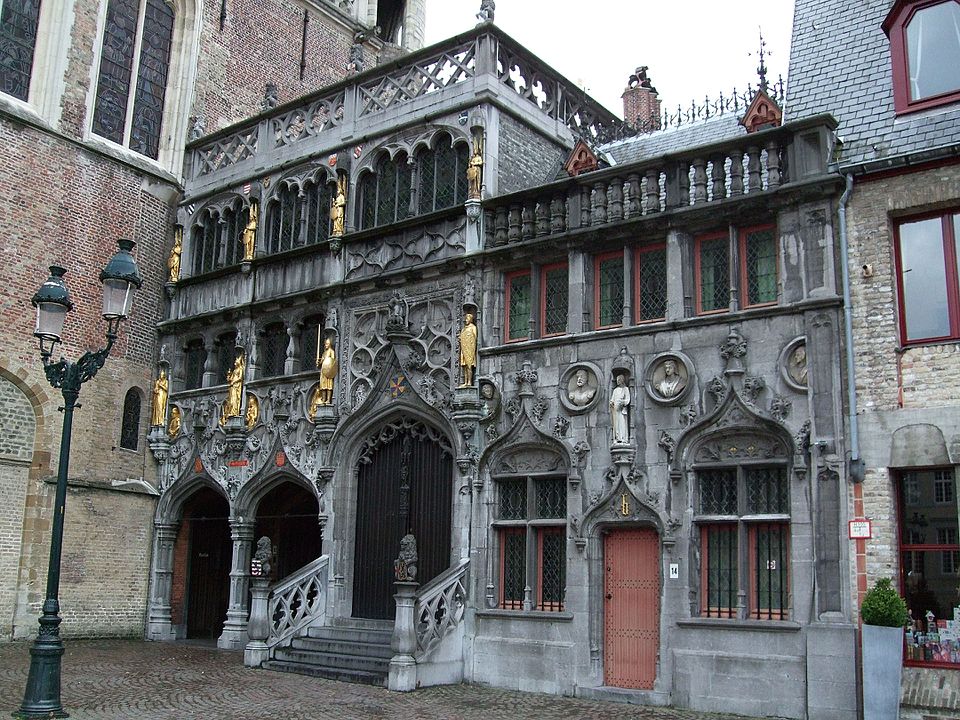
1134–1157
Two stacked chapels on a small square: a dark, largely unaltered Romanesque lower hall beneath a lighter Gothic upper chamber rebuilt in the 16th century and refreshed in Gothic Revival style in the 19th.
Raised between 1134 and 1157 as the private chapel of the Count of Flanders, this basilica houses a relic venerated as the Holy Blood, which tradition holds was collected by Joseph of Arimathea and brought from the Holy Land by Thierry of Alsace. The lower chapel, dedicated to St Basil the Great, remains a largely unaltered dark Romanesque space; the upper chapel was rebuilt in Gothic style in the 16th century and renovated again in the 19th. The building was elevated to a minor basilica only in 1923.
- Tradition holds the relic was collected by Joseph of Arimathea and brought from the Holy Land.
- It was raised to the rank of minor basilica only in 1923, despite dating from the 12th century.
Photo: Jim Linwood (CC BY 2.0)
Ten Wijngaerde Beguinage
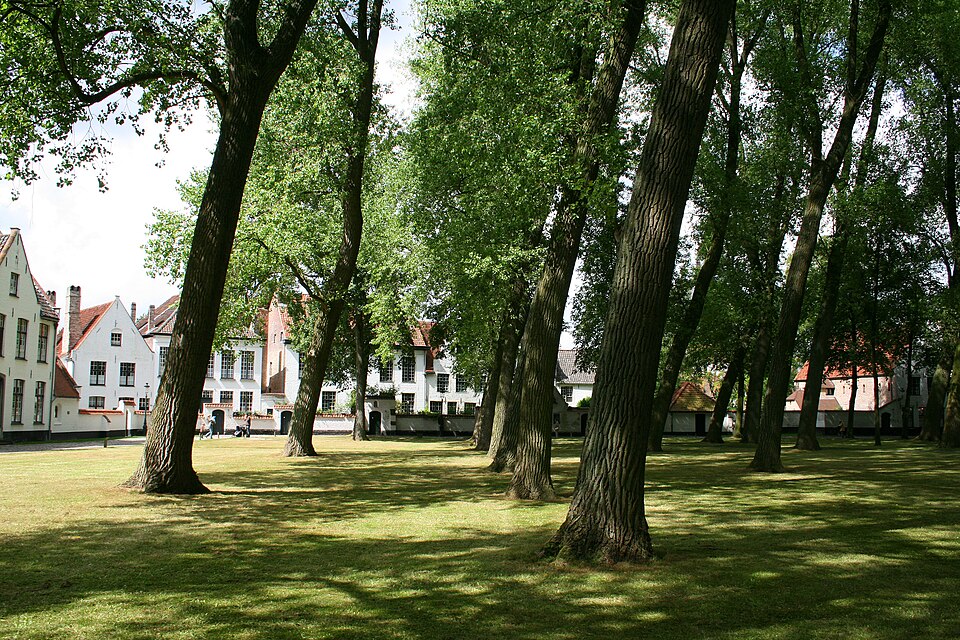
1245
A self-contained walled enclosure of former beguine houses, its western range reshaped and enlarged into a convent complex in the 1920s.
Founded in 1245, this is the only beguinage to survive intact in Bruges, originally built as a walled home for a community of lay religious women. No beguines remain today: since 1927 it has functioned as a convent for Benedictine nuns, a change begun by canon Hoornaert. That same year the houses along its western side were reshaped and enlarged into the Monasterium De Wijngaard, a priory for the Benedictine sisters. It forms part of the historic centre's UNESCO World Heritage listing.
- It is the only beguinage to survive intact in the city.
- Since 1927 it has housed Benedictine nuns rather than the lay beguines it was built for.
Photo: Jean-Pol GRANDMONT (CC BY 3.0)
St. Salvator's Cathedral
The Roman Catholic cathedral of the city, also known as the Cathedral of the Saviour and St. Donat. It is dedicated to the Risen Saviour and to Saint Donatian of Reims.
Markt
The central square of the city, covering about one hectare in the historic centre. Its south side holds one of the city's most famous landmarks, the 13th-century Belfry.
Burg
A square in the historic centre, formerly a fortress, whose Middle Dutch name, Burg, means 'stronghold'. It is one of the city's principal historic squares.
Provinciaal Hof
A prominent neo-Gothic building dominating the Markt, the city's main square. It served as the former meeting place for the Provincial Government of West Flanders.
Brugse Vrije
A former castellany in the County of Flanders surrounding the city, split off as a separate customary-law area in 1127. Its burgrave sat at the Burg, and by the late 14th century it joined Ghent and Ypres as one of the Four Members of Flanders.
Gruuthusemuseum
A museum of applied arts housed in the medieval Gruuthuse, once the residence of Louis de Gruuthuse. Its collection spans the 15th to the 19th century.
St. Walburga's Church
A 17th-century Catholic church, built by the Jesuits in the Baroque style. Now a parish church, it still holds a number of valuable art objects.
Ter Doest Abbey
A former Cistercian abbey in the present-day Lissewege, a district of Bruges. It lay in the West Flanders region of Belgium.
Loppem Castle
A mansion in Loppem, near Bruges, that unusually preserves its original architecture and interior decoration intact. It holds a collection of paintings, stained glass and statuary, set in a park with ponds and a maze, and has been open to the public since 1975.
Groeningemuseum
A municipal museum built on the site of the medieval Eekhout Abbey. Its collection of Flemish and Belgian painting spans six centuries, from Jan van Eyck to Marcel Broodthaers, including Early Netherlandish works, Renaissance and Baroque masters, and Flemish Expressionism.
Frietmuseum
A museum devoted to the history of potatoes and the production of Belgian fries. It describes itself as the first and only museum dedicated to potato fries.
St. Trudo's Abbey
A community of Canonesses Regular of the Holy Sepulchre, originating in the city in the 11th century. Between 1954 and 2013 it was settled in Male Castle, in the Sint-Kruis district of Bruges.
St. Andrew's Abbey
A Benedictine abbey in Sint-Andries that was destroyed during the French Revolution. Its modern successor, St. Andrew's Abbey, Zevenkerken, was founded in 1899-1900 as a Benedictine house of the Congregation of the Annunciation.
Castle Ten Berghe
A castle whose site was first recorded in a charter of 1267, destroyed in 1490 and rebuilt shortly after. Renovation in the late 19th century gave it its current neo-Gothic appearance, and early 21st-century work adapted it for use as a bed and breakfast.
Oostkerke Castle
A castle in Damme, just south of the village of Oostkerke. It was constructed in the 14th century.
Maele Castle
A former castle in Male, once a separate village and now part of the Sint-Kruis suburb. Its buildings were almost entirely rebuilt after destruction in the Second World War, and it housed St. Trudo's Abbey from 1954 until 2011.
Eekhout Abbey
A medieval house of Augustinian Canons, formerly standing in the city of Bruges, West Flanders.
History
Bruges grew wealthy as one of the world's chief commercial cities, and its surviving landmarks read as monuments to that medieval prosperity. The Counts of Flanders raised a private chapel on Burg Square between 1134 and 1157 that later became a pilgrimage site for a venerated relic; the same square later gained a monumental Gothic town hall, built between 1376 and 1421 on the ruins of the counts' fortified castle. The belfry rose from 1240 as a civic watchtower and record store, while the Church of Our Lady's tower, still the tallest structure in the city, took shape mainly across the 13th to 15th centuries. A walled community for lay religious women was founded in 1245 and, centuries later, in 1927, passed to Benedictine nuns.