Landmarks in Bath
Georgian terraces and porticoes ring a Roman bathhouse built over natural springs.
Bath's landmarks sit close together in a compact centre built above the Roman baths that gave the city its name and its natural springs. The Roman remains survive below street level, enclosed by buildings raised in the 19th century, while the streets above are almost entirely Georgian: coursed stone terraces, porticoes and Palladian detailing, reaching their fullest expression in the sweeping Royal Crescent and the shop-lined span of Pulteney Bridge over the River Avon. Bath Abbey, rebuilt in the 16th century and restored again in the 1860s, stands at the historic core near the springs. A plainer Guildhall of 1778 reflects the same period of civic building. The result is a centre that reads mostly as one long Georgian project, wrapped around a much older, half-hidden Roman site.
Roman Baths
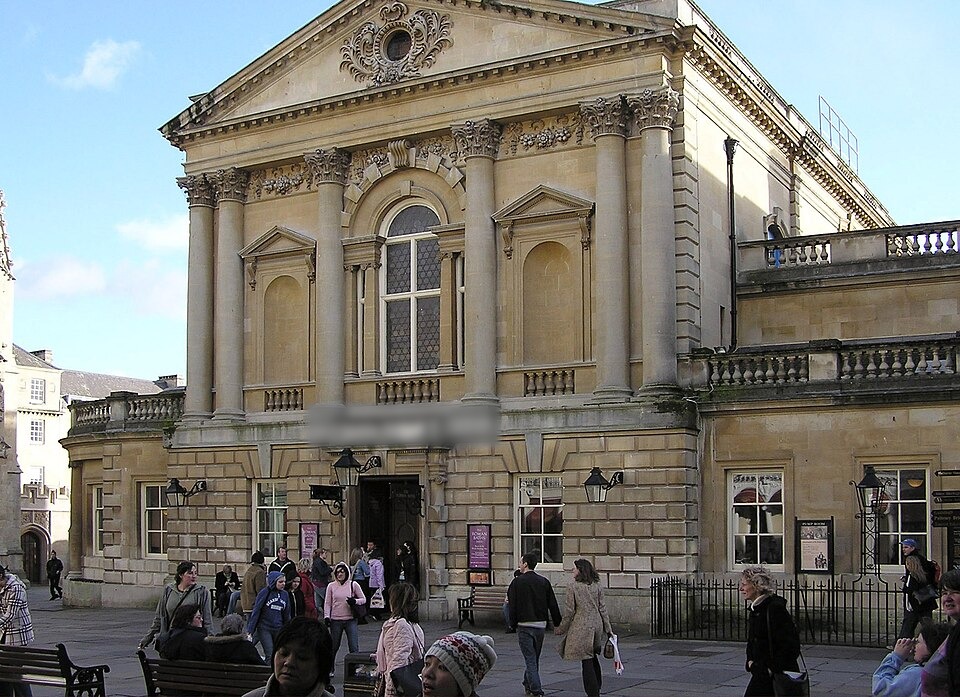
70–1897
A sunken, open-air bath enclosed at street level by a 19th-century stone colonnade; below ground the ancient spring, temple and bath house survive alongside a museum of excavated artefacts, and the water itself is fenced off from visitors.
Temple construction began between 60 and 70 AD, early in Roman Britain, and the settlement of Aquae Sulis grew up around it. The baths served public bathing until the end of Roman rule in the 5th century and, according to the Anglo-Saxon Chronicle, were already in ruins a century later. The site around the spring was redeveloped repeatedly through the medieval period. Every building visible at street level today dates from the 19th century, while the Sacred Spring, Roman Temple and Roman Bath House survive below alongside a museum.
- Visitors can tour the site but cannot enter the water, which hosts the amoeba Naegleria fowleri.
- Within a century of the end of Roman rule, the baths were already in ruins, according to the Anglo-Saxon Chronicle.
- Every building visible at street level dates from the 19th century, even though the site beneath is Roman.
Photo: Xander11012 (CC BY-SA 4.0)
Royal Crescent
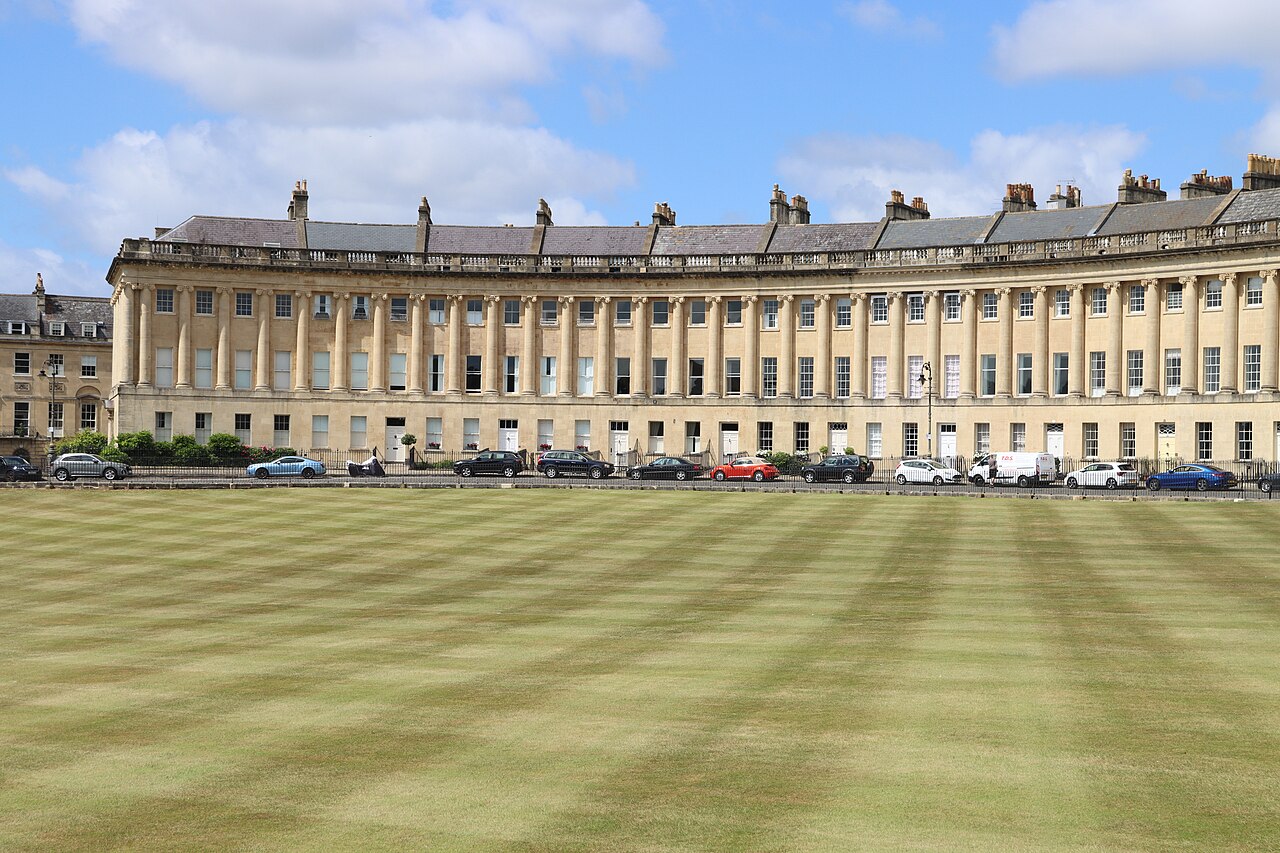
1767–1774 · John Wood the Younger
A long, gently curving terrace of stone houses united behind an unbroken run of 114 Ionic columns and a Palladian entablature above, facing an open lawn and parkland across the way.
Designed by John Wood the Younger and built between 1767 and 1774, this is a continuous terrace of thirty houses arranged in a shallow curve, faced in stone and fronted by 114 Ionic columns beneath a Palladian entablature. It was the first terrace of houses built in this crescent form, and it set its parkland views deliberately against the row's urban front. Of the original thirty houses, ten remain single townhouses, eighteen have been divided into flats, one holds a museum, and two others form a hotel.
- It was the first terrace of houses ever built in a curved, crescent form.
- Two of the original thirty houses were later combined to form a hotel.
Photo: Uhooep (CC BY-SA 4.0)
Pulteney Bridge
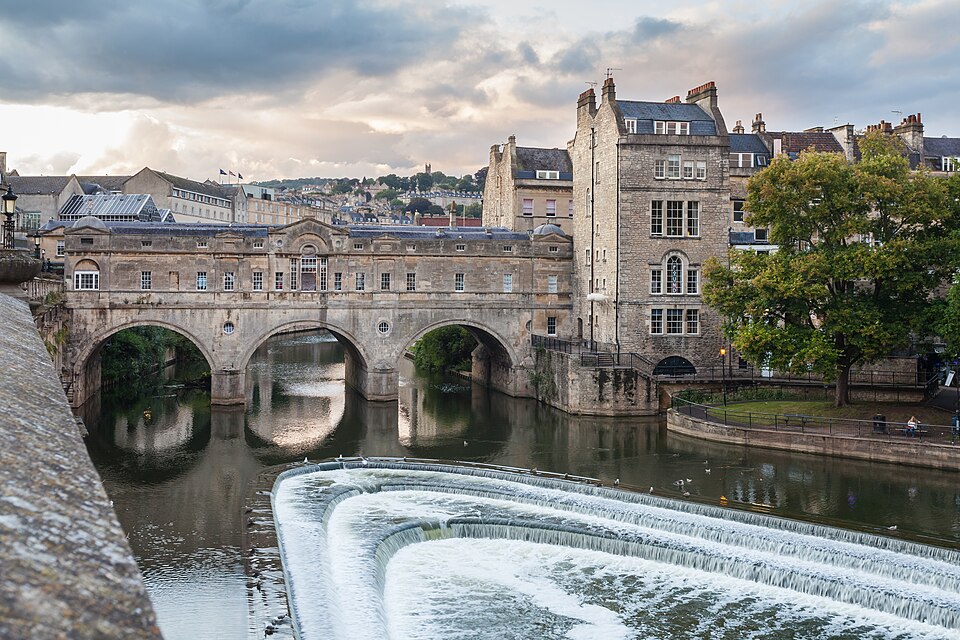
1774 · Robert Adam
A stone road bridge that reads as an ordinary street when crossed, since shopfronts run continuously along both sides of its full span; a Palladian balustrade and, on one face, later cantilevered shop extensions complete the look.
Completed by 1774 to a Palladian design by Robert Adam, the bridge crosses the River Avon and was built to give access to the Bathwick estate that Frances and William Pulteney had inherited in 1767. It is one of only four bridges in the world lined with shops across its full span on both sides. Within twenty years the shops had been enlarged and their facades altered; flood damage by the end of the 18th century forced a rebuild to a similar design, and cantilevered extensions were later added to one face.
- It is one of only four bridges anywhere lined with shops along the whole span, on both sides.
- It is named after Frances Pulteney, who inherited a fortune from a cousin, the Earl of Bath, in 1764.
- Flood damage forced a rebuild to a similar design within about twenty years of completion.
Photo: Diego Delso (CC BY-SA 4.0)
Bath Abbey
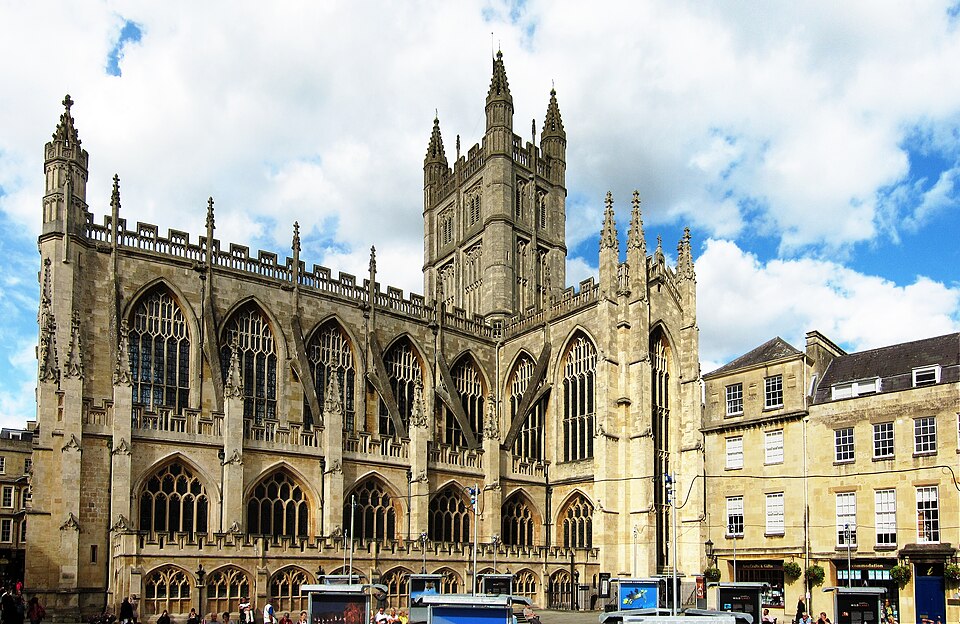
1572–1611
A cruciform church with elaborate fan vaulting inside and, on its west front, carved stone angels climbing ladders on either side of the main doors; inside it seats up to 1,200 and holds two organs and a peal of ten bells.
Founded as a Benedictine monastery in the 7th century and reorganised in the 10th, the building was rebuilt in the 12th and 16th centuries before the monastic community was dissolved in 1539. It once served as a sometime cathedral, a role later settled permanently at Wells. Sir George Gilbert Scott carried out a major restoration in the 1860s. Today it functions as an active parish church that also hosts civic ceremonies, concerts and lectures, with a museum in its cellars and memorials set into its walls and floors.
- Its west front carries stone angels carved climbing ladders on both sides, representing Jacob's Ladder.
- It briefly served as a cathedral before that seat was settled permanently at Wells.
Photo: Velvet (CC BY-SA 3.0)
Guildhall
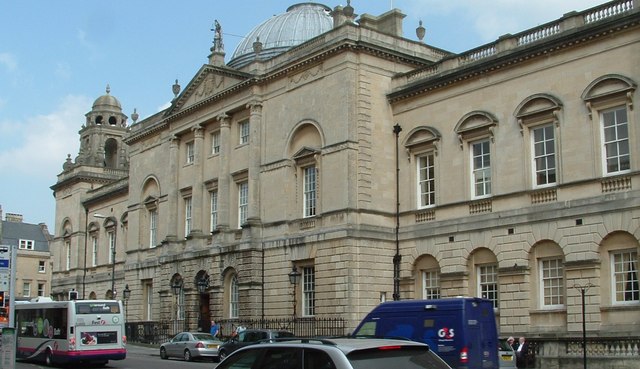
1778
A Grade I listed civic building still in active use as a seat of local government; no further description of its materials or style is recorded here beyond its 18th-century date.
Built in 1778, this is an 18th-century municipal building in central Bath. It serves as the seat of local government for Bath and North East Somerset and continues to function as a city hall. It carries the highest level of heritage protection available, having been designated a Grade I listed building. Beyond its date, function and listing status, the available record gives no further detail about its design, materials or architectural style.
Photo: Donnylad (CC BY-SA 2.0)
Bath Assembly Rooms
Georgian assembly rooms designed by John Wood the Younger, built after construction started in 1769 and funded through a tontine. They opened with a grand ball in 1771 and became the social hub of fashionable Bath society.
Grand Pump Room
A historic building in the Abbey Churchyard, adjacent to the Roman Baths, named for the hot-spring water pumped into it for visitors to drink. Grade I listed since 1950, it formed a social hub for the city together with the Lower Assembly Rooms.
Theatre Royal
A working Georgian theatre built in 1805 by architect George Dance the Younger to replace the Old Orchard Street Theatre. A fire destroyed its interior in 1862, and Charles J. Phipps's rebuilding added the current entrance.
Prior Park
A Neo-Palladian house built in the 1730s and 1740s for Ralph Allen on a hill above the city, designed by John Wood the Elder. Its 15-bay main block was built partly to showcase Bath stone, and its grounds include a Palladian-arched bridge.
Prior Park Landscape Garden
A landscape garden around the Prior Park estate, laid out in the 18th century by the poet Alexander Pope and the gardener Capability Brown. It helped define the English landscape garden style, later copied across continental Europe.
Holburne Museum
The city's first public art gallery, built around the collection of Sir William Holburne and housing works by Gainsborough, Guardi, Stubbs and Zoffany. It reopened in May 2011 after restoration and an extension designed by Eric Parry Architects.
Queen Square
A square of Georgian houses laid out by John Wood the Elder in the early 18th century, the first element of Bath's most important architectural sequence. Its central obelisk was erected by Beau Nash in 1738 to honor Frederick, Prince of Wales.
Beckford's Tower
A neo-classical folly on Lansdown Hill, built for the writer and collector William Beckford to designs by Henry Goodridge and completed in 1827. Its cupola served as a belvedere over the countryside, above ground-floor drawing rooms and a library.
Lansdown Crescent
A Georgian crescent designed by John Palmer and built between 1789 and 1793 on Lansdown Hill, higher than the Royal Crescent and the Circus below. It formed the northernmost boundary of Georgian Bath's development, alongside the curved terraces of Somerset Place.
Cleveland Bridge
A Grade II* listed road bridge over the River Avon, within the Bath World Heritage Site. Each corner is adorned with an unusual lodge, built in a style resembling a miniature Greek temple.
Cross Bath
A historic bathing pool on Bath Street, built in the style of Robert Adam by Thomas Baldwin by 1784 and remodeled by John Palmer in 1789. It is Grade I listed and was restored in the 1990s by Donald Insall Associates.
Thermae Bath Spa
A combination of historic and contemporary spa buildings that reopened in 2006, tapping the UK's only naturally hot mineral-rich springs. The main building, the New Royal Bath, is built in Bath stone under a glass envelope with a rooftop pool.
Farleigh Hungerford Castle
A medieval castle built in two phases, its inner court raised between 1377 and 1383 by Sir Thomas Hungerford on the site of a manor house. His son Sir Walter later added an outer court, enclosing the parish church, before his death in 1449.
Sydney Gardens
The country's only surviving eighteenth-century pleasure gardens, laid out in the 1790s to plans by Thomas Baldwin and completed by Charles Harcourt Masters. They once featured a maze, a grotto and a sham castle, and were visited by Jane Austen among others.
Cleveland Pools
A semi-circular lido on Hampton Row, designed by John Pinch the Elder and built in 1815, believed to be the oldest public outdoor swimming pool in the UK. It operated as public baths until the 1970s, closed in 1984, and was later restored.
Herschel Museum of Astronomy
A museum at 19 New King Street, opened in 1981. It occupies the town house that was once home to the astronomer William Herschel and his sister Caroline.
Victoria Art Gallery
A public art museum opened in 1900 to commemorate the Diamond Jubilee of Queen Victoria. Grade II* listed, it holds over 1,500 works of art, including British oil paintings dating from 1700 onwards, in a building whose ground floor once housed a public library.
American Museum and Gardens
A museum of American art and culture at Claverton, near the city, displaying collections of American furniture, quilts and folk art. It occupies a Grade I listed nineteenth-century house set in gardens overlooking the Avon valley.
History
Bath grew up around a natural spring the Romans enclosed as thermae in the first century AD, giving rise to the settlement of Aquae Sulis; the baths fell into ruin after Roman rule ended and were redeveloped repeatedly through the medieval period. A parish church on the abbey site was founded in the 7th century, reorganised in the 10th, and rebuilt in the 12th and 16th centuries, with a major restoration in the 1860s. The city's present character dates mostly from the 18th century: Pulteney Bridge was completed by 1774 to connect the city with the new Bathwick estate, the Royal Crescent was built between 1767 and 1774, and the Guildhall followed in 1778. The Roman baths themselves were finally re-exposed and rebuilt at street level in the 19th century, adding the buildings visitors see today.