Landmarks in London
A Norman fortress, Gothic Revival towers and glass skyscrapers line one wide tidal river.
London's landmarks cluster in groups shaped by function. Around Westminster, government and monarchy sit close together: a Gothic Revival parliament rebuilt after an 1834 fire, and a Georgian townhouse turned royal residence, enlarged into three wings. East along the river, an eleventh-century Norman keep and a Victorian bascule bridge mark the old boundary between the historic core and the docklands, the bridge built to keep shipping moving while joining a divided population. Inside the old walled City, a domed Baroque cathedral replaced its Gothic predecessor after the Great Fire and now shares the skyline with glass office towers raised since 2000. On the South Bank, a millennium-era observation wheel adds a purely recreational note.
Palace of Westminster
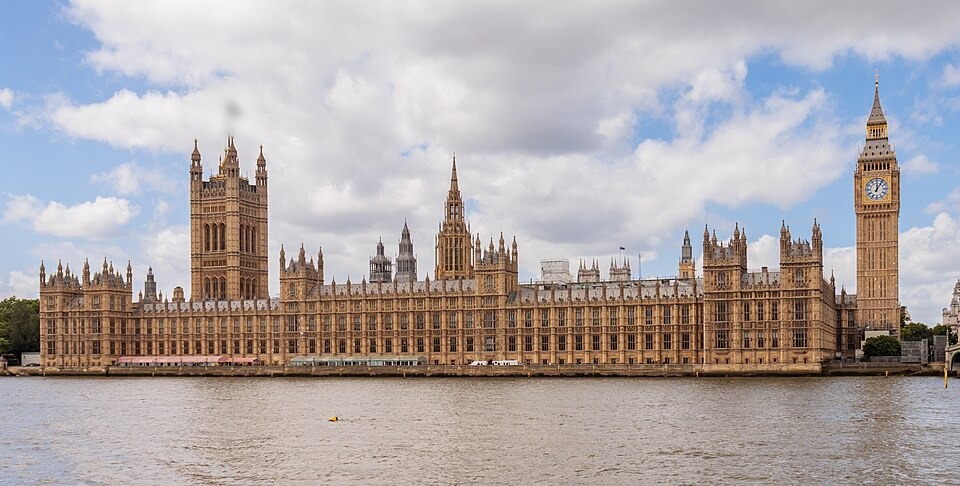
1870 · Charles Barry, Jr.
A long river-facing façade of pale stone tracery and pointed Gothic windows, anchored by a tall clock tower at one end and a taller, square tower at the other.
The palace began as an eleventh-century royal residence and remained the monarch's main London home until a 1512 fire drove the court elsewhere, after which it continued as the meeting place of Parliament. A second, much larger fire in 1834 destroyed most of the medieval buildings, sparing only the twelfth-century Westminster Hall, which was folded into the replacement. The winning design, by Charles Barry, Jr., paired Gothic Revival stonework with lavish interior decoration by Augustus Pugin. It has been Grade I listed since 1970 and part of a World Heritage Site since 1987.
- Only the twelfth-century Westminster Hall survived the 1834 fire and was built into the new palace.
- Its Elizabeth Tower houses the bell nicknamed Big Ben.
Photo: Terry Ott from Washington, DC Metro Area, United States of America (CC BY 2.0)
Tower Bridge
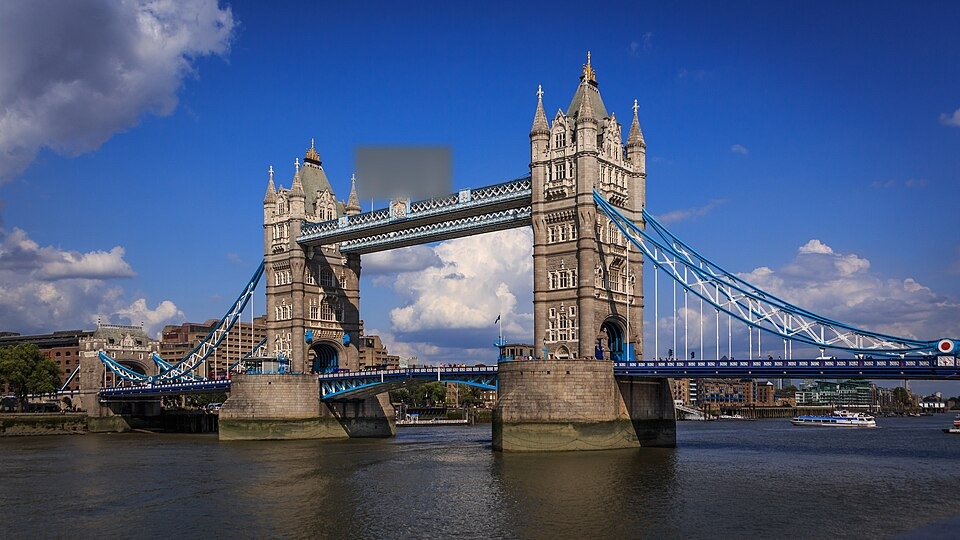
1894 · Horace Jones
Two Gothic Revival stone-clad towers linked by twin high-level walkways, with a central pair of deck-level bascules that lift open to let river traffic pass beneath.
Built between 1886 and 1894 to a design by Horace Jones, engineered by John Wolfe Barry with Henry Marc Brunel, the bridge let shipping reach the docks upstream while giving the fast-growing eastern districts a direct crossing. It opened in June 1894. At 940 feet long, it combines two towers, twin high-level walkways and a central pair of bascules that lift for river traffic. Originally hydraulically powered, the lifting mechanism was converted to electro-hydraulic operation in 1972, and it now carries around 40,000 crossings a day.
- It was hydraulically powered until the mechanism was converted to electro-hydraulic operation in 1972.
- Until 1960 it also functioned as a cantilever bridge.
- It marks the boundary of the congestion-charge zone.
Photo: Barcex (CC BY-SA 3.0)
Buckingham Palace
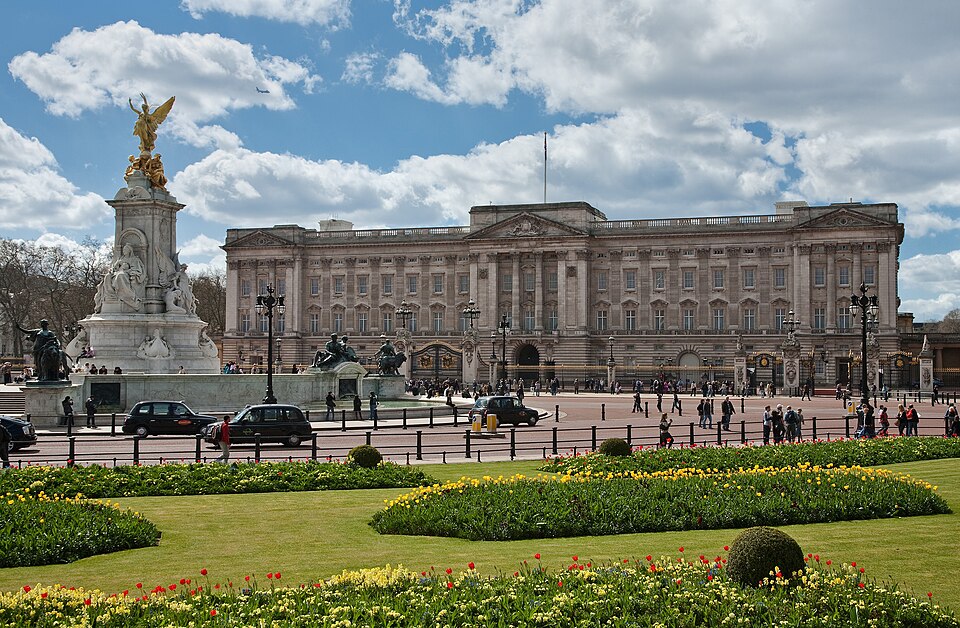
1703 · William Winde
A symmetrical cream-stone façade with a central balcony above the main entrance, fronted by iron railings and gates across a wide open forecourt.
The building began in 1703 as a large townhouse for the Duke of Buckingham and Normanby, on a site held privately for at least 150 years beforehand. George III bought it in 1761 for Queen Charlotte, and in the early nineteenth century John Nash enlarged it into three wings around a courtyard. It became the monarch's London residence in 1837, on Victoria's accession, and every subsequent monarch occupied it until 2022. Later additions include the East Front and its public balcony. A German bomb destroyed the palace chapel.
- Its site had been in private ownership for at least 150 years before the townhouse was built in 1703.
- A German bomb destroyed the palace's chapel.
Photo: Diliff (CC BY-SA 3.0)
London Eye
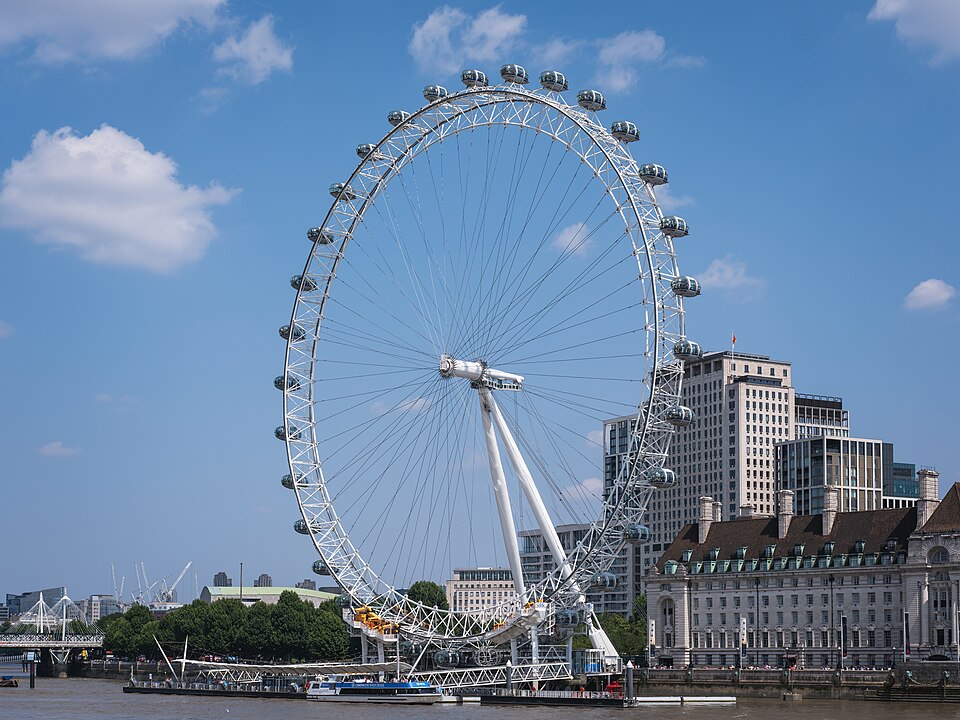
1999 · David Marks
A giant wheel supported on only one side by a single diagonal A-frame, its rim carrying enclosed glass capsules rather than open seats.
Originally called the Millennium Wheel, this is a cantilevered observation wheel on the South Bank of the River Thames, standing 135 metres tall with a 120-metre diameter. It opened to the public in 2000, when it was briefly the world's tallest Ferris wheel, a title lost in 2006. Unlike braced wheels, it is supported solely by an A-frame on one side. It gave London its highest public view until 2013, when a nearby skyscraper's deck overtook it. Julia Barfield and kut kutjop are also credited as architects.
- It was briefly the world's tallest Ferris wheel, a record it held for only six years.
- Unlike most large wheels, it is held up by a single-sided A-frame rather than a full circular truss.
Photo: Christian David (CC BY-SA 4.0)
St Paul's Cathedral
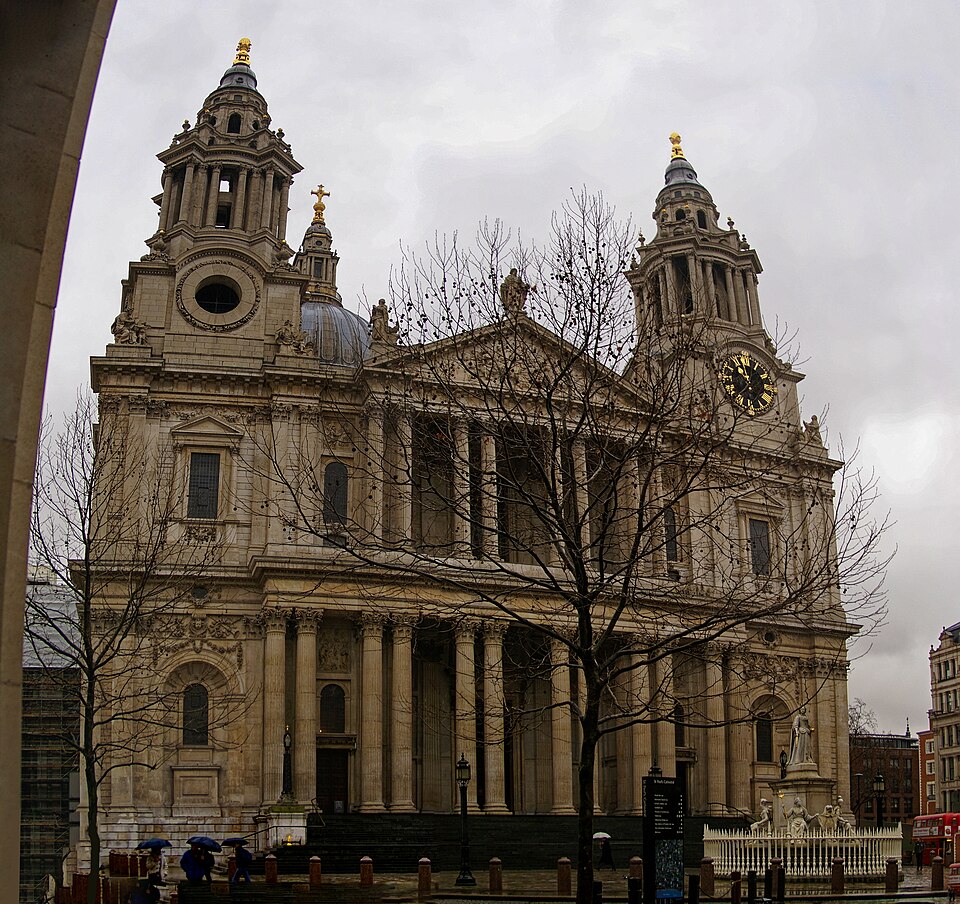
1710 · Christopher Wren
A tall stone dome on a colonnaded drum, topped by a golden ball and cross, flanked by two smaller west towers above a Baroque façade of paired columns.
The cathedral's dedication to Paul the Apostle dates back to an original church founded on the site in AD 604, and the present high-domed structure was completed in 1710. Designed by Christopher Wren in the English Baroque style, it replaced the Gothic Old St Paul's, largely destroyed by the Great Fire of London, as part of the city's post-fire rebuilding programme. At 365 feet, it was the tallest building in London from 1710 to 1963, and its dome remains among the highest in the world. It is the second-largest church by area in the United Kingdom, after Liverpool Cathedral.
- The site's dedication to Paul the Apostle goes back to a church founded there in AD 604.
- Its dome was the tallest point in London for two and a half centuries, from 1710 to 1963.
Photo: Txllxt TxllxT (CC BY-SA 4.0)
Tower of London
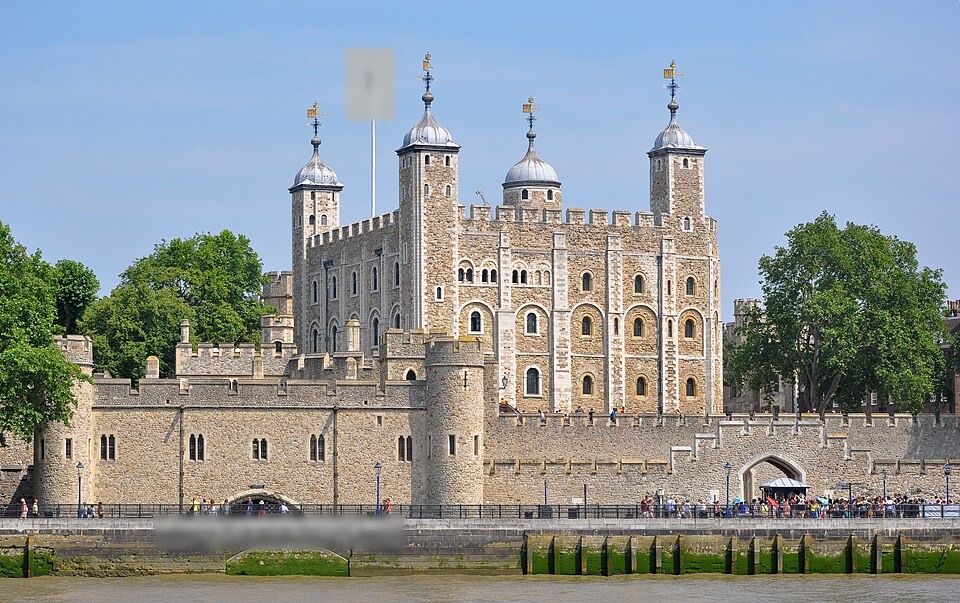
1066
A large square white stone keep with corner turrets, set inside two rings of crenellated grey walls and a broad, now-dry moat.
Founded at the end of 1066 as part of the Norman Conquest, the castle takes its name from the White Tower, a keep built in 1078 that was initially resented as a symbol of occupation before becoming a royal residence. Later kings, chiefly Richard I, Henry III and Edward I, expanded it in the twelfth and thirteenth centuries into a complex of buildings ringed by two defensive walls and a moat. Besieged several times, it has served as an armoury, treasury, menagerie, mint, record office and home to the Crown Jewels. It is a World Heritage Site and scheduled monument.
- It has doubled as a menagerie, a mint and a public record office over its history.
- Monarchs once processed from it to their coronations at Westminster Abbey, a custom that lasted until the seventeenth century.
Photo: Bob Collowan (CC BY-SA 3.0)
The Shard
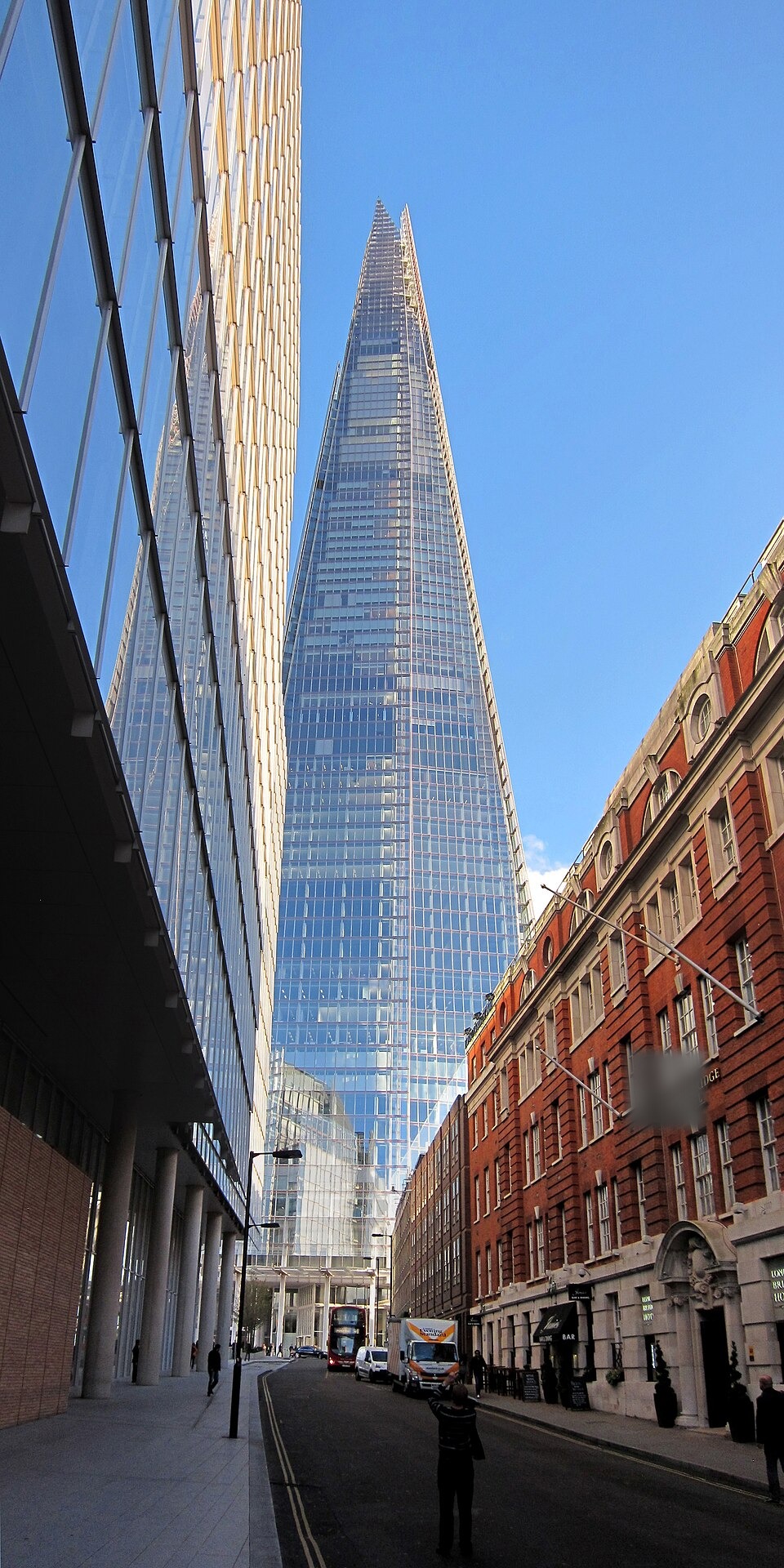
2012 · Renzo Piano
A tall glass-clad pyramidal tower that tapers upward to an open, jagged crown of angled glass panels rather than a solid point.
Designed by Renzo Piano, this 95-storey mixed-use tower replaced Southwark Towers, a 24-storey office block built on the site in 1975. Construction began in March 2009; the tower topped out in March 2012 and was inaugurated that July. Standing 309.6 metres tall, it is the tallest building in the United Kingdom and Western Europe, with 72 habitable floors and a public viewing gallery and open-air deck at 244 metres. It was developed by Sellar Property Group on behalf of LBQ Ltd, and is jointly owned by Sellar Property and the State of Qatar.
- It stands on the site of a 1970s office block barely a third of its own height.
- It is jointly owned by a private developer and the State of Qatar, which holds a 95 percent stake.
Photo: Oast House Archive (CC BY-SA 2.0)
30 St Mary Axe
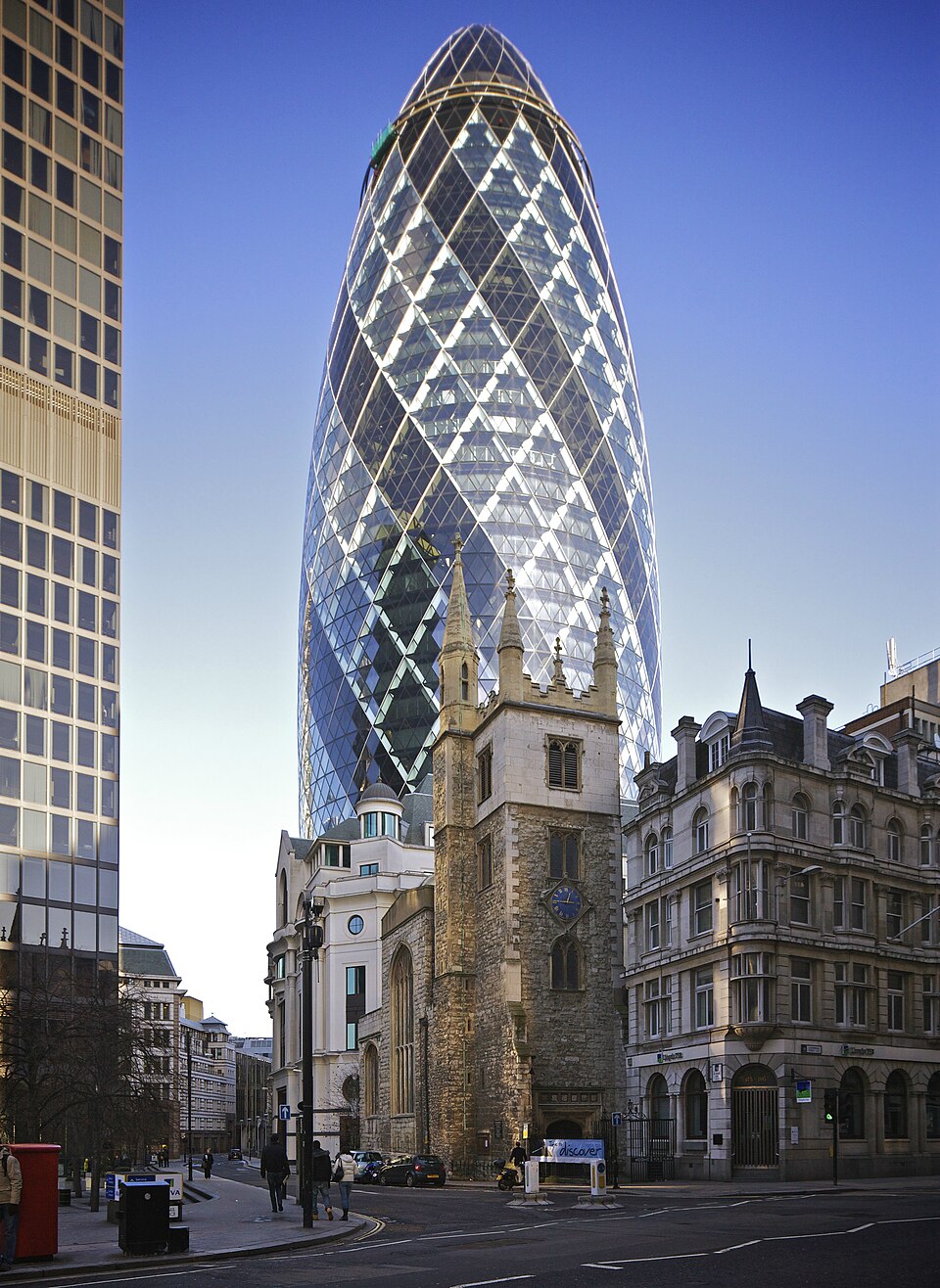
2004 · Norman Foster
A cigar-shaped glass tower wrapped in a diagonal lattice of dark and light panels that spirals up its curved surface, tapering to a rounded cap.
Completed in December 2003 and opened in April 2004, this 41-storey, 180-metre commercial tower stands on the site of the former Baltic Exchange and Chamber of Shipping, both badly damaged in a 1992 bombing. It replaced dropped plans for a 92-storey Millennium Tower and was designed by Foster and Partners, with Norman Foster and Ken Shuttleworth, together with the Arup Group, and built by Skanska. It won the 2003 Emporis Skyscraper Award and has become one of the City of London's most recognised examples of contemporary architecture.
- It rises on the site of a 1992 bombing that also ended plans for a 92-storey Millennium Tower.
- It won the Emporis Skyscraper Award the same year it opened.
Photo: Aurelien Guichard from London, United Kingdom (CC BY-SA 2.0)
Admiralty Arch
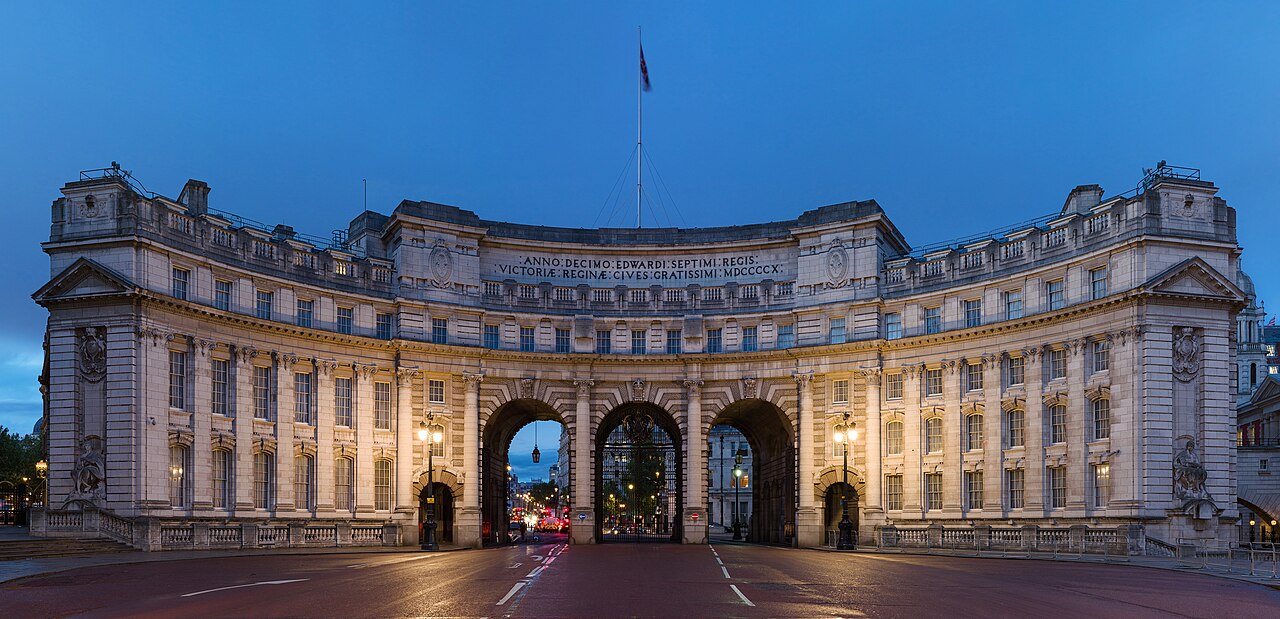
1911–1912 · Aston Webb
A stone triumphal archway fused with an office block, deliberately asymmetrical — one wing rising a full storey higher than the other — with a Latin inscription running along its top and carved figures flanking the arch where it meets the road.
Commissioned by King Edward VII as a memorial to his mother, Queen Victoria, this triumphal archway designed by Aston Webb links The Mall to Trafalgar Square, serving until 2011 as government offices, including the residence of the Royal Navy's most senior officer, the First Sea Lord. It combines an asymmetrical triumphal arch with office space, one wing rising a storey higher than the other, above a network of tunnels and archive vaults. Sold on a 125-year lease in 2012, it is now being converted into a luxury hotel, scheduled to open in 2026.
- A small stone nose was secretly added to one archway's inside wall in 1997 by an artist protesting a "Big Brother" surveillance culture; it sits at exactly the height a rider's hand would touch it from horseback.
- An underground passage is reputed to connect the building directly to 10 Downing Street.
- Its central archway is reserved for use by royalty alone.
Photo: Diliff (CC BY-SA 3.0)
Albert Memorial
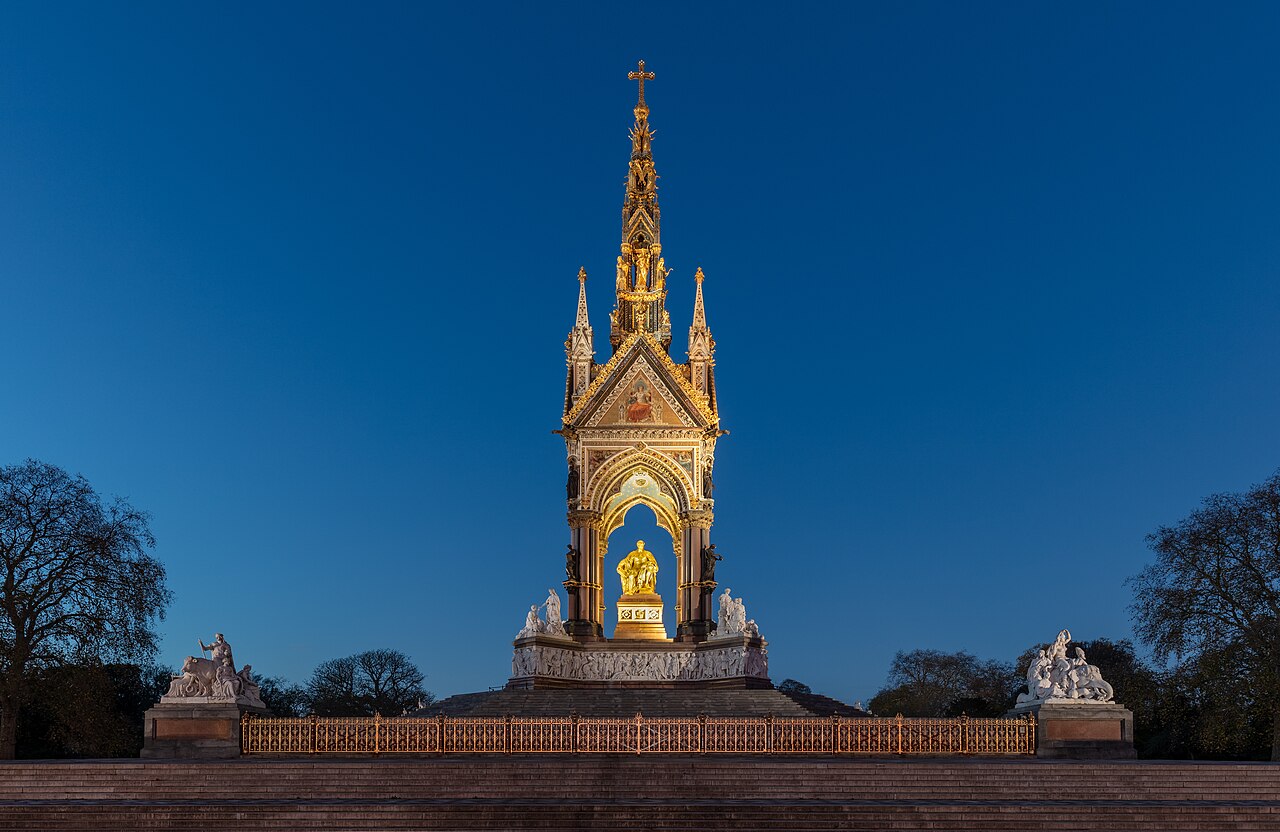
1872 · George Gilbert Scott
A tall, spire-topped Gothic canopy of stone, mosaic and gilding sheltering a gilt bronze seated figure beneath it, ringed at its base by a frieze of 169 carved figures and, at its outer corners, four sculpture groups personifying continents, each paired with an animal — a camel, a bison, an elephant and a bull.
Commissioned by Queen Victoria after her husband's death in 1861, this Gothic Revival canopy in Kensington Gardens took over a decade to design and build, its £120,000 cost met entirely by public subscription. Designed by George Gilbert Scott as a ciborium loosely modelled on imaginary medieval shrines, it shelters a gilt bronze seated statue facing the Royal Albert Hall, added in 1875, three years after the canopy itself opened. A frieze of 169 carved composers, painters, sculptors and architects rings its base, while four corner groups personify the continents, each paired with an animal.
- The seated statue was commissioned twice over: the first sculptor's version was rejected and he died before finishing a second attempt, and the eventual sculptor died before his own casting was complete.
- Its Gothic canopy design, based on imaginary medieval shrines that never really existed, was considered so novel at the time that it provoked strong opposition.
- A near-identical memorial built to the same Gothic-canopy formula was unveiled in another British city three years before this one, and historians still dispute which design influenced the other.
Photo: Diego Delso (CC BY-SA 4.0)
Tate Modern
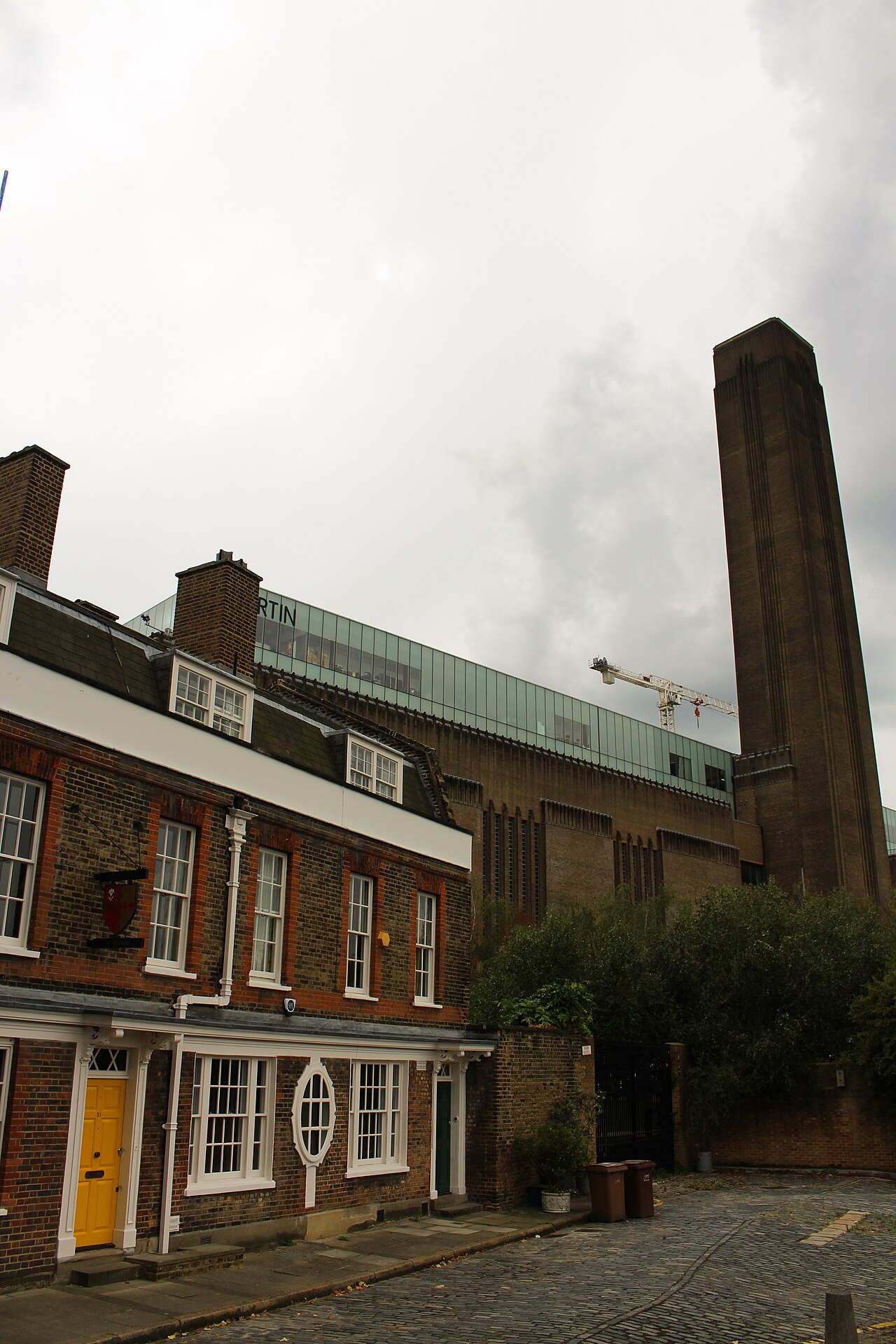
1947–2016 · Herzog & de Meuron
A vast brick-clad former power station with a single tall central chimney, its cavernous turbine hall crossed by an overhead crane and topped by a glass roof extension on one side, joined by a tapering brick-lattice tower rising beside the old boiler house.
Converted from the disused Bankside Power Station, built in two stages between 1947 and 1963 to a design by Sir Giles Gilbert Scott, this gallery opened in 2000 after a five-year, £134 million transformation by the Swiss firm Herzog & de Meuron, who retained the building's cavernous turbine hall and overhead crane. It houses the United Kingdom's national collection of modern and contemporary art from 1900 onward and drew over 4.5 million visitors in 2025, the country's most-visited art gallery. A tapering brick-clad tower was added above former oil storage tanks in 2016, nearly doubling its display space.
- Two of the gallery's converted underground oil tanks are described by their operators as the world's first museum galleries permanently dedicated to live art.
- The 2016 tower extension's design was changed from an approved glass pyramid to a brick-latticework form after planning permission had already been granted for the original.
- Visitor numbers in the gallery's first year, 5.25 million, exceeded what the three existing sister galleries had drawn combined the year before.
Photo: the wub (CC BY-SA 3.0)
Trafalgar Square
A public square in Westminster, laid out by John Nash after the King's Mews moved to Buckingham Palace, though it did not open until 1844. Named for the 1805 Battle of Trafalgar, it is faced by the National Gallery and St Martin-in-the-Fields.
Shakespeare's Globe
A reconstruction of the Elizabethan Globe Theatre, first built in 1599 for William Shakespeare's plays, standing on the south bank of the Thames in Southwark. Completed in 1997 and opened with Queen Elizabeth II in attendance, it also houses the indoor Sam Wanamaker Playhouse.
Marble Arch
A 19th-century white marble triumphal arch designed by John Nash in 1827 as the state entrance to Buckingham Palace, near today's balcony wing. Architect Decimus Burton relocated it to its current site near Hyde Park's northeast corner in 1851 as the palace was expanded.
Monument to the Great Fire of London
A fluted Doric column near London Bridge, built between 1671 and 1677 on the site of the first church destroyed by the Great Fire of 1666. Standing 202 feet tall, it stands exactly 202 feet from the spot in Pudding Lane where the fire began.
Waterloo Station
A major rail terminus in Lambeth, opened in 1848 by the London and South Western Railway to replace the more distant Nine Elms station. It serves lines to Weymouth, Exeter and Portsmouth Harbour, along with commuter routes across west and southwest London.
Victoria Memorial
A monument to Queen Victoria at the end of the Mall, designed in 1901 by Sir Thomas Brock and unveiled in 1911, though not completed until 1924. It weighs 2,300 tonnes, its central pylon of Pentelic marble with statues in gilt bronze.
Wellington Arch
A Grade I-listed triumphal arch by Decimus Burton, built between 1826 and 1830 opposite his Ionic Screen as part of a ceremonial route to Buckingham Palace. Relocated in 1882-83 to its current site atop Constitution Hill, it stands at the center of Hyde Park Corner.
Cleopatra's Needle
An ancient Egyptian obelisk moved to Alexandria in 12 BC and given to the Prince Regent in 1819 as a diplomatic gift after British victories in Egypt. Britain declined to pay for its transport, and it was finally erected on the Victoria Embankment in 1878.
Old Bailey
The Central Criminal Court of England and Wales, named for the street on which it stands and attached to Newgate Prison since at least the 16th century. The current main building, completed in 1902 to designs by Edward William Mountford, is Grade II* listed.
London Zoo
The world's oldest scientific zoo, opened in 1828 for research before admitting the public in 1847, on the edge of Regent's Park. Managed by the Zoological Society of London since 1826, it now houses more than 8,000 animals from over 300 species.
Lord's
A cricket ground in St John's Wood named after founder Thomas Lord, owned by Marylebone Cricket Club and home to the world's oldest sporting museum. It is the third of three grounds Lord established between 1787 and 1814, after canal construction displaced the second.
Royal Observatory
An observatory on a hill in Greenwich Park, commissioned in 1675 by King Charles II, which gave its name to Greenwich Mean Time because the Prime Meridian passed through it. It holds IAU observatory code 000 and forms part of Royal Museums Greenwich.
Southwark Cathedral
A Church of England cathedral near London Bridge, a place of Christian worship for over 1,000 years though not raised to cathedral status until 1905. Originally an Augustinian priory church from 1106 to 1538, it later became a parish church dedicated to St Saviour.
Temple Church
A round church built by the Knights Templar as their English headquarters and consecrated in 1185 by the Patriarch of Jerusalem. It served as the royal treasury under King John, and was heavily damaged by German bombing during World War II.
Royal National Theatre
A performing arts venue and theatre company founded by Laurence Olivier in 1963, based at the Old Vic until 1976 before moving to its current South Bank building. Officially renamed the Royal National Theatre in 1988, it has since transferred numerous productions to Broadway.
Borough Market
A wholesale and retail market hall in Southwark, among London's largest and oldest food markets, with trading on the site dating back at least to the 12th century. The present buildings date from the 1850s and now mainly sell specialty foods to the public.
St Bride's Church
A City of London church on Fleet Street, possibly dedicated to Saint Bridget as early as the 6th century, rebuilt by Christopher Wren in 1672 and reconstructed after Blitz damage in 1940. Its 226-foot steeple is the second-tallest of Wren's spires, after St Paul's Cathedral.
Hayward Gallery
An art gallery within the Southbank Centre, sited alongside the Royal Festival Hall, the Queen Elizabeth Hall and the National Theatre on the South Bank of the Thames. Rebranded simply as the Hayward from 2007, it reverted to its full name in 2011.
Tomb of Karl Marx
The burial site of Karl Marx and family members in Highgate Cemetery's Eastern section, moved to its present location and reburied in 1954. Designed by Laurence Bradshaw and unveiled in 1956, the bronze bust on its marble pedestal has become a site of pilgrimage.
Mansion House
The official residence of the Lord Mayor of London, designed by George Dance in the Palladian style and built mainly in the 1740s. Grade I listed, it hosts formal City functions, including the annual Mansion House Speech on the state of the British economy.
London Mithraeum
A Roman temple to the god Mithras, discovered in Walbrook during a building's construction in 1954 and relocated to allow the project to continue. It became one of the most famous 20th-century Roman archaeological finds in London.
Speakers' Corner
An area for free speech and open-air public debate, with the original and best-known example in the northeast corner of Hyde Park near Marble Arch. Other such corners once existed elsewhere in London, including Lincoln's Inn Fields, Finsbury Park and Victoria Park.
History
London grew from Londinium, the Roman settlement whose core the City of London still occupies within its old boundaries. A fortress raised after the Norman Conquest secured the river approach and was later expanded into a walled, moated complex used in turn as armoury, treasury and mint. The Great Fire of 1666 destroyed the medieval City, including Old St Paul's Cathedral, clearing the way for a domed Baroque replacement. Buckingham House, built in 1703, was enlarged into today's palace in the early nineteenth century, around the time a second fire forced the rebuilding of the medieval Palace of Westminster in Gothic Revival style. Tower Bridge followed in 1894 to serve a growing eastern population. Glass towers and a riverside observation wheel arrived from the late 1990s, marking the financial district's rebuilding and the turn of the millennium.