Landmarks in Honolulu
A former royal capital where a stone palace and harbor tower anchor a compact downtown.
Honolulu's landmarks sit close together in and around its historic downtown, on land that once formed the Hawaiian Kingdom's seat of government. A coral-block Congregational church, built in 1842 from stone quarried nearby, still stands where four thatched chapels once served the same congregation. A few streets away, a stone palace completed in 1882 was the last residence of the kingdom's rulers before serving decades as the territory's and state's capitol. Toward the water, a tall tower raised in 1926 at Pier 9 marks the entrance to Honolulu Harbor, once the tallest structure in the islands. Together the three sites trace a shift from mission settlement, to monarchy, to a working Pacific port.
Iolani Palace
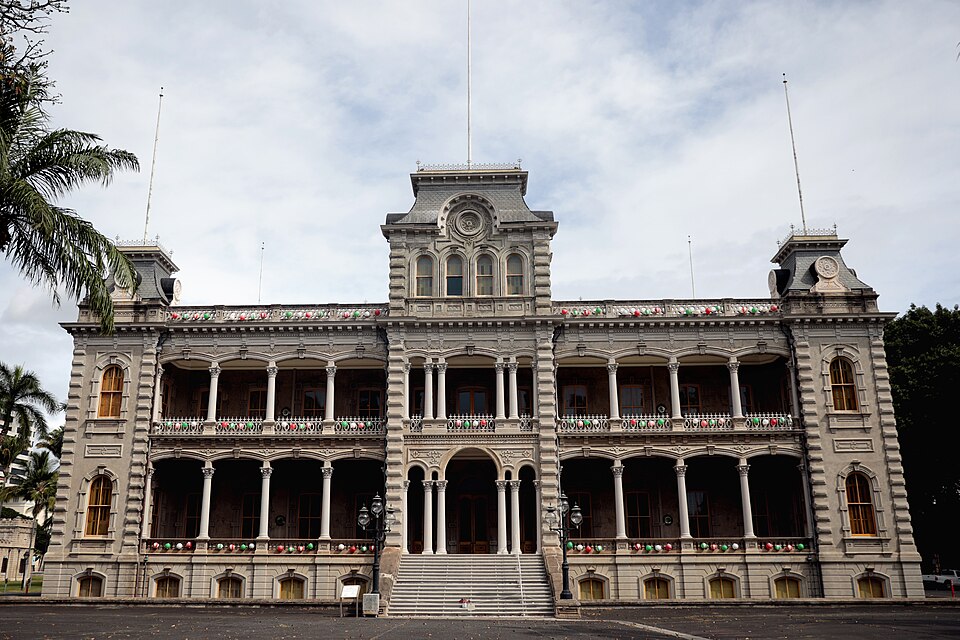
1882
Restored after decades as a government building, it stands as the only royal palace on U.S. soil, set within Honolulu's capitol district in the heart of downtown.
Completed in 1882, it was the last residence built for the rulers of the Hawaiian Kingdom, housing monarchs from Kamehameha III to Queen Liliʻuokalani before the monarchy's overthrow in 1893. It then served as the capitol building for the provisional government, the republic, and the territory and state of Hawaii until 1969. Restored, it reopened to the public as a museum in 1978. It is the only royal palace on U.S. soil and is listed as a National Historic Landmark on the National Register of Historic Places.
- It is the only royal palace on U.S. soil.
- It served as Hawaii's government capitol for eight decades before reopening as a museum in 1978.
Photo: Gage Skidmore from Surprise, AZ, United States of America (CC BY-SA 2.0)
Aloha Tower
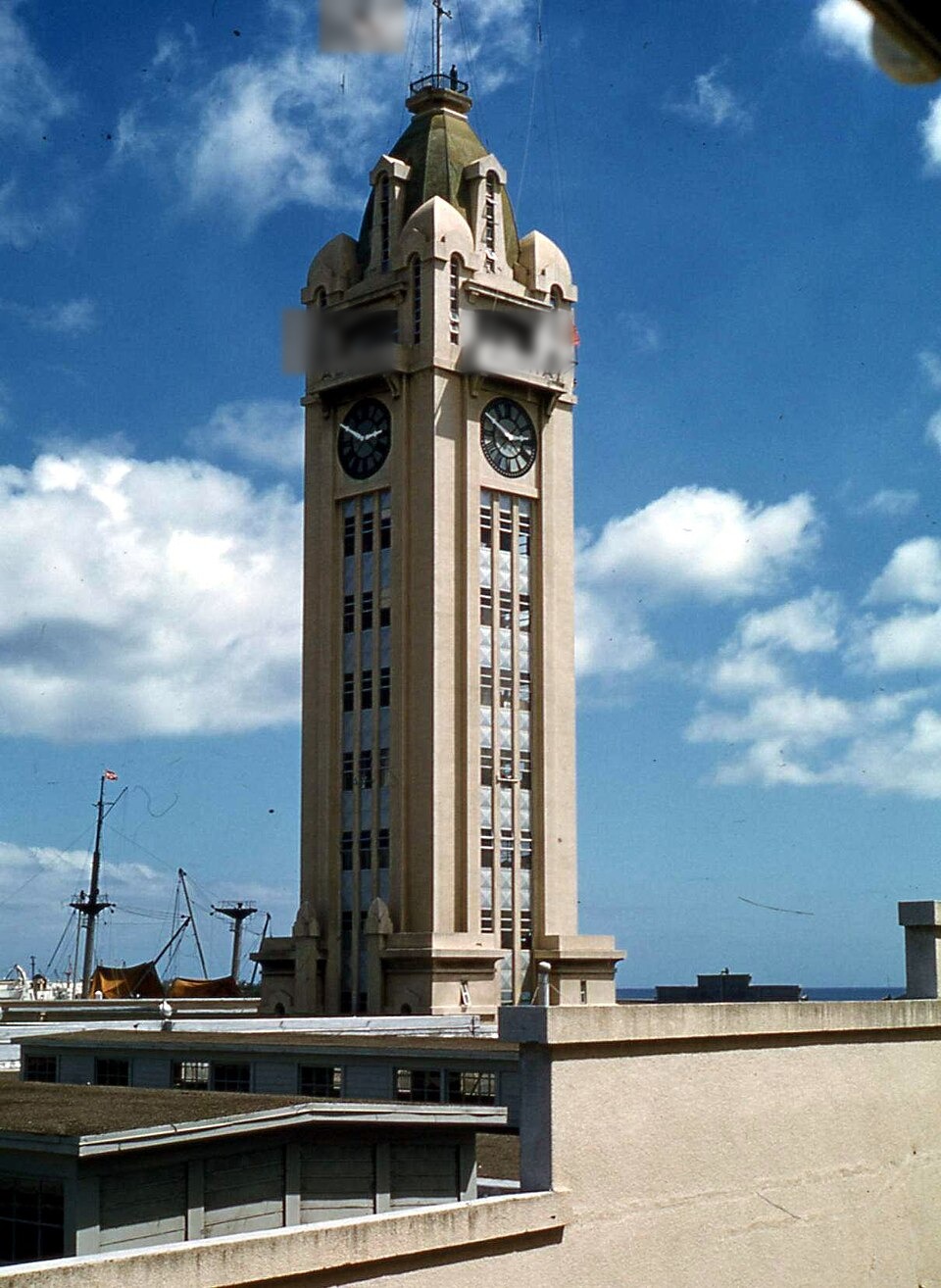
1926
A ten-story tower rising 184 feet with a further 40-foot flag mast on top, standing at the harbor's edge and long the tallest structure in the islands.
Opened on September 11, 1926, at a cost of $160,000, the tower stands at Pier 9 of Honolulu Harbor as a retired lighthouse built in the Hawaiian Gothic style. At ten stories and 184 feet, topped with a 40-foot flag mast, it was the tallest structure in Hawaii for four decades. It has long served as a beacon welcoming arriving vessels, much as the Statue of Liberty greeted immigrants to New York, and remains a familiar landmark of the harbor today.
- Its 1926 construction cost of $160,000 would be worth more than $2.8 million today.
- For four decades it was the tallest structure in Hawaii.
Photo: Father of JGKlein (Public domain)
Kawaiahao Church
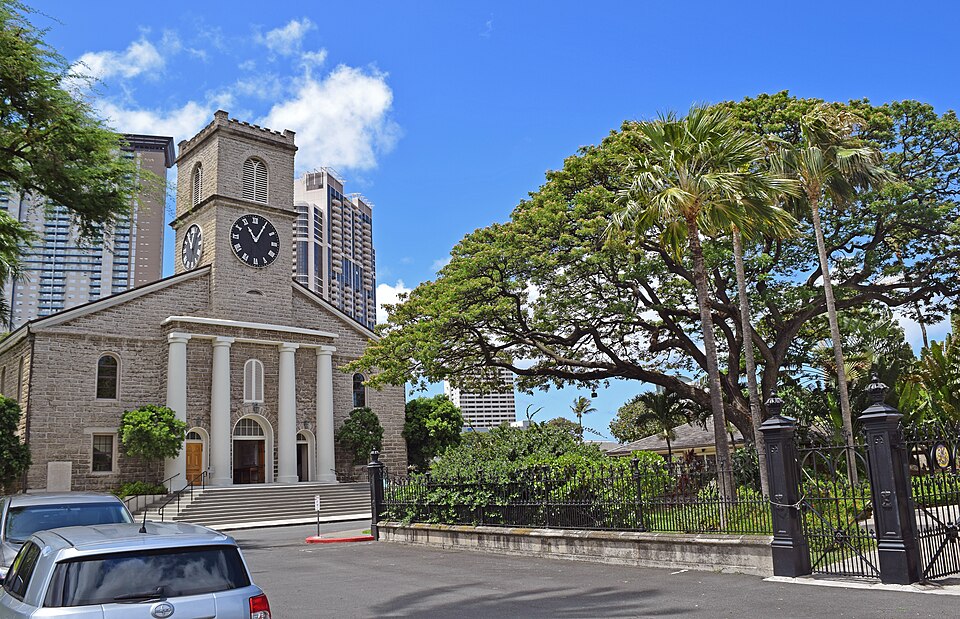
1842
Built of coral blocks and popularly called the Great Stone Church, it stands downtown as one of the oldest churches on its island, still using its congregation's original language for part of its services.
Raised in 1842 to replace a series of thatched chapels on the same site, this coral-block church served as the central church of the Kingdom of Hawaii and the chapel of its royal family, earning the nickname 'Hawaii's Westminster Abbey.' Also known as the Great Stone Church, the Hawaiian Tabernacle, and the King's Chapel among other names, it is the oldest church on Oahu. Designated a National Historic Landmark in 1962, it remains an active congregation of the United Church of Christ and still holds part of its services in the Hawaiian language.
- Four thatched chapels stood on or near the site before this stone church was built.
- It is nicknamed "Hawaii's Westminster Abbey" for its role as the royal family's chapel.
- Its name comes from a freshwater spring once named for a high chiefess, Haʻo.
Photo: Mark Miller (CC BY-SA 4.0)
Bishop Museum
Hawaii's largest museum, founded in 1889 in the historic Kalihi district, holding the world's largest collection of Polynesian cultural artifacts. Its natural history holdings exceed 24 million specimens, including an entomological collection of more than 13.5 million, the third-largest insect collection in the United States.
Aliʻiōlani Hale
A building in downtown Honolulu that now houses the Hawaiʻi State Supreme Court, and once was the seat of government for both the Kingdom and the Republic of Hawaiʻi. Its courtyard holds the famed gold-leaf statue of Kamehameha the Great.
Statue of Kamehameha I
An outdoor bronze sculpture by American artist Thomas Ridgeway Gould, erected in 1883 outside the Aliʻiōlani Hale government building. The second of three casts made from the same design, it depicts Kamehameha I and has become a recognizable symbol of the Hawaiian Islands.
Hawaii State Capitol
The official statehouse of Hawaii, in downtown Honolulu, where the governor, lieutenant governor and the state legislature carry out their duties. Commissioned and dedicated by governor John A. Burns, it opened on 15 March 1969, replacing the former statehouse, ʻIolani Palace.
Royal Hawaiian Hotel
A beachfront luxury hotel in Waikiki, one of the first hotels established there and long considered among the most famous in Hawaiian tourism. Its bright pink Spanish/Moorish-styled stucco façade earned it the nickname 'The Pink Palace of the Pacific'.
Diamond Head Lighthouse
A United States Coast Guard facility on Diamond Head, on the island of Oʻahu. It was listed on the National Register of Historic Places in 1980 and appeared on a US postage stamp in June 2007.
Cathedral Basilica of Our Lady of Peace
The mother church and cathedral of the Diocese of Honolulu.
Honolulu Museum of Art
Founded in 1922 by Anna Rice Cooke and formerly known as the Honolulu Academy of Arts, this is the state's largest art museum. Since opening in 1927, its collections have grown to more than 55,000 works, including major holdings of Asian and Pan-Pacific art.
Washington Place
A Greek Revival palace in the Hawaii Capital Historic District, where Queen Liliʻuokalani was arrested during the overthrow of the Hawaiian Kingdom. It later became the governor's residence, designated a National Historic Landmark in 2007, with a new governor's residence built behind it in 2008.
Royal Mausoleum (Mauna ʻAla)
The Royal Mausoleum of Hawaii, known in Hawaiian as Mauna ʻAla, or Fragrant Hills. It is the final resting place of Hawaii's two prominent royal families, the Kamehameha Dynasty and the Kalākaua Dynasty.
Moana Hotel
A historic hotel at 2365 Kalākaua Avenue in Waikiki, built as the neighborhood's first hotel and opened in 1901. Listed on the National Register of Historic Places, it joined Historic Hotels of America in 1989 and is now part of the Moana Surfrider resort.
Aloha Tower Marketplace
An open-air mixed-use complex at Honolulu Harbor, now the main campus for Hawaii Pacific University after opening in 1994 as a festival marketplace that struggled through bankruptcies. It includes landmarks such as the Aloha Tower, the Falls of Clyde and the Hawaiʻi Maritime Center.
Shangri La
A museum of Islamic art and design in the former Diamond Head home of Doris Duke, built between 1936 and 1938 after her 1935 honeymoon through the Islamic world. Her travels inspired a design blending Islamic art with Hawaii's landscape.
Hawaii Theatre
A theatre in downtown Honolulu, built in 1922 on Bethel Street at the edge of Chinatown. It is listed on the State and National Register of Historic Places.
Honolulu Hale
The official seat of city and county government on South King Street, originally called the Honolulu Municipal Building. In Hawaiian, hale means house or building, and in 1978 the building was listed as a contributing property to the Hawaii Capital Historic District.
Hānaiakamalama
Queen Emma Summer Palace, a retreat used from 1857 to 1885 by Queen Emma of Hawaii, her husband King Kamehameha IV, and their son Prince Albert Edward. Now a historic landmark and museum near downtown Honolulu, it is maintained by the Daughters of Hawaii.
Cathedral Church of Saint Andrew
A cathedral of the Episcopal Church, originally the seat of the Anglican Church of Hawaii and now home to the bishop of the Episcopal Diocese of Hawaii. It is affiliated with St. Andrew's Schools, including a K-12 girls' school and a boys' preparatory school.
ʻIolani Barracks
The 'hale koa', or house of warriors, built in 1870 by architect Theodore Heuck under King Lot Kapuaiwa, adjacent to ʻIolani Palace in downtown Honolulu. It housed about 80 members of the monarch's Royal Guard until the overthrow of the Hawaiian Monarchy in 1893.
Foster Botanical Garden
One of five public botanical gardens on Oahu, spanning 13.5 acres near Chinatown at the intersection of Nuʻuanu Avenue and Vineyard Boulevard. It is the oldest botanical garden in Hawaii and is listed on the National Register of Historic Places.
Waikiki Natatorium War Memorial
A war memorial in Honolulu built in the form of an ocean water public swimming pool. It was dedicated as a living memorial to the men and women who served in World War I.
Hawaiʻi State Library
The seat of the Hawaiʻi State Public Library System, next to ʻIolani Palace and the Hawaiʻi State Capitol, funded by Andrew Carnegie and designed by architect Henry D. Whitfield. Ground was broken in 1911 and construction completed in 1913; it holds over 525,000 cataloged books.
History
American Protestant missionaries arrived in the 1820s and by 1842 had raised a permanent coral-block church downtown, replacing a series of thatched buildings and drawing the Hawaiian royal family among its congregation. The kingdom itself built in stone nearby: a royal palace completed in 1882 replaced an earlier residence and served as home to the monarchy until its overthrow in 1893, then as the seat of the provisional government, republic, territory and state for decades more, finally reopening as a museum in 1978. As Honolulu Harbor grew into the islands' main commercial port, a beacon tower rose at Pier 9 in 1926 to guide ships in; for forty years it remained the tallest structure in Hawaii. These three buildings, mission church, palace and harbor tower, still mark the historic core of downtown.