Landmarks in Lima
A cathedral and a rebuilt palace still frame the square both broke ground on in 1535.
The city's oldest landmarks sit within a few blocks of one another in the Historic Centre, arranged around the Plaza Mayor: a Renaissance-fronted cathedral on its eastern side, a baroque revival government palace to the north, and a Franciscan basilica a short walk away. None of the three is the product of a single building campaign. The cathedral took nearly two centuries to reach its present form; the government palace burned down twice before being rebuilt in the 1920s and 1930s; the basilica grew into a complex alongside two smaller churches on a single block. Baroque and Renaissance detailing dominate, carried over from a colonial centre repeatedly rebuilt on the same central ground, and all three buildings are recognised as cultural heritage of the country, with the basilica's block also inscribed on the UNESCO World Heritage List.
Cathedral of Lima
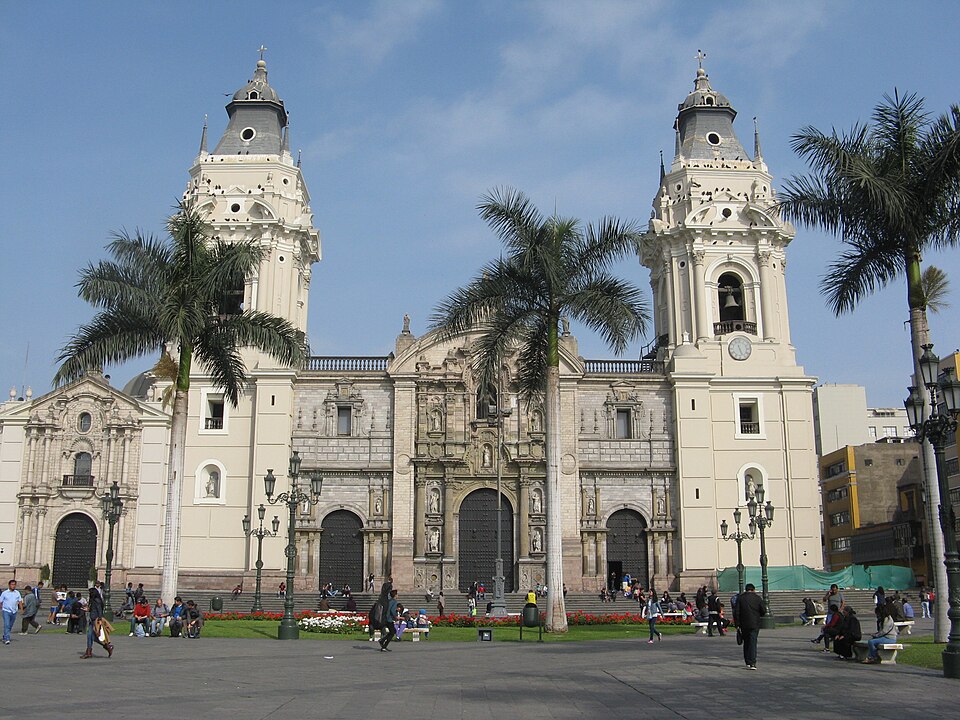
1602–1797 · Francisco Becerra
A Renaissance facade fills the eastern side of a large colonial square, flanked by an archbishop's residence and a smaller chapel; the exterior reads as continuous construction rather than one design campaign.
The cathedral serves as seat of the Archdiocese and stands as the oldest and largest church in the country. Its foundation was laid in 1535 by Francisco Pizarro, but the structure seen today took shape between 1602 and 1797, when construction finally finished. It occupies the eastern edge of the city's main square, next to the Archbishop's Palace and a smaller chapel, the Iglesia del Sagrario, and it is dedicated to Saint John the Apostle and Evangelist.
- Construction began in 1535, the same year work started on the government palace a few blocks away.
Photo: Wasiwatana (CC BY-SA 4.0)
Government Palace of Peru
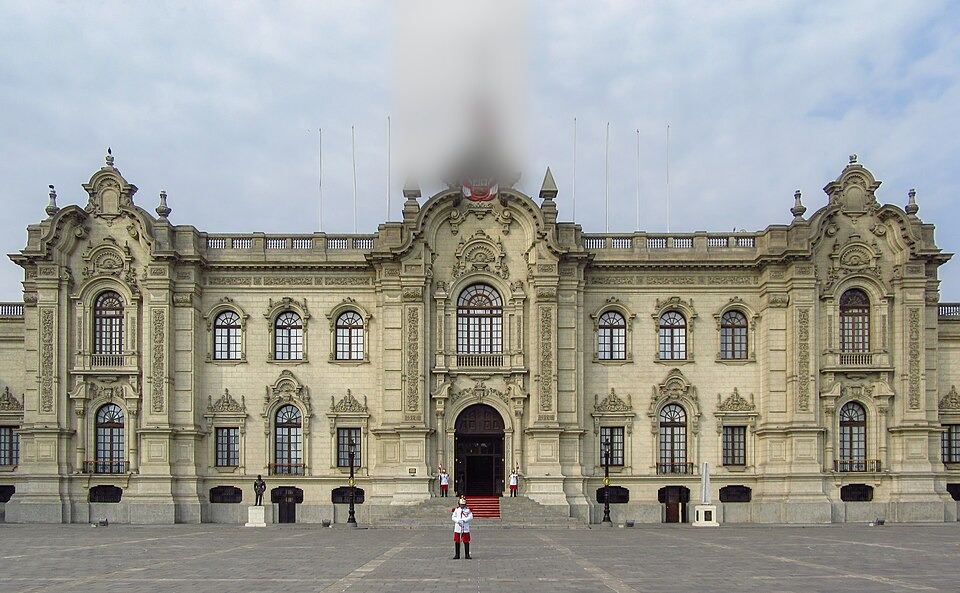
1926–1938 · Claude Sahut and Ricardo de Jaxa Malachowski
A baroque revival facade occupies the northern side of the main square; ceremonial guard units in dress uniform change watch there each day.
Also known as the House of Pizarro, the palace is the seat of the executive branch of the Peruvian government and the president's official residence. It stands on the site of a huaca, a pre-Hispanic revered place, on a bank of the Rímac River. An earlier residence built here in 1535 served the viceroys of the Viceroyalty of Peru until fire destroyed much of it; the present palace, in a baroque revival style, replaced it between 1926 and 1938.
- The huaca beneath the palace held a shrine to Taulichusco, the last indigenous governor of the area before Spanish rule.
- The earlier residence on the site burned twice, in 1884 and 1921, before the current palace replaced it.
Photo: User:Pedro Felipe (CC BY-SA 4.0)
Basilica and Convent of San Francisco
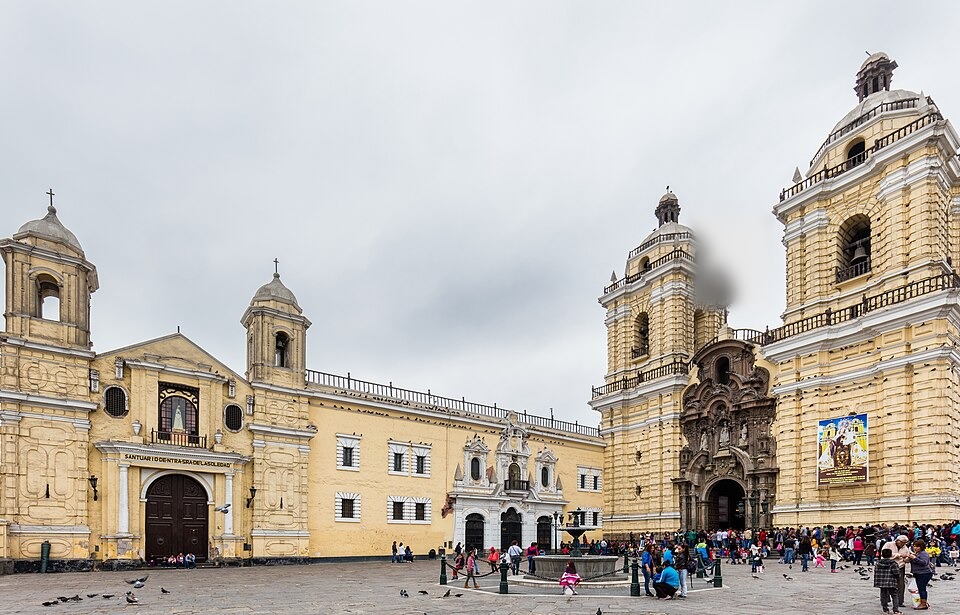
1546–1674
A baroque facade forms one wing of a religious complex that also holds a small sanctuary and a second church, filling an entire block bounded on all sides by streets.
The basilica and its adjoining Franciscan convent form a religious complex together with two smaller churches, the Sanctuary of Our Lady of Solitude and the Church of the Virgin of the Miracle, spread across a block framed by four streets. The Spanish scholar Ramón Menéndez Pidal called it "the largest and noblest monument that the conquest erected in these prodigious lands." The complex belongs to the historic core of the city, added to the UNESCO World Heritage List in 1991.
Photo: Diego Delso (CC BY-SA 4.0)
Plaza Mayor
The main square of Lima's historic centre, dating to the city's founding by Francisco Pizarro on 18 January 1535. It is surrounded by major landmarks including the Government Palace, the Metropolitan Cathedral, the Archbishop's Palace and the Municipal Palace.
Plaza San Martín
One of Lima's most representative public spaces, within the Historic Centre declared a UNESCO World Heritage Site in 1988. Connected to the Plaza Mayor by the Jirón de la Unión, its central monument honors Peru's liberator, José de San Martín.
Legislative Palace
The seat of the Congress of Peru, on Ayacucho street next to Bolívar Square in the Barrios Altos neighborhood. It houses the congressional chambers and the Hall of the Lost Steps, and hosts the president's inauguration speech.
Palacio de Torre Tagle
A colonial-era mansion two blocks southeast of the Plaza Mayor, covering 1,699 square metres. Built with materials shipped from Spain, Panama and elsewhere in Central America, it now houses offices of Peru's Ministry of Foreign Affairs.
Basilica and Convent of Santo Domingo
Commonly known as the Convent of Santo Domingo, this Catholic complex was founded in the 1530s under the patronage of Our Lady of the Rosary. It holds the relics of Rose of Lima and Martin de Porres.
Palacio Municipal
A government building on the third block of Union Street, next to the Plaza Mayor. It serves as the seat of the Metropolitan Municipality of Lima.
Basilica and Convent of Nuestra Señora de la Merced
A Roman Catholic church built under Friar Miguel de Orenes in 1535, designed in the ornate Churrigueresque Baroque style. It venerates the Blessed Virgin Mary of Mercy, patroness of the Peruvian Armed Forces.
Huaca Huallamarca
A truncated stepped pyramid of three levels rising about 19 metres, in the San Isidro district. Formerly known as Huaca Pan de Azúcar, it is one of the few such huacas still preserved in the area.
Puente de Piedra
A 17th-century bridge built by architect Juan del Corral, connecting the districts of Lima and Rímac. It was the city's only bridge until 1861 and links Jirón Trujillo with Jirón de la Unión, once the city's most important street.
Gran Hotel Bolívar
Lima's first large modern hotel, designed by Rafael Marquina y Bueno and inaugurated on 6 December 1924 by President Augusto B. Leguía. Renovated in 1938 to five floors, it later drew Hollywood stars in the 1940s and 1950s.
Fort of Santa Catalina
A Neoclassical fort from the 1800s, one of the few surviving examples of military colonial architecture in Peru. Its remaining premises, covering 25,250 square metres, house the Escuela Taller de Lima and the Chapel of Saint Barbara.
Casa de Osambela
One of the largest mansions in central Lima, also known as Casa de Oquendo, notable for its wide façade and elaborate balconies. Built on the site of a Dominican novitiate destroyed in the 1746 earthquake, it was completed between 1803 and 1805.
Chinese Arch
A paifang gateway at the entrance of Lima's Chinatown in Barrios Altos, also known as the Chinese Portal. It was donated to Peru by its Chinese community and the Government of the Republic of China to mark 150 years of Peruvian independence.
Casona of the National University of San Marcos
A large Spanish colonial building housing the cultural centre of the National University of San Marcos, part of the historic centre's UNESCO World Heritage listing since 1988. Formerly a Jesuit novitiate, it served as the university's headquarters from 1875 to 1966.
National Library of Peru
Peru's oldest and most important library, non-circulating like most Peruvian libraries. It operates from two branches, an older building on Abancay Avenue and a modern one on Avenida Javier Prado in San Borja, both open to the public.
Desamparados station
A railway station beside the Government Palace, begun in 1890 by the Peruvian Corporation and opened three years later on the Lima–La Oroya line. Since 2009 it has mostly housed the House of Peruvian Literature museum, though it still occasionally runs passenger trains to Huancayo.
Plaza de toros de Acho
The oldest bullring in the Americas and the second-oldest in the world after La Maestranza in Spain, opened on 30 January 1766. Built of adobe and wood, it seats 13,700 and remains Peru's most prominent of 56 official bullrings.
Cementerio Presbítero Matías Maestro
Lima's first cemetery separate from its churches, inaugurated on 31 May 1808 and named after its designer, priest Matías Maestro. Its 766 mausoleums and 92 monuments include the Crypt of Heroes, honoring those who fell in the War of the Pacific.
St. Clare's Monastery
A convent and monastery of the Capuchin Poor Clares in Barrios Altos, its first building dating to 1606 though the current church is 19th-century. It occupies a large city block and was declared a Historical Monument in 1972.
Simón Bolívar
A bronze equestrian statue of Simón Bolívar by Adamo Tadolini, cast in Munich in the 1850s and the oldest of three surviving casts. The other two stand in Caracas's Plaza Bolívar and United Nations Plaza in San Francisco, the latter dedicated in December 1984.
El Olivar
A public park in San Isidro named for the olive trees planted there since their introduction in 1560. It is recognized as part of Peru's cultural heritage.
Parque de la Exposición
A park in Santa Beatriz, briefly renamed the Grand Park of Lima between 1999 and 2004. It was built on the site of the city's demolished walls, cleared for a citywide renovation to host an international exhibition in 1872.
Malecón de Miraflores
An esplanade along the coast of Lima. It is one of the city's major tourist attractions.
Larco Museum
A privately owned museum of pre-Columbian art in Pueblo Libre, housed in an 18th-century vice-royal building. Its chronological galleries span 5,000 years of Peruvian history, and it is especially known for its gallery of pre-Columbian erotic pottery.
History
Construction on the main square began in 1535, when the cathedral and the first government residence both broke ground under Francisco Pizarro, on ground that already held an indigenous shrine. The residence became the seat of the Viceroyalty of Peru after 1542 and stood for nearly three and a half centuries until fires in 1884 and 1921 destroyed it; its baroque revival replacement went up between 1926 and 1938. The cathedral took longer still, its Renaissance design reaching present form only in 1797 after continuous building from 1602. Franciscan friars founded their convent nearby in 1546, and building on the basilica and its adjoining chapels continued into the 1670s. The historic core holding all three was added to the UNESCO World Heritage list in 1991.