Landmarks in Ljubljana
A Baroque old town circles a medieval hilltop castle above the Ljubljanica River.
Ljubljana's principal landmarks sit within a few minutes' walk of each other along the Ljubljanica River, which loops through the old town below a wooded hill. The castle occupies that hill, its walls rebuilt and extended in stages from the medieval period through the sixteenth and seventeenth centuries, so it reads less as one building than as a long accumulation. Down in the square below, a Baroque cathedral with a green dome and twin towers stands near a town hall that began Gothic and was reworked with Venetian-influenced Baroque detailing, both facing onto Cyril and Methodius Square by the central market. A short walk along the river reaches a squat reinforced-concrete road bridge from the early twentieth century, decorated in the ornament of the Art Nouveau style then current in Vienna, marking the city's decades inside the Austro-Hungarian Empire.
Ljubljana Castle
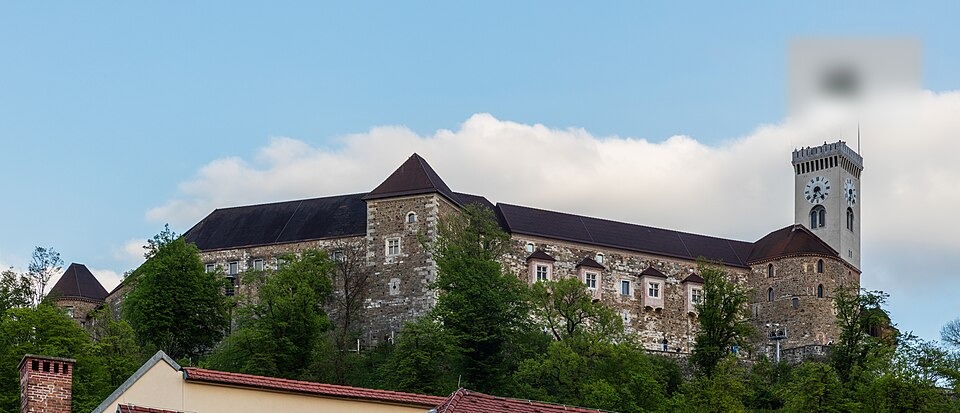
probably 11th century, rebuilt 12th century
The complex crowns a hill directly above the old town's rooftops, its towers and walls the result of staged rebuilding so the outline reflects work from the fifteenth through seventeenth centuries rather than one building campaign.
Originally a medieval defensive structure, probably raised in the eleventh century and rebuilt in the twelfth, the complex became seat of the lords of Carniola from the first half of the fourteenth century. It reached its current outline in a near-complete fifteenth-century overhaul, though most of the standing buildings date to the sixteenth and seventeenth centuries. Used for various other purposes since the early nineteenth century, it now serves as a cultural venue.
- It is depicted on the city's coat of arms together with a dragon perched on top of it.
- Most of the buildings visible today are not medieval at all but date from a sixteenth- and seventeenth-century rebuilding that followed a near-total fifteenth-century overhaul.
Photo: Diego Delso (CC BY-SA 4.0)
Dragon Bridge
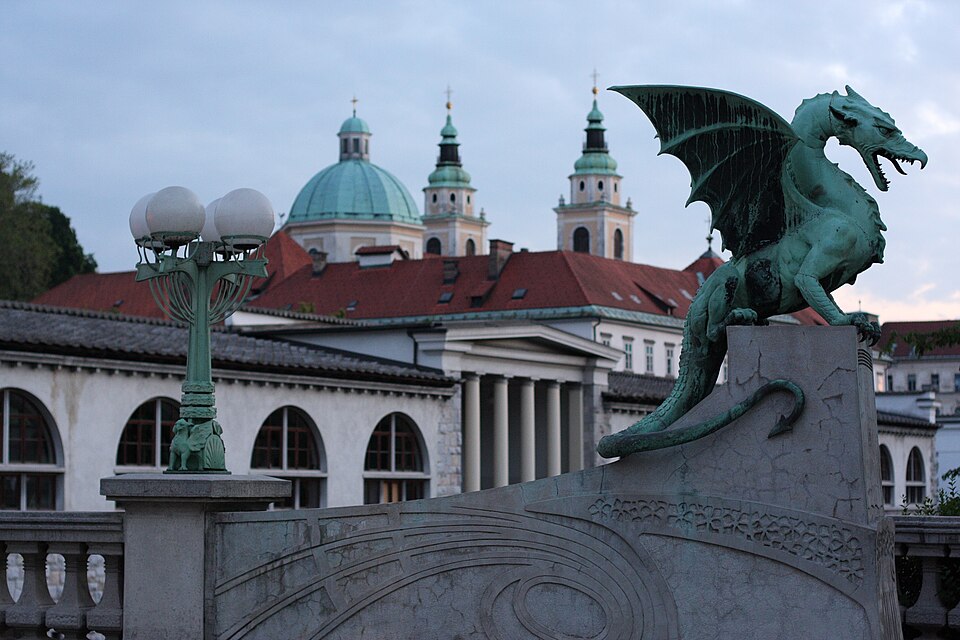
1901
The bridge is a single arch cast in reinforced concrete but finished with the decorative detailing of the Vienna Secession style, making it one of the style's recognized examples applied to bridge engineering.
Built at the start of the twentieth century, when the city lay within the Austro-Hungarian Empire, the bridge carries a road across the Ljubljanica River between two streets just north of the central market. Executed in reinforced concrete, it ranks among the notable early examples of that construction method combined with Vienna Secession styling, and it is protected today as a technical monument while still carrying motorized traffic.
- It is protected as a technical monument for being among the finer early reinforced-concrete bridges built in the Vienna Secession style.
Photo: yeowatzup (CC BY 2.0)
Ljubljana Cathedral
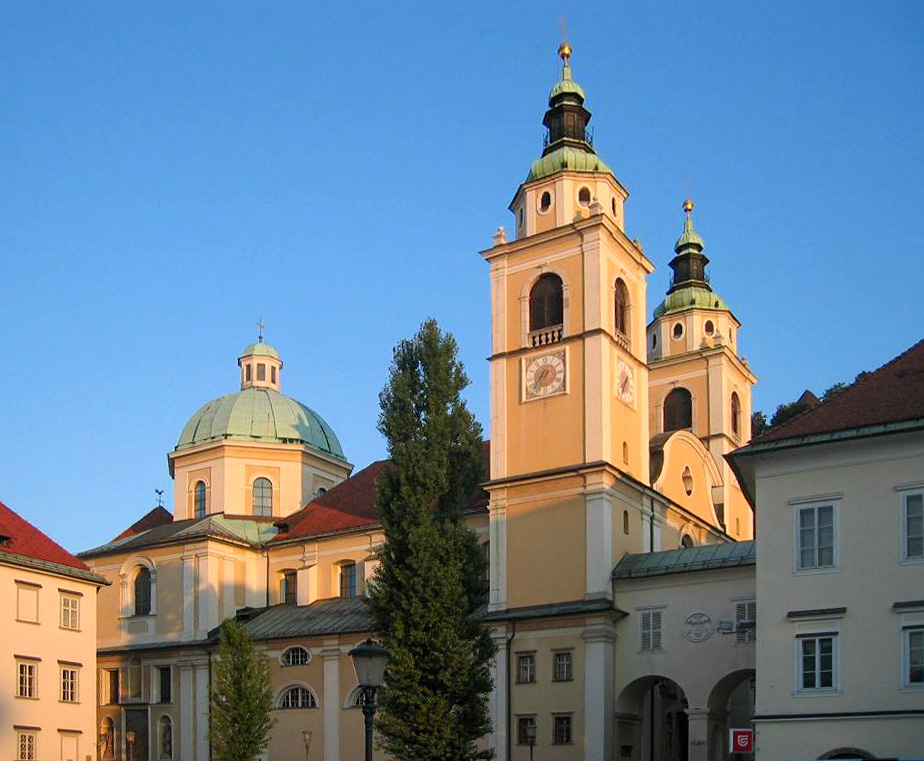
1706 · Andrea Pozzo
The building is identified by its green dome flanked by twin towers, rising over Cyril and Methodius Square next to the central market and the town hall.
The present building, officially named Saint Nicholas's Church, replaced an earlier Gothic church on the same site and took its current Baroque form in the early eighteenth century, work associated with the Italian architect Andrea Pozzo, who died in 1709. It stands on Cyril and Methodius Square beside the central market and the town hall, functioning today as the city's cathedral.
- It began as a Gothic church before being entirely rebuilt in the Baroque style in the early 1700s.
- Its official name is Saint Nicholas's Church, though it is commonly known simply as the Cathedral.
Photo: Žiga (Public domain)
Ljubljana Town Hall
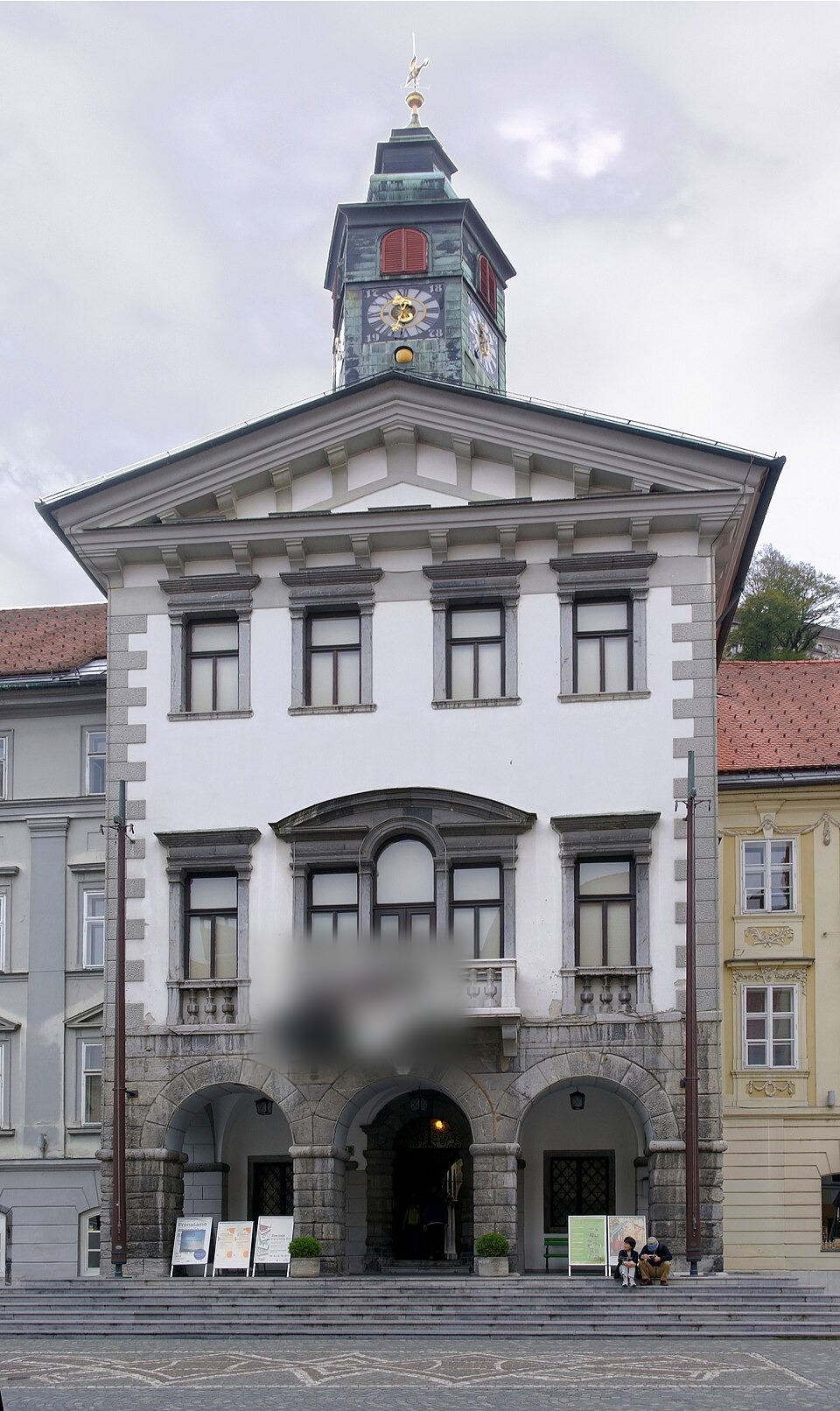
1484 · Peter Bezlaj
The facade carries a Baroque gable front, an open loggia, and a three-part staircase added in a 1717-to-1719 renovation, and a copy of an ornate Baroque fountain stands just outside the entrance.
The original Gothic building of 1484 was probably designed by the builder Peter Bezlaj. Between 1717 and 1719 it received a Venetian-inflected Baroque renovation carried out by the builder Gregor Macek Sr. to plans by the Italian architect Carlo Martinuzzi and his own designs, adding the gable front, loggia, and staircase. In the 1920s a monument to a Yugoslav king was placed at its entrance, designed by the architect Joze Plecnik, then removed and destroyed by occupation authorities in 1941.
- A monument to a Yugoslav king once stood at its entrance until occupying authorities destroyed it in 1941.
- The Baroque fountain outside is a replica; the original, finished in 1751, is kept in the National Gallery.
Photo: Berthold Werner (CC BY-SA 3.0)
Triple Bridge
Three bridges spanning the Ljubljanica River, connecting the medieval old town with Prešeren Square, and the oldest bridge in Ljubljana, dating to the 13th century. Architect Jože Plečnik redesigned and expanded it in the early 1930s; it joined the UNESCO World Heritage List in 2021.
Prešeren Square
The central square of Ljubljana's old town pedestrian zone, a major meeting point for festivals, concerts and political events. Architect Edvard Ravnikar redesigned it from a funnel shape into its current circular form in 1987–88, and it was renovated again in 2007.
Franciscan Church of the Annunciation
A Franciscan church on Prešeren Square, built between 1646 and 1660 with bell towers added around 1720. Its main altar was largely made in 1736 by the Baroque sculptor Francesco Robba, and its exterior was redesigned in 1858.
National and University Library of Slovenia
Slovenia's national library, established in 1774, housed in a building designed by Jože Plečnik in 1930–31 and constructed between 1936 and 1941. Considered one of Plečnik's greatest achievements, it was inscribed on the UNESCO World Heritage List in 2021 and holds about 1.3 million books.
Ljubljana Central Market
A riverside market, often called Plečnik's Market, designed by the architect Jože Plečnik between 1931 and 1939. It stretches along the right bank of the Ljubljanica between the Triple Bridge and the Dragon Bridge, and is designated a cultural monument of national significance.
Nebotičnik
A 13-story high-rise designed by the Slovenian architect Vladimir Šubic, built between 1931 and 1933 for the Pension Institute. Rising 70.35 meters, it was the tallest building in the Kingdom of Yugoslavia and, for a time, the tallest residential building in Europe.
Tivoli City Park
The largest park in Ljubljana, stretching from the Center District toward the Šiška, Vič and Rožnik districts. Protected since 1984 as part of the Tivoli–Rožnik Hill–Šiška Hill Nature Park, it hosts several notable buildings and artworks along with a variety of bird species.
National Assembly Building of Slovenia
A modernist palace at Republic Square, built between 1954 and 1959 to plans by architect Vinko Glanz and opened as the Palace of the People's Assembly. The three-story building now houses both houses of Slovenia's legislature and draws around 13,000 visitors a year.
Congress Square
One of Ljubljana's central squares, renovated in the late 1930s by the architect Jože Plečnik. It was inscribed on the UNESCO World Heritage List in 2021 as part of Plečnik's legacy.
Prešeren Monument
A late Historicist bronze statue of the national poet France Prešeren, standing on the eastern side of Prešeren Square in front of the Central Pharmacy Building. It is among the best-known monuments in Slovenia.
Robba Fountain
A fountain in front of Ljubljana Town Hall at Town Square, made in 1751 by the Italian sculptor Francesco Robba. Also known since the early 20th century as the Fountain of the Three Carniolan Rivers, it is one of the city's most recognizable symbols.
Križanke
An outdoor theatre created by Jože Plečnik in the 1950s inside the courtyard of the former Monastery of the Holy Cross. Its venues include the Baroque Križanke Church, the Knights' Hall and the Devil's Courtyard, with a retractable canopy over the amphitheatre for concerts.
National Museum of Slovenia
Located near Tivoli City Park, the National Museum shares its building with the Slovenian Museum of Natural History, the country's oldest scientific and cultural institution. Its collection spans archaeological artefacts, old coins and banknotes, and in 2021 it received Slovenia's Golden Order for Exceptional Merits.
National Gallery of Slovenia
Slovenia's national art gallery, founded in 1918 following the dissolution of Austria-Hungary and the creation of the State of Slovenes, Croats and Serbs. It was first housed in the Kresija Palace before moving to its present location in 1925.
Žale
The largest and central cemetery in both Ljubljana and Slovenia, located in the Bežigrad District. It is operated by the Žale Public Company.
Metelkova
An autonomous social and cultural centre occupying seven former military barracks covering 12,500 square meters, squatted since September 1993. The buildings once served as headquarters for the Austro-Hungarian and then Yugoslav People's armies, and the site takes its name from nearby Metelkova Street.
Tivoli Hall
A complex of two indoor sports arenas in Tivoli City Park, opened in 1965. The larger ice hockey arena, home to HK Olimpija, seats 6,800, while the smaller basketball hall, seating 4,500, is the secondary home of KK Cedevita Olimpija.
St. Peter's Bridge
A bridge over the Ljubljanica at the northeastern end of the old town, continuing Rozman Street and named after the nearby St. Peter's Church. Also known as Ambrož Bridge, it is used mainly by motor traffic but also by pedestrians.
Kresija Building
A building that, with the Philip Mansion, marks the old town's entrance, on the right bank just downstream of the Triple Bridge. It housed the Ljubljana Center Administrative Unit until 2007, and now holds municipal offices, a gallery and the city's visitor centre.
Stožice Stadium
The country's biggest football stadium, designed by Sadar + Vuga architects in the Bežigrad district north of the city centre. It is the home ground of Olimpija Ljubljana and the main venue of the Slovenia national football team, and also hosts cultural events.
Ljubljana Mosque
An Islamic mosque and cultural center in the Bežigrad district, the culmination of a decades-long effort by the Islamic Community of Slovenia. Officially named the Islamic Religio-Cultural Center, its complex includes a library, a classroom and an ablution fountain.
Ljubljana City Theatre
The city's second theatre company, after the Slovene National Theatre, founded in 1949 as the country's second-largest drama theatre. It has grown to 37 permanent actors staging at least nine productions a year, focused mainly on modern drama and, more recently, musicals.
History
The area was Roman Emona before Ljubljana is first mentioned in written record in the early twelfth century as the historical capital of Carniola, a Habsburg-ruled crownland from the Middle Ages until 1918. The fortress on Castle Hill, probably built in the eleventh century, was rebuilt in the twelfth and then extensively reworked in the fifteenth, with most of its present buildings dating to the sixteenth and seventeenth centuries, by which time it had long served as the seat of the Carniolan lords. The Gothic town hall of 1484 was given a Baroque, Venetian-inspired refit in 1717 to 1719, around the years the Gothic cathedral nearby was rebuilt in Baroque form under plans tied to the architect Andrea Pozzo. The Dragon Bridge, raised over the Ljubljanica in the early 1900s in reinforced concrete and Vienna Secession ornament, belongs to the city's last Austro-Hungarian decades before Habsburg rule ended in 1918.