Landmarks in Milan
A cathedral six centuries in the making anchors a city of duchy, empire and industry.
The five landmarks recorded here span roughly five centuries of building in a city that was, in turn, a wealthy medieval duchy, a Renaissance capital and, from the nineteenth century, an industrializing hub of a newly unified Italy. The cathedral at the centre was begun in 1386 and kept under construction, on and off, until 1965, so its Gothic core carries additions from almost every intervening period. The Sforza family's fortress began as a fourteenth-century stronghold, grew into one of the largest citadels in Europe, and was extensively rebuilt around 1900. A Dominican convent church nearby mixes Gothic and Renaissance building campaigns. The other two landmarks belong to the nineteenth century: a Neoclassical triumphal arch from 1838 and a Renaissance Revival shopping arcade completed in 1877.
Milan Cathedral
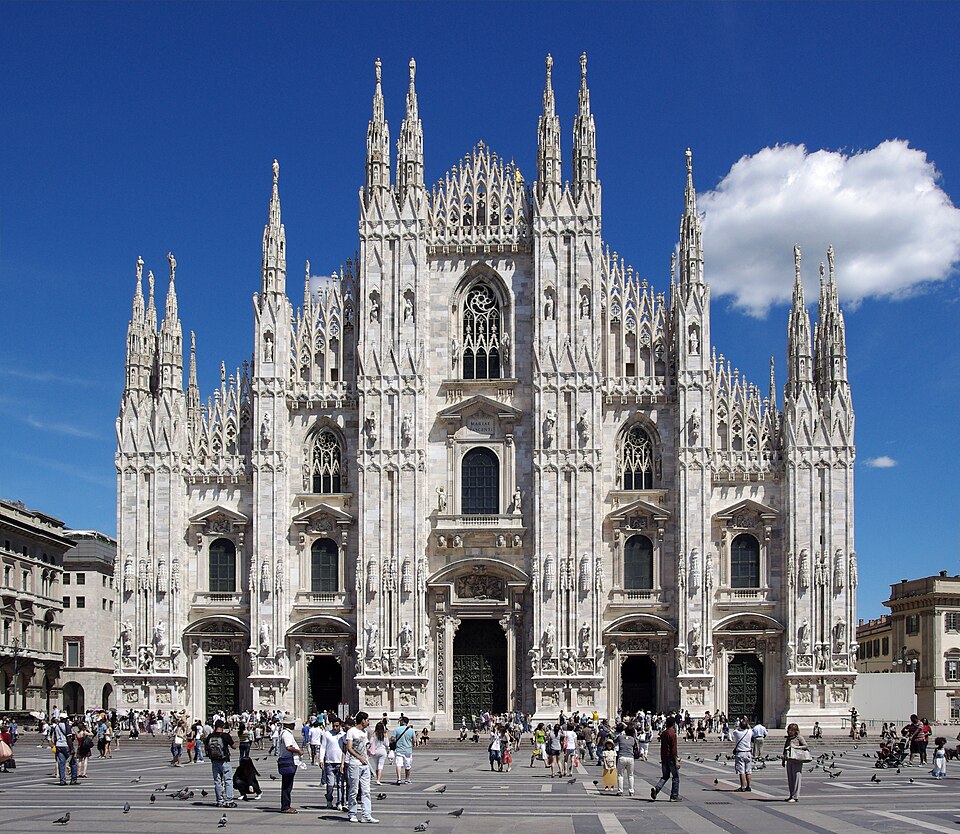
1386–1965 · Simone da Orsenigo
A Gothic cathedral whose roofline bristles with pinnacles and flame-shaped tracery in the Flamboyant style, a design built up piecemeal between the fourteenth and twentieth centuries; its sheer bulk makes it the largest church in Italy, smaller only than St Peter's Basilica across the border in Vatican City.
Milan Cathedral is dedicated to the Nativity of St Mary and serves as the seat of the Archbishop of Milan. Construction began in 1386 under the design of Simone da Orsenigo, and the building was worked on, in stages, for nearly six centuries before its final details were completed in 1965. Built in the Italian Gothic style with Flamboyant detailing, it is the largest church in the Italian Republic — only St Peter's Basilica, in the separate state of Vatican City, is larger — and carries Italian national heritage status.
- Its construction spanned nearly six hundred years, from 1386 to 1965.
- The death date of Simone da Orsenigo, credited with starting the design, is not recorded.
Photo: Jakub Hałun (CC BY-SA 4.0)
Galleria Vittorio Emanuele II
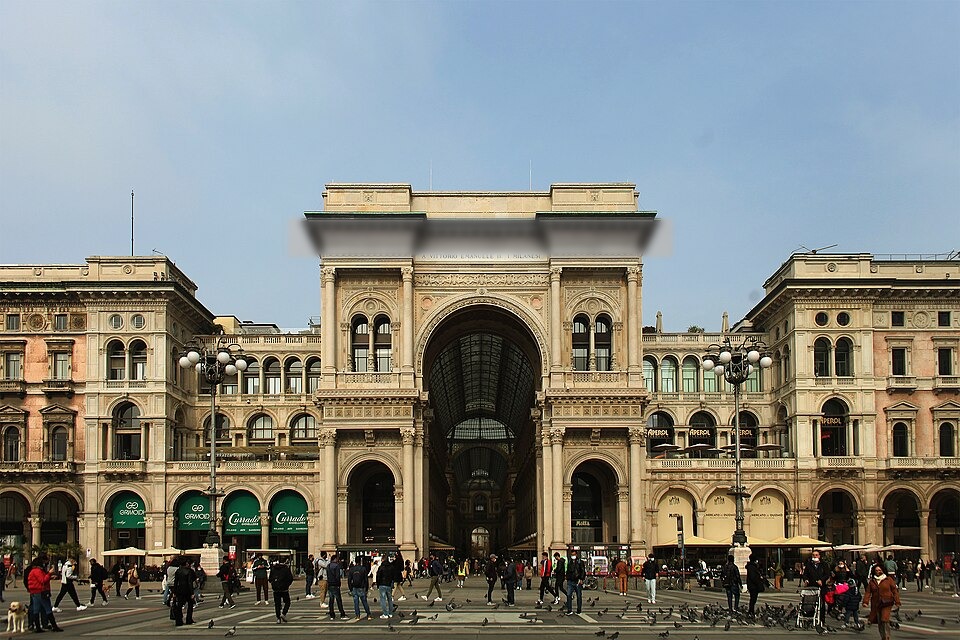
1877 · Giuseppe Mengoni
Two shop-lined arcades crossing at a central point beneath a four-story Renaissance Revival facade, named for Victor Emmanuel II, the first king of a unified Italy, and described as the country's oldest active shopping arcade.
The Galleria Vittorio Emanuele II is a four-story double arcade at the centre of Milan, named after Victor Emmanuel II, the first king of the Kingdom of Italy. It was designed in 1861 by the architect Giuseppe Mengoni and built between 1865 and 1877. Built in the Renaissance Revival style, it functions as a commercial gallery and architectural ensemble, and is described as Italy's oldest active shopping arcade. It carries Italian national heritage status.
- Mengoni died in 1877, the same year the arcade he designed was completed.
- The design was drawn up in 1861, four years before construction on it began.
Photo: Paolobon140 (CC BY-SA 4.0)
Sforza Castle
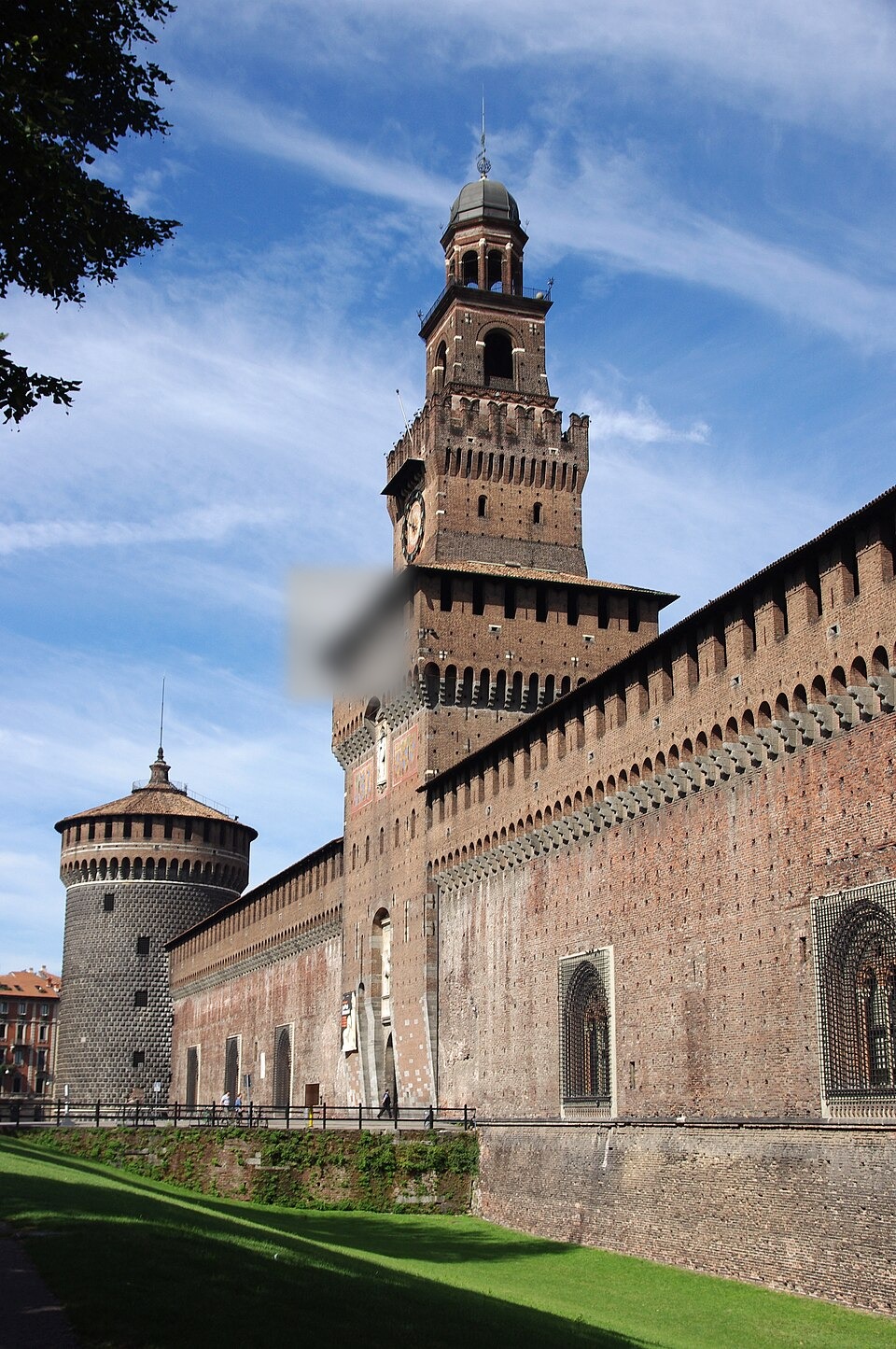
1368
A large fortress complex rebuilt at the turn of the twentieth century by Luca Beltrami, now functioning as a museum quarter that houses several of the city's collections; its scale recalls a citadel once counted among the largest in Europe.
Sforza Castle is a fortress in Milan whose core, per catalogue records, dates to 1368, raised over the remnants of an earlier medieval fortification. The castle recognizable today largely took shape in the fifteenth century, when Francesco Sforza, Duke of Milan, rebuilt and enlarged it; the architect Filarete, who died in 1469, is credited with work of that period. By the sixteenth and seventeenth centuries it ranked among the largest citadels in Europe. It was extensively rebuilt again by Luca Beltrami between 1891 and 1905, and now houses several of the city's museums and art collections.
- At its height in the sixteenth and seventeenth centuries it was one of the largest citadels in Europe.
- It was extensively rebuilt as recently as 1891–1905, more than five centuries after its first fortifications went up.
Photo: Jakub Hałun (CC BY-SA 4.0)
Santa Maria delle Grazie
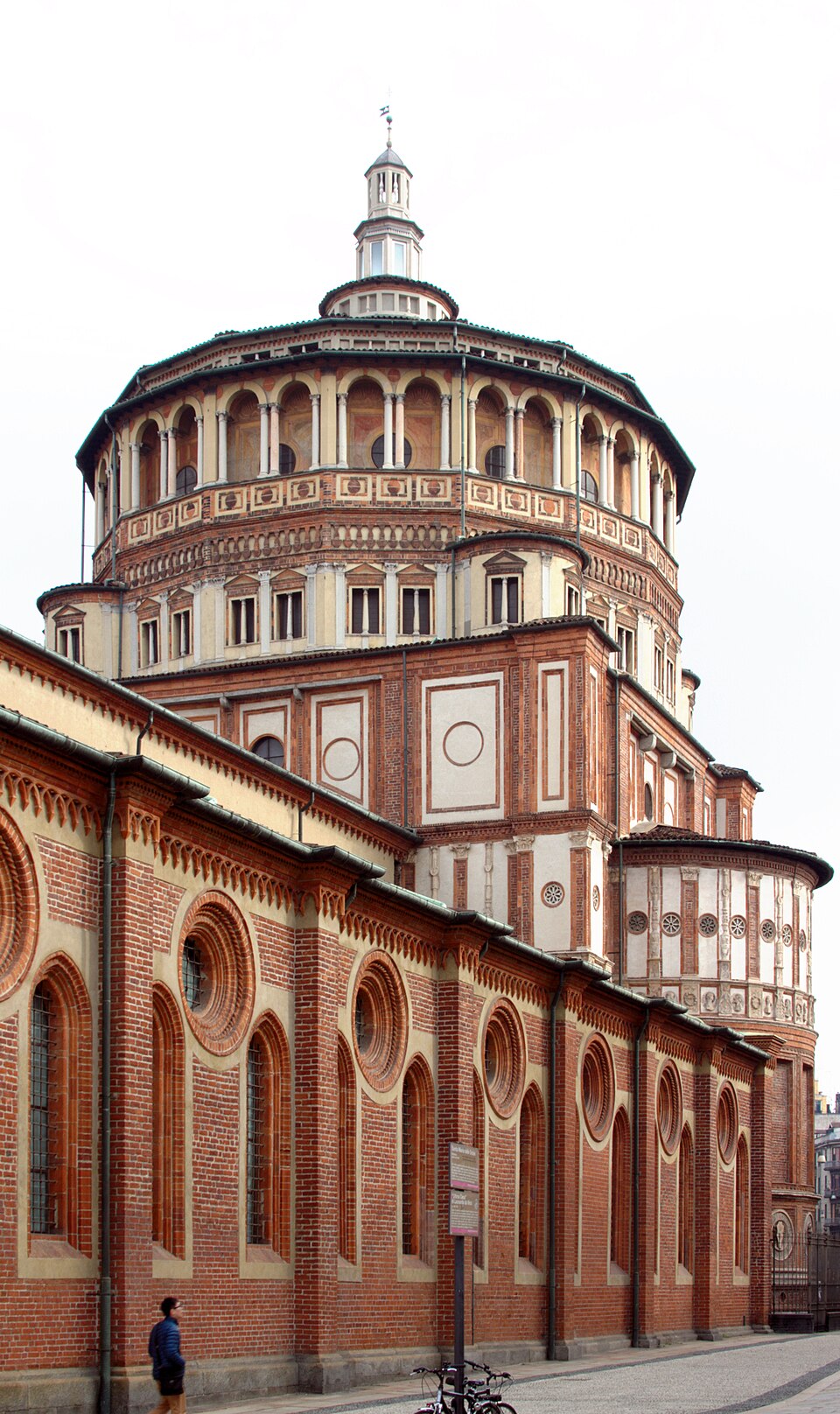
The convent's refectory holds Leonardo da Vinci's mural of The Last Supper. The church itself combines Gothic and Renaissance building phases carried out by different architects across the fifteenth and twentieth centuries.
Santa Maria delle Grazie is a church and former Dominican convent in Milan, recognized as a UNESCO World Heritage Site. Its refectory holds the mural of The Last Supper, painted by Leonardo da Vinci. The building combines Renaissance and Italian Gothic architecture and is credited across its history to at least three architects: Guiniforte Solari, who died in 1481, Donato Bramante, who died in 1514, and Piero Portaluppi, who died in 1967. It is classified as a minor basilica, a church building and an abbey church, and carries both World Heritage and Italian national heritage status.
- The refectory holding Leonardo da Vinci's Last Supper is a separate space from the church itself.
- Its credited architects span five centuries: the earliest died in 1481, the latest in 1967.
Photo: José Luiz (CC BY-SA 3.0)
Arco della Pace
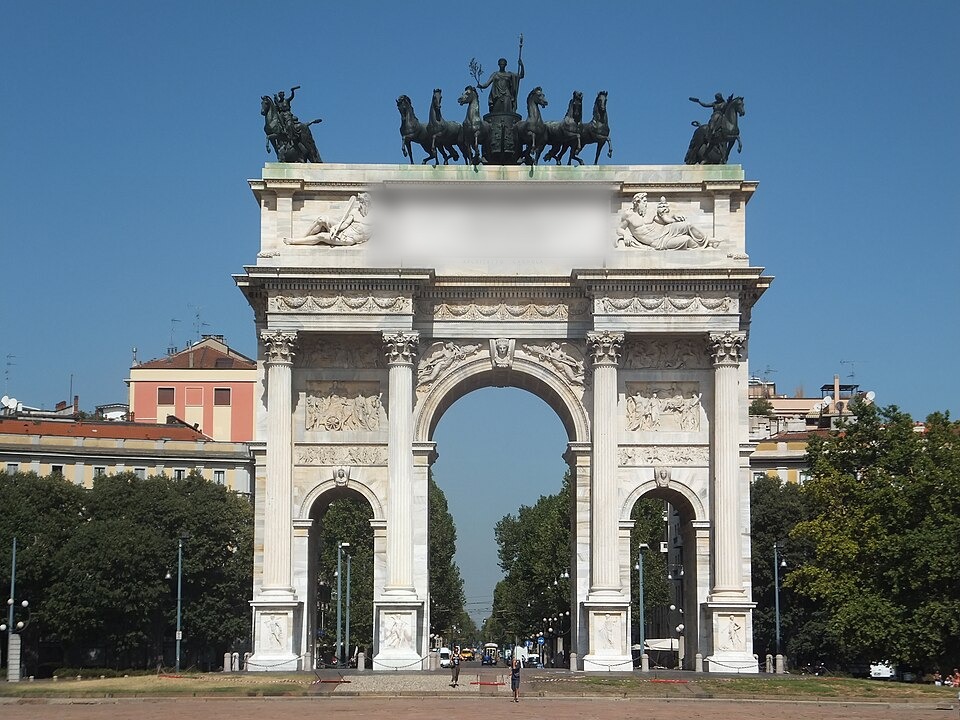
1838 · Luigi Cagnola
A freestanding triumphal arch in the Italian Neoclassical style, designed by Luigi Cagnola and completed in 1838, five years after his death.
Arco della Pace is a freestanding triumphal arch and monument in Milan, built in the Italian Neoclassical style. It was designed by the architect Luigi Cagnola, who died in 1833. Work on the arch continued after his death, and the structure standing today was completed five years later, in 1838, making it one of the city's neoclassical monuments from that period.
Photo: Filip Maljković from Pancevo, Serbia (CC BY-SA 2.0)
Basilica of San Lorenzo
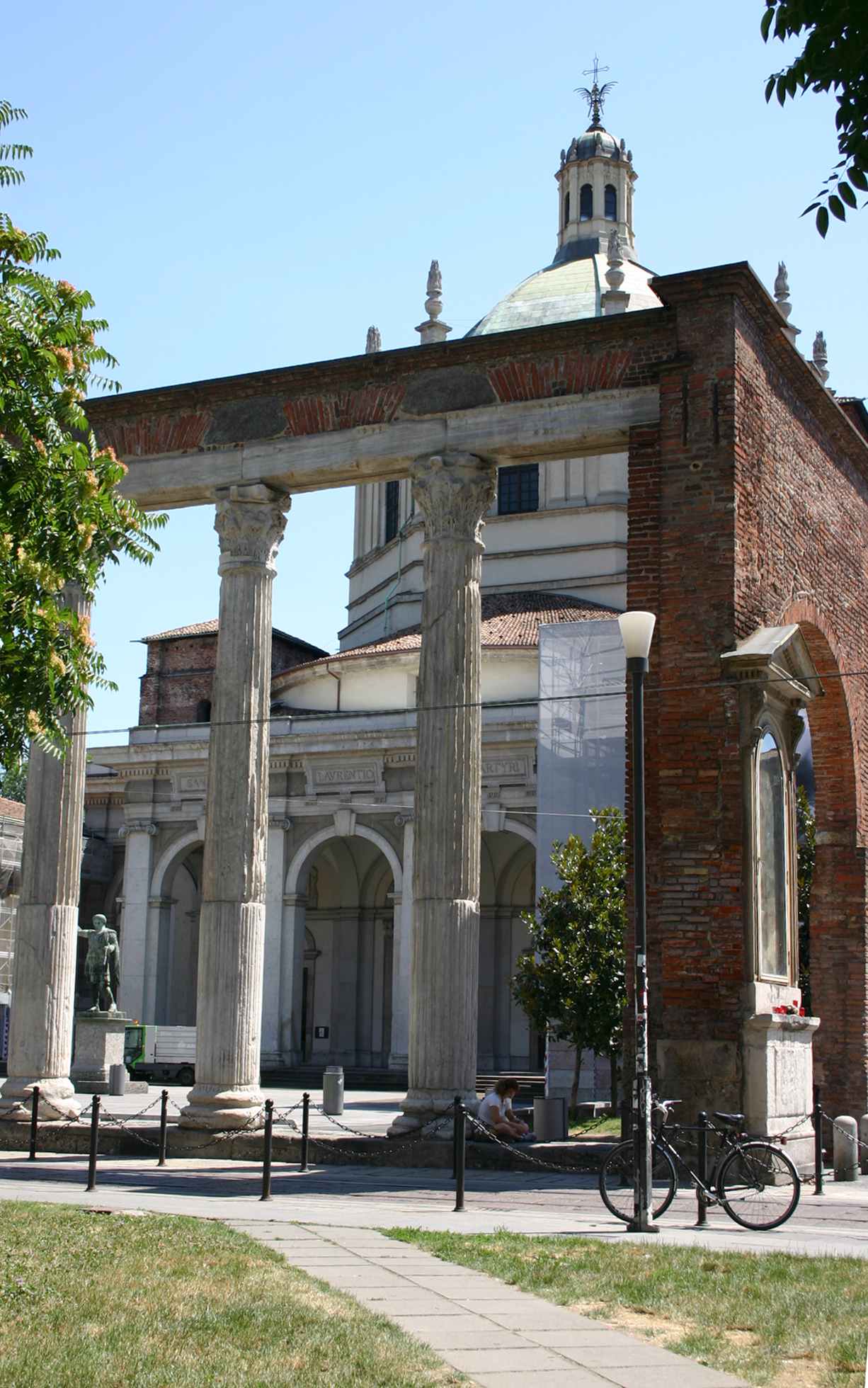
4th century–1619 · Martino Bassi
A square-planned church framed by four projecting apses and corner towers, capped by a dome rebuilt in the early seventeenth century after the original collapsed; the building rises on an artificial mound at the edge of the old city walls.
The Basilica of San Lorenzo Maggiore is a Roman Catholic church in Milan, among the oldest in the city, raised in the late fourth or early fifth century. Scholars dispute whether it predates the four Ambrosian basilicas or was commissioned under Theodosius I, but agree it was the largest centrally planned building then standing in the West, possibly an imperial mausoleum. Fire damaged it in 1071, and its dome collapsed in 1573; the replacement, designed by Martino Bassi in a more modern style, was completed in 1619. Renaissance architects including Bramante and Leonardo studied its classical forms.
- The basilica's dedication to St Lawrence is confirmed only from 590, more than a century after the building itself went up.
- Historians remain divided on its original purpose, reading it either as an imperial basilica meant to rival Rome and Constantinople or as a mausoleum for the Theodosian dynasty.
- The open ground behind the church, known as the Vetra, was used for public executions from the eleventh century until 1840.
Photo: G.dallorto (CC BY-SA 2.5 it)
Basilica of Sant'Ambrogio
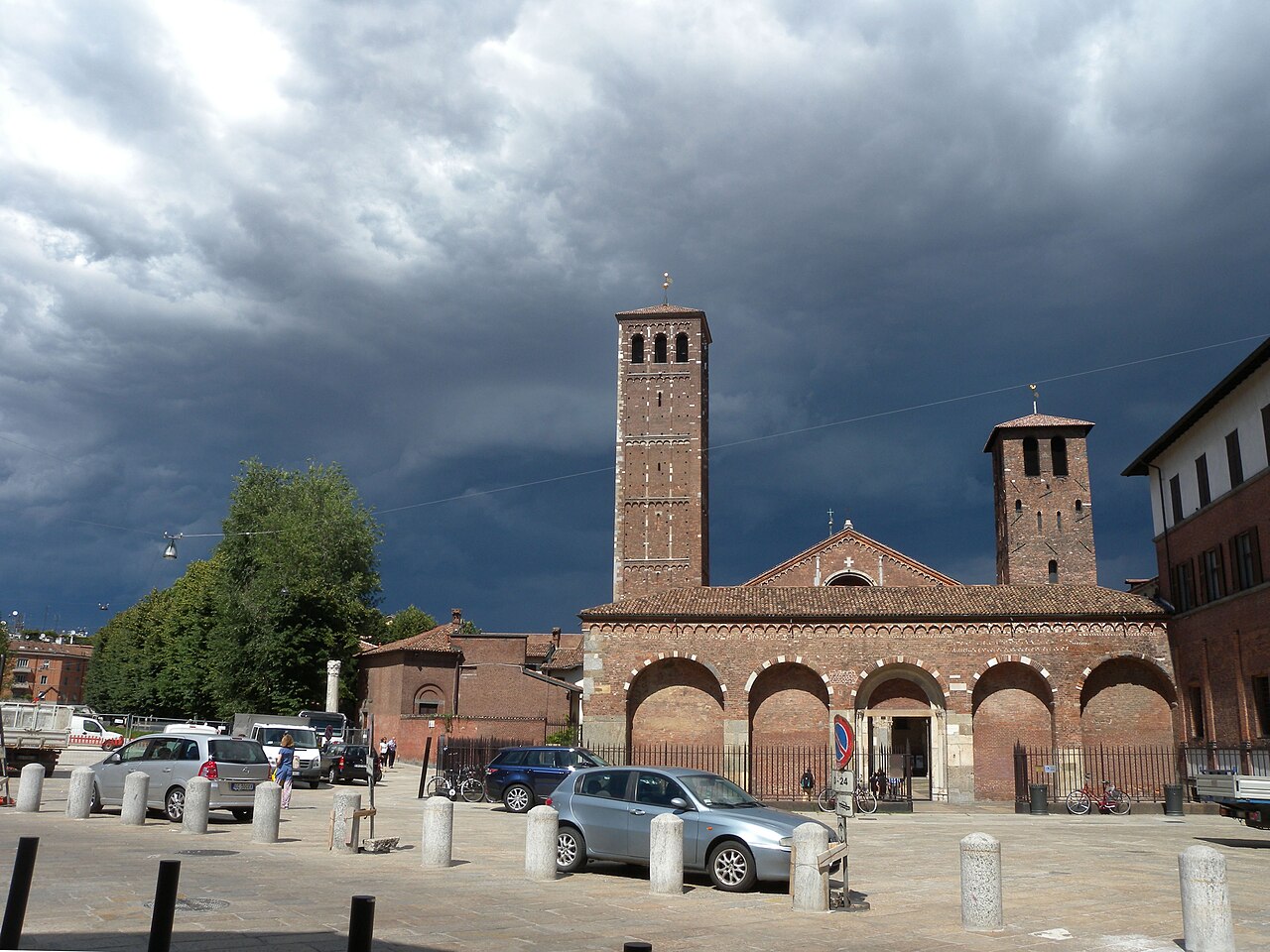
379–1140
Built mostly of brick with sections of stone and white plaster, the church fronts an arcaded atrium. Two mismatched bell towers flank it: a squat one from the ninth century, and a taller one begun in 1144 whose top floors were only added in 1889.
The Basilica of Sant'Ambrogio is a Roman Catholic church in central Milan, one of the city's oldest. It was commissioned in 379–386 to hold the graves of Roman-era martyrs, part of a group of churches built to assert one Christian faction's authority during a doctrinal dispute, and was later renamed after the bishop who founded it. Restored and partly rebuilt repeatedly, the church took its present Romanesque form in the twelfth century, when its nave and rib vaults were completed. Bombing in 1943 damaged the apse, which was later rebuilt.
- In 1492 the Benedictines commissioned Donato Bramante, later the structural architect of St Peter's Basilica in Rome, to renovate the monastery's rectory.
- The church's two bell towers were built roughly three centuries apart; the taller one, begun in 1144, did not get its top two floors until 1889.
- An accord known as the Peace of St. Ambrose, settling a dispute between the city's noble and popular factions, was signed inside the church in 1528.
Photo: Maurizio OM Ongaro (CC BY-SA 3.0)
San Siro
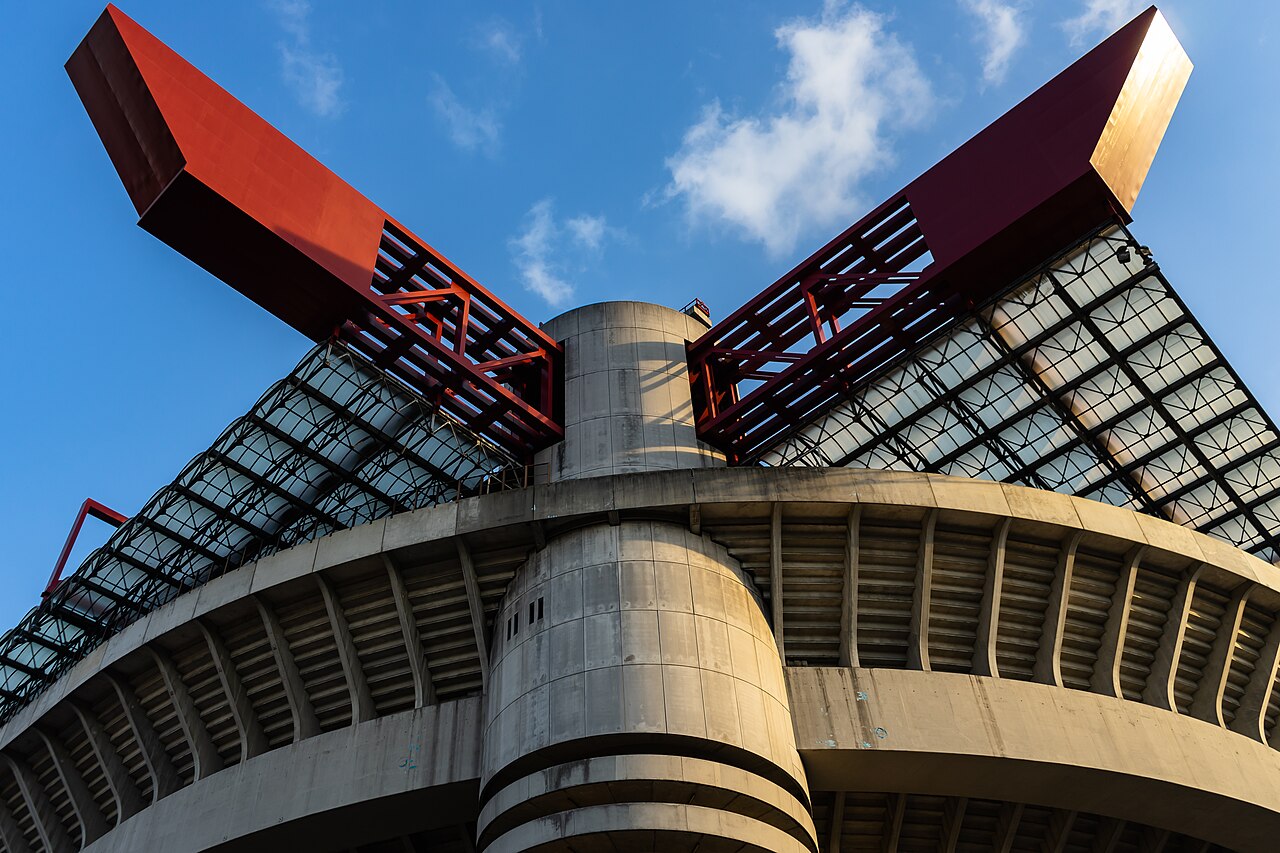
1925–1990
Three tiers wrap around three of the stadium's four sides, resting on eleven cylindrical support towers linked by external spiral ramps, with a roof carried on distinctive protruding red girders visible above the stands.
Construction began in 1925 on a private, football-only stadium commissioned by a Milanese club's president, unlike the athletics-track stadiums Italy usually built with public funds. It opened in 1926 with a match its home club lost 6–3 to its crosstown rival, which became a tenant itself in 1947; the two clubs have shared the ground since. Engineers Armando Ronca and Ferruccio Calzolari extended it between 1948 and 1955, adding tiers reached by nineteen 200-metre spiral ramps. A 1987–1990 renovation, by architects Giancarlo Ragazzi and Enrico Hoffer with engineer Leo Finzi, added a third tier to three of the four sides.
- It opened in 1926 with a match its home club lost 6–3 to the crosstown rival that would become a co-tenant in 1947.
- A 1948–1955 expansion aimed to raise capacity to 150,000 using new tiers reached by nineteen spiral ramps, each 200 metres long, but the highest tier was abandoned partway through construction.
- Its 1987–1990 renovation added a roof carried on eleven concrete support towers, four of which double as corner supports, with distinctive protruding red girders.
Photo: Boris Paladino (CC BY-SA 4.0)
La Scala
An opera house inaugurated on 3 August 1778, built on the site of a former church. The opening performance was Antonio Salieri's Europa riconosciuta, and the theatre is regarded as one of the world's leading opera and ballet houses.
Piazza del Duomo
The city's main square, rectangular and covering about 17,000 square metres, dominated by the cathedral it is named for. First laid out in the 14th century, its present form dates largely to the late 19th century, under architect Giuseppe Mengoni.
Pirelli Tower
A 32-storey skyscraper standing 127 metres tall, among the first tall buildings to abandon the customary block form. It was the tallest building in Italy until 1961, and architectural historian Hasan-Uddin Khan called it one of the most elegant tall buildings in the world.
Biblioteca Ambrosiana
A historic library founded in 1609 by Cardinal Federico Borromeo, who sent agents across Europe, Greece and Syria to acquire books and manuscripts. It also houses the Pinacoteca Ambrosiana art gallery and holds treasures such as the illustrated Iliad known as the Ilias Picta.
Royal Palace
The seat of government for many centuries, spanning about 7,000 square metres beside the cathedral's façade. It now serves as a cultural centre hosting international art exhibitions, and includes the Hall of Caryatids among its historic rooms.
Cimitero Monumentale di Milano
One of the city's two largest cemeteries, designed by architect Carlo Maciachini and officially opened in 1866 to consolidate cemeteries scattered around the city. It is filled with artistic tombs and monuments, including Greek temples, obelisks and a scaled-down replica of Trajan's Column.
San Bernardino alle Ossa
A church best known for its ossuary, a small chapel decorated with numerous human skulls and bones. The bone room dates to 1210; fire destroyed the attached church in 1712, and a larger one was rebuilt and dedicated to Saint Bernardino of Siena.
Pinacoteca di Brera
The main public gallery for paintings in the city, housing one of the foremost collections of Italian art from the 13th to the 20th century. It grew out of the Brera Academy's cultural program and shares the Palazzo Brera with it.
Basilica of Sant'Eustorgio
Probably founded in the 4th century, later rebuilt in Romanesque style. It was an important pilgrim stop, believed to hold the tomb of the Three Magi, whose relics were taken to Cologne in the 12th century and only partly returned in 1903–04.
Palazzo dell'Arengario
An early-20th-century complex of two symmetrical buildings on the Piazza del Duomo, completed in the 1950s. Its name refers to its original function as a local government seat under the Fascist regime, and it now houses the Museo del Novecento, a museum of 20th-century art.
Giardini Pubblici Indro Montanelli
The oldest city park, established in 1784 in the Porta Venezia district and enlarged over time to its current 172,000 square metres. Renamed in 2002 after journalist Indro Montanelli, it holds the Natural History Museum, built in 1888–1893, and a planetarium from 1930.
Santa Maria presso San Satiro
An Italian Renaissance church built between 1476 and 1482 around the early medieval shrine of Satyrus, brother of Saint Ambrose. It is known for its false apse, an early trompe-l'œil illusion attributed to the architect Donato Bramante.
L.O.V.E.
A sculpture by Maurizio Cattelan showing a hand with every finger severed except the middle one, in Piazza degli Affari outside the stock exchange. Built in 2010 for a retrospective at the Royal Palace, it later became permanent after the artist donated it.
Torre Velasca
A 106-metre, 26-storey skyscraper built by the BBPR architectural partnership, completed in 1958 and inaugurated in 1961. It is considered one of the few Italian examples of post-rationalist brutalist architecture, and was placed under protection as a historic building in 2011.
Monument to Leonardo da Vinci
A commemorative sculptural group in Piazza della Scala, unveiled in 1872 after work begun by sculptor Pietro Magni in 1858. A statue of Leonardo da Vinci tops a base carrying figures of four of his pupils.
Bosco Verticale
A pair of residential skyscrapers, 116 and 84 metres tall, designed by Boeri Studio and inaugurated in 2014 in the Porta Nuova district. Their facades hold more than ninety plant species, an experiment in vertical greening that has won numerous architectural awards.
Palazzo Borromeo
A 14th-century palace built as the home and business headquarters of the Borromeo family, merchant-bankers from Tuscany. Damaged in Allied bombing in 1943, it was rebuilt to its 15th-century appearance and retains a fresco cycle from the 1440s.
Portinari Chapel
A Renaissance chapel at the Basilica of Sant'Eustorgio, built between 1460 and 1468 and commissioned by Pigello Portinari as his private sepulchre. It also houses a silver shrine, given by an archbishop in 1340, that holds the relic head of Saint Peter of Verona.
Villa Necchi Campiglio
A house museum built between 1932 and 1935, designed by Rationalist architect Piero Portaluppi and set in a large private garden with a tennis court and swimming pool. That pool was the second ever built in the city and the first on private land.
Casa Atellani
A historic house that once belonged to Ludovico Sforza, Duke of Milan, and is the last surviving trace of the ancient Borgo delle Grazie. Long owned by the Castellini Baldissera family, its purchase by Bernard Arnault's LVMH group was confirmed in December 2022.
Palazzo Isimbardi
A historic building at 35 Corso Monforte, also known as the Palazzo della Provincia. It serves as the seat of the Metropolitan City of Milan.
History
Milan was founded around 590 BC by a Celtic tribe and taken by Rome in 222 BC, which Latinized its name to Mediolanum; from 284 to 402 AD it served as capital of the western Roman Empire. In the late medieval period the wealthy Duchy of Milan became one of the driving forces of the Renaissance, and its rulers left the fortress and church building that still stand at the city's centre. As a centre of the Italian Enlightenment under Austrian rule, and later a focus of the struggle for Italian unification, Milan carried that political weight into the nineteenth century, when it led the country's industrial and financial development and added the Neoclassical arch and Renaissance Revival arcade that mark its more recent past.